Preparing the exhibit. Reading is available immediately.
View controls
Explore the connections
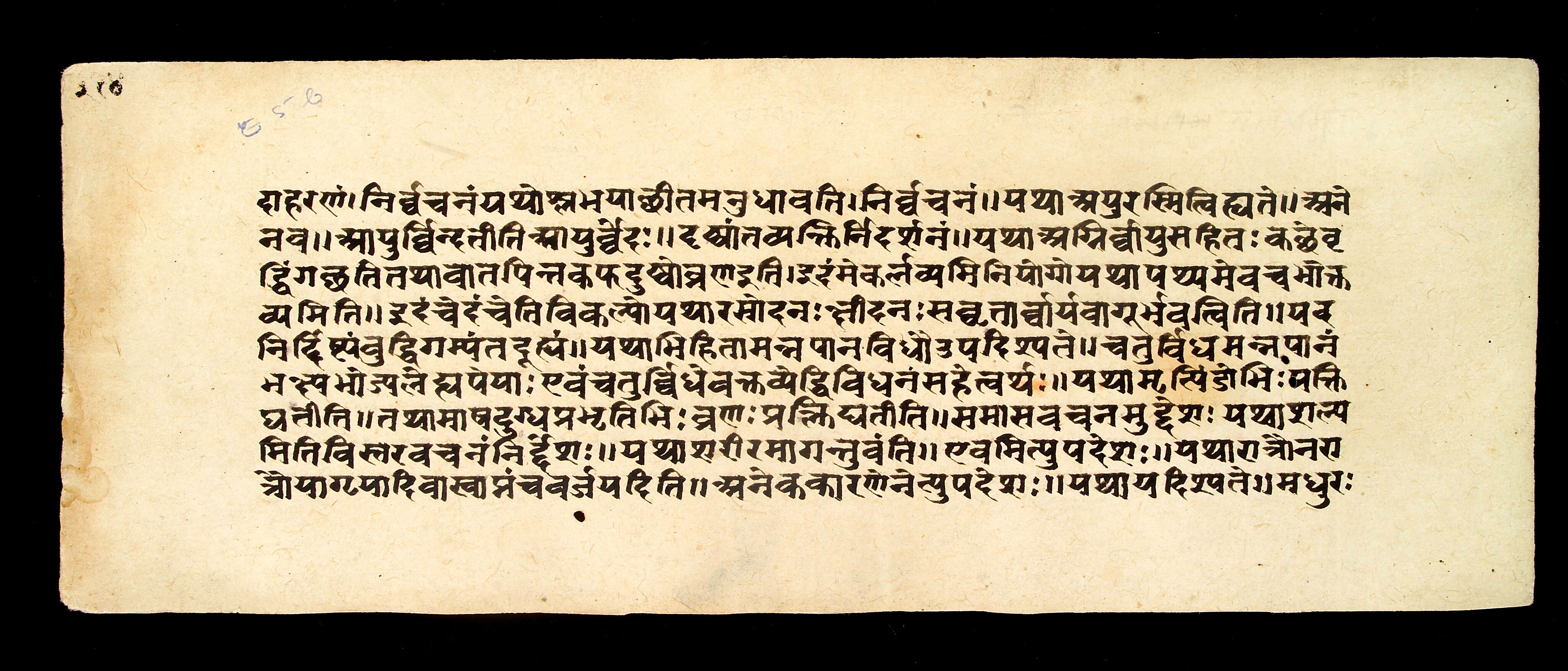
Ānandakanda — reading through scholarship
Patricia Sauthoff examines a medieval medico-alchemical work whose cannabis discussions require careful textual interpretation.
What this record does not establish
The original witness, critical-edition locator, verse, transliteration and translation have not been admitted. The publisher full-text route was access-blocked during this review.
Editorial state: source verified. This state is not an expert endorsement.
Search people, books, studies and subjects in this collection.
Search & filterPlace & period
1 / 1
Follow the historical chronology 26 sourced stops
Move through the record.
These are chronological stops, not equal intervals of elapsed time. Approximate dates and manuscript attributions keep their original qualifications.
Compare the evidence Different questions, different limits
Keep the contexts in view.
The reading archive.
Choose a subject, then open an individual record. The complete collection and its source notes remain here for reading and printing.
This is a selected, expanding archive. Historical use, experimental activity and clinical evidence answer different questions. None establishes a medical benefit, cannabinoid content or treatment use for Mount Herbs seed products.
The original Natural History is the sole chronology. Molecular identities and clinical records are drawn from their existing catalogues. New profiles are limited to verified contributions; a source check does not replace independent historical, Sanskrit or regulatory review.
Collection snapshot 6 November 2026: 47 people, 46 publications and manuscripts, 130 admitted connections and 261 source records. 26 historical stops and 72 molecular identities come from the existing catalogues. Counts describe this selected corpus, not global completeness. Individual records retain their own source-check dates; generating this snapshot does not re-review the full collection.
Botanical identity and structure · 10
taxon / Name published 1753 · current taxon concept checked 2026
Cannabis sativa L.
The shared botanical name connects a living plant, chemical research and an official leaf entry. Kew accepts it within Cannabaceae.
Reading note A shared taxon does not make all plant parts, chemotypes, preparations or legal classifications interchangeable. The name’s 1753 publication is not the plant’s origin.
Historical source context
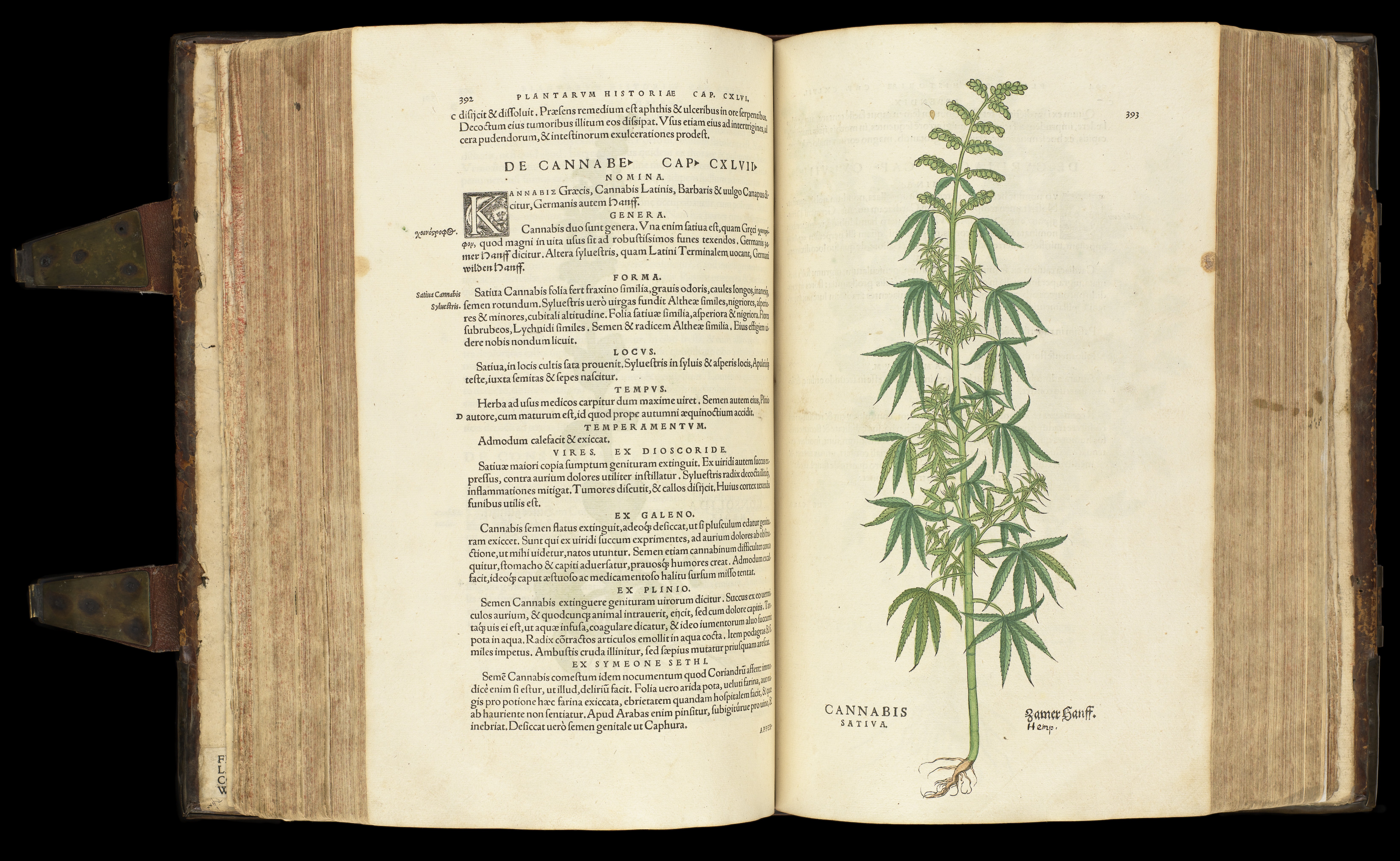
The book is the object: a photographed spread from Leonhart Fuchs’s 1542 De historia stirpium, with its text, plant image, binding and handwritten annotations intact.
Leonhart Fuchs, De historia stirpium (1542); photograph: Wellcome Library, London, L0051246 · 1542 volume; photographic date not established · CC BY 4.0 for this Wellcome photograph
Historical botanical context, not a modern taxonomic standard. This is not a page from Köhler, a Sanskrit manuscript, or a claim that historical remedies are effective. Complete image preserved; delivery copies are resized and compressed without cropping or retouching.
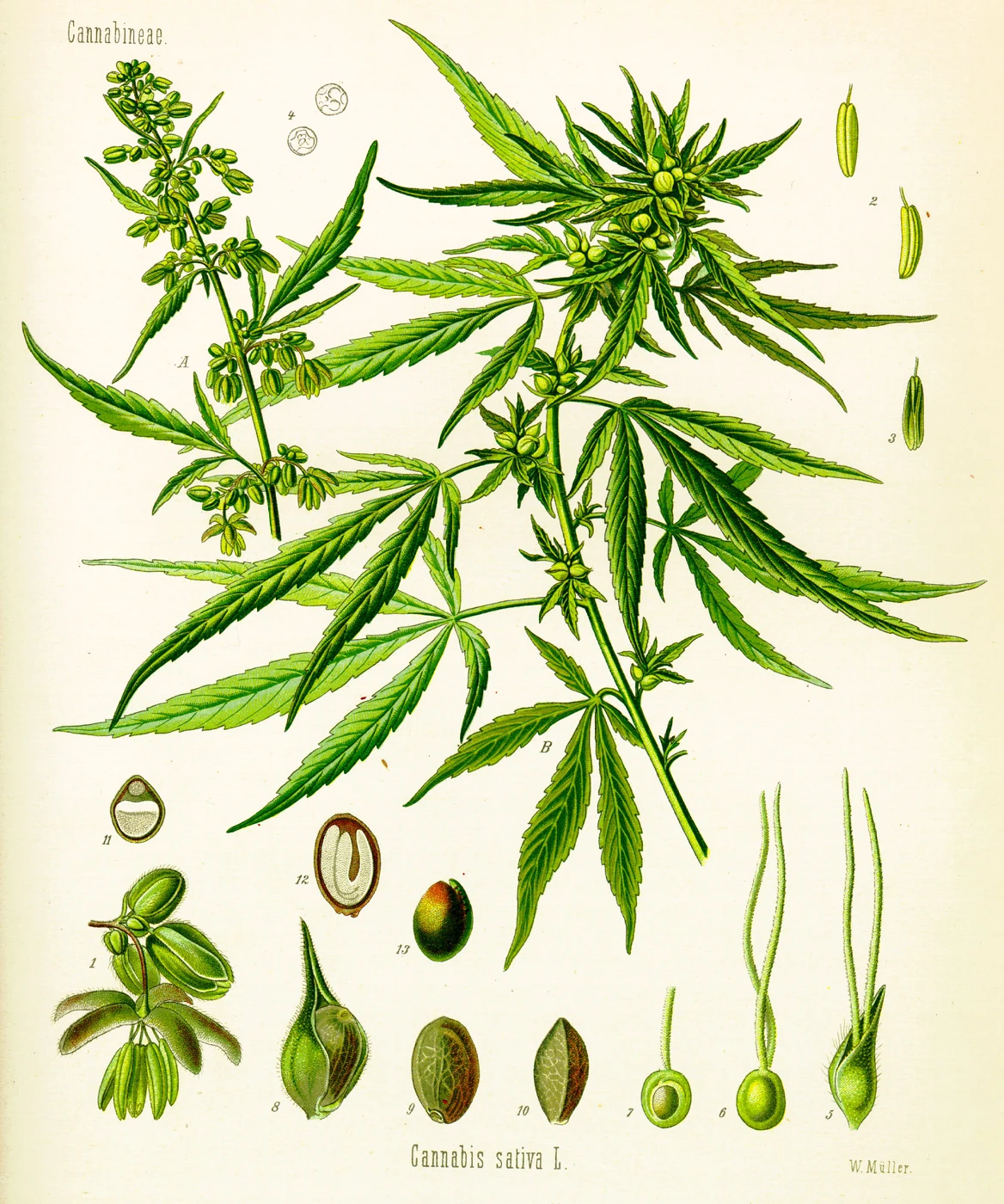
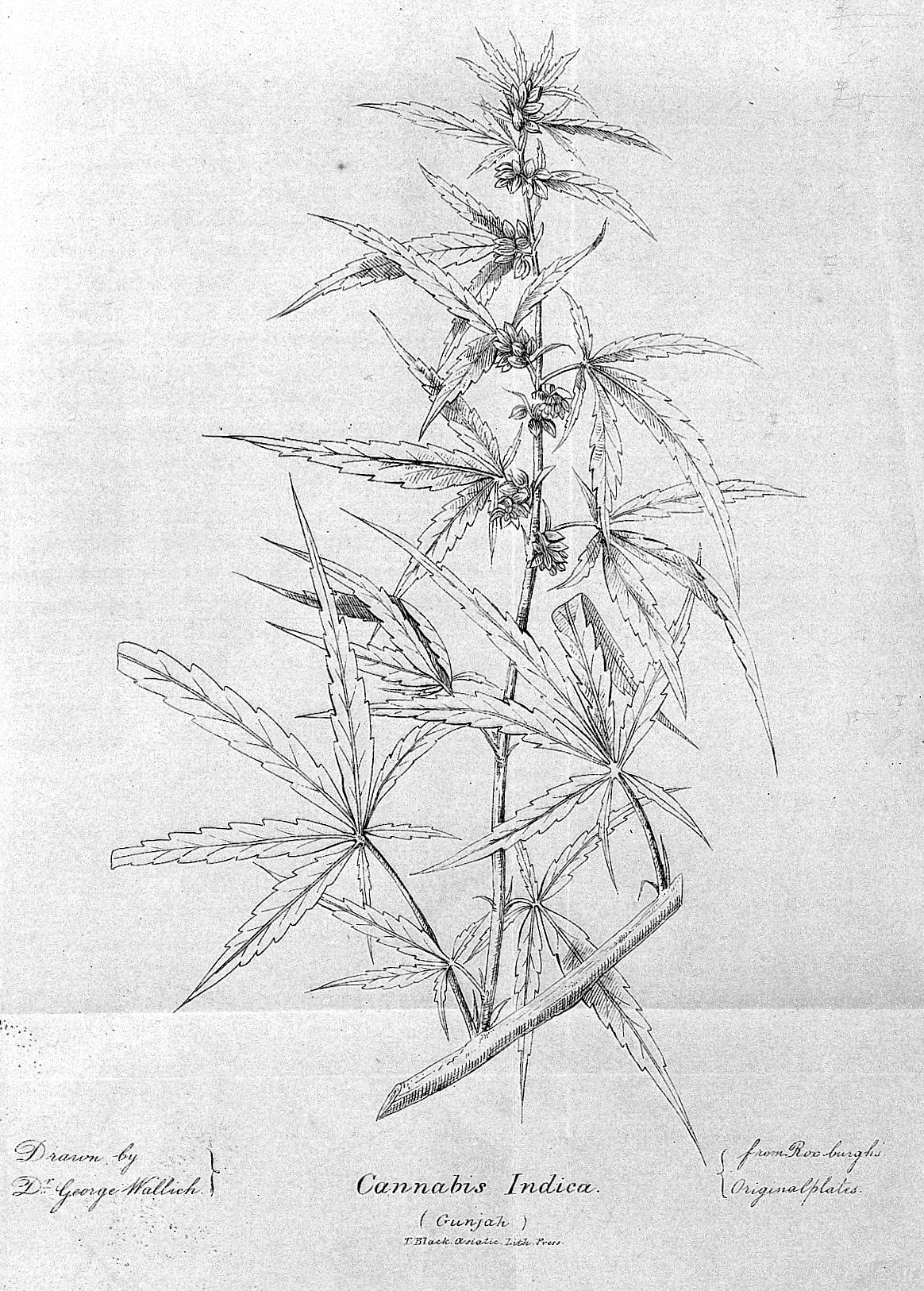
An 1887 Cannabis sativa plate from Köhler’s Medizinal-Pflanzen, plate I-13. The historical labels and complete composition are preserved.
Köhler’s Medizinal-Pflanzen; plate signed W. Müller / Wikimedia Commons · 1887 · Public domain; marked PDM 1.0
Resized and encoded as WebP; no crop or retouching. Historical botanical illustration. The current taxon record is supported separately by Kew and IPNI; this plate is not a modern pharmacopoeial approval.
has anatomical structure · from this recordRoot system ↗
Root system opens an anatomical description of Cannabis sativa L. A documented structure within the taxon; schematic scale and variation remain explicit. This relation establishes neither clinical efficacy, endorsement of Mount Herbs, nor medicinal authorization.Evidence for this connection
Canadian Food Inspection Agency 2020 · official biological synthesis
sections 1.2, 2.6 and 4.1 inspected · Checked 2026-10-26 Supports the branched taproot and morphology variation. A Canadian environmental-risk background document, not an Indian regulatory authority or cultivation guide. Locator: BIO2020-02, sections 1.2, 2.6, 4.1
Stem opens an anatomical description of Cannabis sativa L. A documented structure within the taxon; schematic scale and variation remain explicit. This relation establishes neither clinical efficacy, endorsement of Mount Herbs, nor medicinal authorization.Evidence for this connection
G. J. Harden; Royal Botanic Gardens and Domain Trust, Sydney 1990 · institutional flora description
species description inspected · Checked 2026-10-26 Stem and leaflet morphology; achene enclosed in glandular bracts. Taxon concept is Flora of NSW 1 (1990); photographs were not reused.
Palmately compound leaf opens an anatomical description of Cannabis sativa L. A documented structure within the taxon; schematic scale and variation remain explicit. This relation establishes neither clinical efficacy, endorsement of Mount Herbs, nor medicinal authorization.Evidence for this connection
G. J. Harden; Royal Botanic Gardens and Domain Trust, Sydney 1990 · institutional flora description
species description inspected · Checked 2026-10-26 Stem and leaflet morphology; achene enclosed in glandular bracts. Taxon concept is Flora of NSW 1 (1990); photographs were not reused.
Vascular tissues and bast fibres opens an anatomical description of Cannabis sativa L. A documented structure within the taxon; schematic scale and variation remain explicit. This relation establishes neither clinical efficacy, endorsement of Mount Herbs, nor medicinal authorization.Evidence for this connection
Anastasia Snegireva; Tatyana Chernova; Marina Ageeva; Simcha Lev-Yadun; Tatyana Gorshkova 2015 · original anatomical study
full-text results and author line inspected · Checked 2026-10-26 Microscopy distinguishes primary and secondary phloem-fibre development and their relationship to cambium and xylem. No cultivation methods or experimental operating instructions are reproduced. Locator: Abstract; Results; Figures 1–5 and original Figure 7
Male reproductive structures opens an anatomical description of Cannabis sativa L. A documented structure within the taxon; schematic scale and variation remain explicit. This relation establishes neither clinical efficacy, endorsement of Mount Herbs, nor medicinal authorization.Evidence for this connection
B. Verdcourt (1975); C. M. Wilmot-Dear (1991); hosted by Royal Botanic Gardens, Kew · institutional flora descriptions
Flora of Tropical East Africa and Flora Zambesiaca descriptions inspected · Checked 2026-10-26 Sex-specific inflorescences, stamens, enclosing bracteole, ovary and fruit. Regional flora descriptions are not a specimen-specific measurement or medicinal standard. Locator: Descriptions: Flora of Tropical East Africa (1975); Flora Zambesiaca (1991)
Female reproductive structures opens an anatomical description of Cannabis sativa L. A documented structure within the taxon; schematic scale and variation remain explicit. This relation establishes neither clinical efficacy, endorsement of Mount Herbs, nor medicinal authorization.Evidence for this connection
B. Verdcourt (1975); C. M. Wilmot-Dear (1991); hosted by Royal Botanic Gardens, Kew · institutional flora descriptions
Flora of Tropical East Africa and Flora Zambesiaca descriptions inspected · Checked 2026-10-26 Sex-specific inflorescences, stamens, enclosing bracteole, ovary and fruit. Regional flora descriptions are not a specimen-specific measurement or medicinal standard. Locator: Descriptions: Flora of Tropical East Africa (1975); Flora Zambesiaca (1991)
Fruit and seed opens an anatomical description of Cannabis sativa L. A documented structure within the taxon; schematic scale and variation remain explicit. This relation establishes neither clinical efficacy, endorsement of Mount Herbs, nor medicinal authorization.Evidence for this connection
B. Verdcourt (1975); C. M. Wilmot-Dear (1991); hosted by Royal Botanic Gardens, Kew · institutional flora descriptions
Flora of Tropical East Africa and Flora Zambesiaca descriptions inspected · Checked 2026-10-26 Sex-specific inflorescences, stamens, enclosing bracteole, ovary and fruit. Regional flora descriptions are not a specimen-specific measurement or medicinal standard. Locator: Descriptions: Flora of Tropical East Africa (1975); Flora Zambesiaca (1991)
Glandular trichome opens an anatomical description of Cannabis sativa L. A documented structure within the taxon; schematic scale and variation remain explicit. This relation establishes neither clinical efficacy, endorsement of Mount Herbs, nor medicinal authorization.Evidence for this connection
Samuel J. Livingston; Teagen D. Quilichini; Judith K. Booth; Darren C. J. Wong; Kim H. Rensing; Jessica Laflamme-Yonkman; Simone D. Castellarin; Joerg Bohlmann; Jonathan E. Page; A. Lacey Samuels 2020 · original microscopy and metabolite study
publisher results, figures descriptions and full author line inspected; MEDLINE metadata retained · Checked 2026-10-26 Compares glandular-trichome forms and supports a developmental model. Livingston and Quilichini are credited as equal contributors; sampled varieties do not establish a universal chemical profile. Locator: Results: secretory discs and floral maturation; co-first author note
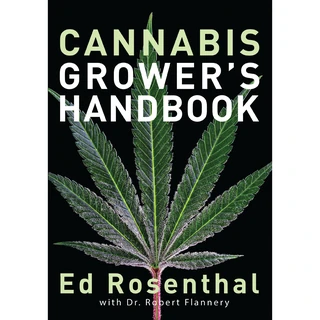
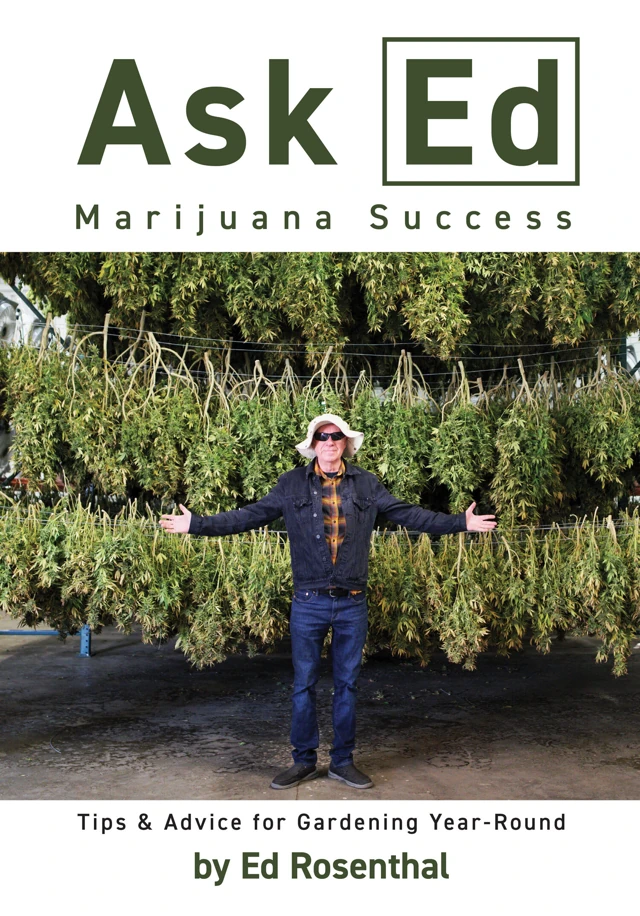
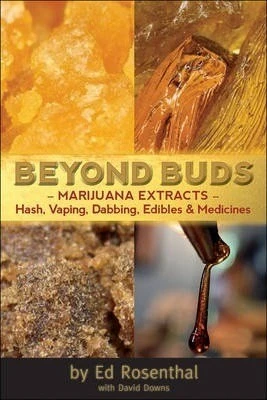
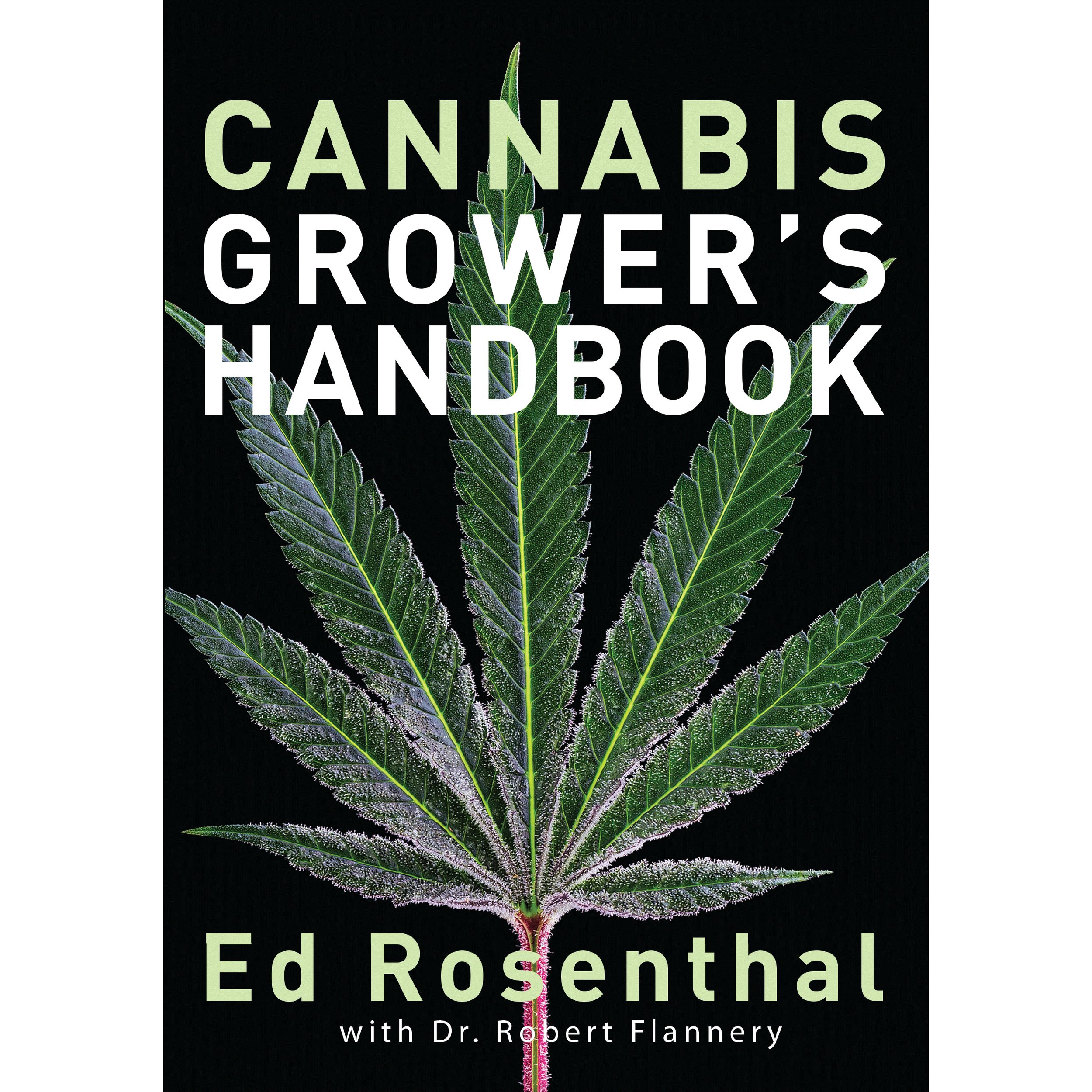
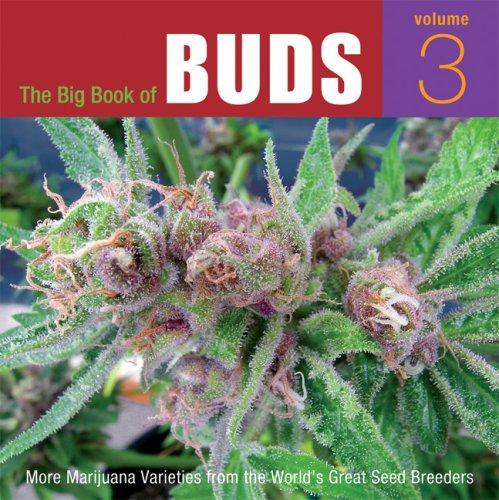
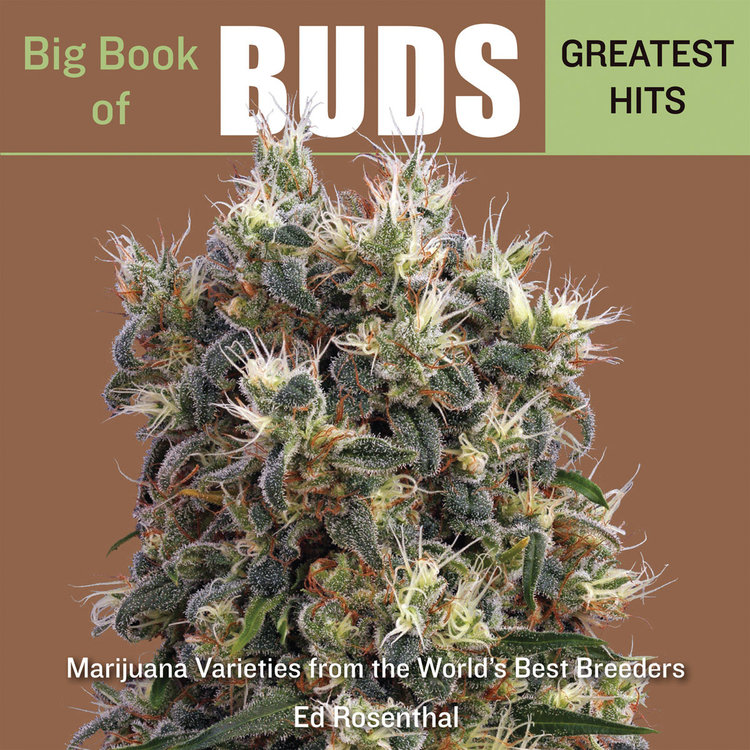
“Cannabis Grower’s Handbook: The Complete Guide to Marijuana and Hemp Cultivation” treats cannabis horticulture; Cannabis sativa L. identifies its botanical subject. The credited 2021 handbook discusses cannabis horticulture; its bibliographic scope is connected to the taxon. It is not the source for each anatomical finding. This relation establishes neither clinical efficacy, endorsement of Mount Herbs, nor medicinal authorization.Evidence for this connection
Weston Family Library, Toronto Botanical Garden 2021 · institutional library catalogue
catalogue inspected · Checked 2026-10-26 Identifies the 2021 Quick American Publishing paperback, ISBN 9781936807543, and the three credited authors Rosenthal, Flannery and Bacca. Pagination differs across catalogues and is not asserted here.
catalogue inspected · Checked 2026-10-26 Establishes the work and its horticultural scope. Current storefront artwork says third printing; this does not establish a new edition. Locator: product title, description and displayed cover
Royal Botanic Gardens, Kew · botanical taxonomic database
current taxon page inspected · Checked 2026-10-26 Accepted name, family Cannabaceae and annual habit. The database taxon concept is distinct from cultivar labels, a measured specimen or a legal product class.
The official Vijayā index identifies its botanical material as Cannabis sativa L. The official index names Cannabis sativa Linn. for Vijayā. This joins botanical identity only, not all parts or preparations. This relation establishes neither clinical efficacy, endorsement of Mount Herbs, nor medicinal authorization.Evidence for this connection
Pharmacopoeia Commission for Indian Medicine & Homoeopathy · official index
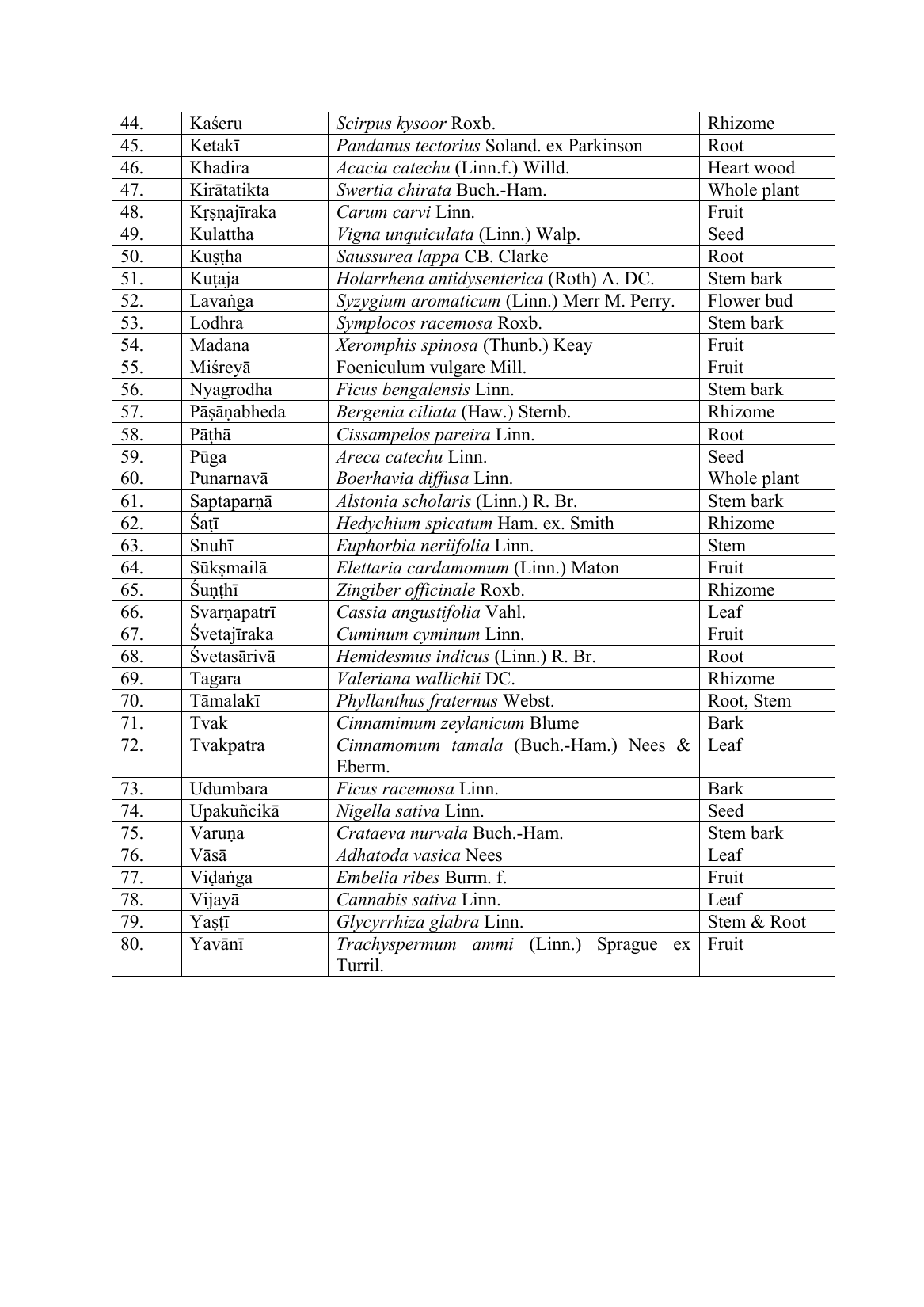
full-document · Checked 2026-10-26 Two-page index; entry 78 identifies Vijayā, Cannabis sativa Linn., Leaf. This is an index, not the full monograph. Locator: Page 2, entry 78
Royal Botanic Gardens, Kew · botanical taxonomic database
current taxon page inspected · Checked 2026-10-26 Accepted name, family Cannabaceae and annual habit. The database taxon concept is distinct from cultivar labels, a measured specimen or a legal product class.
Royal Botanic Gardens, Kew · botanical taxonomic database
current taxon page inspected · Checked 2026-10-26 Accepted name, family Cannabaceae and annual habit. The database taxon concept is distinct from cultivar labels, a measured specimen or a legal product class.
International Plant Names Index 1753 · nomenclatural database
name record inspected · Checked 2026-10-26 Species Plantarum 2:1027, publication 1 May 1753. The date belongs to the botanical name, not the origin of the plant. Locator: urn:lsid:ipni.org:names:306087-2
This source-linked educational record does not verify a Mount Herbs product, batch, licence, commercial claim or institutional endorsement.
Independent publication review remains pending. Source review does not authorize commercial reuse.
Editorial history & rights
source verified. Checked 2026-10-26. Source verification is not independent scholarly approval.
Source images in this record carry their individual creator, licence, original link and presentation limits beside the image. Bibliographic and scientific records retain their separate review status.
A central taproot branches into lateral roots beneath the shoot.
Reading note Root form varies with the plant and its environment. The model is a schematic outline, not a fixed depth or a Himalayan field measurement.Record & context
representation
Conceptual, not to scale; not a measured or authenticated pharmacopoeial specimen.
Root system opens an anatomical description of Cannabis sativa L. A documented structure within the taxon; schematic scale and variation remain explicit. This relation establishes neither clinical efficacy, endorsement of Mount Herbs, nor medicinal authorization.Evidence for this connection
Canadian Food Inspection Agency 2020 · official biological synthesis
sections 1.2, 2.6 and 4.1 inspected · Checked 2026-10-26 Supports the branched taproot and morphology variation. A Canadian environmental-risk background document, not an Indian regulatory authority or cultivation guide. Locator: BIO2020-02, sections 1.2, 2.6, 4.1
This source-linked educational record does not verify a Mount Herbs product, batch, licence, commercial claim or institutional endorsement.
Independent publication review remains pending. Source review does not authorize commercial reuse.
Editorial history & rights
source verified. Checked 2026-10-26. Source verification is not independent scholarly approval.
Original editorial text and bibliographic metadata only. Linked illustrations and publications retain their own rights; no image, cover or full text is reproduced.
The upright, branching stem bears leaves and reproductive shoots; its surface is angular and hairy in the flora description.
Reading note Branching, internode form and proportions vary. A single rendered stem cannot represent every cultivar or growth stage.
Original source image
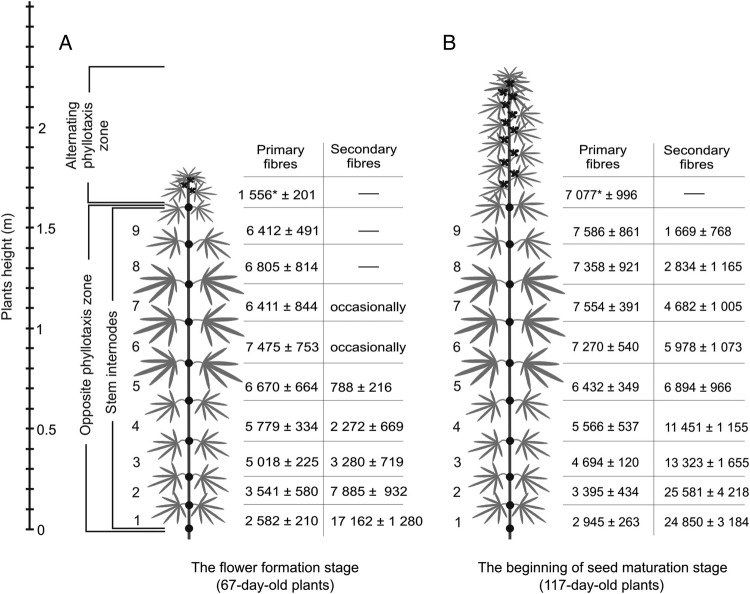
Figure 1 locates the stem samples in two plant stages. The published layout connects a whole plant with the places where its fibres were counted.
Anastasia Snegireva, Tatyana Chernova, Marina Ageeva, Simcha Lev-Yadun and Tatyana Gorshkova · 2015 · CC BY 4.0
Specific samples and stages from this anatomical study; not universal hemp dimensions, a cultivation schedule or Mount Herbs sourcing evidence. Original labels and complete composition retained. The publisher JPEG is preserved byte-for-byte as the full image.
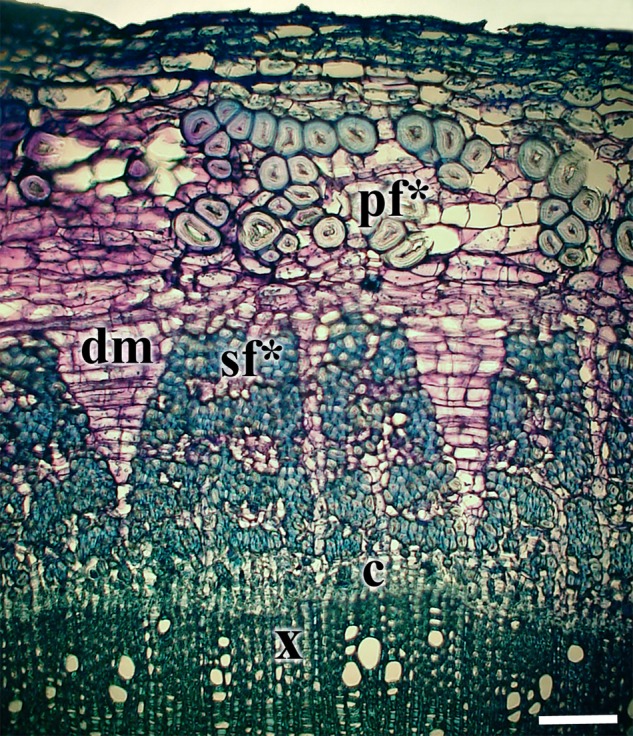
Original Figure 7: a stained hemp stem section from the 2015 anatomical study. Its labels and 50 µm scale bar remain visible.
Anastasia Snegireva, Tatyana Chernova, Marina Ageeva, Simcha Lev-Yadun and Tatyana Gorshkova · 2015 · CC BY 4.0
Original published JPEG, unchanged. This is one sampled stem section from a plant-anatomy study, not a universal tissue proportion, commercial quality test or clinical finding.
Stem opens an anatomical description of Cannabis sativa L. A documented structure within the taxon; schematic scale and variation remain explicit. This relation establishes neither clinical efficacy, endorsement of Mount Herbs, nor medicinal authorization.Evidence for this connection
G. J. Harden; Royal Botanic Gardens and Domain Trust, Sydney 1990 · institutional flora description
species description inspected · Checked 2026-10-26 Stem and leaflet morphology; achene enclosed in glandular bracts. Taxon concept is Flora of NSW 1 (1990); photographs were not reused.
The stem record leads to a closer study of vascular tissues and supporting fibres. The anatomical study locates phloem fibres and vascular development within sampled stems. This relation establishes neither clinical efficacy, endorsement of Mount Herbs, nor medicinal authorization.Evidence for this connection
Anastasia Snegireva; Tatyana Chernova; Marina Ageeva; Simcha Lev-Yadun; Tatyana Gorshkova 2015 · original anatomical study
full-text results and author line inspected · Checked 2026-10-26 Microscopy distinguishes primary and secondary phloem-fibre development and their relationship to cambium and xylem. No cultivation methods or experimental operating instructions are reproduced. Locator: Abstract; Results; Figures 1–5 and original Figure 7
G. J. Harden; Royal Botanic Gardens and Domain Trust, Sydney 1990 · institutional flora description
species description inspected · Checked 2026-10-26 Stem and leaflet morphology; achene enclosed in glandular bracts. Taxon concept is Flora of NSW 1 (1990); photographs were not reused.
This source-linked educational record does not verify a Mount Herbs product, batch, licence, commercial claim or institutional endorsement.
Independent publication review remains pending. Source review does not authorize commercial reuse.
Editorial history & rights
source verified. Checked 2026-10-26. Source verification is not independent scholarly approval.
Source images in this record carry their individual creator, licence, original link and presentation limits beside the image. Bibliographic and scientific records retain their separate review status.
Palmately compound leaf opens an anatomical description of Cannabis sativa L. A documented structure within the taxon; schematic scale and variation remain explicit. This relation establishes neither clinical efficacy, endorsement of Mount Herbs, nor medicinal authorization.Evidence for this connection
G. J. Harden; Royal Botanic Gardens and Domain Trust, Sydney 1990 · institutional flora description
species description inspected · Checked 2026-10-26 Stem and leaflet morphology; achene enclosed in glandular bracts. Taxon concept is Flora of NSW 1 (1990); photographs were not reused.
The Vijayā index specifies leaf material. The next record explains the leaf's botanical structure. Entry 78 specifies leaf. The full monograph remains unavailable; no microscopy, assay limits, dose or broader plant-part permission is inferred. This relation establishes neither clinical efficacy, endorsement of Mount Herbs, nor medicinal authorization.Evidence for this connection
Pharmacopoeia Commission for Indian Medicine & Homoeopathy · official index
full-document · Checked 2026-10-26 Two-page index; entry 78 identifies Vijayā, Cannabis sativa Linn., Leaf. This is an index, not the full monograph. Locator: Page 2, entry 78
G. J. Harden; Royal Botanic Gardens and Domain Trust, Sydney 1990 · institutional flora description
species description inspected · Checked 2026-10-26 Stem and leaflet morphology; achene enclosed in glandular bracts. Taxon concept is Flora of NSW 1 (1990); photographs were not reused.
This source-linked educational record does not verify a Mount Herbs product, batch, licence, commercial claim or institutional endorsement.
Independent publication review remains pending. Source review does not authorize commercial reuse.
Editorial history & rights
source verified. Checked 2026-10-26. Source verification is not independent scholarly approval.
Original editorial text and bibliographic metadata only. Linked illustrations and publications retain their own rights; no image, cover or full text is reproduced.
A stem section separates xylem, cambium and phloem-associated fibres. The 2015 microscopy study followed how primary and secondary phloem fibres form bundles.
Reading note Bast fibres are supporting cells, not all the conducting cells of phloem. Relative tissue thickness depends on the sampled position and developmental stage.
Original source image
Figure 1 locates the stem samples in two plant stages. The published layout connects a whole plant with the places where its fibres were counted.
Anastasia Snegireva, Tatyana Chernova, Marina Ageeva, Simcha Lev-Yadun and Tatyana Gorshkova · 2015 · CC BY 4.0
Specific samples and stages from this anatomical study; not universal hemp dimensions, a cultivation schedule or Mount Herbs sourcing evidence. Original labels and complete composition retained. The publisher JPEG is preserved byte-for-byte as the full image.
Original Figure 7: a stained hemp stem section from the 2015 anatomical study. Its labels and 50 µm scale bar remain visible.
Anastasia Snegireva, Tatyana Chernova, Marina Ageeva, Simcha Lev-Yadun and Tatyana Gorshkova · 2015 · CC BY 4.0
Original published JPEG, unchanged. This is one sampled stem section from a plant-anatomy study, not a universal tissue proportion, commercial quality test or clinical finding.
Vascular tissues and bast fibres opens an anatomical description of Cannabis sativa L. A documented structure within the taxon; schematic scale and variation remain explicit. This relation establishes neither clinical efficacy, endorsement of Mount Herbs, nor medicinal authorization.Evidence for this connection
Anastasia Snegireva; Tatyana Chernova; Marina Ageeva; Simcha Lev-Yadun; Tatyana Gorshkova 2015 · original anatomical study
full-text results and author line inspected · Checked 2026-10-26 Microscopy distinguishes primary and secondary phloem-fibre development and their relationship to cambium and xylem. No cultivation methods or experimental operating instructions are reproduced. Locator: Abstract; Results; Figures 1–5 and original Figure 7
contains anatomical tissues · to this recordStem ↗
The stem record leads to a closer study of vascular tissues and supporting fibres. The anatomical study locates phloem fibres and vascular development within sampled stems. This relation establishes neither clinical efficacy, endorsement of Mount Herbs, nor medicinal authorization.Evidence for this connection
Anastasia Snegireva; Tatyana Chernova; Marina Ageeva; Simcha Lev-Yadun; Tatyana Gorshkova 2015 · original anatomical study
full-text results and author line inspected · Checked 2026-10-26 Microscopy distinguishes primary and secondary phloem-fibre development and their relationship to cambium and xylem. No cultivation methods or experimental operating instructions are reproduced. Locator: Abstract; Results; Figures 1–5 and original Figure 7
“Intrusive growth of primary and secondary phloem fibres in hemp stem determines fibre-bundle formation and structure” reports the anatomical observations discussed in Vascular tissues and bast fibres. The paper concerns fibre-cell development in stems, not a clinical or taxonomic trial. This relation establishes neither clinical efficacy, endorsement of Mount Herbs, nor medicinal authorization.Evidence for this connection
Anastasia Snegireva; Tatyana Chernova; Marina Ageeva; Simcha Lev-Yadun; Tatyana Gorshkova 2015 · original anatomical study
full-text results and author line inspected · Checked 2026-10-26 Microscopy distinguishes primary and secondary phloem-fibre development and their relationship to cambium and xylem. No cultivation methods or experimental operating instructions are reproduced. Locator: Abstract; Results; Figures 1–5 and original Figure 7
The anatomical record connects to a published field study of material uses. The field study reports fibre use; this contextual link is not a microscopic analysis of those community materials or evidence of a brand partnership. This relation establishes neither clinical efficacy, endorsement of Mount Herbs, nor medicinal authorization.Evidence for this connection
Sumati Rathore; Sarla Shashni; Sher Singh Samant; Rakesh Chandra Sundriyal 2018 · original ethnobotanical field study
publisher-indexed abstract and DOI metadata inspected; direct page timed out · Checked 2026-10-26 Publisher record: 25 September 2018, Journal of Non-Timber Forest Products 25(3), 127–130, DOI 10.54207/bsmps2000-2018-7393KF. Field visits, questionnaires and interviews during 2015–2017; pooled traditional-use reports, not efficacy trials.
Anastasia Snegireva; Tatyana Chernova; Marina Ageeva; Simcha Lev-Yadun; Tatyana Gorshkova 2015 · original anatomical study
full-text results and author line inspected · Checked 2026-10-26 Microscopy distinguishes primary and secondary phloem-fibre development and their relationship to cambium and xylem. No cultivation methods or experimental operating instructions are reproduced. Locator: Abstract; Results; Figures 1–5 and original Figure 7
This source-linked educational record does not verify a Mount Herbs product, batch, licence, commercial claim or institutional endorsement.
Independent publication review remains pending. Source review does not authorize commercial reuse.
Editorial history & rights
source verified. Checked 2026-10-26. Source verification is not independent scholarly approval.
Source images in this record carry their individual creator, licence, original link and presentation limits beside the image. Bibliographic and scientific records retain their separate review status.
Loose flower clusters bear stamens with hanging anthers. This is a different arrangement from the compact female inflorescence.
Reading note Male and female structures are shown as separate comparative studies. Cannabis is often dioecious; the display does not imply every plant carries both.Record & context
representation
Conceptual, not to scale; not a measured or authenticated pharmacopoeial specimen.
Male reproductive structures opens an anatomical description of Cannabis sativa L. A documented structure within the taxon; schematic scale and variation remain explicit. This relation establishes neither clinical efficacy, endorsement of Mount Herbs, nor medicinal authorization.Evidence for this connection
B. Verdcourt (1975); C. M. Wilmot-Dear (1991); hosted by Royal Botanic Gardens, Kew · institutional flora descriptions
Flora of Tropical East Africa and Flora Zambesiaca descriptions inspected · Checked 2026-10-26 Sex-specific inflorescences, stamens, enclosing bracteole, ovary and fruit. Regional flora descriptions are not a specimen-specific measurement or medicinal standard. Locator: Descriptions: Flora of Tropical East Africa (1975); Flora Zambesiaca (1991)
This source-linked educational record does not verify a Mount Herbs product, batch, licence, commercial claim or institutional endorsement.
Independent publication review remains pending. Source review does not authorize commercial reuse.
Editorial history & rights
source verified. Checked 2026-10-26. Source verification is not independent scholarly approval.
Original editorial text and bibliographic metadata only. Linked illustrations and publications retain their own rights; no image, cover or full text is reproduced.
Compact clusters contain an ovary surrounded by an enclosing bracteole; slender stigmas emerge from the flower.
Reading note An ovary, bracteole and stigma are different structures. The inset is anatomical interpretation, not medicinal identification or a cultivation instruction.Record & context
representation
Conceptual, not to scale; not a measured or authenticated pharmacopoeial specimen.
Female reproductive structures opens an anatomical description of Cannabis sativa L. A documented structure within the taxon; schematic scale and variation remain explicit. This relation establishes neither clinical efficacy, endorsement of Mount Herbs, nor medicinal authorization.Evidence for this connection
B. Verdcourt (1975); C. M. Wilmot-Dear (1991); hosted by Royal Botanic Gardens, Kew · institutional flora descriptions
Flora of Tropical East Africa and Flora Zambesiaca descriptions inspected · Checked 2026-10-26 Sex-specific inflorescences, stamens, enclosing bracteole, ovary and fruit. Regional flora descriptions are not a specimen-specific measurement or medicinal standard. Locator: Descriptions: Flora of Tropical East Africa (1975); Flora Zambesiaca (1991)
This source-linked educational record does not verify a Mount Herbs product, batch, licence, commercial claim or institutional endorsement.
Independent publication review remains pending. Source review does not authorize commercial reuse.
Editorial history & rights
source verified. Checked 2026-10-26. Source verification is not independent scholarly approval.
Original editorial text and bibliographic metadata only. Linked illustrations and publications retain their own rights; no image, cover or full text is reproduced.
The familiar whole hemp “seed” is botanically an achene: a dry fruit enclosing a seed. Fruit wall and seed are distinct layers.
Reading note Seed-food descriptions do not establish cannabinoid concentrations, therapeutic effects or the composition of a Mount Herbs batch.Record & context
representation
Conceptual, not to scale; not a measured or authenticated pharmacopoeial specimen.
taxon id
taxon-cannabis-sativa
structures
achene · fruit wall · seed
display scale
cutaway schematic
journey connection
The existing seed → oil and powder material study is a navigation link, not a tested manufacturing claim.
The documented relationship is “investigates”: Evaluating the quality of protein from hemp seed (Cannabis sativa L.) products through the use of the protein digestibility-corrected amino acid score method to Fruit and seed. The study compares seed-derived foods and processing contexts. Its sampled foods and rat-bioassay results do not establish the nutrition or health effects of a Mount Herbs product.Evidence for this connection
James D. House; Jason Neufeld; Gero Leson 2010 · original food-science study
Original article metadata and abstract inspected in PubMed; full text not inspected · Checked 2026-11-04 Compares sampled hemp-seed foods. Protein-digestibility testing used a rat bioassay; the paper is not a human feeding trial or an analysis of Mount Herbs products. Locator: PubMed PMID 20977230: author line, publication details and abstract; DOI 10.1021/jf102636b.
Fruit and seed opens an anatomical description of Cannabis sativa L. A documented structure within the taxon; schematic scale and variation remain explicit. This relation establishes neither clinical efficacy, endorsement of Mount Herbs, nor medicinal authorization.Evidence for this connection
B. Verdcourt (1975); C. M. Wilmot-Dear (1991); hosted by Royal Botanic Gardens, Kew · institutional flora descriptions
Flora of Tropical East Africa and Flora Zambesiaca descriptions inspected · Checked 2026-10-26 Sex-specific inflorescences, stamens, enclosing bracteole, ovary and fruit. Regional flora descriptions are not a specimen-specific measurement or medicinal standard. Locator: Descriptions: Flora of Tropical East Africa (1975); Flora Zambesiaca (1991)
The anatomical record connects to a published field study of material uses. The 2015–2017 field study reports seed use in a pooled local-use record. It establishes neither product sourcing, current prevalence nor efficacy. This relation establishes neither clinical efficacy, endorsement of Mount Herbs, nor medicinal authorization.Evidence for this connection
Sumati Rathore; Sarla Shashni; Sher Singh Samant; Rakesh Chandra Sundriyal 2018 · original ethnobotanical field study
publisher-indexed abstract and DOI metadata inspected; direct page timed out · Checked 2026-10-26 Publisher record: 25 September 2018, Journal of Non-Timber Forest Products 25(3), 127–130, DOI 10.54207/bsmps2000-2018-7393KF. Field visits, questionnaires and interviews during 2015–2017; pooled traditional-use reports, not efficacy trials.
B. Verdcourt (1975); C. M. Wilmot-Dear (1991); hosted by Royal Botanic Gardens, Kew · institutional flora descriptions
Flora of Tropical East Africa and Flora Zambesiaca descriptions inspected · Checked 2026-10-26 Sex-specific inflorescences, stamens, enclosing bracteole, ovary and fruit. Regional flora descriptions are not a specimen-specific measurement or medicinal standard. Locator: Descriptions: Flora of Tropical East Africa (1975); Flora Zambesiaca (1991)
This source-linked educational record does not verify a Mount Herbs product, batch, licence, commercial claim or institutional endorsement.
Independent publication review remains pending. Source review does not authorize commercial reuse.
Editorial history & rights
source verified. Checked 2026-10-26. Source verification is not independent scholarly approval.
Original editorial text and bibliographic metadata only. Linked illustrations and publications retain their own rights; no image, cover or full text is reproduced.
A small secretory structure has a cellular head and a storage space. The 2020 study distinguished stalked and sessile forms and linked their development with metabolite differences.
Reading note Not every plant hair is glandular. Enlarged geometry is conceptual; sampled trichomes do not certify any product’s chemistry or clinical effects.Record & context
representation
Conceptual, not to scale; not a measured or authenticated pharmacopoeial specimen.
taxon id
taxon-cannabis-sativa
structures
stalk · secretory disc · storage cavity
display scale
magnified schematic; not to scale
view qualification
Do not interpret glow or colour as a chemical assay.
Glandular trichome opens an anatomical description of Cannabis sativa L. A documented structure within the taxon; schematic scale and variation remain explicit. This relation establishes neither clinical efficacy, endorsement of Mount Herbs, nor medicinal authorization.Evidence for this connection
Samuel J. Livingston; Teagen D. Quilichini; Judith K. Booth; Darren C. J. Wong; Kim H. Rensing; Jessica Laflamme-Yonkman; Simone D. Castellarin; Joerg Bohlmann; Jonathan E. Page; A. Lacey Samuels 2020 · original microscopy and metabolite study
publisher results, figures descriptions and full author line inspected; MEDLINE metadata retained · Checked 2026-10-26 Compares glandular-trichome forms and supports a developmental model. Livingston and Quilichini are credited as equal contributors; sampled varieties do not establish a universal chemical profile. Locator: Results: secretory discs and floral maturation; co-first author note
“Cannabis glandular trichomes alter morphology and metabolite content during flower maturation” reports the anatomical observations discussed in Glandular trichome. The paper compares sampled glandular structures and metabolites; diagram colours are not assay results. This relation establishes neither clinical efficacy, endorsement of Mount Herbs, nor medicinal authorization.Evidence for this connection
Samuel J. Livingston; Teagen D. Quilichini; Judith K. Booth; Darren C. J. Wong; Kim H. Rensing; Jessica Laflamme-Yonkman; Simone D. Castellarin; Joerg Bohlmann; Jonathan E. Page; A. Lacey Samuels 2020 · original microscopy and metabolite study
publisher results, figures descriptions and full author line inspected; MEDLINE metadata retained · Checked 2026-10-26 Compares glandular-trichome forms and supports a developmental model. Livingston and Quilichini are credited as equal contributors; sampled varieties do not establish a universal chemical profile. Locator: Results: secretory discs and floral maturation; co-first author note
Experiments on glandular trichomes provide the connection to this biosynthetic pathway. Expression, activity and reporter evidence supported the authors’ proposed THCA-synthase localization. This relation establishes neither clinical efficacy, endorsement of Mount Herbs, nor medicinal authorization.Evidence for this connection
Supaart Sirikantaramas; Futoshi Taura; Yumi Tanaka; Yu Ishikawa; Satoshi Morimoto; Yukihiro Shoyama 2005 · original enzyme-localization study
indexed abstract and complete author metadata inspected · Checked 2026-10-26 The authors suggest THCA biosynthesis in the trichome storage cavity from expression, activity and reporter evidence. This is a scoped localization finding, not a universal whole-pathway map.
Samuel J. Livingston; Teagen D. Quilichini; Judith K. Booth; Darren C. J. Wong; Kim H. Rensing; Jessica Laflamme-Yonkman; Simone D. Castellarin; Joerg Bohlmann; Jonathan E. Page; A. Lacey Samuels 2020 · original microscopy and metabolite study
publisher results, figures descriptions and full author line inspected; MEDLINE metadata retained · Checked 2026-10-26 Compares glandular-trichome forms and supports a developmental model. Livingston and Quilichini are credited as equal contributors; sampled varieties do not establish a universal chemical profile. Locator: Results: secretory discs and floral maturation; co-first author note
This source-linked educational record does not verify a Mount Herbs product, batch, licence, commercial claim or institutional endorsement.
Independent publication review remains pending. Source review does not authorize commercial reuse.
Editorial history & rights
source verified. Checked 2026-10-26. Source verification is not independent scholarly approval.
Original editorial text and bibliographic metadata only. Linked illustrations and publications retain their own rights; no image, cover or full text is reproduced.
THCA synthase converts CBGA into THCA. Separate research located synthase activity in glandular-trichome storage cavities. This is one experimentally studied branch of plant metabolism.
Reading note THCA and THC are distinct molecules. These experiments do not describe the whole biosynthetic network, endogenous human signalling or a method for making a product.Record & context
substrate id
molecule-cbga
product id
molecule-thca
enzyme
THCA synthase
scope
Mechanistic overview; no protocol, yield, dosing or cultivation parameters
Experiments on glandular trichomes provide the connection to this biosynthetic pathway. Expression, activity and reporter evidence supported the authors’ proposed THCA-synthase localization. This relation establishes neither clinical efficacy, endorsement of Mount Herbs, nor medicinal authorization.Evidence for this connection
Supaart Sirikantaramas; Futoshi Taura; Yumi Tanaka; Yu Ishikawa; Satoshi Morimoto; Yukihiro Shoyama 2005 · original enzyme-localization study
indexed abstract and complete author metadata inspected · Checked 2026-10-26 The authors suggest THCA biosynthesis in the trichome storage cavity from expression, activity and reporter evidence. This is a scoped localization finding, not a universal whole-pathway map.
The experimentally studied pathway uses Cannabigerolic acid as a substrate. CBGA is the substrate in the THCA-synthase reaction studied; no practical synthesis instructions are provided. This relation establishes neither clinical efficacy, endorsement of Mount Herbs, nor medicinal authorization.Evidence for this connection
Supaart Sirikantaramas; Satoshi Morimoto; Yoshinari Shoyama; Yu Ishikawa; Yoshiko Wada; Yukihiro Shoyama; Futoshi Taura 2004 · original enzyme study
indexed abstract and complete author metadata inspected · Checked 2026-10-26 Identifies THCA synthase and CBGA-to-THCA activity. Only the mechanistic finding is summarized; no enzyme-production procedure is reproduced.
The experimentally studied pathway forms Δ9-Tetrahydrocannabinolic acid A; this is a chemical relationship. THCA is the enzyme reaction product. This edge does not mean direct enzymatic synthesis of neutral THC. This relation establishes neither clinical efficacy, endorsement of Mount Herbs, nor medicinal authorization.Evidence for this connection
Supaart Sirikantaramas; Satoshi Morimoto; Yoshinari Shoyama; Yu Ishikawa; Yoshiko Wada; Yukihiro Shoyama; Futoshi Taura 2004 · original enzyme study
indexed abstract and complete author metadata inspected · Checked 2026-10-26 Identifies THCA synthase and CBGA-to-THCA activity. Only the mechanistic finding is summarized; no enzyme-production procedure is reproduced.
This original study characterizes the enzyme in the selected biosynthetic pathway. The authors characterized THCA synthase; bibliographic titles retain their historical terminology. This relation establishes neither clinical efficacy, endorsement of Mount Herbs, nor medicinal authorization.Evidence for this connection
Supaart Sirikantaramas; Satoshi Morimoto; Yoshinari Shoyama; Yu Ishikawa; Yoshiko Wada; Yukihiro Shoyama; Futoshi Taura 2004 · original enzyme study
indexed abstract and complete author metadata inspected · Checked 2026-10-26 Identifies THCA synthase and CBGA-to-THCA activity. Only the mechanistic finding is summarized; no enzyme-production procedure is reproduced.
This experiment investigates where the selected biosynthetic activity occurs. The authors investigated the enzyme’s glandular-trichome location, with the abstract’s evidential scope retained. This relation establishes neither clinical efficacy, endorsement of Mount Herbs, nor medicinal authorization.Evidence for this connection
Supaart Sirikantaramas; Futoshi Taura; Yumi Tanaka; Yu Ishikawa; Satoshi Morimoto; Yukihiro Shoyama 2005 · original enzyme-localization study
indexed abstract and complete author metadata inspected · Checked 2026-10-26 The authors suggest THCA biosynthesis in the trichome storage cavity from expression, activity and reporter evidence. This is a scoped localization finding, not a universal whole-pathway map.
Supaart Sirikantaramas; Satoshi Morimoto; Yoshinari Shoyama; Yu Ishikawa; Yoshiko Wada; Yukihiro Shoyama; Futoshi Taura 2004 · original enzyme study
indexed abstract and complete author metadata inspected · Checked 2026-10-26 Identifies THCA synthase and CBGA-to-THCA activity. Only the mechanistic finding is summarized; no enzyme-production procedure is reproduced.
Supaart Sirikantaramas; Futoshi Taura; Yumi Tanaka; Yu Ishikawa; Satoshi Morimoto; Yukihiro Shoyama 2005 · original enzyme-localization study
indexed abstract and complete author metadata inspected · Checked 2026-10-26 The authors suggest THCA biosynthesis in the trichome storage cavity from expression, activity and reporter evidence. This is a scoped localization finding, not a universal whole-pathway map.
Presentation scope
Cannabinoid molecular research · molecular-research, source-index
Molecular identity and research do not establish presence, quantity, effect or authorization in a Mount Herbs product batch.
Independent publication review remains pending. Source review does not authorize commercial reuse.
Editorial history & rights
source verified. Checked 2026-10-26. Source verification is not independent scholarly approval.
Original editorial text and bibliographic metadata only. Linked illustrations and publications retain their own rights; no image, cover or full text is reproduced.
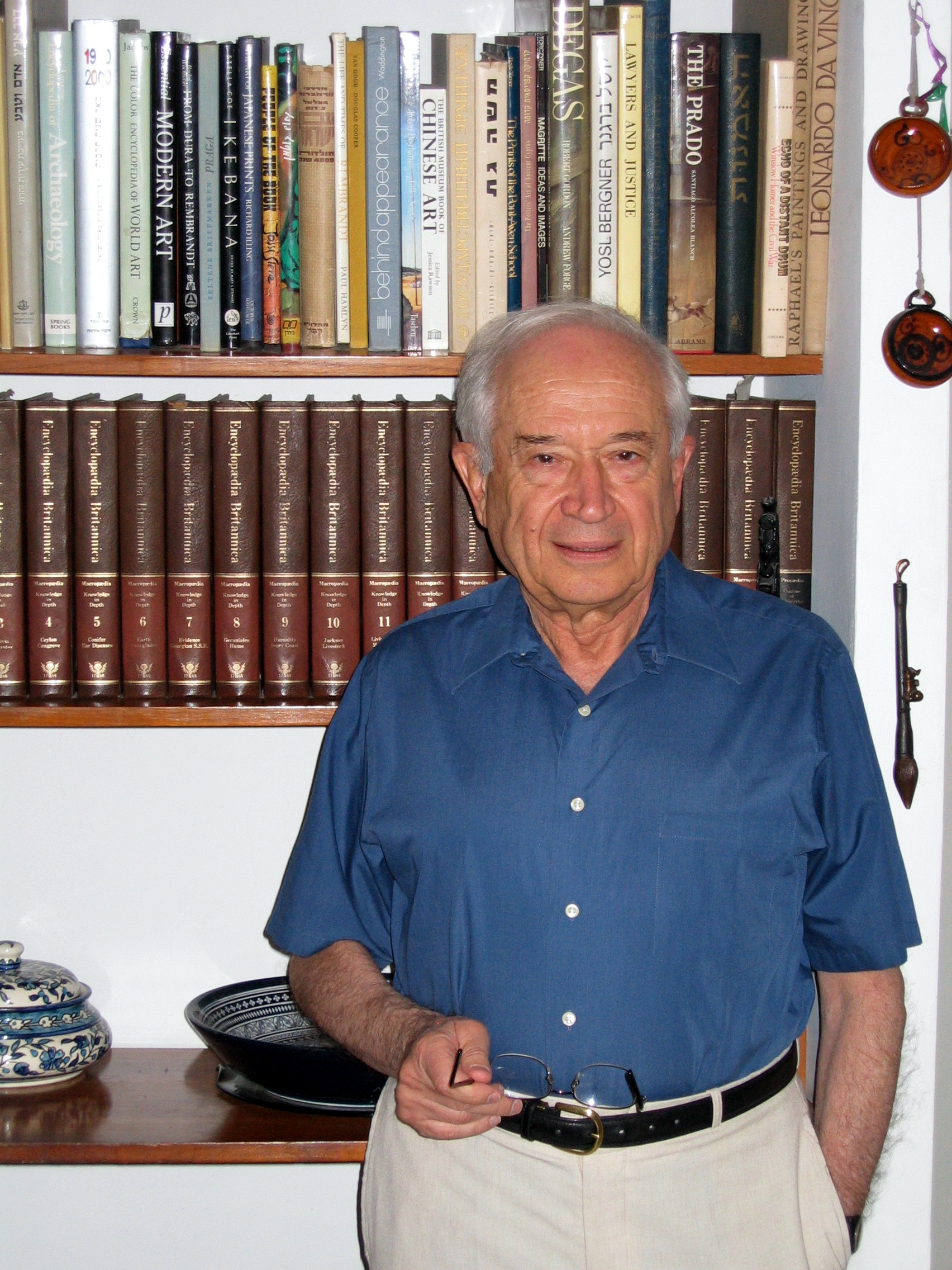
Coauthor with Raphael Mechoulam of the 1964 isolation, structure and partial-synthesis paper on an active hashish constituent.
Reading note This profile establishes the cited scientific contribution only. Team authorship does not identify each individual’s experimental task; it is not a complete biography or an endorsement.
Original source image
Yehiel Gaoni. His research record and the collaborative authorship of the original papers are presented separately.
Israeli photographer (name not supplied); source: Tami_GF / Wikimedia Commons · Photograph date unresolved in source metadata · CC BY-SA 4.0
Original JPEG, unchanged. The Commons page records permission from the creator’s heirs and VRT ticket 2025082910004167; this audit inspected the public confirmation, not the private correspondence. The page gives conflicting date fields, so no exact capture date is claimed. Contextual portrait; it does not document an experiment or imply endorsement.
Yehiel Gaoni is a named author of “Isolation, Structure, and Partial Synthesis of an Active Constituent of Hashish”. Named authorship in the original publication or verified edition. Only profiles admitted to this collection appear as nodes; the work retains its broader author list.Evidence for this connection
Yehiel Gaoni and Raphael Mechoulam 1964 · canonical history
Inherited source record; access extent not reassessed in this edition Consult the linked record and its original context.
Presentation scope
Cannabinoid molecular research · molecular-research, source-index
Molecular identity and research do not establish presence, quantity, effect or authorization in a Mount Herbs product batch.
Independent publication review remains pending. Source review does not authorize commercial reuse.
Editorial history & rights
source verified. Checked 2026-10-26. Source verification is not independent scholarly approval.
Source images in this record carry their individual creator, licence, original link and presentation limits beside the image. Bibliographic and scientific records retain their separate review status.
2026-10-26 · Verified bounded contribution or publication metadata; independent specialist review is not implied.
Record ID: person-yehiel-gaoni
person / Selected contribution · 1964
Raphael Mechoulam
A contributor to the 1964 THC paper and the collaborative 1992 anandamide and 1995 gut 2-AG studies. Each discovery retains its own author team.
Reading note This profile establishes the cited scientific contribution only. Team authorship does not identify each individual’s experimental task; it is not a complete biography or an endorsement.
Original source image
A portrait of Raphael Mechoulam. The papers in this record retain their full collaborative authorship.
Tzahy / Wikimedia Commons · Photograph date not independently verified · Reuse permitted with attribution by the copyright holder
The delivery WebP is resized and encoded without cropping or retouching; the original JPEG is retained unchanged for inspection. Contextual portrait; it does not document an experiment or imply endorsement.
Raphael Mechoulam is a named author of “Isolation, Structure, and Partial Synthesis of an Active Constituent of Hashish”. Named authorship in the original publication or verified edition. Only profiles admitted to this collection appear as nodes; the work retains its broader author list.Evidence for this connection
Raphael Mechoulam is a named author of “Isolation and structure of a brain constituent that binds to the cannabinoid receptor”. Named authorship in the original publication or verified edition. Only profiles admitted to this collection appear as nodes; the work retains its broader author list.Evidence for this connection
Raphael Mechoulam is a named author of “Identification of an endogenous 2-monoglyceride, present in canine gut, that binds to cannabinoid receptors”. Named authorship in the original publication or verified edition. Only profiles admitted to this collection appear as nodes; the work retains its broader author list.Evidence for this connection
Inherited source record; access extent not reassessed in this edition Consult the linked record and its original context.
Presentation scope
Cannabinoid molecular research · molecular-research, source-index
Molecular identity and research do not establish presence, quantity, effect or authorization in a Mount Herbs product batch.
Independent publication review remains pending. Source review does not authorize commercial reuse.
Editorial history & rights
source verified. Checked 2026-10-26. Source verification is not independent scholarly approval.
Source images in this record carry their individual creator, licence, original link and presentation limits beside the image. Bibliographic and scientific records retain their separate review status.
2026-10-26 · Verified bounded contribution or publication metadata; independent specialist review is not implied.
Record ID: person-raphael-mechoulam
person / Selected contribution · 1988
William A. Devane
First author of the 1988 rat-brain receptor-binding study and the 1992 anandamide isolation paper. These are different experimental contributions.
Reading note This profile establishes the cited scientific contribution only. Team authorship does not identify each individual’s experimental task; it is not a complete biography or an endorsement.
Original source image
Lumír Hanuš (left) and William Devane (right), Dublin, 2009. Their joint photograph was taken years after the 1992 anandamide paper.
Lumír Hanuš / Wikimedia Commons · 2009 (source caption) · Public domain, released by the copyright holder
Original JPEG, unchanged. The source identifies both researchers and releases the photograph into the public domain (PD-self). Keep the complete composition so the left/right identification remains clear. This is not a photograph of the discovery or evidence of endorsement.
William A. Devane is a named author of “Determination and characterization of a cannabinoid receptor in rat brain”. Named authorship in the original publication or verified edition. Only profiles admitted to this collection appear as nodes; the work retains its broader author list.Evidence for this connection
William A. Devane is a named author of “Isolation and structure of a brain constituent that binds to the cannabinoid receptor”. Named authorship in the original publication or verified edition. Only profiles admitted to this collection appear as nodes; the work retains its broader author list.Evidence for this connection
Devane, Hanuš and colleagues 1992 · canonical history
Inherited source record; access extent not reassessed in this edition Consult the linked record and its original context.
Presentation scope
Cannabinoid molecular research · molecular-research, source-index
Molecular identity and research do not establish presence, quantity, effect or authorization in a Mount Herbs product batch.
Independent publication review remains pending. Source review does not authorize commercial reuse.
Editorial history & rights
source verified. Checked 2026-10-26. Source verification is not independent scholarly approval.
Source images in this record carry their individual creator, licence, original link and presentation limits beside the image. Bibliographic and scientific records retain their separate review status.
2026-10-26 · Verified bounded contribution or publication metadata; independent specialist review is not implied.
Record ID: person-william-devane
person / Selected contribution · 1992
Lumír Hanuš
Coauthor of the original anandamide isolation paper and the 1995 study identifying receptor-binding 2-AG from canine gut.
Reading note This profile establishes the cited scientific contribution only. Team authorship does not identify each individual’s experimental task; it is not a complete biography or an endorsement.
Original source image
Lumír Hanuš (left) and William Devane (right), Dublin, 2009. Their joint photograph was taken years after the 1992 anandamide paper.
Lumír Hanuš / Wikimedia Commons · 2009 (source caption) · Public domain, released by the copyright holder
Original JPEG, unchanged. The source identifies both researchers and releases the photograph into the public domain (PD-self). Keep the complete composition so the left/right identification remains clear. This is not a photograph of the discovery or evidence of endorsement.
Lumír Hanuš is a named author of “Isolation and structure of a brain constituent that binds to the cannabinoid receptor”. Named authorship in the original publication or verified edition. Only profiles admitted to this collection appear as nodes; the work retains its broader author list.Evidence for this connection
Lumír Hanuš is a named author of “Identification of an endogenous 2-monoglyceride, present in canine gut, that binds to cannabinoid receptors”. Named authorship in the original publication or verified edition. Only profiles admitted to this collection appear as nodes; the work retains its broader author list.Evidence for this connection
Inherited source record; access extent not reassessed in this edition Consult the linked record and its original context.
Presentation scope
Cannabinoid molecular research · molecular-research, source-index
Molecular identity and research do not establish presence, quantity, effect or authorization in a Mount Herbs product batch.
Independent publication review remains pending. Source review does not authorize commercial reuse.
Editorial history & rights
source verified. Checked 2026-10-26. Source verification is not independent scholarly approval.
Source images in this record carry their individual creator, licence, original link and presentation limits beside the image. Bibliographic and scientific records retain their separate review status.
2026-10-26 · Verified bounded contribution or publication metadata; independent specialist review is not implied.
Record ID: person-lumir-hanus
person / Selected contribution · 1992
Aviva Breuer
A named coauthor of the 1992 anandamide isolation and structure paper; her contribution remains visible within the ten-person author team.
Reading note This profile establishes the cited scientific contribution only. Team authorship does not identify each individual’s experimental task; it is not a complete biography or an endorsement.Record & context
review scope
Selected published contribution. Geographic context concerns the cited work, not inferred nationality; no current affiliation or lifespan inferred.
Aviva Breuer is a named author of “Isolation and structure of a brain constituent that binds to the cannabinoid receptor”. Named authorship in the original publication or verified edition. Only profiles admitted to this collection appear as nodes; the work retains its broader author list.Evidence for this connection
Devane, Hanuš and colleagues 1992 · canonical history
Inherited source record; access extent not reassessed in this edition Consult the linked record and its original context.
Presentation scope
Cannabinoid molecular research · molecular-research, source-index
Molecular identity and research do not establish presence, quantity, effect or authorization in a Mount Herbs product batch.
Independent publication review remains pending. Source review does not authorize commercial reuse.
Editorial history & rights
source verified. Checked 2026-10-26. Source verification is not independent scholarly approval.
Original editorial summary and bibliographic metadata. No portrait, cover, manuscript or full text reproduced; follow the source holder’s terms.
2026-10-26 · Verified bounded contribution or publication metadata; independent specialist review is not implied.
Record ID: person-aviva-breuer
person / Selected contribution · 1992
Roger G. Pertwee
Coauthor of the 1992 anandamide paper, connecting chemical identification with cannabinoid-receptor pharmacology.
Reading note This profile establishes the cited scientific contribution only. Team authorship does not identify each individual’s experimental task; it is not a complete biography or an endorsement.
Original source image
Speaker-profile portrait identifying Roger Pertwee.
British Association for Psychopharmacology; photographer not stated · Photograph date not verified; source checked 1 November 2026 · Copyright retained by respective rights holders; no open licence or permission has been established
Original source photograph for biographical identification. It does not imply endorsement, affiliation with Mount Herbs, or scientific approval. No retouching or upscaling performed. Full source composition retained; delivery copies are resized and encoded as WebP without retouching.
Roger G. Pertwee is a named author of “Isolation and structure of a brain constituent that binds to the cannabinoid receptor”. Named authorship in the original publication or verified edition. Only profiles admitted to this collection appear as nodes; the work retains its broader author list.Evidence for this connection
Roger G. Pertwee is a named author of “Identification of an endogenous 2-monoglyceride, present in canine gut, that binds to cannabinoid receptors”. Named authorship in the original publication or verified edition. Only profiles admitted to this collection appear as nodes; the work retains its broader author list.Evidence for this connection
Devane, Hanuš and colleagues 1992 · canonical history
Inherited source record; access extent not reassessed in this edition Consult the linked record and its original context.
Presentation scope
Cannabinoid molecular research · molecular-research, source-index
Molecular identity and research do not establish presence, quantity, effect or authorization in a Mount Herbs product batch.
Independent publication review remains pending. Source review does not authorize commercial reuse.
Editorial history & rights
source verified. Checked 2026-10-26. Source verification is not independent scholarly approval.
Source images in this record carry their individual creator, licence, original link and presentation limits beside the image. Bibliographic and scientific records retain their separate review status.
2026-10-26 · Verified bounded contribution or publication metadata; independent specialist review is not implied.
Record ID: person-roger-pertwee
person / Selected contribution · 1990
Lisa A. Matsuda
First author of the five-author 1990 receptor-cDNA paper. Molecular cloning and functional expression were team work, distinct from later atomic structures.
Reading note This profile establishes the cited scientific contribution only. Team authorship does not identify each individual’s experimental task; it is not a complete biography or an endorsement.Record & context
review scope
Selected published contribution. Geographic context concerns the cited work, not inferred nationality; no current affiliation or lifespan inferred.
Lisa A. Matsuda is a named author of “Structure of a cannabinoid receptor and functional expression of the cloned cDNA”. Named authorship in the original publication or verified edition. Only profiles admitted to this collection appear as nodes; the work retains its broader author list.Evidence for this connection
Inherited source record; access extent not reassessed in this edition Consult the linked record and its original context.
Presentation scope
Cannabinoid molecular research · molecular-research, source-index
Molecular identity and research do not establish presence, quantity, effect or authorization in a Mount Herbs product batch.
Independent publication review remains pending. Source review does not authorize commercial reuse.
Editorial history & rights
source verified. Checked 2026-10-26. Source verification is not independent scholarly approval.
Original editorial summary and bibliographic metadata. No portrait, cover, manuscript or full text reproduced; follow the source holder’s terms.
2026-10-26 · Verified bounded contribution or publication metadata; independent specialist review is not implied.
Record ID: person-lisa-matsuda
person / Selected contribution · 1990
Stephen J. Lolait
Coauthor of the five-author 1990 receptor-cDNA paper. Molecular cloning and functional expression were team work, distinct from later atomic structures.
Reading note This profile establishes the cited scientific contribution only. Team authorship does not identify each individual’s experimental task; it is not a complete biography or an endorsement.Record & context
review scope
Selected published contribution. Geographic context concerns the cited work, not inferred nationality; no current affiliation or lifespan inferred.
Stephen J. Lolait is a named author of “Structure of a cannabinoid receptor and functional expression of the cloned cDNA”. Named authorship in the original publication or verified edition. Only profiles admitted to this collection appear as nodes; the work retains its broader author list.Evidence for this connection
Inherited source record; access extent not reassessed in this edition Consult the linked record and its original context.
Presentation scope
Cannabinoid molecular research · molecular-research, source-index
Molecular identity and research do not establish presence, quantity, effect or authorization in a Mount Herbs product batch.
Independent publication review remains pending. Source review does not authorize commercial reuse.
Editorial history & rights
source verified. Checked 2026-10-26. Source verification is not independent scholarly approval.
Original editorial summary and bibliographic metadata. No portrait, cover, manuscript or full text reproduced; follow the source holder’s terms.
2026-10-26 · Verified bounded contribution or publication metadata; independent specialist review is not implied.
Record ID: person-stephen-lolait
person / Selected contribution · 1990
Michael J. Brownstein
Coauthor of the five-author 1990 receptor-cDNA paper. Molecular cloning and functional expression were team work, distinct from later atomic structures.
Reading note This profile establishes the cited scientific contribution only. Team authorship does not identify each individual’s experimental task; it is not a complete biography or an endorsement.
Original source image
Michael Brownstein, the NIH neuroscientist and Azevan co-founder, identified by the company team biography describing his NIMH and NHGRI work.
Azevan Pharmaceuticals; photographer not stated · Photograph date not verified; source checked 1 November 2026 · Copyright retained by respective rights holders; no open licence or permission has been established
Authentic source photograph for contextual identification. No endorsement, association or scientific approval implied. Full source composition retained; no generative alteration, retouching, face reconstruction or upscaling.
Michael J. Brownstein is a named author of “Structure of a cannabinoid receptor and functional expression of the cloned cDNA”. Named authorship in the original publication or verified edition. Only profiles admitted to this collection appear as nodes; the work retains its broader author list.Evidence for this connection
Inherited source record; access extent not reassessed in this edition Consult the linked record and its original context.
Presentation scope
Cannabinoid molecular research · molecular-research, source-index
Molecular identity and research do not establish presence, quantity, effect or authorization in a Mount Herbs product batch.
Independent publication review remains pending. Source review does not authorize commercial reuse.
Editorial history & rights
source verified. Checked 2026-10-26. Source verification is not independent scholarly approval.
Source images in this record carry their individual creator, licence, original link and presentation limits beside the image. Bibliographic and scientific records retain their separate review status.
2026-10-26 · Verified bounded contribution or publication metadata; independent specialist review is not implied.
Record ID: person-michael-brownstein
person / Selected contribution · 1990
Alice C. Young
Coauthor of the five-author 1990 receptor-cDNA paper. Molecular cloning and functional expression were team work, distinct from later atomic structures.
Reading note This profile establishes the cited scientific contribution only. Team authorship does not identify each individual’s experimental task; it is not a complete biography or an endorsement.Record & context
review scope
Selected published contribution. Geographic context concerns the cited work, not inferred nationality; no current affiliation or lifespan inferred.
Alice C. Young is a named author of “Structure of a cannabinoid receptor and functional expression of the cloned cDNA”. Named authorship in the original publication or verified edition. Only profiles admitted to this collection appear as nodes; the work retains its broader author list.Evidence for this connection
Inherited source record; access extent not reassessed in this edition Consult the linked record and its original context.
Presentation scope
Cannabinoid molecular research · molecular-research, source-index
Molecular identity and research do not establish presence, quantity, effect or authorization in a Mount Herbs product batch.
Independent publication review remains pending. Source review does not authorize commercial reuse.
Editorial history & rights
source verified. Checked 2026-10-26. Source verification is not independent scholarly approval.
Original editorial summary and bibliographic metadata. No portrait, cover, manuscript or full text reproduced; follow the source holder’s terms.
2026-10-26 · Verified bounded contribution or publication metadata; independent specialist review is not implied.
Record ID: person-alice-young
person / Selected contribution · 1990
Tom I. Bonner
Coauthor of the five-author 1990 receptor-cDNA paper. Molecular cloning and functional expression were team work, distinct from later atomic structures.
Reading note This profile establishes the cited scientific contribution only. Team authorship does not identify each individual’s experimental task; it is not a complete biography or an endorsement.Record & context
review scope
Selected published contribution. Geographic context concerns the cited work, not inferred nationality; no current affiliation or lifespan inferred.
Tom I. Bonner is a named author of “Structure of a cannabinoid receptor and functional expression of the cloned cDNA”. Named authorship in the original publication or verified edition. Only profiles admitted to this collection appear as nodes; the work retains its broader author list.Evidence for this connection
Inherited source record; access extent not reassessed in this edition Consult the linked record and its original context.
Presentation scope
Cannabinoid molecular research · molecular-research, source-index
Molecular identity and research do not establish presence, quantity, effect or authorization in a Mount Herbs product batch.
Independent publication review remains pending. Source review does not authorize commercial reuse.
Editorial history & rights
source verified. Checked 2026-10-26. Source verification is not independent scholarly approval.
Original editorial summary and bibliographic metadata. No portrait, cover, manuscript or full text reproduced; follow the source holder’s terms.
2026-10-26 · Verified bounded contribution or publication metadata; independent specialist review is not implied.
Record ID: person-tom-bonner
person / Selected contribution · 1993
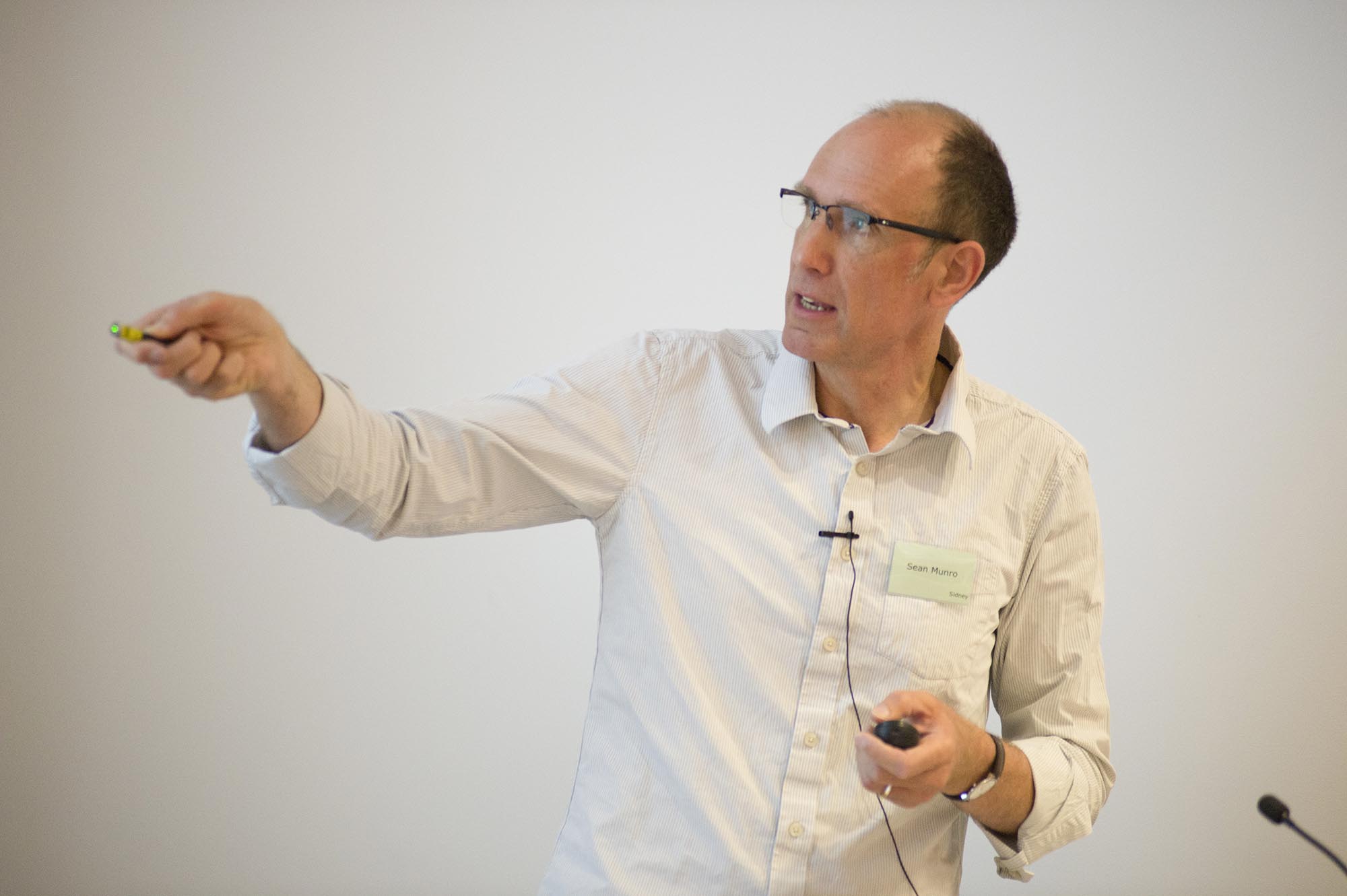
Sean Munro
One of the three authors of the 1993 molecular characterization of the peripheral cannabinoid receptor now called CB2.
Reading note This profile establishes the cited scientific contribution only. Team authorship does not identify each individual’s experimental task; it is not a complete biography or an endorsement.
Original source image
Sean Munro, photographed in 2014. His role in cannabinoid-receptor research is documented in the linked publications.
Graywiki / Wikimedia Commons · 12 July 2014 (source record) · CC BY-SA 4.0
Photograph by Graywiki, CC BY-SA 4.0. The full composition is preserved: web versions are resized and encoded as WebP without cropping or retouching; the original JPEG remains unchanged. Source record reviewed at revision 1110229129. A contextual portrait, not a photograph of the 1993 discovery or an endorsement of Mount Herbs.
Sean Munro is a named author of “Molecular characterization of a peripheral receptor for cannabinoids”. Named authorship in the original publication or verified edition. Only profiles admitted to this collection appear as nodes; the work retains its broader author list.Evidence for this connection
Munro, Thomas and Abu-Shaar 1993 · canonical history
Inherited source record; access extent not reassessed in this edition Consult the linked record and its original context. Additional review & access notesECS archive · 2026-10-26 · indexed-abstract Indexed metadata and abstract inspected through PubMed or Europe PMC. Only the specific model and outcome described are admitted. Selected evidence, not a systematic review. Numerical detail is omitted when not verified.
Presentation scope
Cannabinoid molecular research · molecular-research, source-index
Molecular identity and research do not establish presence, quantity, effect or authorization in a Mount Herbs product batch.
Independent publication review remains pending. Source review does not authorize commercial reuse.
Editorial history & rights
source verified. Checked 2026-10-26. Source verification is not independent scholarly approval.
Source images in this record carry their individual creator, licence, original link and presentation limits beside the image. Bibliographic and scientific records retain their separate review status.
2026-10-26 · Verified bounded contribution or publication metadata; independent specialist review is not implied.
Record ID: person-sean-munro
person / Selected contribution · 1993
Kerrie L. Thomas
One of the three authors of the 1993 molecular characterization of the peripheral cannabinoid receptor now called CB2.
Reading note This profile establishes the cited scientific contribution only. Team authorship does not identify each individual’s experimental task; it is not a complete biography or an endorsement.Record & context
review scope
Selected published contribution. Geographic context concerns the cited work, not inferred nationality; no current affiliation or lifespan inferred.
aliases
K. L. Thomas
identity note
Publisher DOI metadata says Kerrie L. Thomas. “Kathy Thomas” in the supplied candidate roster is not the verified name.
Kerrie L. Thomas is a named author of “Molecular characterization of a peripheral receptor for cannabinoids”. Named authorship in the original publication or verified edition. Only profiles admitted to this collection appear as nodes; the work retains its broader author list.Evidence for this connection
Munro, Thomas and Abu-Shaar 1993 · canonical history
Inherited source record; access extent not reassessed in this edition Consult the linked record and its original context. Additional review & access notesECS archive · 2026-10-26 · indexed-abstract Indexed metadata and abstract inspected through PubMed or Europe PMC. Only the specific model and outcome described are admitted. Selected evidence, not a systematic review. Numerical detail is omitted when not verified.
Presentation scope
Cannabinoid molecular research · molecular-research, source-index
Molecular identity and research do not establish presence, quantity, effect or authorization in a Mount Herbs product batch.
Independent publication review remains pending. Source review does not authorize commercial reuse.
Editorial history & rights
source verified. Checked 2026-10-26. Source verification is not independent scholarly approval.
Original editorial summary and bibliographic metadata. No portrait, cover, manuscript or full text reproduced; follow the source holder’s terms.
2026-10-26 · Verified bounded contribution or publication metadata; independent specialist review is not implied.
Record ID: person-kerrie-thomas
person / Selected contribution · 1993
Muna Abu-Shaar
One of the three authors of the 1993 molecular characterization of the peripheral cannabinoid receptor now called CB2.
Reading note This profile establishes the cited scientific contribution only. Team authorship does not identify each individual’s experimental task; it is not a complete biography or an endorsement.Record & context
review scope
Selected published contribution. Geographic context concerns the cited work, not inferred nationality; no current affiliation or lifespan inferred.
Muna Abu-Shaar is a named author of “Molecular characterization of a peripheral receptor for cannabinoids”. Named authorship in the original publication or verified edition. Only profiles admitted to this collection appear as nodes; the work retains its broader author list.Evidence for this connection
Munro, Thomas and Abu-Shaar 1993 · canonical history
Inherited source record; access extent not reassessed in this edition Consult the linked record and its original context. Additional review & access notesECS archive · 2026-10-26 · indexed-abstract Indexed metadata and abstract inspected through PubMed or Europe PMC. Only the specific model and outcome described are admitted. Selected evidence, not a systematic review. Numerical detail is omitted when not verified.
Presentation scope
Cannabinoid molecular research · molecular-research, source-index
Molecular identity and research do not establish presence, quantity, effect or authorization in a Mount Herbs product batch.
Independent publication review remains pending. Source review does not authorize commercial reuse.
Editorial history & rights
source verified. Checked 2026-10-26. Source verification is not independent scholarly approval.
Original editorial summary and bibliographic metadata. No portrait, cover, manuscript or full text reproduced; follow the source holder’s terms.
2026-10-26 · Verified bounded contribution or publication metadata; independent specialist review is not implied.
Record ID: person-muna-abu-shaar
person / Selected contribution · 1988
Allyn C. Howlett
Coauthor of the 1988 experimental characterization of cannabinoid binding sites in rat brain. The study names Devane, Dysarz, Johnson, Melvin and Howlett.
Reading note This profile establishes the cited scientific contribution only. Team authorship does not identify each individual’s experimental task; it is not a complete biography or an endorsement.
Wake Forest University School of Medicine / Atrium Health; photographer not stated · Photograph date not verified; source checked 1 November 2026 · Copyright retained by respective rights holders; no open licence or permission has been established
Original source photograph for biographical identification. It does not imply endorsement, affiliation with Mount Herbs, or scientific approval. No retouching or upscaling performed. Full source composition retained; delivery copies are resized and encoded as WebP without retouching.
Allyn C. Howlett is a named author of “Determination and characterization of a cannabinoid receptor in rat brain”. Named authorship in the original publication or verified edition. Only profiles admitted to this collection appear as nodes; the work retains its broader author list.Evidence for this connection
Wake Forest University School of Medicine · institutional identity record
institutional record inspected · Checked 2026-10-26 Reconciles Allyn Howlett’s name and field with A. C. Howlett on the 1988 paper. Self-described priority language is not adopted instead of the original author team.
Presentation scope
Cannabinoid molecular research · molecular-research, source-index
Molecular identity and research do not establish presence, quantity, effect or authorization in a Mount Herbs product batch.
Independent publication review remains pending. Source review does not authorize commercial reuse.
Editorial history & rights
source verified. Checked 2026-10-26. Source verification is not independent scholarly approval.
Source images in this record carry their individual creator, licence, original link and presentation limits beside the image. Bibliographic and scientific records retain their separate review status.
2026-10-26 · Verified bounded contribution or publication metadata; independent specialist review is not implied.
Record ID: person-allyn-howlett
person / Selected contribution · 1995
Takayuki Sugiura
First author of the 1995 Japanese study proposing 2-AG as an endogenous cannabinoid receptor ligand in brain preparations.
Reading note This profile establishes the cited scientific contribution only. Team authorship does not identify each individual’s experimental task; it is not a complete biography or an endorsement.Record & context
review scope
Selected published contribution. Geographic context concerns the cited work, not inferred nationality; no current affiliation or lifespan inferred.
Takayuki Sugiura is a named author of “2-Arachidonoylglycerol: a possible endogenous cannabinoid receptor ligand in brain”. Named authorship in the original publication or verified edition. Only profiles admitted to this collection appear as nodes; the work retains its broader author list.Evidence for this connection
Teikyo University 1995 · institutional publication record
Japanese institutional catalogue inspected · Checked 2026-10-26 Reconciles the original paper’s initials with Takayuki Sugiura, Sachiko Kondo, Akihiro Sukagawa, Shinji Nakane, Akira Shinoda, Kiyoko Itoh, Atsushi Yamashita and Keizo Waku.
Presentation scope
Cannabinoid molecular research · molecular-research, source-index
Molecular identity and research do not establish presence, quantity, effect or authorization in a Mount Herbs product batch.
Independent publication review remains pending. Source review does not authorize commercial reuse.
Editorial history & rights
source verified. Checked 2026-10-26. Source verification is not independent scholarly approval.
Original editorial summary and bibliographic metadata. No portrait, cover, manuscript or full text reproduced; follow the source holder’s terms.
2026-10-26 · Verified bounded contribution or publication metadata; independent specialist review is not implied.
Record ID: person-takayuki-sugiura
person / Selected contribution · 2017
J. Helen Cross
Coauthor of the multicentre 2017 Dravet syndrome randomized trial of pharmaceutical cannabidiol added to existing treatment.
Reading note This profile establishes the cited scientific contribution only. Team authorship does not identify each individual’s experimental task; it is not a complete biography or an endorsement.
Original source image
Officer-profile portrait identifying Helen Cross.
Epilepsy Research Institute; photographer not stated · Photograph date not verified; source checked 1 November 2026 · Copyright retained by respective rights holders; no open licence or permission has been established
Original source photograph for biographical identification. It does not imply endorsement, affiliation with Mount Herbs, or scientific approval. No retouching or upscaling performed. Full source composition retained; delivery copies are resized and encoded as WebP without retouching.
J. Helen Cross is a named author of “Trial of Cannabidiol for Drug-Resistant Seizures in the Dravet Syndrome”. Named authorship in the original publication or verified edition. Only profiles admitted to this collection appear as nodes; the work retains its broader author list.Evidence for this connection
Inherited source record; access extent not reassessed in this edition Consult the linked record and its original context.
Presentation scope
Clinical and medical literature · medical-literature, source-index
This evidence concerns the formulation, population and outcome in the cited study. It does not establish efficacy or a permitted claim for a Mount Herbs product.
Independent publication review remains pending. Source review does not authorize commercial reuse.
Editorial history & rights
source verified. Checked 2026-10-26. Source verification is not independent scholarly approval.
Source images in this record carry their individual creator, licence, original link and presentation limits beside the image. Bibliographic and scientific records retain their separate review status.
2026-10-26 · Verified bounded contribution or publication metadata; independent specialist review is not implied.
Record ID: person-j-helen-cross
person / Selected contribution · 2017
Ingrid E. Scheffer
Coauthor of the 2017 Dravet trial. The study provides a specific formulation, patient group, comparator and adverse-event record.
Reading note This profile establishes the cited scientific contribution only. Team authorship does not identify each individual’s experimental task; it is not a complete biography or an endorsement.
Original source image
Ingrid Scheffer in a Royal Society portrait. Her clinical research is documented separately in the linked studies.
The Royal Society; uploaded by Duncan.Hull / Wikimedia Commons · 13 July 2018 (source record) · CC BY-SA 3.0, Royal Society permission statement
Original 576 × 864 JPEG, unchanged. The source summary records Royal Society permission under CC BY-SA 3.0 and public VRT confirmation 2014062710019796; a separate uploader block says CC BY-SA 4.0. This record retains the originating institution’s CC BY-SA 3.0 attribution rather than inferring a broader grant. Private correspondence was not inspected. Embedded camera metadata does not increase the downloaded file’s native resolution. Portrait use does not imply endorsement.
Ingrid E. Scheffer is a named author of “Trial of Cannabidiol for Drug-Resistant Seizures in the Dravet Syndrome”. Named authorship in the original publication or verified edition. Only profiles admitted to this collection appear as nodes; the work retains its broader author list.Evidence for this connection
Inherited source record; access extent not reassessed in this edition Consult the linked record and its original context.
Presentation scope
Clinical and medical literature · medical-literature, source-index
This evidence concerns the formulation, population and outcome in the cited study. It does not establish efficacy or a permitted claim for a Mount Herbs product.
Independent publication review remains pending. Source review does not authorize commercial reuse.
Editorial history & rights
source verified. Checked 2026-10-26. Source verification is not independent scholarly approval.
Source images in this record carry their individual creator, licence, original link and presentation limits beside the image. Bibliographic and scientific records retain their separate review status.
2026-10-26 · Verified bounded contribution or publication metadata; independent specialist review is not implied.
Record ID: person-ingrid-scheffer
person / Selected contribution · 2017
Elizabeth A. Thiele
Coauthor of the 2017 Dravet study and first author of the 2020 online tuberous-sclerosis trial. These distinct studies must not be collapsed into a claim about all cannabis.
Reading note This profile establishes the cited scientific contribution only. Team authorship does not identify each individual’s experimental task; it is not a complete biography or an endorsement.
Original source image
Elizabeth A. Thiele, identified on the Gill Institute 2022 awardee page as affiliated with Massachusetts General Hospital / Harvard Medical School.
Indiana University Gill Institute for Neuroscience; photographer not stated · Photograph date not verified; source checked 1 November 2026 · Copyright retained by respective rights holders; no open licence or permission has been established
Authentic source photograph for contextual identification. No endorsement, association or scientific approval implied. Full source composition retained; no generative alteration, retouching, face reconstruction or upscaling.
Elizabeth A. Thiele is a named author of “Trial of Cannabidiol for Drug-Resistant Seizures in the Dravet Syndrome”. Named authorship in the original publication or verified edition. Only profiles admitted to this collection appear as nodes; the work retains its broader author list.Evidence for this connection
Elizabeth A. Thiele is a named author of “Add-on Cannabidiol Treatment for Drug-Resistant Seizures in Tuberous Sclerosis Complex: A Placebo-Controlled Randomized Clinical Trial”. Named authorship in the original publication or verified edition. Only profiles admitted to this collection appear as nodes; the work retains its broader author list.Evidence for this connection
Inherited source record; access extent not reassessed in this edition Source metadata inherited from the medical dossier. The dossier update date is not this publication’s date.
Inherited source record; access extent not reassessed in this edition Source metadata inherited from the medical dossier. The dossier update date is not this publication’s date.
Presentation scope
Clinical and medical literature · medical-literature, source-index
This evidence concerns the formulation, population and outcome in the cited study. It does not establish efficacy or a permitted claim for a Mount Herbs product.
Independent publication review remains pending. Source review does not authorize commercial reuse.
Editorial history & rights
source verified. Checked 2026-10-26. Source verification is not independent scholarly approval.
Source images in this record carry their individual creator, licence, original link and presentation limits beside the image. Bibliographic and scientific records retain their separate review status.
2026-10-26 · Verified bounded contribution or publication metadata; independent specialist review is not implied.
Record ID: person-elizabeth-thiele
person / Selected contribution · 2019
Yasmin L. Hurd
First author of an exploratory 2019 placebo-controlled study of cue-induced craving and anxiety in drug-abstinent people with heroin use disorder.
Reading note This profile establishes the cited scientific contribution only. Team authorship does not identify each individual’s experimental task; it is not a complete biography or an endorsement.
Original source image
Yasmin Hurd, photographed in 2015. The findings and limits of her research remain attached to the original studies.
Droldn / Wikimedia Commons · 2 May 2015 (source record) · CC BY-SA 4.0
Original JPEG, unchanged. The Commons contributor credits this as their own work. This portrait does not depict a trial, establish a treatment benefit or imply endorsement.
Yasmin L. Hurd is a named author of “Cannabidiol for the Reduction of Cue-Induced Craving and Anxiety in Drug-Abstinent Individuals With Heroin Use Disorder: A Double-Blind Randomized Placebo-Controlled Trial”. Named authorship in the original publication or verified edition. Only profiles admitted to this collection appear as nodes; the work retains its broader author list.Evidence for this connection
Yasmin L. Hurd; Sharron Spriggs; Julia Alishayev; Gary Winkel; Kristina Gurgov; Chris Kudrich; Anna M. Oprescu; Edwin Salsitz 2019 · original clinical study
MEDLINE record and abstract via Europe PMC inspected · Checked 2026-10-26 Exploratory randomized study of cue-induced craving/anxiety. Short observation and surrogate outcomes do not establish prevention of relapse or a licensed treatment.
Presentation scope
Clinical and medical literature · medical-literature, source-index
This evidence concerns the formulation, population and outcome in the cited study. It does not establish efficacy or a permitted claim for a Mount Herbs product.
Independent publication review remains pending. Source review does not authorize commercial reuse.
Editorial history & rights
source verified. Checked 2026-10-26. Source verification is not independent scholarly approval.
Source images in this record carry their individual creator, licence, original link and presentation limits beside the image. Bibliographic and scientific records retain their separate review status.
2026-10-26 · Verified bounded contribution or publication metadata; independent specialist review is not implied.
Record ID: person-yasmin-hurd
person / Selected contribution · 2018
Sumati Rathore
Coauthor of the 2018 Manikaran Valley ethnobotanical study, based on field visits, questionnaires and interviews during 2015–2017. Community knowledge remains attributed to its holders.
Reading note Published authorship establishes participation in the cited field study, not each person’s interview role. Reported practices are not clinical findings or a Mount Herbs sourcing relationship.Record & context
review scope
Selected published contribution. Geographic context concerns the cited work, not inferred nationality; no current affiliation or lifespan inferred.
affiliations
name: G. B. Pant Himalayan institute, Himachal centre / unit; date: Institutional name as recorded for the 2018 publication; not a current position
Sumati Rathore is a named author of “Indigenous uses of wild hemp (Cannabis sativa) by the local inhabitants in Manikaran Valley of Himachal Pradesh, North Western Himalaya”. Named authorship in the original publication or verified edition. Only profiles admitted to this collection appear as nodes; the work retains its broader author list.Evidence for this connection
Sumati Rathore; Sarla Shashni; Sher Singh Samant; Rakesh Chandra Sundriyal 2018 · original ethnobotanical field study
publisher-indexed abstract and DOI metadata inspected; direct page timed out · Checked 2026-10-26 Publisher record: 25 September 2018, Journal of Non-Timber Forest Products 25(3), 127–130, DOI 10.54207/bsmps2000-2018-7393KF. Field visits, questionnaires and interviews during 2015–2017; pooled traditional-use reports, not efficacy trials.
This source-linked educational record does not verify a Mount Herbs product, batch, licence, commercial claim or institutional endorsement.
Independent publication review remains pending. Source review does not authorize commercial reuse.
Editorial history & rights
source verified. Checked 2026-10-26. Source verification is not independent scholarly approval.
Original editorial summary and bibliographic metadata. No portrait, cover, manuscript or full text reproduced; follow the source holder’s terms.
2026-10-26 · Verified bounded contribution or publication metadata; independent specialist review is not implied.
Record ID: person-sumati-rathore
person / Selected contribution · 2018
Sarla Shashni
Coauthor of the 2018 Manikaran Valley ethnobotanical study, based on field visits, questionnaires and interviews during 2015–2017. Community knowledge remains attributed to its holders.
Reading note Published authorship establishes participation in the cited field study, not each person’s interview role. Reported practices are not clinical findings or a Mount Herbs sourcing relationship.
Original source image
Sarla Shashni, in the portrait on her institutional profile.
G. B. Pant National Institute of Himalayan Environment; photographer not stated · Photograph date not verified; source checked 1 November 2026 · Copyright retained by respective rights holders; no open licence or permission has been established
Original source photograph for biographical identification. No Mount Herbs endorsement or affiliation implied. No retouching or upscaling. Full source composition retained; delivery copies are resized and encoded as WebP without retouching.
Sarla Shashni is a named author of “Indigenous uses of wild hemp (Cannabis sativa) by the local inhabitants in Manikaran Valley of Himachal Pradesh, North Western Himalaya”. Named authorship in the original publication or verified edition. Only profiles admitted to this collection appear as nodes; the work retains its broader author list.Evidence for this connection
Sumati Rathore; Sarla Shashni; Sher Singh Samant; Rakesh Chandra Sundriyal 2018 · original ethnobotanical field study
publisher-indexed abstract and DOI metadata inspected; direct page timed out · Checked 2026-10-26 Publisher record: 25 September 2018, Journal of Non-Timber Forest Products 25(3), 127–130, DOI 10.54207/bsmps2000-2018-7393KF. Field visits, questionnaires and interviews during 2015–2017; pooled traditional-use reports, not efficacy trials.
This source-linked educational record does not verify a Mount Herbs product, batch, licence, commercial claim or institutional endorsement.
Independent publication review remains pending. Source review does not authorize commercial reuse.
Editorial history & rights
source verified. Checked 2026-10-26. Source verification is not independent scholarly approval.
Source images in this record carry their individual creator, licence, original link and presentation limits beside the image. Bibliographic and scientific records retain their separate review status.
2026-10-26 · Verified bounded contribution or publication metadata; independent specialist review is not implied.
Record ID: person-sarla-shashni
person / Selected contribution · 2018
Sher Singh Samant
Coauthor of the 2018 Manikaran Valley ethnobotanical study, based on field visits, questionnaires and interviews during 2015–2017. Community knowledge remains attributed to its holders.
Reading note Published authorship establishes participation in the cited field study, not each person’s interview role. Reported practices are not clinical findings or a Mount Herbs sourcing relationship.Record & context
review scope
Selected published contribution. Geographic context concerns the cited work, not inferred nationality; no current affiliation or lifespan inferred.
affiliations
name: G. B. Pant Himalayan institute, Himachal centre / unit; date: Institutional name as recorded for the 2018 publication; not a current position
Sher Singh Samant is a named author of “Indigenous uses of wild hemp (Cannabis sativa) by the local inhabitants in Manikaran Valley of Himachal Pradesh, North Western Himalaya”. Named authorship in the original publication or verified edition. Only profiles admitted to this collection appear as nodes; the work retains its broader author list.Evidence for this connection
Sumati Rathore; Sarla Shashni; Sher Singh Samant; Rakesh Chandra Sundriyal 2018 · original ethnobotanical field study
publisher-indexed abstract and DOI metadata inspected; direct page timed out · Checked 2026-10-26 Publisher record: 25 September 2018, Journal of Non-Timber Forest Products 25(3), 127–130, DOI 10.54207/bsmps2000-2018-7393KF. Field visits, questionnaires and interviews during 2015–2017; pooled traditional-use reports, not efficacy trials.
This source-linked educational record does not verify a Mount Herbs product, batch, licence, commercial claim or institutional endorsement.
Independent publication review remains pending. Source review does not authorize commercial reuse.
Editorial history & rights
source verified. Checked 2026-10-26. Source verification is not independent scholarly approval.
Original editorial summary and bibliographic metadata. No portrait, cover, manuscript or full text reproduced; follow the source holder’s terms.
2026-10-26 · Verified bounded contribution or publication metadata; independent specialist review is not implied.
Record ID: person-sher-singh-samant
person / Selected contribution · 2018
Rakesh Chandra Sundriyal
Coauthor of the 2018 Manikaran Valley ethnobotanical study, based on field visits, questionnaires and interviews during 2015–2017. Community knowledge remains attributed to its holders.
Reading note Published authorship establishes participation in the cited field study, not each person’s interview role. Reported practices are not clinical findings or a Mount Herbs sourcing relationship.
Original source image
R. C. Sundriyal, in the portrait accompanying his university biography. The source identifies his GB Pant and HNB Garhwal University career.
Sparsh Himalaya University; photographer not stated · Photograph date not verified; source checked 1 November 2026 · Copyright retained by respective rights holders; no open licence or permission has been established
Original source photograph for biographical identification. It does not imply endorsement, affiliation with Mount Herbs, or scientific approval. No retouching or upscaling performed. Full source composition retained; delivery copies are resized and encoded as WebP without retouching.
Selected published contribution. Geographic context concerns the cited work, not inferred nationality; no current affiliation or lifespan inferred.
affiliations
name: G. B. Pant National Institute of Himalayan Environment, Kosi-Katarmal; date: Institutional name as recorded for the 2018 publication; not a current position
Rakesh Chandra Sundriyal is a named author of “Indigenous uses of wild hemp (Cannabis sativa) by the local inhabitants in Manikaran Valley of Himachal Pradesh, North Western Himalaya”. Named authorship in the original publication or verified edition. Only profiles admitted to this collection appear as nodes; the work retains its broader author list.Evidence for this connection
Sumati Rathore; Sarla Shashni; Sher Singh Samant; Rakesh Chandra Sundriyal 2018 · original ethnobotanical field study
publisher-indexed abstract and DOI metadata inspected; direct page timed out · Checked 2026-10-26 Publisher record: 25 September 2018, Journal of Non-Timber Forest Products 25(3), 127–130, DOI 10.54207/bsmps2000-2018-7393KF. Field visits, questionnaires and interviews during 2015–2017; pooled traditional-use reports, not efficacy trials.
This source-linked educational record does not verify a Mount Herbs product, batch, licence, commercial claim or institutional endorsement.
Independent publication review remains pending. Source review does not authorize commercial reuse.
Editorial history & rights
source verified. Checked 2026-10-26. Source verification is not independent scholarly approval.
Source images in this record carry their individual creator, licence, original link and presentation limits beside the image. Bibliographic and scientific records retain their separate review status.
2026-10-26 · Verified bounded contribution or publication metadata; independent specialist review is not implied.
Record ID: person-rakesh-chandra-sundriyal
person / Selected contribution · 2013
Robert C. Clarke
Coauthor with Mark D. Merlin of the 2013 first edition of Cannabis: Evolution and Ethnobotany, an interdisciplinary synthesis of plant and human histories.
Reading note The selected edition credits both coauthors. It does not assign individual chapters or fieldwork to either person; the synthesis is not a final taxonomic consensus or a complete biography.Record & context
review scope
Selected published contribution. Geographic context concerns the cited work, not inferred nationality; no current affiliation or lifespan inferred.
Robert C. Clarke is a named author of “Cannabis: Evolution and Ethnobotany”. Named authorship in the original publication or verified edition. Only profiles admitted to this collection appear as nodes; the work retains its broader author list.Evidence for this connection
University of California Press 2013 · publisher catalogue
catalogue inspected · Checked 2026-10-26 September 2013 first edition; Robert Clarke and Mark Merlin; electronic ISBN 9780520954571. Publisher description, not a chapter-by-chapter critical review.
University of California Press 2013 · publisher catalogue
catalogue inspected · Checked 2026-10-26 September 2013 first edition; Robert Clarke and Mark Merlin; electronic ISBN 9780520954571. Publisher description, not a chapter-by-chapter critical review.
This source-linked educational record does not verify a Mount Herbs product, batch, licence, commercial claim or institutional endorsement.
Independent publication review remains pending. Source review does not authorize commercial reuse.
Editorial history & rights
source verified. Checked 2026-10-26. Source verification is not independent scholarly approval.
Original editorial summary and bibliographic metadata. No portrait, cover, manuscript or full text reproduced; follow the source holder’s terms.
2026-10-26 · Verified bounded contribution or publication metadata; independent specialist review is not implied.
Record ID: person-robert-clarke
person / Selected contribution · 2013
Mark D. Merlin
Coauthor with Robert C. Clarke of Cannabis: Evolution and Ethnobotany. The book places botanical and cultural evidence within a shared historical account.
Reading note The selected edition credits both coauthors. It does not assign individual chapters or fieldwork to either person; the synthesis is not a final taxonomic consensus or a complete biography.
Original source image
Mark Merlin standing behind an Oʻahu relief map, as identified by the university caption. Environmental portrait, not a reconstruction of his research.
University of Hawaiʻi News; photographer not stated · Photograph date not verified; source checked 1 November 2026 · Copyright retained by respective rights holders; no open licence or permission has been established
Original source photograph for biographical identification. It does not imply endorsement, affiliation with Mount Herbs, or scientific approval. No retouching or upscaling performed. Full source composition retained; delivery copies are resized and encoded as WebP without retouching.
Mark D. Merlin is a named author of “Cannabis: Evolution and Ethnobotany”. Named authorship in the original publication or verified edition. Only profiles admitted to this collection appear as nodes; the work retains its broader author list.Evidence for this connection
University of California Press 2013 · publisher catalogue
catalogue inspected · Checked 2026-10-26 September 2013 first edition; Robert Clarke and Mark Merlin; electronic ISBN 9780520954571. Publisher description, not a chapter-by-chapter critical review.
University of California Press 2013 · publisher catalogue
catalogue inspected · Checked 2026-10-26 September 2013 first edition; Robert Clarke and Mark Merlin; electronic ISBN 9780520954571. Publisher description, not a chapter-by-chapter critical review.
This source-linked educational record does not verify a Mount Herbs product, batch, licence, commercial claim or institutional endorsement.
Independent publication review remains pending. Source review does not authorize commercial reuse.
Editorial history & rights
source verified. Checked 2026-10-26. Source verification is not independent scholarly approval.
Source images in this record carry their individual creator, licence, original link and presentation limits beside the image. Bibliographic and scientific records retain their separate review status.
2026-10-26 · Verified bounded contribution or publication metadata; independent specialist review is not implied.
Record ID: person-mark-merlin
person / Books and selected contributions
Ed Rosenthal
Ed Rosenthal writes, edits and publishes books about cannabis. His work moves between broad horticultural references, focused garden guides, photography and the politics surrounding the plant.
His official biography traces the Ask Ed advice column and his publishing work. The books below show why the individual credit matters: Rosenthal appears as an author, coauthor, editor or photographer, depending on the title. A general handbook, an account of India and a policy argument ask different questions. Follow each book to its edition, collaborators and original record.
Reading note The selected edition establishes credited authorship. It does not establish medical authority, assign individual sections to a coauthor or authorize cultivation in a reader’s jurisdiction.
Original source image
Ed Rosenthal, photographed in 2015. This portrait accompanies the author record; the book edition has its own bibliographic evidence.
Dabsel Adams (filename credit); uploaded as own work by Cannaman201 / Wikimedia Commons · 14 December 2015 (source record) · CC BY-SA 4.0
The delivery WebP is resized and encoded without cropping or retouching; the original JPEG is retained unchanged for inspection. Both versions retain the CC BY-SA 4.0 attribution. Portrait use does not imply endorsement or legal permission to cultivate.
Start with the kind of book you want to understand. Broad handbooks sit beside question-led guides, collaborative books, photographs and historical arguments. Open a title for its exact credit and edition.
19 verified catalogue records · checked 2026-10-28
The broad handbooks
Keep similarly named books and their editions separate.
Ed Rosenthal, Robert Flannery and Angela Bacca are credited on this broad reference to cannabis and hemp horticulture. The 2021 edition remains distinct from the earlier Marijuana Grower’s Handbook.
2021 paperback; not conflated with earlier Marijuana Grower’s Handbook editions
An earlier broad horticultural reference, retained in the author’s eBook directory. Its title and edition history remain separate from Cannabis Grower’s Handbook.
Edition and publication date not stated in the checked catalogue
A field guide built around recognising plant problems. Pests, disease and environmental stress sit together in the currently displayed revised edition.
An edited collection on hemp’s history and industrial uses. Rosenthal’s role here is editor, bringing contributions together rather than supplying a single-author handbook.
A policy argument written with Steve Kubby and a contribution credited to S. Newhart. Read it as an intervention in its time, rather than a guide to present law.
A 1997 handbook credited to Ed Rosenthal, Dale Gieringer and Tod Mikuriya. This historical book remains separate from contemporary clinical trials and later editions.
Ed Rosenthal is a named author of “Cannabis Grower’s Handbook: The Complete Guide to Marijuana and Hemp Cultivation”. Named authorship in the original publication or verified edition. Only profiles admitted to this collection appear as nodes; the work retains its broader author list.Evidence for this connection
Weston Family Library, Toronto Botanical Garden 2021 · institutional library catalogue
catalogue inspected · Checked 2026-10-26 Identifies the 2021 Quick American Publishing paperback, ISBN 9781936807543, and the three credited authors Rosenthal, Flannery and Bacca. Pagination differs across catalogues and is not asserted here.
Ed Rosenthal is a named author of “Marijuana Grower’s Handbook: Your Complete Guide for Medical and Personal Marijuana Cultivation”. The source identifies this specific contribution. Full contributors remain in the publication record; catalogue presence is not medical authority or an endorsement.Evidence for this connection
Ed Rosenthal official website · author or institutional catalogue
Catalogue metadata and stated locator inspected; book contents not independently reviewed · Checked 2026-10-28 Supports the title and stated contribution within this catalogue record. Unknown publication or edition details remain unasserted. Locator: ebook title list
Ed Rosenthal official website · author or institutional catalogue
Catalogue metadata and stated locator inspected; book contents not independently reviewed · Checked 2026-10-28 Supports the title and stated contribution within this catalogue record. Unknown publication or edition details remain unasserted. Locator: collection contents
Ed Rosenthal is a named author of “Marijuana Growers Guide”. The source identifies this specific contribution. Full contributors remain in the publication record; catalogue presence is not medical authority or an endorsement.Evidence for this connection
Ed Rosenthal official website · author or institutional catalogue
Catalogue metadata and stated locator inspected; book contents not independently reviewed · Checked 2026-10-28 Supports the title and stated contribution within this catalogue record. Unknown publication or edition details remain unasserted. Locator: author-hosted interview: discussion of collaboration with Mel Frank and the 1978 review
Ed Rosenthal is a named author of “Closet Cultivator”. The source identifies this specific contribution. Wellcome supplies[1991]; preserve this bibliographic qualification.Evidence for this connection
Wellcome Collection · author or institutional catalogue
Catalogue metadata and stated locator inspected; book contents not independently reviewed · Checked 2026-10-28 Supports the title and stated contribution within this catalogue record. Wellcome supplies[1991]; preserve this bibliographic qualification. Locator: Publication/Creation and Contributors; date supplied in square brackets by catalogue
Ed Rosenthal is a named author of “Ask Ed: Marijuana Success: Tips and Advice for Gardening Year-Round”. The source identifies this specific contribution. Full contributors remain in the publication record; catalogue presence is not medical authority or an endorsement.Evidence for this connection
Ed Rosenthal official website · author or institutional catalogue
Catalogue metadata and stated locator inspected; book contents not independently reviewed · Checked 2026-10-28 Supports the title and stated contribution within this catalogue record. Unknown publication or edition details remain unasserted. Locator: product title, description and displayed cover
Ed Rosenthal is a named author of “Marijuana Garden Saver: A Field Guide to Identifying and Correcting Cannabis Problems”. The source identifies this specific contribution. Do not conflate the earlier J.C. Stitch edition edited by Rosenthal with this cover, which credits Ed Rosenthal.Evidence for this connection
Ed Rosenthal official website · author or institutional catalogue
Catalogue metadata and stated locator inspected; book contents not independently reviewed · Checked 2026-10-28 Supports the title and stated contribution within this catalogue record. Do not conflate the earlier J.C. Stitch edition edited by Rosenthal with this cover, which credits Ed Rosenthal. Locator: product title, description and displayed cover
Ed Rosenthal is a named author of “Protect Your Garden”. The source identifies this specific contribution. Full contributors remain in the publication record; catalogue presence is not medical authority or an endorsement.Evidence for this connection
Ed Rosenthal official website · author or institutional catalogue
Catalogue metadata and stated locator inspected; book contents not independently reviewed · Checked 2026-10-28 Supports the title and stated contribution within this catalogue record. Unknown publication or edition details remain unasserted. Locator: product title, description and displayed cover
Ed Rosenthal is a named author of “Marijuana Pest and Disease Control”. The source identifies this specific contribution. Full contributors remain in the publication record; catalogue presence is not medical authority or an endorsement.Evidence for this connection
Ed Rosenthal official website · author or institutional catalogue
Catalogue metadata and stated locator inspected; book contents not independently reviewed · Checked 2026-10-28 Supports the title and stated contribution within this catalogue record. Unknown publication or edition details remain unasserted. Locator: author-hosted interview: discussion of collaboration with Mel Frank and the 1978 review
US National Agricultural Library, via AGRIS · author or institutional catalogue
Catalogue metadata and stated locator inspected; book contents not independently reviewed · Checked 2026-10-28 Supports the title and stated contribution within this catalogue record. Unknown publication or edition details remain unasserted. Locator: NAL-provided record:2012; Ed Rosenthal with Kathy Imbriani;ISBN
Ed Rosenthal is a named author of “Marijuana Harvest: How to Maximize Quality and Yield in Your Cannabis Garden”. The source identifies this specific contribution. Full contributors remain in the publication record; catalogue presence is not medical authority or an endorsement.Evidence for this connection
Ed Rosenthal official website · author or institutional catalogue
Catalogue metadata and stated locator inspected; book contents not independently reviewed · Checked 2026-10-28 Supports the title and stated contribution within this catalogue record. Unknown publication or edition details remain unasserted. Locator: ebook title list
Ed Rosenthal official website · author or institutional catalogue
Catalogue metadata and stated locator inspected; book contents not independently reviewed · Checked 2026-10-28 Supports the title and stated contribution within this catalogue record. Unknown publication or edition details remain unasserted. Locator: Opening attribution explicitly names Ed Rosenthal and David Downs
Catalogue metadata and stated locator inspected; book contents not independently reviewed · Checked 2026-10-28 Supports the title and stated contribution within this catalogue record. Unknown publication or edition details remain unasserted. Locator: Freelance Journalist, Author paragraph: coauthor of Marijuana Harvest(2017)
Ed Rosenthal is a named author of “Beyond Buds: Marijuana Extracts, Hash, Vaping, Dabbing, Edibles and Medicines”. The source identifies this specific contribution. David Downs identifies his contribution and2014 publication on his own resume; complete edition ISBN remains unverified.Evidence for this connection
Ed Rosenthal official website · author or institutional catalogue
Catalogue metadata and stated locator inspected; book contents not independently reviewed · Checked 2026-10-28 Supports the title and stated contribution within this catalogue record. Unknown publication or edition details remain unasserted. Locator: ebook title list
Catalogue metadata and stated locator inspected; book contents not independently reviewed · Checked 2026-10-28 Supports the title and stated contribution within this catalogue record. Unknown publication or edition details remain unasserted. Locator: Freelance Journalist, Author paragraph: coauthor of Marijuana Harvest(2017)
Ed Rosenthal is a named author of “Beyond Buds, Next Generation: Marijuana Concentrates and Cannabis Infusions”. The source identifies this specific contribution. Full contributors remain in the publication record; catalogue presence is not medical authority or an endorsement.Evidence for this connection
Ed Rosenthal official website · author or institutional catalogue
Catalogue metadata and stated locator inspected; book contents not independently reviewed · Checked 2026-10-28 Supports the title and stated contribution within this catalogue record. Unknown publication or edition details remain unasserted. Locator: product title, description and displayed cover
Ed Rosenthal official website · author or institutional catalogue
Catalogue metadata and stated locator inspected; book contents not independently reviewed · Checked 2026-10-28 Supports the title and stated contribution within this catalogue record. Unknown publication or edition details remain unasserted. Locator: Title and interview with coauthor Greg Zeman
The documented relationship is “photographed”: Ed Rosenthal to Ganja in India. The source identifies this specific contribution. 1981 is the date of the photographs, not a verified publication date.Evidence for this connection
Ed Rosenthal official website · author or institutional catalogue
Catalogue metadata and stated locator inspected; book contents not independently reviewed · Checked 2026-10-28 Supports the title and stated contribution within this catalogue record. 1981 is the date of the photographs, not a verified publication date. Locator: product title, description and displayed cover
Ed Rosenthal is a named author of “The Big Book of Buds: Marijuana Varieties from the World’s Great Seed Breeders”. The source identifies this specific contribution. Full contributors remain in the publication record; catalogue presence is not medical authority or an endorsement.Evidence for this connection
WorldCat / OCLC · author or institutional catalogue
Catalogue metadata and stated locator inspected; book contents not independently reviewed · Checked 2026-10-28 Supports the title and stated contribution within this catalogue record. Unknown publication or edition details remain unasserted. Locator: Authors, print book, copyright2001, Quick American Archives
Ed Rosenthal is a named author of “Big Book of Buds 2”. The source identifies this specific contribution. Full contributors remain in the publication record; catalogue presence is not medical authority or an endorsement.Evidence for this connection
Ed Rosenthal official website · author or institutional catalogue
Catalogue metadata and stated locator inspected; book contents not independently reviewed · Checked 2026-10-28 Supports the title and stated contribution within this catalogue record. Unknown publication or edition details remain unasserted. Locator: collection contents
Ed Rosenthal is a named author of “The Big Book of Buds, Volume 3: More Marijuana Varieties from the World’s Greatest Seed Breeders”. The source identifies this specific contribution. Full contributors remain in the publication record; catalogue presence is not medical authority or an endorsement.Evidence for this connection
WorldCat / OCLC · author or institutional catalogue
Catalogue metadata and stated locator inspected; book contents not independently reviewed · Checked 2026-10-28 Supports the title and stated contribution within this catalogue record. Unknown publication or edition details remain unasserted. Locator: Summary identifies third volume; author and ebook publication record2007
The documented relationship is “edited”: Ed Rosenthal to Big Book of Buds Greatest Hits: Marijuana Varieties from the World’s Best Breeders. The source identifies this specific contribution. 2016 distributor catalogue; exact release day is not asserted.Evidence for this connection
Ingram Content Group · author or institutional catalogue
Catalogue metadata and stated locator inspected; book contents not independently reviewed · Checked 2026-10-28 Supports the title and stated contribution within this catalogue record. 2016 distributor catalogue; exact release day is not asserted. Locator: September2016 Advance catalogue,page79; editor,title,ISBN; date is catalogue-year evidence
Blink / Scott Idleman · author or institutional catalogue
Catalogue metadata and stated locator inspected; book contents not independently reviewed · Checked 2026-10-28 Supports the title and stated contribution within this catalogue record. 2016 distributor catalogue; exact release day is not asserted. Locator: Big Book of Buds Greatest Hits: author,publisher,book-design credits
The documented relationship is “edited”: Ed Rosenthal to Hemp Today. The source identifies this specific contribution. Full contributors remain in the publication record; catalogue presence is not medical authority or an endorsement.Evidence for this connection
US National Agricultural Library, via AGRIS · author or institutional catalogue
Catalogue metadata and stated locator inspected; book contents not independently reviewed · Checked 2026-10-28 Supports the title and stated contribution within this catalogue record. Unknown publication or edition details remain unasserted. Locator: Bibliographic information: edited by Ed Rosenthal; Quick American Archives; 1994; ISBN
Ed Rosenthal is a named author of “Why Marijuana Should Be Legal”. The source identifies this specific contribution. Full contributors remain in the publication record; catalogue presence is not medical authority or an endorsement.Evidence for this connection
Hachette Book Group · author or institutional catalogue
Catalogue metadata and stated locator inspected; book contents not independently reviewed · Checked 2026-10-28 Supports the title and stated contribution within this catalogue record. Unknown publication or edition details remain unasserted. Locator: Byline; on-sale date; ISBN-13; publisher
Ed Rosenthal is a named author of “Marijuana Medical Handbook”. The source identifies this specific contribution. This is the library’s 1997 item. Later editions have different collaborators; do not merge their attribution.Evidence for this connection
BC Cancer Library · author or institutional catalogue
Catalogue metadata and stated locator inspected; book contents not independently reviewed · Checked 2026-10-28 Supports the title and stated contribution within this catalogue record. This is the library’s 1997 item. Later editions have different collaborators; do not merge their attribution. Locator: Books: QV766 R815 1997; ISBN0932551165; listed authors
Weston Family Library, Toronto Botanical Garden 2021 · institutional library catalogue
catalogue inspected · Checked 2026-10-26 Identifies the 2021 Quick American Publishing paperback, ISBN 9781936807543, and the three credited authors Rosenthal, Flannery and Bacca. Pagination differs across catalogues and is not asserted here.
catalogue inspected · Checked 2026-10-26 Establishes the work and its horticultural scope. Current storefront artwork says third printing; this does not establish a new edition. Locator: product title, description and displayed cover
Ed Rosenthal official website · author or institutional catalogue
Catalogue metadata and stated locator inspected; book contents not independently reviewed · Checked 2026-10-28 First-party account identifies author, educator, activist, the Ask Ed column and Quick Trading Publishing. Promotional rankings and sales totals are not adopted. Locator: Opening biography; Ask Ed column paragraph; Marijuana innovator section
Ed Rosenthal official website · author or institutional catalogue
Catalogue metadata and stated locator inspected; book contents not independently reviewed · Checked 2026-10-28 The snapshot contains 26 listings: 19 standalone books, four bundles, two hats and an eBook directory. Shop presence is not Ed Rosenthal authorship. The shop states US-only shipping; stock and checkout availability were not verified. Locator: Complete shop listing and shipping notice, checked 28 October 2026
US National Agricultural Library, via AGRIS · author or institutional catalogue
Catalogue metadata and stated locator inspected; book contents not independently reviewed · Checked 2026-10-28 Supports the title and stated contribution within this catalogue record. Unknown publication or edition details remain unasserted. Locator: NAL-provided bibliographic record: coauthors, title,2021,ISBN9781936807543
Ed Rosenthal official website · author or institutional catalogue
Catalogue metadata and stated locator inspected; book contents not independently reviewed · Checked 2026-10-28 Supports the title and stated contribution within this catalogue record. Unknown publication or edition details remain unasserted. Locator: ebook title list
Ed Rosenthal official website · author or institutional catalogue
Catalogue metadata and stated locator inspected; book contents not independently reviewed · Checked 2026-10-28 Supports the title and stated contribution within this catalogue record. Unknown publication or edition details remain unasserted. Locator: collection contents
Ed Rosenthal official website · author or institutional catalogue
Catalogue metadata and stated locator inspected; book contents not independently reviewed · Checked 2026-10-28 Supports the title and stated contribution within this catalogue record. Unknown publication or edition details remain unasserted. Locator: author-hosted interview: discussion of collaboration with Mel Frank and the 1978 review
Wellcome Collection · author or institutional catalogue
Catalogue metadata and stated locator inspected; book contents not independently reviewed · Checked 2026-10-28 Supports the title and stated contribution within this catalogue record. Wellcome supplies[1991]; preserve this bibliographic qualification. Locator: Publication/Creation and Contributors; date supplied in square brackets by catalogue
Ed Rosenthal official website · author or institutional catalogue
Catalogue metadata and stated locator inspected; book contents not independently reviewed · Checked 2026-10-28 Supports the title and stated contribution within this catalogue record. Unknown publication or edition details remain unasserted. Locator: product title, description and displayed cover
Ed Rosenthal official website · author or institutional catalogue
Catalogue metadata and stated locator inspected; book contents not independently reviewed · Checked 2026-10-28 Supports the title and stated contribution within this catalogue record. Do not conflate the earlier J.C. Stitch edition edited by Rosenthal with this cover, which credits Ed Rosenthal. Locator: product title, description and displayed cover
Ed Rosenthal official website · author or institutional catalogue
Catalogue metadata and stated locator inspected; book contents not independently reviewed · Checked 2026-10-28 Supports the title and stated contribution within this catalogue record. Unknown publication or edition details remain unasserted. Locator: product title, description and displayed cover
US National Agricultural Library, via AGRIS · author or institutional catalogue
Catalogue metadata and stated locator inspected; book contents not independently reviewed · Checked 2026-10-28 Supports the title and stated contribution within this catalogue record. Unknown publication or edition details remain unasserted. Locator: NAL-provided record:2012; Ed Rosenthal with Kathy Imbriani;ISBN
Ed Rosenthal official website · author or institutional catalogue
Catalogue metadata and stated locator inspected; book contents not independently reviewed · Checked 2026-10-28 Supports the title and stated contribution within this catalogue record. Unknown publication or edition details remain unasserted. Locator: Opening attribution explicitly names Ed Rosenthal and David Downs
Catalogue metadata and stated locator inspected; book contents not independently reviewed · Checked 2026-10-28 Supports the title and stated contribution within this catalogue record. Unknown publication or edition details remain unasserted. Locator: Freelance Journalist, Author paragraph: coauthor of Marijuana Harvest(2017)
Ed Rosenthal official website · author or institutional catalogue
Catalogue metadata and stated locator inspected; book contents not independently reviewed · Checked 2026-10-28 Supports the title and stated contribution within this catalogue record. Unknown publication or edition details remain unasserted. Locator: product title, description and displayed cover
Ed Rosenthal official website · author or institutional catalogue
Catalogue metadata and stated locator inspected; book contents not independently reviewed · Checked 2026-10-28 Supports the title and stated contribution within this catalogue record. Unknown publication or edition details remain unasserted. Locator: Title and interview with coauthor Greg Zeman
Ed Rosenthal official website · author or institutional catalogue
Catalogue metadata and stated locator inspected; book contents not independently reviewed · Checked 2026-10-28 Supports the title and stated contribution within this catalogue record. 1981 is the date of the photographs, not a verified publication date. Locator: product title, description and displayed cover
WorldCat / OCLC · author or institutional catalogue
Catalogue metadata and stated locator inspected; book contents not independently reviewed · Checked 2026-10-28 Supports the title and stated contribution within this catalogue record. Unknown publication or edition details remain unasserted. Locator: Authors, print book, copyright2001, Quick American Archives
WorldCat / OCLC · author or institutional catalogue
Catalogue metadata and stated locator inspected; book contents not independently reviewed · Checked 2026-10-28 Supports the title and stated contribution within this catalogue record. Unknown publication or edition details remain unasserted. Locator: Summary identifies third volume; author and ebook publication record2007
Ingram Content Group · author or institutional catalogue
Catalogue metadata and stated locator inspected; book contents not independently reviewed · Checked 2026-10-28 Supports the title and stated contribution within this catalogue record. 2016 distributor catalogue; exact release day is not asserted. Locator: September2016 Advance catalogue,page79; editor,title,ISBN; date is catalogue-year evidence
Blink / Scott Idleman · author or institutional catalogue
Catalogue metadata and stated locator inspected; book contents not independently reviewed · Checked 2026-10-28 Supports the title and stated contribution within this catalogue record. 2016 distributor catalogue; exact release day is not asserted. Locator: Big Book of Buds Greatest Hits: author,publisher,book-design credits
US National Agricultural Library, via AGRIS · author or institutional catalogue
Catalogue metadata and stated locator inspected; book contents not independently reviewed · Checked 2026-10-28 Supports the title and stated contribution within this catalogue record. Unknown publication or edition details remain unasserted. Locator: Bibliographic information: edited by Ed Rosenthal; Quick American Archives; 1994; ISBN
Hachette Book Group · author or institutional catalogue
Catalogue metadata and stated locator inspected; book contents not independently reviewed · Checked 2026-10-28 Supports the title and stated contribution within this catalogue record. Unknown publication or edition details remain unasserted. Locator: Byline; on-sale date; ISBN-13; publisher
BC Cancer Library · author or institutional catalogue
Catalogue metadata and stated locator inspected; book contents not independently reviewed · Checked 2026-10-28 Supports the title and stated contribution within this catalogue record. This is the library’s 1997 item. Later editions have different collaborators; do not merge their attribution. Locator: Books: QV766 R815 1997; ISBN0932551165; listed authors
This source-linked educational record does not verify a Mount Herbs product, batch, licence, commercial claim or institutional endorsement.
Independent publication review remains pending. Source review does not authorize commercial reuse.
Editorial history & rights
source verified. Checked 2026-10-28. Source verification is not independent scholarly approval.
Source images in this record carry their individual creator, licence, original link and presentation limits beside the image. Bibliographic and scientific records retain their separate review status.
2026-10-26 · Verified bounded contribution or publication metadata; independent specialist review is not implied.
2026-10-28 · Expanded bounded bibliography from official product pages, eBook directory, author-hosted interviews and named institutional or publisher catalogues.
Record ID: person-ed-rosenthal
person / Selected contribution · 2021
Robert Flannery
Coauthor credited in the institutional catalogue for the 2021 Cannabis Grower’s Handbook, alongside Ed Rosenthal and Angela Bacca.
Reading note The selected edition establishes credited authorship. It does not establish medical authority, assign individual sections to a coauthor or authorize cultivation in a reader’s jurisdiction.
Company account linked by Robert Flannery’s own professional profile; not a personal account. Account source ↗. Links do not imply an association with Mount Herbs.
Instagram restricts this profile for some visitors. Its feed is not embedded here; open the profile directly.
Record & context
review scope
Selected published contribution. Geographic context concerns the cited work, not inferred nationality; no current affiliation or lifespan inferred.
Robert Flannery is a named author of “Cannabis Grower’s Handbook: The Complete Guide to Marijuana and Hemp Cultivation”. Named authorship in the original publication or verified edition. Only profiles admitted to this collection appear as nodes; the work retains its broader author list.Evidence for this connection
Weston Family Library, Toronto Botanical Garden 2021 · institutional library catalogue
catalogue inspected · Checked 2026-10-26 Identifies the 2021 Quick American Publishing paperback, ISBN 9781936807543, and the three credited authors Rosenthal, Flannery and Bacca. Pagination differs across catalogues and is not asserted here.
This source-linked educational record does not verify a Mount Herbs product, batch, licence, commercial claim or institutional endorsement.
Independent publication review remains pending. Source review does not authorize commercial reuse.
Editorial history & rights
source verified. Checked 2026-10-26. Source verification is not independent scholarly approval.
Original editorial summary and bibliographic metadata. No portrait, cover, manuscript or full text reproduced; follow the source holder’s terms.
2026-10-26 · Verified bounded contribution or publication metadata; independent specialist review is not implied.
Record ID: person-robert-flannery
person / Selected contribution · 2021
Angela Bacca
Coauthor credited on the 2021 Cannabis Grower’s Handbook. The bibliography preserves her authorship instead of attributing the whole book to its best-known name.
Reading note The selected edition establishes credited authorship. It does not establish medical authority, assign individual sections to a coauthor or authorize cultivation in a reader’s jurisdiction.
Angela Bacca is a named author of “Cannabis Grower’s Handbook: The Complete Guide to Marijuana and Hemp Cultivation”. Named authorship in the original publication or verified edition. Only profiles admitted to this collection appear as nodes; the work retains its broader author list.Evidence for this connection
Weston Family Library, Toronto Botanical Garden 2021 · institutional library catalogue
catalogue inspected · Checked 2026-10-26 Identifies the 2021 Quick American Publishing paperback, ISBN 9781936807543, and the three credited authors Rosenthal, Flannery and Bacca. Pagination differs across catalogues and is not asserted here.
This source-linked educational record does not verify a Mount Herbs product, batch, licence, commercial claim or institutional endorsement.
Independent publication review remains pending. Source review does not authorize commercial reuse.
Editorial history & rights
source verified. Checked 2026-10-26. Source verification is not independent scholarly approval.
Original editorial summary and bibliographic metadata. No portrait, cover, manuscript or full text reproduced; follow the source holder’s terms.
2026-10-26 · Verified bounded contribution or publication metadata; independent specialist review is not implied.
Record ID: person-angela-bacca
person / Selected contribution · 2019
Chris S. Duvall
Author of The African Roots of Marijuana, which examines African agency, historical geography and racial assumptions in accounts of cannabis.
Reading note This profile identifies the author and subject of a historical work. Its catalogue description does not verify every route, date or interpretation developed in the book.
Original source image
Chris S. Duvall, the geographer and author of The African Roots of Marijuana, identified by his University of New Mexico profile.
University of New Mexico; photographer not stated · Photograph date not verified; source checked 1 November 2026 · Copyright retained by respective rights holders; no open licence or permission has been established
Authentic source photograph for contextual identification. No endorsement, association or scientific approval implied. Full source composition retained; no generative alteration, retouching, face reconstruction or upscaling.
Chris S. Duvall is a named author of “The African Roots of Marijuana”. Named authorship in the original publication or verified edition. Only profiles admitted to this collection appear as nodes; the work retains its broader author list.Evidence for this connection
catalogue inspected · Checked 2026-10-26 Chris S. Duvall; June 2019; paperback ISBN 9781478003946. Documents the book’s historical/geographic subject and its challenge to racialized accounts.
catalogue inspected · Checked 2026-10-26 Chris S. Duvall; June 2019; paperback ISBN 9781478003946. Documents the book’s historical/geographic subject and its challenge to racialized accounts.
Presentation scope
Heritage, culture and community records · heritage-reference, source-index
A historical or cultural record does not verify present-day operations, a supplier relationship, product efficacy or medicinal authorization.
Independent publication review remains pending. Source review does not authorize commercial reuse.
Editorial history & rights
source verified. Checked 2026-10-26. Source verification is not independent scholarly approval.
Source images in this record carry their individual creator, licence, original link and presentation limits beside the image. Bibliographic and scientific records retain their separate review status.
2026-10-26 · Verified bounded contribution or publication metadata; independent specialist review is not implied.
Record ID: person-chris-duvall
person / Selected contribution · 2017
Emily Dufton
Historian and author of Grass Roots, a study of United States marijuana activism and opposition across changing political coalitions.
Reading note The cited book establishes this contribution to policy history. A historical account of advocacy is not current legal advice or clinical evidence.
Original source image
Portrait of historian Emily Dufton, credited to Mike Kepka on the author’s About page.
Mike Kepka, credited on Emily Dufton’s author website · Photograph date not verified; source checked 1 November 2026 · Copyright retained by respective rights holders; no open licence or permission has been established
Original source photograph for biographical identification. It does not imply endorsement, affiliation with Mount Herbs, or scientific approval. No retouching or upscaling performed. Full source composition retained; delivery copies are resized and encoded as WebP without retouching.
Emily Dufton is a named author of “Grass Roots: The Rise and Fall and Rise of Marijuana in America”. Named authorship in the original publication or verified edition. Only profiles admitted to this collection appear as nodes; the work retains its broader author list.Evidence for this connection
Basic Books / Hachette Book Group 2017 · publisher catalogue
catalogue inspected · Checked 2026-10-26 Emily Dufton; 5 December 2017; eBook ISBN 9780465096176. Examines pro- and anti-legalization organizing; dated publisher copy is not current law.
Basic Books / Hachette Book Group 2017 · publisher catalogue
catalogue inspected · Checked 2026-10-26 Emily Dufton; 5 December 2017; eBook ISBN 9780465096176. Examines pro- and anti-legalization organizing; dated publisher copy is not current law.
Presentation scope
Heritage, culture and community records · heritage-reference, source-index
A historical or cultural record does not verify present-day operations, a supplier relationship, product efficacy or medicinal authorization.
Independent publication review remains pending. Source review does not authorize commercial reuse.
Editorial history & rights
source verified. Checked 2026-10-26. Source verification is not independent scholarly approval.
Source images in this record carry their individual creator, licence, original link and presentation limits beside the image. Bibliographic and scientific records retain their separate review status.
2026-10-26 · Verified bounded contribution or publication metadata; independent specialist review is not implied.
Record ID: person-emily-dufton
person / Selected contribution · 2024
Patricia Sauthoff
Author of the 2024 chapter Cannabis in Traditional Indian Alchemy, examining medieval texts and the problems of historical plant identification.
Reading note This profile concerns the cited historical scholarship. Interpreting a medical text does not authenticate every ancient plant name or establish modern treatment efficacy.
Hong Kong Baptist University; photographer not stated · Photograph date not verified; source checked 1 November 2026 · Copyright retained by respective rights holders; no open licence or permission has been established
Original source photograph for biographical identification. It does not imply endorsement, affiliation with Mount Herbs, or scientific approval. No retouching or upscaling performed. Full source composition retained; delivery copies are resized and encoded as WebP without retouching.
Patricia Sauthoff is a named author of “Cannabis in Traditional Indian Alchemy”. Named authorship in the original publication or verified edition. Only profiles admitted to this collection appear as nodes; the work retains its broader author list.Evidence for this connection
The documented relationship is “studies”: Patricia Sauthoff to Ānandakanda — reading through scholarship. Modern scholarly interpretation; passage-level primary verification remains pending.Evidence for this connection
Hong Kong Baptist University 2024 · institutional publication record
metadata inspected · Checked 2026-10-26 Confirms Patricia Sauthoff, chapter 6, pages 165–179, 17 May 2024 and DOI 10.11588/hasp.1386.c20158. Original chapter remains canonical source indianAlchemy2024.
Presentation scope
Historical Ayurveda and traditional medicine · historical-reference, source-index
A historical or cultural record does not verify present-day operations, a supplier relationship, product efficacy or medicinal authorization.
Independent publication review remains pending. Source review does not authorize commercial reuse.
Editorial history & rights
source verified. Checked 2026-10-26. Source verification is not independent scholarly approval.
Source images in this record carry their individual creator, licence, original link and presentation limits beside the image. Bibliographic and scientific records retain their separate review status.
2026-10-26 · Verified bounded contribution or publication metadata; independent specialist review is not implied.
Record ID: person-patricia-sauthoff
person / Selected contribution · 2017
E. Joseph Brand
Coauthor with Zhongzhen Zhao of a 2017 scholarly review of cannabis in Chinese medical literature and its possible relationships to modern cannabinoid research.
Reading note This profile concerns the cited historical scholarship. Interpreting a medical text does not authenticate every ancient plant name or establish modern treatment efficacy.Record & context
review scope
Selected published contribution. Geographic context concerns the cited work, not inferred nationality; no current affiliation or lifespan inferred.
E. Joseph Brand is a named author of “Cannabis in Chinese Medicine: Are Some Traditional Indications Referenced in Ancient Literature Related to Cannabinoids?”. Named authorship in the original publication or verified edition. Only profiles admitted to this collection appear as nodes; the work retains its broader author list.Evidence for this connection
E. Joseph Brand and Zhongzhen Zhao 2017 · canonical history
Inherited source record; access extent not reassessed in this edition Consult the linked record and its original context.
Presentation scope
Historical Ayurveda and traditional medicine · historical-reference, source-index
A historical or cultural record does not verify present-day operations, a supplier relationship, product efficacy or medicinal authorization.
Independent publication review remains pending. Source review does not authorize commercial reuse.
Editorial history & rights
source verified. Checked 2026-10-26. Source verification is not independent scholarly approval.
Original editorial summary and bibliographic metadata. No portrait, cover, manuscript or full text reproduced; follow the source holder’s terms.
2026-10-26 · Verified bounded contribution or publication metadata; independent specialist review is not implied.
Record ID: person-joseph-brand
person / Selected contribution · 2017
Zhongzhen Zhao
Coauthor with E. Joseph Brand of the 2017 review connecting historical Chinese materia medica, plant-part terminology and modern research questions.
Reading note This profile concerns the cited historical scholarship. Interpreting a medical text does not authenticate every ancient plant name or establish modern treatment efficacy.
Original source image
Zhongzhen Zhao, identified by the institutional staff image title.
Hong Kong Baptist University School of Chinese Medicine; photographer not stated · Photograph date not verified; source checked 1 November 2026 · Copyright retained by respective rights holders; no open licence or permission has been established
Original source photograph for biographical identification. It does not imply endorsement, affiliation with Mount Herbs, or scientific approval. No retouching or upscaling performed. Full source composition retained; delivery copies are resized and encoded as WebP without retouching.
Zhongzhen Zhao is a named author of “Cannabis in Chinese Medicine: Are Some Traditional Indications Referenced in Ancient Literature Related to Cannabinoids?”. Named authorship in the original publication or verified edition. Only profiles admitted to this collection appear as nodes; the work retains its broader author list.Evidence for this connection
E. Joseph Brand and Zhongzhen Zhao 2017 · canonical history
Inherited source record; access extent not reassessed in this edition Consult the linked record and its original context.
Presentation scope
Historical Ayurveda and traditional medicine · historical-reference, source-index
A historical or cultural record does not verify present-day operations, a supplier relationship, product efficacy or medicinal authorization.
Independent publication review remains pending. Source review does not authorize commercial reuse.
Editorial history & rights
source verified. Checked 2026-10-26. Source verification is not independent scholarly approval.
Source images in this record carry their individual creator, licence, original link and presentation limits beside the image. Bibliographic and scientific records retain their separate review status.
2026-10-26 · Verified bounded contribution or publication metadata; independent specialist review is not implied.
Record ID: person-zhongzhen-zhao
person / Selected contribution · 2009
Yuichiro Kudo
First author of the eight-author 2009 study directly radiocarbon-dating hemp fruits from Okinoshima. It provides dated botanical evidence, not an eyewitness account.
Reading note This profile establishes the cited scientific contribution only. Team authorship does not identify each individual’s experimental task; it is not a complete biography or an endorsement.Record & context
review scope
Selected published contribution. Geographic context concerns the cited work, not inferred nationality; no current affiliation or lifespan inferred.
Yuichiro Kudo is a named author of “Radiocarbon dating of fossil hemp fruits in the earliest Jomon period excavated from the Okinoshima site, Chiba, Japan”. Named authorship in the original publication or verified edition. Only profiles admitted to this collection appear as nodes; the work retains its broader author list.Evidence for this connection
This source-linked educational record does not verify a Mount Herbs product, batch, licence, commercial claim or institutional endorsement.
Independent publication review remains pending. Source review does not authorize commercial reuse.
Editorial history & rights
source verified. Checked 2026-10-26. Source verification is not independent scholarly approval.
Original editorial summary and bibliographic metadata. No portrait, cover, manuscript or full text reproduced; follow the source holder’s terms.
2026-10-26 · Verified bounded contribution or publication metadata; independent specialist review is not implied.
Record ID: person-yuichiro-kudo
person / Selected contribution · 2009
Makiko Kobayashi
Coauthor of the 2009 Okinoshima hemp-fruit radiocarbon study. The record preserves the whole research team and separates specimen age from publication date.
Reading note This profile establishes the cited scientific contribution only. Team authorship does not identify each individual’s experimental task; it is not a complete biography or an endorsement.Record & context
review scope
Selected published contribution. Geographic context concerns the cited work, not inferred nationality; no current affiliation or lifespan inferred.
Makiko Kobayashi is a named author of “Radiocarbon dating of fossil hemp fruits in the earliest Jomon period excavated from the Okinoshima site, Chiba, Japan”. Named authorship in the original publication or verified edition. Only profiles admitted to this collection appear as nodes; the work retains its broader author list.Evidence for this connection
This source-linked educational record does not verify a Mount Herbs product, batch, licence, commercial claim or institutional endorsement.
Independent publication review remains pending. Source review does not authorize commercial reuse.
Editorial history & rights
source verified. Checked 2026-10-26. Source verification is not independent scholarly approval.
Original editorial summary and bibliographic metadata. No portrait, cover, manuscript or full text reproduced; follow the source holder’s terms.
2026-10-26 · Verified bounded contribution or publication metadata; independent specialist review is not implied.
Record ID: person-makiko-kobayashi
person / Selected contribution · 1970
R. Keith Stroup
NORML’s own organizational biography credits Stroup with founding it in 1970. His entry concerns public advocacy and legal-reform organizing.
Reading note This profile follows a first-party organizational account of advocacy. It is not independent medical evidence, a complete biography or an endorsement of Mount Herbs.
Original source image
Keith Stroup at the 1998 NORML conference. This image belongs to his advocacy history.
Carolmooredc / Wikimedia Commons · 1 October 1998 (source record) · CC BY-SA 3.0
Original JPEG, unchanged. CC BY-SA 3.0 is the selected reuse option from the source’s multiple licences. Advocacy, medicinal evidence and present-day authorization remain separate. This photograph does not imply endorsement of Mount Herbs.
The documented relationship is “documented in”: R. Keith Stroup to R. Keith Stroup, JD — NORML organizational biography. First-party organizational biography; not Stroup’s authorship of the page and not independent clinical evidence.Evidence for this connection
organization page inspected · Checked 2026-10-26 NORML attributes its founding in 1970 to Stroup. This is an organizational account of advocacy, not independent medical evidence or an endorsement.
organization page inspected · Checked 2026-10-26 NORML attributes its founding in 1970 to Stroup. This is an organizational account of advocacy, not independent medical evidence or an endorsement.
Presentation scope
Heritage, culture and community records · heritage-reference, source-index
A historical or cultural record does not verify present-day operations, a supplier relationship, product efficacy or medicinal authorization.
Independent publication review remains pending. Source review does not authorize commercial reuse.
Editorial history & rights
source verified. Checked 2026-10-26. Source verification is not independent scholarly approval.
Source images in this record carry their individual creator, licence, original link and presentation limits beside the image. Bibliographic and scientific records retain their separate review status.
2026-10-26 · Verified bounded contribution or publication metadata; independent specialist review is not implied.
Record ID: person-keith-stroup
person / Selected contribution · 1978
Bob Marley
A 1978 interview catalogued by France’s audiovisual archive records Marley discussing the Wailers and Rastafari. This is a cultural-history entry.
Reading note The archive identifies the interview subject and context. No transcript was verified; no quotation, medical authority or endorsement of Mount Herbs is inferred.
Original source image
Bob Marley at the Hallenstadion, Zürich, 30 May 1980. This is a different performance from the 1978 One Love Peace Concert discussed in the record.
Ueli Frey / Wikimedia Commons · 30 May 1980 · CC BY-SA 3.0
Original 600 × 497 JPEG, unchanged. The source records public VRT confirmation 2007040610018101 and the migrated CC BY-SA 3.0 reuse option for this exact photograph; it is not permission for the photographer’s other images. Private correspondence was not inspected. No invented detail or endorsement is implied.
Linked from the official Bob Marley website. An official legacy account, not a personal voice. Account source ↗. Links do not imply an association with Mount Herbs.
Record & context
review scope
Selected published contribution. Geographic context concerns the cited work, not inferred nationality; no current affiliation or lifespan inferred.
evidence type
Archival interview metadata; no interview transcript verified
endorsement
No connection with or endorsement of Mount Herbs is claimed.
The documented relationship is “interview subject”: Bob Marley to Entretien avec Bob Marley. The archive identifies the interview subject; this is not a medical contribution or endorsement.Evidence for this connection
Institut national de l’audiovisuel; French Ministry of Culture catalogue 1978 · audiovisual archive metadata
institutional catalogue inspected; interview not transcribed · Checked 2026-10-26 Catalogues a Paris interview about the Wailers and Rastafari. French metadata is preserved; no dialogue, music or portrait is reproduced.
Presentation scope
Heritage, culture and community records · heritage-reference, source-index
A historical or cultural record does not verify present-day operations, a supplier relationship, product efficacy or medicinal authorization.
Independent publication review remains pending. Source review does not authorize commercial reuse.
Editorial history & rights
source verified. Checked 2026-10-26. Source verification is not independent scholarly approval.
Source images in this record carry their individual creator, licence, original link and presentation limits beside the image. Bibliographic and scientific records retain their separate review status.
2026-10-26 · Verified bounded contribution or publication metadata; independent specialist review is not implied.
Record ID: person-bob-marley
person / Selected contribution · 2025
Adam Bremer-McCollum
Author of a 2025 Harvard research reflection on Arabic cannabis texts, vocabulary and the competing voices of poets, historians and jurists.
Reading note The cited reflection establishes a contribution to textual scholarship. It is not an authenticated edition of every text discussed, a clinical source or a complete biography.Record & context
review scope
Selected published contribution. Geographic context concerns the cited work, not inferred nationality; no current affiliation or lifespan inferred.
Adam Bremer-McCollum is a named author of “Just Call It Weed: On Arabic Edibles”. Named authorship in the original publication or verified edition. Only profiles admitted to this collection appear as nodes; the work retains its broader author list.Evidence for this connection
Adam Bremer-McCollum · Harvard Center for the Study of World Religions 2025 · canonical history
Inherited source record; access extent not reassessed in this edition Consult the linked record and its original context.
Presentation scope
Historical Ayurveda and traditional medicine · historical-reference, source-index
A historical or cultural record does not verify present-day operations, a supplier relationship, product efficacy or medicinal authorization.
Independent publication review remains pending. Source review does not authorize commercial reuse.
Editorial history & rights
source verified. Checked 2026-10-26. Source verification is not independent scholarly approval.
Original editorial summary and bibliographic metadata. No portrait, cover, manuscript or full text reproduced; follow the source holder’s terms.
2026-10-26 · Verified bounded contribution or publication metadata; independent specialist review is not implied.
Record ID: person-adam-bremer-mccollum
person / Selected contribution · 2010
James D. House
Coauthor of the 2010 study comparing composition and protein quality across sampled hemp-seed foods. This contribution connects seed processing with the interpretation of food research.
Reading note The original article names all three coauthors but does not assign their individual experimental tasks in the inspected abstract. No current affiliation, complete biography, nutrition advice, Mount Herbs role or endorsement is claimed.Record & context
review scope
Selected published contribution. Geographic context concerns the cited work, not inferred nationality; no current affiliation or lifespan inferred.
geography note
Western Canada identifies the study’s reported food-source context, not the coauthor’s nationality or current workplace.
experimental scope
Food-composition study with rat-bioassay protein-digestibility testing; not a human feeding trial.
James D. House is a named author of “Evaluating the quality of protein from hemp seed (Cannabis sativa L.) products through the use of the protein digestibility-corrected amino acid score method”. Named authorship in the original publication or verified edition. Only profiles admitted to this collection appear as nodes; the work retains its broader author list.Evidence for this connection
James D. House; Jason Neufeld; Gero Leson 2010 · original food-science study
Original article metadata and abstract inspected in PubMed; full text not inspected · Checked 2026-11-04 Compares sampled hemp-seed foods. Protein-digestibility testing used a rat bioassay; the paper is not a human feeding trial or an analysis of Mount Herbs products. Locator: PubMed PMID 20977230: author line, publication details and abstract; DOI 10.1021/jf102636b.
Presentation scope
Hemp seed foods · food-education, source-index
This source-linked educational record does not verify a Mount Herbs product, batch, licence, commercial claim or institutional endorsement.
Independent publication review remains pending. Source review does not authorize commercial reuse.
Editorial history & rights
source verified. Checked 2026-11-04. Source verification is not independent scholarly approval.
Original editorial summary and bibliographic metadata. No portrait, cover, manuscript or full text reproduced; follow the source holder’s terms.
2026-11-04 · Verified the coauthor line in the original article’s PubMed record. No portrait or unverified biographical detail added.
Record ID: person-james-house
person / Selected contribution · 2010
Jason Neufeld
Coauthor of the 2010 study comparing composition and protein quality across sampled hemp-seed foods. This contribution connects seed processing with the interpretation of food research.
Reading note The original article names all three coauthors but does not assign their individual experimental tasks in the inspected abstract. No current affiliation, complete biography, nutrition advice, Mount Herbs role or endorsement is claimed.Record & context
review scope
Selected published contribution. Geographic context concerns the cited work, not inferred nationality; no current affiliation or lifespan inferred.
geography note
Western Canada identifies the study’s reported food-source context, not the coauthor’s nationality or current workplace.
experimental scope
Food-composition study with rat-bioassay protein-digestibility testing; not a human feeding trial.
Jason Neufeld is a named author of “Evaluating the quality of protein from hemp seed (Cannabis sativa L.) products through the use of the protein digestibility-corrected amino acid score method”. Named authorship in the original publication or verified edition. Only profiles admitted to this collection appear as nodes; the work retains its broader author list.Evidence for this connection
James D. House; Jason Neufeld; Gero Leson 2010 · original food-science study
Original article metadata and abstract inspected in PubMed; full text not inspected · Checked 2026-11-04 Compares sampled hemp-seed foods. Protein-digestibility testing used a rat bioassay; the paper is not a human feeding trial or an analysis of Mount Herbs products. Locator: PubMed PMID 20977230: author line, publication details and abstract; DOI 10.1021/jf102636b.
Presentation scope
Hemp seed foods · food-education, source-index
This source-linked educational record does not verify a Mount Herbs product, batch, licence, commercial claim or institutional endorsement.
Independent publication review remains pending. Source review does not authorize commercial reuse.
Editorial history & rights
source verified. Checked 2026-11-04. Source verification is not independent scholarly approval.
Original editorial summary and bibliographic metadata. No portrait, cover, manuscript or full text reproduced; follow the source holder’s terms.
2026-11-04 · Verified the coauthor line in the original article’s PubMed record. No portrait or unverified biographical detail added.
Record ID: person-jason-neufeld
person / Selected contribution · 2010
Gero Leson
Coauthor of the 2010 study comparing composition and protein quality across sampled hemp-seed foods. This contribution connects seed processing with the interpretation of food research.
Reading note The original article names all three coauthors but does not assign their individual experimental tasks in the inspected abstract. No current affiliation, complete biography, nutrition advice, Mount Herbs role or endorsement is claimed.Record & context
review scope
Selected published contribution. Geographic context concerns the cited work, not inferred nationality; no current affiliation or lifespan inferred.
geography note
Western Canada identifies the study’s reported food-source context, not the coauthor’s nationality or current workplace.
experimental scope
Food-composition study with rat-bioassay protein-digestibility testing; not a human feeding trial.
Gero Leson is a named author of “Evaluating the quality of protein from hemp seed (Cannabis sativa L.) products through the use of the protein digestibility-corrected amino acid score method”. Named authorship in the original publication or verified edition. Only profiles admitted to this collection appear as nodes; the work retains its broader author list.Evidence for this connection
James D. House; Jason Neufeld; Gero Leson 2010 · original food-science study
Original article metadata and abstract inspected in PubMed; full text not inspected · Checked 2026-11-04 Compares sampled hemp-seed foods. Protein-digestibility testing used a rat bioassay; the paper is not a human feeding trial or an analysis of Mount Herbs products. Locator: PubMed PMID 20977230: author line, publication details and abstract; DOI 10.1021/jf102636b.
Presentation scope
Hemp seed foods · food-education, source-index
This source-linked educational record does not verify a Mount Herbs product, batch, licence, commercial claim or institutional endorsement.
Independent publication review remains pending. Source review does not authorize commercial reuse.
Editorial history & rights
source verified. Checked 2026-11-04. Source verification is not independent scholarly approval.
Original editorial summary and bibliographic metadata. No portrait, cover, manuscript or full text reproduced; follow the source holder’s terms.
2026-11-04 · Verified the coauthor line in the original article’s PubMed record. No portrait or unverified biographical detail added.
Record ID: person-gero-leson
person / 2015 phloem-fibre study
Anastasia Snegireva
Anastasia Snegireva is a coauthor of the 2015 study of primary and secondary phloem fibres in hemp stems. The team's microscopy connects the stem's internal anatomy with the formation of fibre bundles.
Reading note This record establishes authorship of one paper. The byline does not assign individual experimental tasks. No current affiliation, biography, portrait, Mount Herbs role or endorsement is inferred. The study does not verify commercial fibre quality or the origin of a brand product.Record & context
contribution
Coauthor of the existing 2015 phloem-fibre study; individual experimental role not assigned.
review scope
Original paper byline and publication details rechecked 5 November 2026. No new experimental finding admitted.
source locator
PMC4512043: complete five-author byline; AoB PLANTS 7:plv061, published 27 May 2015.
Anastasia Snegireva is a named author of “Intrusive growth of primary and secondary phloem fibres in hemp stem determines fibre-bundle formation and structure”. The original paper names this person in its five-author byline. Authorship is distinct from an individually assigned experiment or a current institutional role. This relation establishes neither clinical efficacy, endorsement of Mount Herbs, nor medicinal authorization.Evidence for this connection
Anastasia Snegireva; Tatyana Chernova; Marina Ageeva; Simcha Lev-Yadun; Tatyana Gorshkova 2015 · original anatomical study
full-text results and author line inspected · Checked 2026-10-26 Microscopy distinguishes primary and secondary phloem-fibre development and their relationship to cambium and xylem. No cultivation methods or experimental operating instructions are reproduced. Locator: Abstract; Results; Figures 1–5 and original Figure 7
Presentation scope
Heritage, culture and community records · heritage-reference, source-index
A historical or cultural record does not verify present-day operations, a supplier relationship, product efficacy or medicinal authorization.
Independent publication review remains pending. Source review does not authorize commercial reuse.
Editorial history & rights
source verified. Checked 2026-11-05. Source verification is not independent scholarly approval.
Original editorial text and bibliographic metadata only. Linked illustrations and publications retain their own rights; no image, cover or full text is reproduced.
2026-11-05 · Connected a named coauthor to the existing study after original-byline verification; no inferred experimental role, current affiliation or portrait.
Record ID: person-anastasia-snegireva
person / 2015 phloem-fibre study
Tatyana Chernova
Tatyana Chernova is a coauthor of the 2015 study of primary and secondary phloem fibres in hemp stems. The team's microscopy connects the stem's internal anatomy with the formation of fibre bundles.
Reading note This record establishes authorship of one paper. The byline does not assign individual experimental tasks. No current affiliation, biography, portrait, Mount Herbs role or endorsement is inferred. The study does not verify commercial fibre quality or the origin of a brand product.Record & context
contribution
Coauthor of the existing 2015 phloem-fibre study; individual experimental role not assigned.
review scope
Original paper byline and publication details rechecked 5 November 2026. No new experimental finding admitted.
source locator
PMC4512043: complete five-author byline; AoB PLANTS 7:plv061, published 27 May 2015.
Tatyana Chernova is a named author of “Intrusive growth of primary and secondary phloem fibres in hemp stem determines fibre-bundle formation and structure”. The original paper names this person in its five-author byline. Authorship is distinct from an individually assigned experiment or a current institutional role. This relation establishes neither clinical efficacy, endorsement of Mount Herbs, nor medicinal authorization.Evidence for this connection
Anastasia Snegireva; Tatyana Chernova; Marina Ageeva; Simcha Lev-Yadun; Tatyana Gorshkova 2015 · original anatomical study
full-text results and author line inspected · Checked 2026-10-26 Microscopy distinguishes primary and secondary phloem-fibre development and their relationship to cambium and xylem. No cultivation methods or experimental operating instructions are reproduced. Locator: Abstract; Results; Figures 1–5 and original Figure 7
Presentation scope
Heritage, culture and community records · heritage-reference, source-index
A historical or cultural record does not verify present-day operations, a supplier relationship, product efficacy or medicinal authorization.
Independent publication review remains pending. Source review does not authorize commercial reuse.
Editorial history & rights
source verified. Checked 2026-11-05. Source verification is not independent scholarly approval.
Original editorial text and bibliographic metadata only. Linked illustrations and publications retain their own rights; no image, cover or full text is reproduced.
2026-11-05 · Connected a named coauthor to the existing study after original-byline verification; no inferred experimental role, current affiliation or portrait.
Record ID: person-tatyana-chernova
person / 2015 phloem-fibre study
Marina Ageeva
Marina Ageeva is a coauthor of the 2015 study of primary and secondary phloem fibres in hemp stems. The team's microscopy connects the stem's internal anatomy with the formation of fibre bundles.
Reading note This record establishes authorship of one paper. The byline does not assign individual experimental tasks. No current affiliation, biography, portrait, Mount Herbs role or endorsement is inferred. The study does not verify commercial fibre quality or the origin of a brand product.Record & context
contribution
Coauthor of the existing 2015 phloem-fibre study; individual experimental role not assigned.
review scope
Original paper byline and publication details rechecked 5 November 2026. No new experimental finding admitted.
source locator
PMC4512043: complete five-author byline; AoB PLANTS 7:plv061, published 27 May 2015.
Marina Ageeva is a named author of “Intrusive growth of primary and secondary phloem fibres in hemp stem determines fibre-bundle formation and structure”. The original paper names this person in its five-author byline. Authorship is distinct from an individually assigned experiment or a current institutional role. This relation establishes neither clinical efficacy, endorsement of Mount Herbs, nor medicinal authorization.Evidence for this connection
Anastasia Snegireva; Tatyana Chernova; Marina Ageeva; Simcha Lev-Yadun; Tatyana Gorshkova 2015 · original anatomical study
full-text results and author line inspected · Checked 2026-10-26 Microscopy distinguishes primary and secondary phloem-fibre development and their relationship to cambium and xylem. No cultivation methods or experimental operating instructions are reproduced. Locator: Abstract; Results; Figures 1–5 and original Figure 7
Presentation scope
Heritage, culture and community records · heritage-reference, source-index
A historical or cultural record does not verify present-day operations, a supplier relationship, product efficacy or medicinal authorization.
Independent publication review remains pending. Source review does not authorize commercial reuse.
Editorial history & rights
source verified. Checked 2026-11-05. Source verification is not independent scholarly approval.
Original editorial text and bibliographic metadata only. Linked illustrations and publications retain their own rights; no image, cover or full text is reproduced.
2026-11-05 · Connected a named coauthor to the existing study after original-byline verification; no inferred experimental role, current affiliation or portrait.
Record ID: person-marina-ageeva
person / 2015 phloem-fibre study
Simcha Lev-Yadun
Simcha Lev-Yadun is a coauthor of the 2015 study of primary and secondary phloem fibres in hemp stems. The team's microscopy connects the stem's internal anatomy with the formation of fibre bundles.
Reading note This record establishes authorship of one paper. The byline does not assign individual experimental tasks. No current affiliation, biography, portrait, Mount Herbs role or endorsement is inferred. The study does not verify commercial fibre quality or the origin of a brand product.Record & context
contribution
Coauthor of the existing 2015 phloem-fibre study; individual experimental role not assigned.
review scope
Original paper byline and publication details rechecked 5 November 2026. No new experimental finding admitted.
source locator
PMC4512043: complete five-author byline; AoB PLANTS 7:plv061, published 27 May 2015.
Simcha Lev-Yadun is a named author of “Intrusive growth of primary and secondary phloem fibres in hemp stem determines fibre-bundle formation and structure”. The original paper names this person in its five-author byline. Authorship is distinct from an individually assigned experiment or a current institutional role. This relation establishes neither clinical efficacy, endorsement of Mount Herbs, nor medicinal authorization.Evidence for this connection
Anastasia Snegireva; Tatyana Chernova; Marina Ageeva; Simcha Lev-Yadun; Tatyana Gorshkova 2015 · original anatomical study
full-text results and author line inspected · Checked 2026-10-26 Microscopy distinguishes primary and secondary phloem-fibre development and their relationship to cambium and xylem. No cultivation methods or experimental operating instructions are reproduced. Locator: Abstract; Results; Figures 1–5 and original Figure 7
Presentation scope
Heritage, culture and community records · heritage-reference, source-index
A historical or cultural record does not verify present-day operations, a supplier relationship, product efficacy or medicinal authorization.
Independent publication review remains pending. Source review does not authorize commercial reuse.
Editorial history & rights
source verified. Checked 2026-11-05. Source verification is not independent scholarly approval.
Original editorial text and bibliographic metadata only. Linked illustrations and publications retain their own rights; no image, cover or full text is reproduced.
2026-11-05 · Connected a named coauthor to the existing study after original-byline verification; no inferred experimental role, current affiliation or portrait.
Record ID: person-simcha-lev-yadun
person / 2015 phloem-fibre study
Tatyana Gorshkova
Tatyana Gorshkova is a coauthor of the 2015 study of primary and secondary phloem fibres in hemp stems. The team's microscopy connects the stem's internal anatomy with the formation of fibre bundles.
Reading note This record establishes authorship of one paper. The byline does not assign individual experimental tasks. No current affiliation, biography, portrait, Mount Herbs role or endorsement is inferred. The study does not verify commercial fibre quality or the origin of a brand product.Record & context
contribution
Coauthor of the existing 2015 phloem-fibre study; individual experimental role not assigned.
review scope
Original paper byline and publication details rechecked 5 November 2026. No new experimental finding admitted.
source locator
PMC4512043: complete five-author byline; AoB PLANTS 7:plv061, published 27 May 2015.
Tatyana Gorshkova is a named author of “Intrusive growth of primary and secondary phloem fibres in hemp stem determines fibre-bundle formation and structure”. The original paper names this person in its five-author byline. Authorship is distinct from an individually assigned experiment or a current institutional role. This relation establishes neither clinical efficacy, endorsement of Mount Herbs, nor medicinal authorization.Evidence for this connection
Anastasia Snegireva; Tatyana Chernova; Marina Ageeva; Simcha Lev-Yadun; Tatyana Gorshkova 2015 · original anatomical study
full-text results and author line inspected · Checked 2026-10-26 Microscopy distinguishes primary and secondary phloem-fibre development and their relationship to cambium and xylem. No cultivation methods or experimental operating instructions are reproduced. Locator: Abstract; Results; Figures 1–5 and original Figure 7
Presentation scope
Heritage, culture and community records · heritage-reference, source-index
A historical or cultural record does not verify present-day operations, a supplier relationship, product efficacy or medicinal authorization.
Independent publication review remains pending. Source review does not authorize commercial reuse.
Editorial history & rights
source verified. Checked 2026-11-05. Source verification is not independent scholarly approval.
Original editorial text and bibliographic metadata only. Linked illustrations and publications retain their own rights; no image, cover or full text is reproduced.
2026-11-05 · Connected a named coauthor to the existing study after original-byline verification; no inferred experimental role, current affiliation or portrait.
Record ID: person-tatyana-gorshkova
Publications and manuscripts · 46
publication / 1964
Isolation, Structure, and Partial Synthesis of an Active Constituent of Hashish
Gaoni and Mechoulam isolated an active hashish constituent and established its structure through chemical work. The paper is a specific milestone in THC chemistry.
Reading note This is not the first human knowledge of cannabis, nor a single-person discovery of the plant’s effects.Record & context
review scope
Selected published contribution. Geographic context concerns the cited work, not inferred nationality; no current affiliation or lifespan inferred.
Yehiel Gaoni is a named author of “Isolation, Structure, and Partial Synthesis of an Active Constituent of Hashish”. Named authorship in the original publication or verified edition. Only profiles admitted to this collection appear as nodes; the work retains its broader author list.Evidence for this connection
Raphael Mechoulam is a named author of “Isolation, Structure, and Partial Synthesis of an Active Constituent of Hashish”. Named authorship in the original publication or verified edition. Only profiles admitted to this collection appear as nodes; the work retains its broader author list.Evidence for this connection
“Isolation, Structure, and Partial Synthesis of an Active Constituent of Hashish” reports work characterizing Δ9-Tetrahydrocannabinol. The finding and its limits are stated below. Chemical isolation and structure; not a claim of first traditional use.Evidence for this connection
The existing Natural History record “A constituent becomes a structure” cites “Isolation, Structure, and Partial Synthesis of an Active Constituent of Hashish”. The canonical timeline cites this source; this edge does not date a new event.Evidence for this connection
William A. Devane is a named author of “Determination and characterization of a cannabinoid receptor in rat brain”. Named authorship in the original publication or verified edition. Only profiles admitted to this collection appear as nodes; the work retains its broader author list.Evidence for this connection
Allyn C. Howlett is a named author of “Determination and characterization of a cannabinoid receptor in rat brain”. Named authorship in the original publication or verified edition. Only profiles admitted to this collection appear as nodes; the work retains its broader author list.Evidence for this connection
The existing Natural History record “A binding site comes into view” cites “Determination and characterization of a cannabinoid receptor in rat brain”. The canonical timeline cites this source; this edge does not date a new event.Evidence for this connection
Lisa A. Matsuda is a named author of “Structure of a cannabinoid receptor and functional expression of the cloned cDNA”. Named authorship in the original publication or verified edition. Only profiles admitted to this collection appear as nodes; the work retains its broader author list.Evidence for this connection
Stephen J. Lolait is a named author of “Structure of a cannabinoid receptor and functional expression of the cloned cDNA”. Named authorship in the original publication or verified edition. Only profiles admitted to this collection appear as nodes; the work retains its broader author list.Evidence for this connection
Michael J. Brownstein is a named author of “Structure of a cannabinoid receptor and functional expression of the cloned cDNA”. Named authorship in the original publication or verified edition. Only profiles admitted to this collection appear as nodes; the work retains its broader author list.Evidence for this connection
Alice C. Young is a named author of “Structure of a cannabinoid receptor and functional expression of the cloned cDNA”. Named authorship in the original publication or verified edition. Only profiles admitted to this collection appear as nodes; the work retains its broader author list.Evidence for this connection
Tom I. Bonner is a named author of “Structure of a cannabinoid receptor and functional expression of the cloned cDNA”. Named authorship in the original publication or verified edition. Only profiles admitted to this collection appear as nodes; the work retains its broader author list.Evidence for this connection
“Structure of a cannabinoid receptor and functional expression of the cloned cDNA” reports work characterizing CB1. The finding and its limits are stated below. Molecular cloning and functional expression, not an atomic structure.Evidence for this connection
The existing Natural History record “The receptor’s genetic instructions” cites “Structure of a cannabinoid receptor and functional expression of the cloned cDNA”. The canonical timeline cites this source; this edge does not date a new event.Evidence for this connection
Inherited source record; access extent not reassessed in this edition Consult the linked record and its original context.
Presentation scope
Cannabinoid molecular research · molecular-research, source-index
Molecular identity and research do not establish presence, quantity, effect or authorization in a Mount Herbs product batch.
Independent publication review remains pending. Source review does not authorize commercial reuse.
Editorial history & rights
source verified. Checked 2026-10-26. Source verification is not independent scholarly approval.
Original editorial summary and bibliographic metadata. No portrait, cover, manuscript or full text reproduced; follow the source holder’s terms.
2026-10-26 · Verified bounded contribution or publication metadata; independent specialist review is not implied.
Record ID: work-cb11990
publication / 1993
Molecular characterization of a peripheral receptor for cannabinoids
Munro, Thomas and Abu-Shaar characterized a peripheral cannabinoid receptor, now called CB2, through molecular cloning and expression analysis.
Reading note The original expression findings have a specific experimental scope. They do not establish that CB2 can never occur in nervous-system cells.Record & context
review scope
Selected published contribution. Geographic context concerns the cited work, not inferred nationality; no current affiliation or lifespan inferred.
language
English
edition
Journal version of record
authors
Sean Munro · Kerrie L. Thomas · Muna Abu-Shaar
publisher
Nature
doi
10.1038/365061a0
pmid
7689702
pages
365, 61–65
name correction
The publisher-deposited name is Kerrie L. Thomas; the supplied discovery roster’s “Kathy Thomas” was not adopted.
Sean Munro is a named author of “Molecular characterization of a peripheral receptor for cannabinoids”. Named authorship in the original publication or verified edition. Only profiles admitted to this collection appear as nodes; the work retains its broader author list.Evidence for this connection
Munro, Thomas and Abu-Shaar 1993 · canonical history
Inherited source record; access extent not reassessed in this edition Consult the linked record and its original context. Additional review & access notesECS archive · 2026-10-26 · indexed-abstract Indexed metadata and abstract inspected through PubMed or Europe PMC. Only the specific model and outcome described are admitted. Selected evidence, not a systematic review. Numerical detail is omitted when not verified.
Kerrie L. Thomas is a named author of “Molecular characterization of a peripheral receptor for cannabinoids”. Named authorship in the original publication or verified edition. Only profiles admitted to this collection appear as nodes; the work retains its broader author list.Evidence for this connection
Munro, Thomas and Abu-Shaar 1993 · canonical history
Inherited source record; access extent not reassessed in this edition Consult the linked record and its original context. Additional review & access notesECS archive · 2026-10-26 · indexed-abstract Indexed metadata and abstract inspected through PubMed or Europe PMC. Only the specific model and outcome described are admitted. Selected evidence, not a systematic review. Numerical detail is omitted when not verified.
Muna Abu-Shaar is a named author of “Molecular characterization of a peripheral receptor for cannabinoids”. Named authorship in the original publication or verified edition. Only profiles admitted to this collection appear as nodes; the work retains its broader author list.Evidence for this connection
Munro, Thomas and Abu-Shaar 1993 · canonical history
Inherited source record; access extent not reassessed in this edition Consult the linked record and its original context. Additional review & access notesECS archive · 2026-10-26 · indexed-abstract Indexed metadata and abstract inspected through PubMed or Europe PMC. Only the specific model and outcome described are admitted. Selected evidence, not a systematic review. Numerical detail is omitted when not verified.
“Molecular characterization of a peripheral receptor for cannabinoids” reports work characterizing CB2. The finding and its limits are stated below. Peripheral receptor characterization in the reported preparations.Evidence for this connection
Munro, Thomas and Abu-Shaar 1993 · canonical history
Inherited source record; access extent not reassessed in this edition Consult the linked record and its original context. Additional review & access notesECS archive · 2026-10-26 · indexed-abstract Indexed metadata and abstract inspected through PubMed or Europe PMC. Only the specific model and outcome described are admitted. Selected evidence, not a systematic review. Numerical detail is omitted when not verified.
The existing Natural History record “A second receptor” cites “Molecular characterization of a peripheral receptor for cannabinoids”. The canonical timeline cites this source; this edge does not date a new event.Evidence for this connection
Munro, Thomas and Abu-Shaar 1993 · canonical history
Inherited source record; access extent not reassessed in this edition Consult the linked record and its original context. Additional review & access notesECS archive · 2026-10-26 · indexed-abstract Indexed metadata and abstract inspected through PubMed or Europe PMC. Only the specific model and outcome described are admitted. Selected evidence, not a systematic review. Numerical detail is omitted when not verified.
Presentation scope
Cannabinoid molecular research · molecular-research, source-index
Molecular identity and research do not establish presence, quantity, effect or authorization in a Mount Herbs product batch.
Independent publication review remains pending. Source review does not authorize commercial reuse.
Editorial history & rights
source verified. Checked 2026-10-26. Source verification is not independent scholarly approval.
Original editorial summary and bibliographic metadata. No portrait, cover, manuscript or full text reproduced; follow the source holder’s terms.
2026-10-26 · Verified bounded contribution or publication metadata; independent specialist review is not implied.
Record ID: work-cb21993
publication / 1992
Isolation and structure of a brain constituent that binds to the cannabinoid receptor
Ten authors reported isolation and structure of an endogenous brain constituent that binds the cannabinoid receptor: anandamide.
Reading note A Sanskrit-derived name does not mean ancient writers had isolated this molecule. Endogenous signalling and plant products remain different subjects.Record & context
review scope
Selected published contribution. Geographic context concerns the cited work, not inferred nationality; no current affiliation or lifespan inferred.
language
English
edition
Journal version of record
authors
William A. Devane · Lumír Hanuš · Aviva Breuer · Roger G. Pertwee · Lesley A. Stevenson · Graeme Griffin · Dan Gibson · Asher Mandelbaum · Alexander Etinger · Raphael Mechoulam
William A. Devane is a named author of “Isolation and structure of a brain constituent that binds to the cannabinoid receptor”. Named authorship in the original publication or verified edition. Only profiles admitted to this collection appear as nodes; the work retains its broader author list.Evidence for this connection
Lumír Hanuš is a named author of “Isolation and structure of a brain constituent that binds to the cannabinoid receptor”. Named authorship in the original publication or verified edition. Only profiles admitted to this collection appear as nodes; the work retains its broader author list.Evidence for this connection
Aviva Breuer is a named author of “Isolation and structure of a brain constituent that binds to the cannabinoid receptor”. Named authorship in the original publication or verified edition. Only profiles admitted to this collection appear as nodes; the work retains its broader author list.Evidence for this connection
Roger G. Pertwee is a named author of “Isolation and structure of a brain constituent that binds to the cannabinoid receptor”. Named authorship in the original publication or verified edition. Only profiles admitted to this collection appear as nodes; the work retains its broader author list.Evidence for this connection
Raphael Mechoulam is a named author of “Isolation and structure of a brain constituent that binds to the cannabinoid receptor”. Named authorship in the original publication or verified edition. Only profiles admitted to this collection appear as nodes; the work retains its broader author list.Evidence for this connection
The existing Natural History record “A signal made within” cites “Isolation and structure of a brain constituent that binds to the cannabinoid receptor”. The canonical timeline cites this source; this edge does not date a new event.Evidence for this connection
Devane, Hanuš and colleagues 1992 · canonical history
Inherited source record; access extent not reassessed in this edition Consult the linked record and its original context.
Presentation scope
Cannabinoid molecular research · molecular-research, source-index
Molecular identity and research do not establish presence, quantity, effect or authorization in a Mount Herbs product batch.
Independent publication review remains pending. Source review does not authorize commercial reuse.
Editorial history & rights
source verified. Checked 2026-10-26. Source verification is not independent scholarly approval.
Original editorial summary and bibliographic metadata. No portrait, cover, manuscript or full text reproduced; follow the source holder’s terms.
2026-10-26 · Verified bounded contribution or publication metadata; independent specialist review is not implied.
Record ID: work-anandamide1992
publication / 1995
Identification of an endogenous 2-monoglyceride, present in canine gut, that binds to cannabinoid receptors
An international team identified receptor-binding 2-arachidonoylglycerol from canine gut. A separate Japanese study examined its binding in brain preparations that year.
Reading note The full fifteen-person publisher author list is retained; the MEDLINE display truncates it after ten names. This record does not assign sole priority across both studies.Record & context
review scope
Selected published contribution. Geographic context concerns the cited work, not inferred nationality; no current affiliation or lifespan inferred.
language
English
edition
Journal version of record
authors
Raphael Mechoulam · Shimon Ben-Shabat · Lumír Hanuš · Moshe Ligumsky · Norbert E. Kaminski · Anthony R. Schatz · Asher Gopher · Shlomo Almog · Billy R. Martin · David R. Compton · Roger G. Pertwee · Graeme Griffin · Michael Bayewitch · Jacob Barg · Zvi Vogel
Raphael Mechoulam is a named author of “Identification of an endogenous 2-monoglyceride, present in canine gut, that binds to cannabinoid receptors”. Named authorship in the original publication or verified edition. Only profiles admitted to this collection appear as nodes; the work retains its broader author list.Evidence for this connection
Lumír Hanuš is a named author of “Identification of an endogenous 2-monoglyceride, present in canine gut, that binds to cannabinoid receptors”. Named authorship in the original publication or verified edition. Only profiles admitted to this collection appear as nodes; the work retains its broader author list.Evidence for this connection
Roger G. Pertwee is a named author of “Identification of an endogenous 2-monoglyceride, present in canine gut, that binds to cannabinoid receptors”. Named authorship in the original publication or verified edition. Only profiles admitted to this collection appear as nodes; the work retains its broader author list.Evidence for this connection
The existing Natural History record “More than one internal signal” cites “Identification of an endogenous 2-monoglyceride, present in canine gut, that binds to cannabinoid receptors”. The canonical timeline cites this source; this edge does not date a new event.Evidence for this connection
Inherited source record; access extent not reassessed in this edition Consult the linked record and its original context.
Presentation scope
Cannabinoid molecular research · molecular-research, source-index
Molecular identity and research do not establish presence, quantity, effect or authorization in a Mount Herbs product batch.
Independent publication review remains pending. Source review does not authorize commercial reuse.
Editorial history & rights
source verified. Checked 2026-10-26. Source verification is not independent scholarly approval.
Original editorial summary and bibliographic metadata. No portrait, cover, manuscript or full text reproduced; follow the source holder’s terms.
2026-10-26 · Verified bounded contribution or publication metadata; independent specialist review is not implied.
Record ID: work-2ag-gut1995
publication / 1995
2-Arachidonoylglycerol: a possible endogenous cannabinoid receptor ligand in brain
Sugiura and seven coauthors tested 2-arachidonoylglycerol binding in synaptosomal membranes and proposed an endogenous receptor-ligand role in brain.
Reading note Binding depended on assay conditions, including protection against degradation. It does not alone describe all signalling in a living brain.Record & context
review scope
Selected published contribution. Geographic context concerns the cited work, not inferred nationality; no current affiliation or lifespan inferred.
language
English
edition
Journal version of record
authors
Takayuki Sugiura · S. Kondo · A. Sukagawa · S. Nakane · A. Shinoda · K. Itoh · A. Yamashita · K. Waku
publisher
Biochemical and Biophysical Research Communications
Takayuki Sugiura is a named author of “2-Arachidonoylglycerol: a possible endogenous cannabinoid receptor ligand in brain”. Named authorship in the original publication or verified edition. Only profiles admitted to this collection appear as nodes; the work retains its broader author list.Evidence for this connection
The existing Natural History record “More than one internal signal” cites “2-Arachidonoylglycerol: a possible endogenous cannabinoid receptor ligand in brain”. The canonical timeline cites this source; this edge does not date a new event.Evidence for this connection
Inherited source record; access extent not reassessed in this edition Consult the linked record and its original context.
Presentation scope
Cannabinoid molecular research · molecular-research, source-index
Molecular identity and research do not establish presence, quantity, effect or authorization in a Mount Herbs product batch.
Independent publication review remains pending. Source review does not authorize commercial reuse.
Editorial history & rights
source verified. Checked 2026-10-26. Source verification is not independent scholarly approval.
Original editorial summary and bibliographic metadata. No portrait, cover, manuscript or full text reproduced; follow the source holder’s terms.
2026-10-26 · Verified bounded contribution or publication metadata; independent specialist review is not implied.
Record ID: work-2ag-brain1995
publication / 2017
Trial of Cannabidiol for Drug-Resistant Seizures in the Dravet Syndrome
A randomized placebo-controlled trial tested pharmaceutical cannabidiol as an addition to existing treatment in 120 children and young adults with Dravet syndrome. Convulsive seizures fell more with CBD; adverse events also occurred more often.
Reading note Specific formulation, population and outcomes. Neither this trial nor its authors establish equivalent effects for hemp seed oil or protein.Record & context
review scope
Selected published contribution. Geographic context concerns the cited work, not inferred nationality; no current affiliation or lifespan inferred.
language
English
edition
Journal version of record
authors
Orrin Devinsky · J. Helen Cross · Linda Laux · Eric Marsh · Ian Miller · Rima Nabbout · Ingrid E. Scheffer · Elizabeth A. Thiele · Stephen Wright · Cannabidiol in Dravet Syndrome Study Group
publisher
New England Journal of Medicine
doi
10.1056/NEJMoa1611618
pmid
28538134
trial
NCT02091375
funding
GW Pharmaceuticals, as declared in the trial abstract.
J. Helen Cross is a named author of “Trial of Cannabidiol for Drug-Resistant Seizures in the Dravet Syndrome”. Named authorship in the original publication or verified edition. Only profiles admitted to this collection appear as nodes; the work retains its broader author list.Evidence for this connection
Ingrid E. Scheffer is a named author of “Trial of Cannabidiol for Drug-Resistant Seizures in the Dravet Syndrome”. Named authorship in the original publication or verified edition. Only profiles admitted to this collection appear as nodes; the work retains its broader author list.Evidence for this connection
Elizabeth A. Thiele is a named author of “Trial of Cannabidiol for Drug-Resistant Seizures in the Dravet Syndrome”. Named authorship in the original publication or verified edition. Only profiles admitted to this collection appear as nodes; the work retains its broader author list.Evidence for this connection
The documented relationship is “investigates”: Trial of Cannabidiol for Drug-Resistant Seizures in the Dravet Syndrome to Cannabidiol. Pharmaceutical oral formulation in a defined trial; not hemp seed products.Evidence for this connection
The documented relationship is “documented in”: Trial of Cannabidiol for Drug-Resistant Seizures in the Dravet Syndrome to A specific medicine. Specific seizure disorders.. Uses the existing clinical evidence record for formulation, outcomes and safety context.Evidence for this connection
The existing Natural History record “From mechanism to a trial” cites “Trial of Cannabidiol for Drug-Resistant Seizures in the Dravet Syndrome”. The canonical timeline cites this source; this edge does not date a new event.Evidence for this connection
Inherited source record; access extent not reassessed in this edition Consult the linked record and its original context.
Presentation scope
Clinical and medical literature · medical-literature, source-index
This evidence concerns the formulation, population and outcome in the cited study. It does not establish efficacy or a permitted claim for a Mount Herbs product.
Independent publication review remains pending. Source review does not authorize commercial reuse.
Editorial history & rights
source verified. Checked 2026-10-26. Source verification is not independent scholarly approval.
Original editorial summary and bibliographic metadata. No portrait, cover, manuscript or full text reproduced; follow the source holder’s terms.
2026-10-26 · Verified bounded contribution or publication metadata; independent specialist review is not implied.
Record ID: work-dravet2017
publication / 2020
Add-on Cannabidiol Treatment for Drug-Resistant Seizures in Tuberous Sclerosis Complex: A Placebo-Controlled Randomized Clinical Trial
A separate randomized trial evaluated add-on cannabidiol for seizures associated with tuberous sclerosis complex. Its study population differs from the Dravet trial.
Reading note This is pharmaceutical CBD research, not a product recommendation. Full outcomes and safety context remain in the existing clinical record.Record & context
review scope
Selected published contribution. Geographic context concerns the cited work, not inferred nationality; no current affiliation or lifespan inferred.
authors
Elizabeth A. Thiele · E. Martina Bebin · Hari Bhathal · Floor E. Jansen · Katarzyna Kotulska · John A. Lawson · Finbar J. O’Callaghan · Michael Wong · Farhad Sahebkar · Daniel Checketts · Volker Knappertz · GWPCARE6 Study Group
Elizabeth A. Thiele is a named author of “Add-on Cannabidiol Treatment for Drug-Resistant Seizures in Tuberous Sclerosis Complex: A Placebo-Controlled Randomized Clinical Trial”. Named authorship in the original publication or verified edition. Only profiles admitted to this collection appear as nodes; the work retains its broader author list.Evidence for this connection
Inherited source record; access extent not reassessed in this edition Source metadata inherited from the medical dossier. The dossier update date is not this publication’s date.
The documented relationship is “documented in”: Add-on Cannabidiol Treatment for Drug-Resistant Seizures in Tuberous Sclerosis Complex: A Placebo-Controlled Randomized Clinical Trial to A specific medicine. Specific seizure disorders.. Separate TSC trial retained within the existing epilepsy evidence dossier.Evidence for this connection
Inherited source record; access extent not reassessed in this edition Source metadata inherited from the medical dossier. The dossier update date is not this publication’s date.
Inherited source record; access extent not reassessed in this edition Source metadata inherited from the medical dossier. The dossier update date is not this publication’s date.
Presentation scope
Clinical and medical literature · medical-literature, source-index
This evidence concerns the formulation, population and outcome in the cited study. It does not establish efficacy or a permitted claim for a Mount Herbs product.
Independent publication review remains pending. Source review does not authorize commercial reuse.
Editorial history & rights
source verified. Checked 2026-10-26. Source verification is not independent scholarly approval.
Original editorial summary and bibliographic metadata. No portrait, cover, manuscript or full text reproduced; follow the source holder’s terms.
2026-10-26 · Verified bounded contribution or publication metadata; independent specialist review is not implied.
Record ID: work-tsc2020
publication / 2019
Cannabidiol for the Reduction of Cue-Induced Craving and Anxiety in Drug-Abstinent Individuals With Heroin Use Disorder: A Double-Blind Randomized Placebo-Controlled Trial
Hurd and seven coauthors investigated short-term cue-induced craving and anxiety in drug-abstinent people with heroin use disorder in an exploratory placebo-controlled trial.
Reading note Reported changes in experimental cues do not establish sustained abstinence, relapse prevention or an approved treatment. No self-treatment instructions follow.Record & context
review scope
Selected published contribution. Geographic context concerns the cited work, not inferred nationality; no current affiliation or lifespan inferred.
language
English
edition
Journal version of record
authors
Yasmin L. Hurd · Sharron Spriggs · Julia Alishayev · Gary Winkel · Kristina Gurgov · Chris Kudrich · Anna M. Oprescu · Edwin Salsitz
Yasmin L. Hurd is a named author of “Cannabidiol for the Reduction of Cue-Induced Craving and Anxiety in Drug-Abstinent Individuals With Heroin Use Disorder: A Double-Blind Randomized Placebo-Controlled Trial”. Named authorship in the original publication or verified edition. Only profiles admitted to this collection appear as nodes; the work retains its broader author list.Evidence for this connection
Yasmin L. Hurd; Sharron Spriggs; Julia Alishayev; Gary Winkel; Kristina Gurgov; Chris Kudrich; Anna M. Oprescu; Edwin Salsitz 2019 · original clinical study
MEDLINE record and abstract via Europe PMC inspected · Checked 2026-10-26 Exploratory randomized study of cue-induced craving/anxiety. Short observation and surrogate outcomes do not establish prevention of relapse or a licensed treatment.
The documented relationship is “investigates”: Cannabidiol for the Reduction of Cue-Induced Craving and Anxiety in Drug-Abstinent Individuals With Heroin Use Disorder: A Double-Blind Randomized Placebo-Controlled Trial to Cannabidiol. Exploratory cue-reactivity outcomes; not proven relapse prevention.Evidence for this connection
Yasmin L. Hurd; Sharron Spriggs; Julia Alishayev; Gary Winkel; Kristina Gurgov; Chris Kudrich; Anna M. Oprescu; Edwin Salsitz 2019 · original clinical study
MEDLINE record and abstract via Europe PMC inspected · Checked 2026-10-26 Exploratory randomized study of cue-induced craving/anxiety. Short observation and surrogate outcomes do not establish prevention of relapse or a licensed treatment.
Presentation scope
Clinical and medical literature · medical-literature, source-index
This evidence concerns the formulation, population and outcome in the cited study. It does not establish efficacy or a permitted claim for a Mount Herbs product.
Independent publication review remains pending. Source review does not authorize commercial reuse.
Editorial history & rights
source verified. Checked 2026-10-26. Source verification is not independent scholarly approval.
Original editorial summary and bibliographic metadata. No portrait, cover, manuscript or full text reproduced; follow the source holder’s terms.
2026-10-26 · Verified bounded contribution or publication metadata; independent specialist review is not implied.
Record ID: work-hurd2019
publication / 2021
Cannabis Grower’s Handbook: The Complete Guide to Marijuana and Hemp Cultivation
Ed Rosenthal, Robert Flannery and Angela Bacca are credited on this broad reference to cannabis and hemp horticulture. The 2021 edition remains distinct from the earlier Marijuana Grower’s Handbook.
Reading note Bibliographic treatment only. Horticultural authorship is not medical authority, and publication does not authorize cultivation in a reader’s jurisdiction.
Original source image
Cannabis Grower’s Handbook: The Complete Guide to Marijuana and Hemp Cultivation
Cover rights retained by the respective publisher / rights holders. Image source: author publisher. · 2021 paperback; not conflated with earlier Marijuana Grower’s Handbook editions · Copyright retained; identification reproduction, not an open licence
Cover reproduced for identification and discussion of this book. Copyright remains with the respective rights holders; no open licence or endorsement is claimed. Complete source composition retained, without retouching, reconstruction or upscaling. Cover printing may differ from other editions of this title.
Ed Rosenthal is a named author of “Cannabis Grower’s Handbook: The Complete Guide to Marijuana and Hemp Cultivation”. Named authorship in the original publication or verified edition. Only profiles admitted to this collection appear as nodes; the work retains its broader author list.Evidence for this connection
Weston Family Library, Toronto Botanical Garden 2021 · institutional library catalogue
catalogue inspected · Checked 2026-10-26 Identifies the 2021 Quick American Publishing paperback, ISBN 9781936807543, and the three credited authors Rosenthal, Flannery and Bacca. Pagination differs across catalogues and is not asserted here.
Robert Flannery is a named author of “Cannabis Grower’s Handbook: The Complete Guide to Marijuana and Hemp Cultivation”. Named authorship in the original publication or verified edition. Only profiles admitted to this collection appear as nodes; the work retains its broader author list.Evidence for this connection
Weston Family Library, Toronto Botanical Garden 2021 · institutional library catalogue
catalogue inspected · Checked 2026-10-26 Identifies the 2021 Quick American Publishing paperback, ISBN 9781936807543, and the three credited authors Rosenthal, Flannery and Bacca. Pagination differs across catalogues and is not asserted here.
Angela Bacca is a named author of “Cannabis Grower’s Handbook: The Complete Guide to Marijuana and Hemp Cultivation”. Named authorship in the original publication or verified edition. Only profiles admitted to this collection appear as nodes; the work retains its broader author list.Evidence for this connection
Weston Family Library, Toronto Botanical Garden 2021 · institutional library catalogue
catalogue inspected · Checked 2026-10-26 Identifies the 2021 Quick American Publishing paperback, ISBN 9781936807543, and the three credited authors Rosenthal, Flannery and Bacca. Pagination differs across catalogues and is not asserted here.
“Cannabis Grower’s Handbook: The Complete Guide to Marijuana and Hemp Cultivation” treats cannabis horticulture; Cannabis sativa L. identifies its botanical subject. The credited 2021 handbook discusses cannabis horticulture; its bibliographic scope is connected to the taxon. It is not the source for each anatomical finding. This relation establishes neither clinical efficacy, endorsement of Mount Herbs, nor medicinal authorization.Evidence for this connection
Weston Family Library, Toronto Botanical Garden 2021 · institutional library catalogue
catalogue inspected · Checked 2026-10-26 Identifies the 2021 Quick American Publishing paperback, ISBN 9781936807543, and the three credited authors Rosenthal, Flannery and Bacca. Pagination differs across catalogues and is not asserted here.
catalogue inspected · Checked 2026-10-26 Establishes the work and its horticultural scope. Current storefront artwork says third printing; this does not establish a new edition. Locator: product title, description and displayed cover
Royal Botanic Gardens, Kew · botanical taxonomic database
current taxon page inspected · Checked 2026-10-26 Accepted name, family Cannabaceae and annual habit. The database taxon concept is distinct from cultivar labels, a measured specimen or a legal product class.
Weston Family Library, Toronto Botanical Garden 2021 · institutional library catalogue
catalogue inspected · Checked 2026-10-26 Identifies the 2021 Quick American Publishing paperback, ISBN 9781936807543, and the three credited authors Rosenthal, Flannery and Bacca. Pagination differs across catalogues and is not asserted here.
catalogue inspected · Checked 2026-10-26 Establishes the work and its horticultural scope. Current storefront artwork says third printing; this does not establish a new edition. Locator: product title, description and displayed cover
US National Agricultural Library, via AGRIS · author or institutional catalogue
Catalogue metadata and stated locator inspected; book contents not independently reviewed · Checked 2026-10-28 Supports the title and stated contribution within this catalogue record. Unknown publication or edition details remain unasserted. Locator: NAL-provided bibliographic record: coauthors, title,2021,ISBN9781936807543
This source-linked educational record does not verify a Mount Herbs product, batch, licence, commercial claim or institutional endorsement.
Independent publication review remains pending. Source review does not authorize commercial reuse.
Editorial history & rights
source verified. Checked 2026-10-28. Source verification is not independent scholarly approval.
Source images in this record carry their individual creator, licence, original link and presentation limits beside the image. Bibliographic and scientific records retain their separate review status.
2026-10-26 · Verified bounded contribution or publication metadata; independent specialist review is not implied.
2026-10-28 · Added current official catalogue route and author collection; earlier institutional edition metadata retained.
Record ID: work-rosenthal2021
publication / 2013
Cannabis: Evolution and Ethnobotany
Clarke and Merlin bring botanical, archaeological and cultural evidence together in a broad account of cannabis and human societies.
Reading note An influential synthesis is not an immutable taxonomic consensus. This record verifies the edition and subject; individual historical claims require their cited evidence.
Original source image
Cannabis: Evolution and Ethnobotany
Cover rights retained by the respective publisher / rights holders. Image source: publisher. · First edition, September 2013; eBook · Copyright retained; identification reproduction, not an open licence
Cover reproduced for identification and discussion of this book. Copyright remains with the respective rights holders; no open licence or endorsement is claimed. Complete source composition retained, without retouching, reconstruction or upscaling. Cover printing may differ from other editions of this title.
Robert C. Clarke is a named author of “Cannabis: Evolution and Ethnobotany”. Named authorship in the original publication or verified edition. Only profiles admitted to this collection appear as nodes; the work retains its broader author list.Evidence for this connection
University of California Press 2013 · publisher catalogue
catalogue inspected · Checked 2026-10-26 September 2013 first edition; Robert Clarke and Mark Merlin; electronic ISBN 9780520954571. Publisher description, not a chapter-by-chapter critical review.
Mark D. Merlin is a named author of “Cannabis: Evolution and Ethnobotany”. Named authorship in the original publication or verified edition. Only profiles admitted to this collection appear as nodes; the work retains its broader author list.Evidence for this connection
University of California Press 2013 · publisher catalogue
catalogue inspected · Checked 2026-10-26 September 2013 first edition; Robert Clarke and Mark Merlin; electronic ISBN 9780520954571. Publisher description, not a chapter-by-chapter critical review.
University of California Press 2013 · publisher catalogue
catalogue inspected · Checked 2026-10-26 September 2013 first edition; Robert Clarke and Mark Merlin; electronic ISBN 9780520954571. Publisher description, not a chapter-by-chapter critical review.
This source-linked educational record does not verify a Mount Herbs product, batch, licence, commercial claim or institutional endorsement.
Independent publication review remains pending. Source review does not authorize commercial reuse.
Editorial history & rights
source verified. Checked 2026-10-26. Source verification is not independent scholarly approval.
Source images in this record carry their individual creator, licence, original link and presentation limits beside the image. Bibliographic and scientific records retain their separate review status.
2026-10-26 · Verified bounded contribution or publication metadata; independent specialist review is not implied.
Record ID: work-clarke-merlin2013
publication / 2019
The African Roots of Marijuana
Duvall centres African people and knowledge in cannabis history, examining transmission, labour and the racial assumptions embedded in earlier writing.
Reading note This is a historical argument developed from sources. The book’s description does not by itself verify every migration date, route or etymology.
Original source image
The African Roots of Marijuana
Cover rights retained by the respective publisher / rights holders. Image source: publisher. · 2019 paperback edition · Copyright retained; identification reproduction, not an open licence
Cover reproduced for identification and discussion of this book. Copyright remains with the respective rights holders; no open licence or endorsement is claimed. Complete source composition retained, without retouching, reconstruction or upscaling. Cover printing may differ from other editions of this title.
Chris S. Duvall is a named author of “The African Roots of Marijuana”. Named authorship in the original publication or verified edition. Only profiles admitted to this collection appear as nodes; the work retains its broader author list.Evidence for this connection
catalogue inspected · Checked 2026-10-26 Chris S. Duvall; June 2019; paperback ISBN 9781478003946. Documents the book’s historical/geographic subject and its challenge to racialized accounts.
catalogue inspected · Checked 2026-10-26 Chris S. Duvall; June 2019; paperback ISBN 9781478003946. Documents the book’s historical/geographic subject and its challenge to racialized accounts.
Presentation scope
Heritage, culture and community records · heritage-reference, source-index
A historical or cultural record does not verify present-day operations, a supplier relationship, product efficacy or medicinal authorization.
Independent publication review remains pending. Source review does not authorize commercial reuse.
Editorial history & rights
source verified. Checked 2026-10-26. Source verification is not independent scholarly approval.
Source images in this record carry their individual creator, licence, original link and presentation limits beside the image. Bibliographic and scientific records retain their separate review status.
2026-10-26 · Verified bounded contribution or publication metadata; independent specialist review is not implied.
Record ID: work-duvall2019
publication / 2017
Grass Roots: The Rise and Fall and Rise of Marijuana in America
Dufton follows the changing coalitions behind United States marijuana reform and opposition, including grassroots activists and parent movements.
Reading note A historical account of advocacy is distinct from pharmacology and present-day legal advice. This record does not endorse either movement.
Original source image
Grass Roots: The Rise and Fall and Rise of Marijuana in America
Cover rights retained by the respective publisher / rights holders. Image source: publisher. · 5 December 2017 eBook · Copyright retained; identification reproduction, not an open licence
Cover reproduced for identification and discussion of this book. Copyright remains with the respective rights holders; no open licence or endorsement is claimed. Complete source composition retained, without retouching, reconstruction or upscaling. Cover printing may differ from other editions of this title.
Emily Dufton is a named author of “Grass Roots: The Rise and Fall and Rise of Marijuana in America”. Named authorship in the original publication or verified edition. Only profiles admitted to this collection appear as nodes; the work retains its broader author list.Evidence for this connection
Basic Books / Hachette Book Group 2017 · publisher catalogue
catalogue inspected · Checked 2026-10-26 Emily Dufton; 5 December 2017; eBook ISBN 9780465096176. Examines pro- and anti-legalization organizing; dated publisher copy is not current law.
Basic Books / Hachette Book Group 2017 · publisher catalogue
catalogue inspected · Checked 2026-10-26 Emily Dufton; 5 December 2017; eBook ISBN 9780465096176. Examines pro- and anti-legalization organizing; dated publisher copy is not current law.
Presentation scope
Heritage, culture and community records · heritage-reference, source-index
A historical or cultural record does not verify present-day operations, a supplier relationship, product efficacy or medicinal authorization.
Independent publication review remains pending. Source review does not authorize commercial reuse.
Editorial history & rights
source verified. Checked 2026-10-26. Source verification is not independent scholarly approval.
Source images in this record carry their individual creator, licence, original link and presentation limits beside the image. Bibliographic and scientific records retain their separate review status.
2026-10-26 · Verified bounded contribution or publication metadata; independent specialist review is not implied.
Record ID: work-dufton2017
publication / 2024
Cannabis in Traditional Indian Alchemy
Sauthoff examines cannabis in medieval Indian alchemical writing and the difficulty of identifying plants from terms that change across texts.
Reading note Modern philological interpretation must remain separate from authenticated original passages. Neither historical preparations nor traditional names prove clinical efficacy.Record & context
review scope
Selected published contribution. Geographic context concerns the cited work, not inferred nationality; no current affiliation or lifespan inferred.
language
English
edition
Chapter 6 in Suhṛdayasaṃhitā, 2024
authors
Patricia Sauthoff
publisher
Heidelberg Asian Studies Publishing
doi
10.11588/hasp.1386.c20158
pages
165–179
isbn
9783869772653
electronic isbn
9783948791995
access note
Institutional metadata and publisher-indexed introduction rechecked; direct chapter access denied in this run.
Patricia Sauthoff is a named author of “Cannabis in Traditional Indian Alchemy”. Named authorship in the original publication or verified edition. Only profiles admitted to this collection appear as nodes; the work retains its broader author list.Evidence for this connection
The documented relationship is “discusses”: Cannabis in Traditional Indian Alchemy to Ānandakanda — reading through scholarship. The modern chapter is distinct from the historical work.Evidence for this connection
The existing Natural History record “Reading the names carefully” cites “Cannabis in Traditional Indian Alchemy”. The canonical timeline cites this source; this edge does not date a new event.Evidence for this connection
Inherited source record; access extent not reassessed in this edition Consult the linked record and its original context.
Presentation scope
Historical Ayurveda and traditional medicine · historical-reference, source-index
A historical or cultural record does not verify present-day operations, a supplier relationship, product efficacy or medicinal authorization.
Independent publication review remains pending. Source review does not authorize commercial reuse.
Editorial history & rights
source verified. Checked 2026-10-26. Source verification is not independent scholarly approval.
Original editorial summary and bibliographic metadata. No portrait, cover, manuscript or full text reproduced; follow the source holder’s terms.
2026-10-26 · Verified bounded contribution or publication metadata; independent specialist review is not implied.
Record ID: work-indian-alchemy
publication / 2018
Indigenous uses of wild hemp (Cannabis sativa) by the local inhabitants in Manikaran Valley of Himachal Pradesh, North Western Himalaya
Rathore, Shashni, Samant and Sundriyal recorded local uses of hemp through field visits, questionnaires and interviews during 2015–2017. The paper includes seed foods and fibre objects.
Reading note These are pooled reports of practice, not clinical tests or a present-day census. No household, sensitive growing location or Mount Herbs sourcing relationship is inferred. Community knowledge is not the brand’s discovery.Record & context
review scope
Selected published contribution. Geographic context concerns the cited work, not inferred nationality; no current affiliation or lifespan inferred.
Sumati Rathore is a named author of “Indigenous uses of wild hemp (Cannabis sativa) by the local inhabitants in Manikaran Valley of Himachal Pradesh, North Western Himalaya”. Named authorship in the original publication or verified edition. Only profiles admitted to this collection appear as nodes; the work retains its broader author list.Evidence for this connection
Sumati Rathore; Sarla Shashni; Sher Singh Samant; Rakesh Chandra Sundriyal 2018 · original ethnobotanical field study
publisher-indexed abstract and DOI metadata inspected; direct page timed out · Checked 2026-10-26 Publisher record: 25 September 2018, Journal of Non-Timber Forest Products 25(3), 127–130, DOI 10.54207/bsmps2000-2018-7393KF. Field visits, questionnaires and interviews during 2015–2017; pooled traditional-use reports, not efficacy trials.
Sarla Shashni is a named author of “Indigenous uses of wild hemp (Cannabis sativa) by the local inhabitants in Manikaran Valley of Himachal Pradesh, North Western Himalaya”. Named authorship in the original publication or verified edition. Only profiles admitted to this collection appear as nodes; the work retains its broader author list.Evidence for this connection
Sumati Rathore; Sarla Shashni; Sher Singh Samant; Rakesh Chandra Sundriyal 2018 · original ethnobotanical field study
publisher-indexed abstract and DOI metadata inspected; direct page timed out · Checked 2026-10-26 Publisher record: 25 September 2018, Journal of Non-Timber Forest Products 25(3), 127–130, DOI 10.54207/bsmps2000-2018-7393KF. Field visits, questionnaires and interviews during 2015–2017; pooled traditional-use reports, not efficacy trials.
Sher Singh Samant is a named author of “Indigenous uses of wild hemp (Cannabis sativa) by the local inhabitants in Manikaran Valley of Himachal Pradesh, North Western Himalaya”. Named authorship in the original publication or verified edition. Only profiles admitted to this collection appear as nodes; the work retains its broader author list.Evidence for this connection
Sumati Rathore; Sarla Shashni; Sher Singh Samant; Rakesh Chandra Sundriyal 2018 · original ethnobotanical field study
publisher-indexed abstract and DOI metadata inspected; direct page timed out · Checked 2026-10-26 Publisher record: 25 September 2018, Journal of Non-Timber Forest Products 25(3), 127–130, DOI 10.54207/bsmps2000-2018-7393KF. Field visits, questionnaires and interviews during 2015–2017; pooled traditional-use reports, not efficacy trials.
Rakesh Chandra Sundriyal is a named author of “Indigenous uses of wild hemp (Cannabis sativa) by the local inhabitants in Manikaran Valley of Himachal Pradesh, North Western Himalaya”. Named authorship in the original publication or verified edition. Only profiles admitted to this collection appear as nodes; the work retains its broader author list.Evidence for this connection
Sumati Rathore; Sarla Shashni; Sher Singh Samant; Rakesh Chandra Sundriyal 2018 · original ethnobotanical field study
publisher-indexed abstract and DOI metadata inspected; direct page timed out · Checked 2026-10-26 Publisher record: 25 September 2018, Journal of Non-Timber Forest Products 25(3), 127–130, DOI 10.54207/bsmps2000-2018-7393KF. Field visits, questionnaires and interviews during 2015–2017; pooled traditional-use reports, not efficacy trials.
The documented relationship is “has published study context”: Parvati Valley: knowledge with attribution to Indigenous uses of wild hemp (Cannabis sativa) by the local inhabitants in Manikaran Valley of Himachal Pradesh, North Western Himalaya. Published study context; no inferred proprietary knowledge, present-day practice or sourcing relationship.Evidence for this connection
Sumati Rathore; Sarla Shashni; Sher Singh Samant; Rakesh Chandra Sundriyal 2018 · original ethnobotanical field study
publisher-indexed abstract and DOI metadata inspected; direct page timed out · Checked 2026-10-26 Publisher record: 25 September 2018, Journal of Non-Timber Forest Products 25(3), 127–130, DOI 10.54207/bsmps2000-2018-7393KF. Field visits, questionnaires and interviews during 2015–2017; pooled traditional-use reports, not efficacy trials.
has documented material use context · to this recordFruit and seed ↗
The anatomical record connects to a published field study of material uses. The 2015–2017 field study reports seed use in a pooled local-use record. It establishes neither product sourcing, current prevalence nor efficacy. This relation establishes neither clinical efficacy, endorsement of Mount Herbs, nor medicinal authorization.Evidence for this connection
Sumati Rathore; Sarla Shashni; Sher Singh Samant; Rakesh Chandra Sundriyal 2018 · original ethnobotanical field study
publisher-indexed abstract and DOI metadata inspected; direct page timed out · Checked 2026-10-26 Publisher record: 25 September 2018, Journal of Non-Timber Forest Products 25(3), 127–130, DOI 10.54207/bsmps2000-2018-7393KF. Field visits, questionnaires and interviews during 2015–2017; pooled traditional-use reports, not efficacy trials.
The anatomical record connects to a published field study of material uses. The field study reports fibre use; this contextual link is not a microscopic analysis of those community materials or evidence of a brand partnership. This relation establishes neither clinical efficacy, endorsement of Mount Herbs, nor medicinal authorization.Evidence for this connection
Sumati Rathore; Sarla Shashni; Sher Singh Samant; Rakesh Chandra Sundriyal 2018 · original ethnobotanical field study
publisher-indexed abstract and DOI metadata inspected; direct page timed out · Checked 2026-10-26 Publisher record: 25 September 2018, Journal of Non-Timber Forest Products 25(3), 127–130, DOI 10.54207/bsmps2000-2018-7393KF. Field visits, questionnaires and interviews during 2015–2017; pooled traditional-use reports, not efficacy trials.
This source-linked educational record does not verify a Mount Herbs product, batch, licence, commercial claim or institutional endorsement.
Independent publication review remains pending. Source review does not authorize commercial reuse.
Editorial history & rights
source verified. Checked 2026-10-26. Source verification is not independent scholarly approval.
Original editorial summary and bibliographic metadata. No portrait, cover, manuscript or full text reproduced; follow the source holder’s terms.
2026-10-26 · Verified bounded contribution or publication metadata; independent specialist review is not implied.
Record ID: work-manikaran-2018
publication / 2017
Cannabis in Chinese Medicine: Are Some Traditional Indications Referenced in Ancient Literature Related to Cannabinoids?
Brand and Zhao examine historical Chinese medicinal descriptions, plant parts and the difficulty of connecting old terminology to modern cannabinoid knowledge.
Reading note A historical indication is not a modern clinical result. Legendary attribution to Shennong does not supply a securely dated contemporary manuscript.Record & context
review scope
Selected published contribution. Geographic context concerns the cited work, not inferred nationality; no current affiliation or lifespan inferred.
E. Joseph Brand is a named author of “Cannabis in Chinese Medicine: Are Some Traditional Indications Referenced in Ancient Literature Related to Cannabinoids?”. Named authorship in the original publication or verified edition. Only profiles admitted to this collection appear as nodes; the work retains its broader author list.Evidence for this connection
Zhongzhen Zhao is a named author of “Cannabis in Chinese Medicine: Are Some Traditional Indications Referenced in Ancient Literature Related to Cannabinoids?”. Named authorship in the original publication or verified edition. Only profiles admitted to this collection appear as nodes; the work retains its broader author list.Evidence for this connection
The existing Natural History record “A plant in the written record” cites “Cannabis in Chinese Medicine: Are Some Traditional Indications Referenced in Ancient Literature Related to Cannabinoids?”. The canonical timeline cites this source; this edge does not date a new event.Evidence for this connection
E. Joseph Brand and Zhongzhen Zhao 2017 · canonical history
Inherited source record; access extent not reassessed in this edition Consult the linked record and its original context.
Presentation scope
Historical Ayurveda and traditional medicine · historical-reference, source-index
A historical or cultural record does not verify present-day operations, a supplier relationship, product efficacy or medicinal authorization.
Independent publication review remains pending. Source review does not authorize commercial reuse.
Editorial history & rights
source verified. Checked 2026-10-26. Source verification is not independent scholarly approval.
Original editorial summary and bibliographic metadata. No portrait, cover, manuscript or full text reproduced; follow the source holder’s terms.
2026-10-26 · Verified bounded contribution or publication metadata; independent specialist review is not implied.
Record ID: work-chinese-medicine2017
publication / 2009
Radiocarbon dating of fossil hemp fruits in the earliest Jomon period excavated from the Okinoshima site, Chiba, Japan
The eight-author study directly dated excavated hemp fruits using accelerator mass spectrometry. It distinguishes a radiocarbon measurement from its calibrated calendar estimate.
Reading note Dated fruits establish material presence; they do not by themselves prove cultivation or psychoactive use. The authors’ “oldest” language is bounded to their 2009 comparison.Record & context
review scope
Selected published contribution. Geographic context concerns the cited work, not inferred nationality; no current affiliation or lifespan inferred.
Yuichiro Kudo is a named author of “Radiocarbon dating of fossil hemp fruits in the earliest Jomon period excavated from the Okinoshima site, Chiba, Japan”. Named authorship in the original publication or verified edition. Only profiles admitted to this collection appear as nodes; the work retains its broader author list.Evidence for this connection
Makiko Kobayashi is a named author of “Radiocarbon dating of fossil hemp fruits in the earliest Jomon period excavated from the Okinoshima site, Chiba, Japan”. Named authorship in the original publication or verified edition. Only profiles admitted to this collection appear as nodes; the work retains its broader author list.Evidence for this connection
The existing Natural History record “Into human hands” cites “Radiocarbon dating of fossil hemp fruits in the earliest Jomon period excavated from the Okinoshima site, Chiba, Japan”. The canonical timeline cites this source; this edge does not date a new event.Evidence for this connection
This source-linked educational record does not verify a Mount Herbs product, batch, licence, commercial claim or institutional endorsement.
Independent publication review remains pending. Source review does not authorize commercial reuse.
Editorial history & rights
source verified. Checked 2026-10-26. Source verification is not independent scholarly approval.
Original editorial summary and bibliographic metadata. No portrait, cover, manuscript or full text reproduced; follow the source holder’s terms.
2026-10-26 · Verified bounded contribution or publication metadata; independent specialist review is not implied.
Record ID: work-okinoshima2009
publication / 2019
The origins of cannabis smoking: Chemical residue evidence from the first millennium BCE in the Pamirs
Ren and six coauthors analysed chemical residues in wooden braziers from a first-millennium BCE cemetery in the eastern Pamirs. The evidence concerns a specific archaeological context.
Reading note Chemical residue interpretation is not a transcript of a ritual, a precise dose, or evidence for all Central Asian societies.Record & context
review scope
Selected published contribution. Geographic context concerns the cited work, not inferred nationality; no current affiliation or lifespan inferred.
language
English
edition
Original archaeological study
authors
Meng Ren · Zihua Tang · Xinhua Wu · Robert Spengler · Hongen Jiang · Yimin Yang · Nicole Boivin
The existing Natural History record “What the brazier retained” cites “The origins of cannabis smoking: Chemical residue evidence from the first millennium BCE in the Pamirs”. The canonical timeline cites this source; this edge does not date a new event.Evidence for this connection
Meng Ren, Zihua Tang, Xinhua Wu, Robert Spengler, Hongen Jiang, Yimin Yang and Nicole Boivin 2019 · canonical history
Inherited source record; access extent not reassessed in this edition Consult the linked record and its original context.
Presentation scope
Heritage, culture and community records · heritage-reference, source-index
A historical or cultural record does not verify present-day operations, a supplier relationship, product efficacy or medicinal authorization.
Independent publication review remains pending. Source review does not authorize commercial reuse.
Editorial history & rights
source verified. Checked 2026-10-26. Source verification is not independent scholarly approval.
Original editorial summary and bibliographic metadata. No portrait, cover, manuscript or full text reproduced; follow the source holder’s terms.
2026-10-26 · Verified bounded contribution or publication metadata; independent specialist review is not implied.
Record ID: work-pamir2019
publication / 2025
Just Call It Weed: On Arabic Edibles
Bremer-McCollum introduces Arabic literary and historical discussions of cannabis, including vocabulary and conflicting attitudes in medieval texts.
Reading note This is a contemporary scholarly reflection, not a newly verified critical edition. Its reported legends and textual voices are not established migration facts or medical advice.Record & context
review scope
Selected published contribution. Geographic context concerns the cited work, not inferred nationality; no current affiliation or lifespan inferred.
Adam Bremer-McCollum is a named author of “Just Call It Weed: On Arabic Edibles”. Named authorship in the original publication or verified edition. Only profiles admitted to this collection appear as nodes; the work retains its broader author list.Evidence for this connection
The existing Natural History record “Many voices, one herb” cites “Just Call It Weed: On Arabic Edibles”. The canonical timeline cites this source; this edge does not date a new event.Evidence for this connection
Adam Bremer-McCollum · Harvard Center for the Study of World Religions 2025 · canonical history
Inherited source record; access extent not reassessed in this edition Consult the linked record and its original context.
Presentation scope
Historical Ayurveda and traditional medicine · historical-reference, source-index
A historical or cultural record does not verify present-day operations, a supplier relationship, product efficacy or medicinal authorization.
Independent publication review remains pending. Source review does not authorize commercial reuse.
Editorial history & rights
source verified. Checked 2026-10-26. Source verification is not independent scholarly approval.
Original editorial summary and bibliographic metadata. No portrait, cover, manuscript or full text reproduced; follow the source holder’s terms.
2026-10-26 · Verified bounded contribution or publication metadata; independent specialist review is not implied.
Record ID: work-arabic2025
publication / 1978
Entretien avec Bob Marley
The French archival catalogue identifies a 1978 Paris interview in which Bob Marley discusses the Wailers and Rastafari.
Reading note Only the catalogue was inspected. No dialogue or cannabis-specific quotation is invented; no music, portrait, endorsement or medical inference is licensed by this entry.Record & context
review scope
Selected published contribution. Geographic context concerns the cited work, not inferred nationality; no current affiliation or lifespan inferred.
language
French catalogue; interview language not independently checked
The documented relationship is “interview subject”: Bob Marley to Entretien avec Bob Marley. The archive identifies the interview subject; this is not a medical contribution or endorsement.Evidence for this connection
Institut national de l’audiovisuel; French Ministry of Culture catalogue 1978 · audiovisual archive metadata
institutional catalogue inspected; interview not transcribed · Checked 2026-10-26 Catalogues a Paris interview about the Wailers and Rastafari. French metadata is preserved; no dialogue, music or portrait is reproduced.
Institut national de l’audiovisuel; French Ministry of Culture catalogue 1978 · audiovisual archive metadata
institutional catalogue inspected; interview not transcribed · Checked 2026-10-26 Catalogues a Paris interview about the Wailers and Rastafari. French metadata is preserved; no dialogue, music or portrait is reproduced.
Presentation scope
Heritage, culture and community records · heritage-reference, source-index
A historical or cultural record does not verify present-day operations, a supplier relationship, product efficacy or medicinal authorization.
Independent publication review remains pending. Source review does not authorize commercial reuse.
Editorial history & rights
source verified. Checked 2026-10-26. Source verification is not independent scholarly approval.
Original editorial summary and bibliographic metadata. No portrait, cover, manuscript or full text reproduced; follow the source holder’s terms.
2026-10-26 · Verified bounded contribution or publication metadata; independent specialist review is not implied.
Record ID: work-marley-interview1978
publication / Date not established
R. Keith Stroup, JD — NORML organizational biography
NORML’s organizational biography attributes its founding in 1970 to R. Keith Stroup and describes his legal-reform work.
Reading note First-party institutional history can establish the organization’s account; it does not independently prove every causal claim about legal change or any medical benefit.Record & context
review scope
Selected published contribution. Geographic context concerns the cited work, not inferred nationality; no current affiliation or lifespan inferred.
language
English
edition
Undated organizational biography, checked 26 October 2026
authors
NORML
publisher
NORML
date range
Describes founding in 1970; page publication date not stated
The documented relationship is “documented in”: R. Keith Stroup to R. Keith Stroup, JD — NORML organizational biography. First-party organizational biography; not Stroup’s authorship of the page and not independent clinical evidence.Evidence for this connection
organization page inspected · Checked 2026-10-26 NORML attributes its founding in 1970 to Stroup. This is an organizational account of advocacy, not independent medical evidence or an endorsement.
organization page inspected · Checked 2026-10-26 NORML attributes its founding in 1970 to Stroup. This is an organizational account of advocacy, not independent medical evidence or an endorsement.
Presentation scope
Heritage, culture and community records · heritage-reference, source-index
A historical or cultural record does not verify present-day operations, a supplier relationship, product efficacy or medicinal authorization.
Independent publication review remains pending. Source review does not authorize commercial reuse.
Editorial history & rights
source verified. Checked 2026-10-26. Source verification is not independent scholarly approval.
Original editorial summary and bibliographic metadata. No portrait, cover, manuscript or full text reproduced; follow the source holder’s terms.
2026-10-26 · Verified bounded contribution or publication metadata; independent specialist review is not implied.
Record ID: work-norml-stroup-record
publication / 2010
Evaluating the quality of protein from hemp seed (Cannabis sativa L.) products through the use of the protein digestibility-corrected amino acid score method
House, Neufeld and Leson compared the composition and protein quality of sampled hemp-seed foods. Whole seeds, seed meal and dehulled seeds are different materials; processing matters when interpreting a nutrition reference.
Reading note The protein-digestibility component used a rat bioassay and a child amino-acid reference pattern. This was not a human feeding trial, and its findings do not establish the composition, digestibility or labelling claims of Mount Herbs flour. Only the indexed abstract and bibliographic record were inspected.Record & context
review scope
Selected published contribution. Geographic context concerns the cited work, not inferred nationality; no current affiliation or lifespan inferred.
language
English
edition
Journal version of record
authors
James D. House · Jason Neufeld · Gero Leson
publisher
Journal of Agricultural and Food Chemistry
doi
10.1021/jf102636b
pmid
20977230
pages
58(22), 11801–11807
published
24 November 2010; online 26 October 2010
method
Food composition analysis; protein digestibility assessed with a rat bioassay, combined with an amino-acid reference pattern for children.
source access
Indexed abstract and bibliographic metadata; full text not inspected.
The documented relationship is “investigates”: Evaluating the quality of protein from hemp seed (Cannabis sativa L.) products through the use of the protein digestibility-corrected amino acid score method to Fruit and seed. The study compares seed-derived foods and processing contexts. Its sampled foods and rat-bioassay results do not establish the nutrition or health effects of a Mount Herbs product.Evidence for this connection
James D. House; Jason Neufeld; Gero Leson 2010 · original food-science study
Original article metadata and abstract inspected in PubMed; full text not inspected · Checked 2026-11-04 Compares sampled hemp-seed foods. Protein-digestibility testing used a rat bioassay; the paper is not a human feeding trial or an analysis of Mount Herbs products. Locator: PubMed PMID 20977230: author line, publication details and abstract; DOI 10.1021/jf102636b.
James D. House is a named author of “Evaluating the quality of protein from hemp seed (Cannabis sativa L.) products through the use of the protein digestibility-corrected amino acid score method”. Named authorship in the original publication or verified edition. Only profiles admitted to this collection appear as nodes; the work retains its broader author list.Evidence for this connection
James D. House; Jason Neufeld; Gero Leson 2010 · original food-science study
Original article metadata and abstract inspected in PubMed; full text not inspected · Checked 2026-11-04 Compares sampled hemp-seed foods. Protein-digestibility testing used a rat bioassay; the paper is not a human feeding trial or an analysis of Mount Herbs products. Locator: PubMed PMID 20977230: author line, publication details and abstract; DOI 10.1021/jf102636b.
Jason Neufeld is a named author of “Evaluating the quality of protein from hemp seed (Cannabis sativa L.) products through the use of the protein digestibility-corrected amino acid score method”. Named authorship in the original publication or verified edition. Only profiles admitted to this collection appear as nodes; the work retains its broader author list.Evidence for this connection
James D. House; Jason Neufeld; Gero Leson 2010 · original food-science study
Original article metadata and abstract inspected in PubMed; full text not inspected · Checked 2026-11-04 Compares sampled hemp-seed foods. Protein-digestibility testing used a rat bioassay; the paper is not a human feeding trial or an analysis of Mount Herbs products. Locator: PubMed PMID 20977230: author line, publication details and abstract; DOI 10.1021/jf102636b.
Gero Leson is a named author of “Evaluating the quality of protein from hemp seed (Cannabis sativa L.) products through the use of the protein digestibility-corrected amino acid score method”. Named authorship in the original publication or verified edition. Only profiles admitted to this collection appear as nodes; the work retains its broader author list.Evidence for this connection
James D. House; Jason Neufeld; Gero Leson 2010 · original food-science study
Original article metadata and abstract inspected in PubMed; full text not inspected · Checked 2026-11-04 Compares sampled hemp-seed foods. Protein-digestibility testing used a rat bioassay; the paper is not a human feeding trial or an analysis of Mount Herbs products. Locator: PubMed PMID 20977230: author line, publication details and abstract; DOI 10.1021/jf102636b.
James D. House; Jason Neufeld; Gero Leson 2010 · original food-science study
Original article metadata and abstract inspected in PubMed; full text not inspected · Checked 2026-11-04 Compares sampled hemp-seed foods. Protein-digestibility testing used a rat bioassay; the paper is not a human feeding trial or an analysis of Mount Herbs products. Locator: PubMed PMID 20977230: author line, publication details and abstract; DOI 10.1021/jf102636b.
Presentation scope
Hemp seed foods · food-education, source-index
This source-linked educational record does not verify a Mount Herbs product, batch, licence, commercial claim or institutional endorsement.
Independent publication review remains pending. Source review does not authorize commercial reuse.
Editorial history & rights
source verified. Checked 2026-11-04. Source verification is not independent scholarly approval.
Original editorial summary and bibliographic metadata. No portrait, cover, manuscript or full text reproduced; follow the source holder’s terms.
2026-11-04 · Added the source-linked food-science study; retained the animal-assay and product-specific evidence limits. No experimental numerical claims added.
Record ID: work-hemp-protein2010
publication / Publication date not established
Marijuana Grower’s Handbook: Your Complete Guide for Medical and Personal Marijuana Cultivation
An earlier broad horticultural reference, retained in the author’s eBook directory. Its title and edition history remain separate from Cannabis Grower’s Handbook.
Reading note A published horticultural book does not authorize cultivation in a reader’s jurisdiction or establish medicinal efficacy.
Original source image
Marijuana Grower’s Handbook: Your Complete Guide for Medical and Personal Marijuana Cultivation
Cover rights retained by the respective publisher / rights holders. Image source: library cover. · Edition and publication date not stated in the checked catalogue · Copyright retained; identification reproduction, not an open licence
Cover reproduced for identification and discussion of this book. Copyright remains with the respective rights holders; no open licence or endorsement is claimed. Complete source composition retained, without retouching, reconstruction or upscaling. Cover printing may differ from other editions of this title.
Ed Rosenthal is a named author of “Marijuana Grower’s Handbook: Your Complete Guide for Medical and Personal Marijuana Cultivation”. The source identifies this specific contribution. Full contributors remain in the publication record; catalogue presence is not medical authority or an endorsement.Evidence for this connection
Ed Rosenthal official website · author or institutional catalogue
Catalogue metadata and stated locator inspected; book contents not independently reviewed · Checked 2026-10-28 Supports the title and stated contribution within this catalogue record. Unknown publication or edition details remain unasserted. Locator: ebook title list
Ed Rosenthal official website · author or institutional catalogue
Catalogue metadata and stated locator inspected; book contents not independently reviewed · Checked 2026-10-28 Supports the title and stated contribution within this catalogue record. Unknown publication or edition details remain unasserted. Locator: collection contents
Ed Rosenthal official website · author or institutional catalogue
Catalogue metadata and stated locator inspected; book contents not independently reviewed · Checked 2026-10-28 Supports the title and stated contribution within this catalogue record. Unknown publication or edition details remain unasserted. Locator: ebook title list
Ed Rosenthal official website · author or institutional catalogue
Catalogue metadata and stated locator inspected; book contents not independently reviewed · Checked 2026-10-28 Supports the title and stated contribution within this catalogue record. Unknown publication or edition details remain unasserted. Locator: collection contents
This source-linked educational record does not verify a Mount Herbs product, batch, licence, commercial claim or institutional endorsement.
Independent publication review remains pending. Source review does not authorize commercial reuse.
Editorial history & rights
source verified. Checked 2026-10-28. Source verification is not independent scholarly approval.
Source images in this record carry their individual creator, licence, original link and presentation limits beside the image. Bibliographic and scientific records retain their separate review status.
2026-10-28 · Checked bibliographic contribution, official route and stated source locators; no complete book-content review.
Record ID: work-rosenthal-marijuana-growers-handbook
publication / Publication date not established
Marijuana Growers Guide
An early collaboration between Mel Frank and Ed Rosenthal, discussed in an author-hosted interview about the beginnings of his publishing work.
Reading note A published horticultural book does not authorize cultivation in a reader’s jurisdiction or establish medicinal efficacy.
Original source image
Marijuana Growers Guide
Cover rights retained by the respective publisher / rights holders. Image source: historical museum. · Edition and publication date not stated in the checked catalogue · Copyright retained; identification reproduction, not an open licence
Cover reproduced for identification and discussion of this book. Copyright remains with the respective rights holders; no open licence or endorsement is claimed. Complete source composition retained, without retouching, reconstruction or upscaling. Cover printing may differ from other editions of this title. Historical deluxe-edition cover visibly credits Mel Frank and Ed Rosenthal. Its precise printing is not verified. Two conflicting library covers credited only Mel Frank and were rejected.
Ed Rosenthal is a named author of “Marijuana Growers Guide”. The source identifies this specific contribution. Full contributors remain in the publication record; catalogue presence is not medical authority or an endorsement.Evidence for this connection
Ed Rosenthal official website · author or institutional catalogue
Catalogue metadata and stated locator inspected; book contents not independently reviewed · Checked 2026-10-28 Supports the title and stated contribution within this catalogue record. Unknown publication or edition details remain unasserted. Locator: author-hosted interview: discussion of collaboration with Mel Frank and the 1978 review
This source-linked educational record does not verify a Mount Herbs product, batch, licence, commercial claim or institutional endorsement.
Independent publication review remains pending. Source review does not authorize commercial reuse.
Editorial history & rights
source verified. Checked 2026-10-28. Source verification is not independent scholarly approval.
Source images in this record carry their individual creator, licence, original link and presentation limits beside the image. Bibliographic and scientific records retain their separate review status.
2026-10-28 · Checked bibliographic contribution, official route and stated source locators; no complete book-content review.
Record ID: work-rosenthal-marijuana-growers-guide
publication / [1991] (catalogue-supplied)
Closet Cultivator
An early small-space horticulture manual with illustrations by Larry Todd. The Wellcome Collection preserves it within the DrugScope archive.
Reading note A published horticultural book does not authorize cultivation in a reader’s jurisdiction or establish medicinal efficacy.
Original source image
Closet Cultivator
Cover rights retained by the respective publisher / rights holders. Image source: library cover. · [1991] in the Wellcome catalogue; publication date supplied by the catalogue · Copyright retained; identification reproduction, not an open licence
Cover reproduced for identification and discussion of this book. Copyright remains with the respective rights holders; no open licence or endorsement is claimed. Complete source composition retained, without retouching, reconstruction or upscaling. Cover printing may differ from other editions of this title.
Ed Rosenthal is a named author of “Closet Cultivator”. The source identifies this specific contribution. Wellcome supplies[1991]; preserve this bibliographic qualification.Evidence for this connection
Wellcome Collection · author or institutional catalogue
Catalogue metadata and stated locator inspected; book contents not independently reviewed · Checked 2026-10-28 Supports the title and stated contribution within this catalogue record. Wellcome supplies[1991]; preserve this bibliographic qualification. Locator: Publication/Creation and Contributors; date supplied in square brackets by catalogue
This source-linked educational record does not verify a Mount Herbs product, batch, licence, commercial claim or institutional endorsement.
Independent publication review remains pending. Source review does not authorize commercial reuse.
Editorial history & rights
source verified. Checked 2026-10-28. Source verification is not independent scholarly approval.
Source images in this record carry their individual creator, licence, original link and presentation limits beside the image. Bibliographic and scientific records retain their separate review status.
2026-10-28 · Checked bibliographic contribution, official route and stated source locators; no complete book-content review.
Record ID: work-rosenthal-closet-cultivator
publication / Publication date not established
Ask Ed: Marijuana Success: Tips and Advice for Gardening Year-Round
Reader questions shape this collection of Rosenthal’s advice-column writing and observations from gardens and travel.
Reading note A published horticultural book does not authorize cultivation in a reader’s jurisdiction or establish medicinal efficacy.
Original source image
Ask Ed: Marijuana Success: Tips and Advice for Gardening Year-Round
Cover rights retained by the respective publisher / rights holders. Image source: author publisher. · First edition offered on official product page; publication date not independently verified · Copyright retained; identification reproduction, not an open licence
Cover reproduced for identification and discussion of this book. Copyright remains with the respective rights holders; no open licence or endorsement is claimed. Complete source composition retained, without retouching, reconstruction or upscaling. Cover printing may differ from other editions of this title.
Ed Rosenthal is a named author of “Ask Ed: Marijuana Success: Tips and Advice for Gardening Year-Round”. The source identifies this specific contribution. Full contributors remain in the publication record; catalogue presence is not medical authority or an endorsement.Evidence for this connection
Ed Rosenthal official website · author or institutional catalogue
Catalogue metadata and stated locator inspected; book contents not independently reviewed · Checked 2026-10-28 Supports the title and stated contribution within this catalogue record. Unknown publication or edition details remain unasserted. Locator: product title, description and displayed cover
This source-linked educational record does not verify a Mount Herbs product, batch, licence, commercial claim or institutional endorsement.
Independent publication review remains pending. Source review does not authorize commercial reuse.
Editorial history & rights
source verified. Checked 2026-10-28. Source verification is not independent scholarly approval.
Source images in this record carry their individual creator, licence, original link and presentation limits beside the image. Bibliographic and scientific records retain their separate review status.
2026-10-28 · Checked bibliographic contribution, official route and stated source locators; no complete book-content review.
Record ID: work-rosenthal-ask-ed-marijuana-sucess
publication / Publication date not established
Marijuana Garden Saver: A Field Guide to Identifying and Correcting Cannabis Problems
A field guide built around recognising plant problems. Pests, disease and environmental stress sit together in the currently displayed revised edition.
Reading note A published horticultural book does not authorize cultivation in a reader’s jurisdiction or establish medicinal efficacy.
Original source image
Marijuana Garden Saver: A Field Guide to Identifying and Correcting Cannabis Problems
Cover rights retained by the respective publisher / rights holders. Image source: author publisher. · Revised and updated (displayed cover) · Copyright retained; identification reproduction, not an open licence
Cover reproduced for identification and discussion of this book. Copyright remains with the respective rights holders; no open licence or endorsement is claimed. Complete source composition retained, without retouching, reconstruction or upscaling. Cover printing may differ from other editions of this title.
Original back cover of Marijuana Garden Saver: A Field Guide to Identifying and Correcting Cannabis Problems
Respective publisher / cover rights holders; source: Ed Rosenthal official author-publisher shop · Revised and updated cover shown by the author-publisher; matching source gallery front and back. Precise printing and physical dimensions not verified. · Copyright retained; book-identification and discussion reproduction, not an open licence
Complete original back-cover image, with publisher text and barcode retained. The publisher gallery identifies both faces of the same offered book; precise printing, book thickness and binding measurements remain unverified. No endorsement or rights clearance is asserted. No spine image has been located.
Ed Rosenthal is a named author of “Marijuana Garden Saver: A Field Guide to Identifying and Correcting Cannabis Problems”. The source identifies this specific contribution. Do not conflate the earlier J.C. Stitch edition edited by Rosenthal with this cover, which credits Ed Rosenthal.Evidence for this connection
Ed Rosenthal official website · author or institutional catalogue
Catalogue metadata and stated locator inspected; book contents not independently reviewed · Checked 2026-10-28 Supports the title and stated contribution within this catalogue record. Do not conflate the earlier J.C. Stitch edition edited by Rosenthal with this cover, which credits Ed Rosenthal. Locator: product title, description and displayed cover
This source-linked educational record does not verify a Mount Herbs product, batch, licence, commercial claim or institutional endorsement.
Independent publication review remains pending. Source review does not authorize commercial reuse.
Editorial history & rights
source verified. Checked 2026-10-28. Source verification is not independent scholarly approval.
Source images in this record carry their individual creator, licence, original link and presentation limits beside the image. Bibliographic and scientific records retain their separate review status.
2026-10-28 · Checked bibliographic contribution, official route and stated source locators; no complete book-content review.
Record ID: work-rosenthal-marijuana-garden-saver
publication / Publication date not established
Protect Your Garden
A general garden reference on pests, disease and plant-nutrition problems, extending beyond a cannabis-only handbook.
Reading note A published horticultural book does not authorize cultivation in a reader’s jurisdiction or establish medicinal efficacy.
Original source image
Protect Your Garden
Cover rights retained by the respective publisher / rights holders. Image source: author publisher. · Edition and publication date not stated in the checked catalogue · Copyright retained; identification reproduction, not an open licence
Cover reproduced for identification and discussion of this book. Copyright remains with the respective rights holders; no open licence or endorsement is claimed. Complete source composition retained, without retouching, reconstruction or upscaling. Cover printing may differ from other editions of this title.
Ed Rosenthal is a named author of “Protect Your Garden”. The source identifies this specific contribution. Full contributors remain in the publication record; catalogue presence is not medical authority or an endorsement.Evidence for this connection
Ed Rosenthal official website · author or institutional catalogue
Catalogue metadata and stated locator inspected; book contents not independently reviewed · Checked 2026-10-28 Supports the title and stated contribution within this catalogue record. Unknown publication or edition details remain unasserted. Locator: product title, description and displayed cover
This source-linked educational record does not verify a Mount Herbs product, batch, licence, commercial claim or institutional endorsement.
Independent publication review remains pending. Source review does not authorize commercial reuse.
Editorial history & rights
source verified. Checked 2026-10-28. Source verification is not independent scholarly approval.
Source images in this record carry their individual creator, licence, original link and presentation limits beside the image. Bibliographic and scientific records retain their separate review status.
2026-10-28 · Checked bibliographic contribution, official route and stated source locators; no complete book-content review.
Record ID: work-rosenthal-protect-your-garden
publication / 2012
Marijuana Pest and Disease Control
A plant-problem reference credited to Ed Rosenthal with Kathy Imbriani in the National Agricultural Library’s 2012 record.
Reading note A published horticultural book does not authorize cultivation in a reader’s jurisdiction or establish medicinal efficacy.
Original source image
Marijuana Pest and Disease Control
Cover rights retained by the respective publisher / rights holders. Image source: licensed distributor. · 2012 bibliographic record · Copyright retained; identification reproduction, not an open licence
Cover reproduced for identification and discussion of this book. Copyright remains with the respective rights holders; no open licence or endorsement is claimed. Complete source composition retained, without retouching, reconstruction or upscaling. Cover printing may differ from other editions of this title. Pictured: distributor’s 2012 ebook cover, ISBN 9781936807185; the bibliography separately records the paperback ISBN.
Ed Rosenthal is a named author of “Marijuana Pest and Disease Control”. The source identifies this specific contribution. Full contributors remain in the publication record; catalogue presence is not medical authority or an endorsement.Evidence for this connection
Ed Rosenthal official website · author or institutional catalogue
Catalogue metadata and stated locator inspected; book contents not independently reviewed · Checked 2026-10-28 Supports the title and stated contribution within this catalogue record. Unknown publication or edition details remain unasserted. Locator: author-hosted interview: discussion of collaboration with Mel Frank and the 1978 review
US National Agricultural Library, via AGRIS · author or institutional catalogue
Catalogue metadata and stated locator inspected; book contents not independently reviewed · Checked 2026-10-28 Supports the title and stated contribution within this catalogue record. Unknown publication or edition details remain unasserted. Locator: NAL-provided record:2012; Ed Rosenthal with Kathy Imbriani;ISBN
This source-linked educational record does not verify a Mount Herbs product, batch, licence, commercial claim or institutional endorsement.
Independent publication review remains pending. Source review does not authorize commercial reuse.
Editorial history & rights
source verified. Checked 2026-10-28. Source verification is not independent scholarly approval.
Source images in this record carry their individual creator, licence, original link and presentation limits beside the image. Bibliographic and scientific records retain their separate review status.
2026-10-28 · Checked bibliographic contribution, official route and stated source locators; no complete book-content review.
Record ID: work-rosenthal-marijuana-pest-disease-control
publication / 2017
Marijuana Harvest: How to Maximize Quality and Yield in Your Cannabis Garden
Rosenthal and David Downs focus on the harvest and the period after it. It is a narrower subject than the general grower’s handbooks.
Reading note This record describes a publication about horticulture or cannabis preparations. It supplies no extraction procedure, dose or health recommendation.
Original source image
Marijuana Harvest: How to Maximize Quality and Yield in Your Cannabis Garden
Cover rights retained by the respective publisher / rights holders. Image source: contributor portfolio. · 2017 bibliographic record · Copyright retained; identification reproduction, not an open licence
Cover reproduced for identification and discussion of this book. Copyright remains with the respective rights holders; no open licence or endorsement is claimed. Complete source composition retained, without retouching, reconstruction or upscaling. Cover printing may differ from other editions of this title.
Ed Rosenthal is a named author of “Marijuana Harvest: How to Maximize Quality and Yield in Your Cannabis Garden”. The source identifies this specific contribution. Full contributors remain in the publication record; catalogue presence is not medical authority or an endorsement.Evidence for this connection
Ed Rosenthal official website · author or institutional catalogue
Catalogue metadata and stated locator inspected; book contents not independently reviewed · Checked 2026-10-28 Supports the title and stated contribution within this catalogue record. Unknown publication or edition details remain unasserted. Locator: ebook title list
Ed Rosenthal official website · author or institutional catalogue
Catalogue metadata and stated locator inspected; book contents not independently reviewed · Checked 2026-10-28 Supports the title and stated contribution within this catalogue record. Unknown publication or edition details remain unasserted. Locator: Opening attribution explicitly names Ed Rosenthal and David Downs
Catalogue metadata and stated locator inspected; book contents not independently reviewed · Checked 2026-10-28 Supports the title and stated contribution within this catalogue record. Unknown publication or edition details remain unasserted. Locator: Freelance Journalist, Author paragraph: coauthor of Marijuana Harvest(2017)
Ed Rosenthal official website · author or institutional catalogue
Catalogue metadata and stated locator inspected; book contents not independently reviewed · Checked 2026-10-28 Supports the title and stated contribution within this catalogue record. Unknown publication or edition details remain unasserted. Locator: ebook title list
Ed Rosenthal official website · author or institutional catalogue
Catalogue metadata and stated locator inspected; book contents not independently reviewed · Checked 2026-10-28 Supports the title and stated contribution within this catalogue record. Unknown publication or edition details remain unasserted. Locator: Opening attribution explicitly names Ed Rosenthal and David Downs
Catalogue metadata and stated locator inspected; book contents not independently reviewed · Checked 2026-10-28 Supports the title and stated contribution within this catalogue record. Unknown publication or edition details remain unasserted. Locator: Freelance Journalist, Author paragraph: coauthor of Marijuana Harvest(2017)
This source-linked educational record does not verify a Mount Herbs product, batch, licence, commercial claim or institutional endorsement.
Independent publication review remains pending. Source review does not authorize commercial reuse.
Editorial history & rights
source verified. Checked 2026-10-28. Source verification is not independent scholarly approval.
Source images in this record carry their individual creator, licence, original link and presentation limits beside the image. Bibliographic and scientific records retain their separate review status.
2026-10-28 · Checked bibliographic contribution, official route and stated source locators; no complete book-content review.
Record ID: work-rosenthal-marijuana-harvest
publication / 2014
Beyond Buds: Marijuana Extracts, Hash, Vaping, Dabbing, Edibles and Medicines
The original Beyond Buds volume covers extracts and other cannabis preparations. It remains a distinct book from Next Generation.
Reading note This record describes a publication about horticulture or cannabis preparations. It supplies no extraction procedure, dose or health recommendation.
Original source image
Beyond Buds: Marijuana Extracts, Hash, Vaping, Dabbing, Edibles and Medicines
Cover rights retained by the respective publisher / rights holders. Image source: library cover. · 2014 bibliographic record · Copyright retained; identification reproduction, not an open licence
Cover reproduced for identification and discussion of this book. Copyright remains with the respective rights holders; no open licence or endorsement is claimed. Complete source composition retained, without retouching, reconstruction or upscaling. Cover printing may differ from other editions of this title.
Ed Rosenthal is a named author of “Beyond Buds: Marijuana Extracts, Hash, Vaping, Dabbing, Edibles and Medicines”. The source identifies this specific contribution. David Downs identifies his contribution and2014 publication on his own resume; complete edition ISBN remains unverified.Evidence for this connection
Ed Rosenthal official website · author or institutional catalogue
Catalogue metadata and stated locator inspected; book contents not independently reviewed · Checked 2026-10-28 Supports the title and stated contribution within this catalogue record. Unknown publication or edition details remain unasserted. Locator: ebook title list
Catalogue metadata and stated locator inspected; book contents not independently reviewed · Checked 2026-10-28 Supports the title and stated contribution within this catalogue record. Unknown publication or edition details remain unasserted. Locator: Freelance Journalist, Author paragraph: coauthor of Marijuana Harvest(2017)
This source-linked educational record does not verify a Mount Herbs product, batch, licence, commercial claim or institutional endorsement.
Independent publication review remains pending. Source review does not authorize commercial reuse.
Editorial history & rights
source verified. Checked 2026-10-28. Source verification is not independent scholarly approval.
Source images in this record carry their individual creator, licence, original link and presentation limits beside the image. Bibliographic and scientific records retain their separate review status.
2026-10-28 · Checked bibliographic contribution, official route and stated source locators; no complete book-content review.
Record ID: work-rosenthal-beyond-buds-original
publication / Publication date not established
Beyond Buds, Next Generation: Marijuana Concentrates and Cannabis Infusions
Written with Greg Zeman, this later Beyond Buds volume surveys concentrates, processing technologies and changes in cannabis culture.
Reading note This record describes a publication about horticulture or cannabis preparations. It supplies no extraction procedure, dose or health recommendation.
Original source image
Beyond Buds, Next Generation: Marijuana Concentrates and Cannabis Infusions
Cover rights retained by the respective publisher / rights holders. Image source: author publisher. · Edition and publication date not stated in the checked catalogue · Copyright retained; identification reproduction, not an open licence
Cover reproduced for identification and discussion of this book. Copyright remains with the respective rights holders; no open licence or endorsement is claimed. Complete source composition retained, without retouching, reconstruction or upscaling. Cover printing may differ from other editions of this title.
Ed Rosenthal is a named author of “Beyond Buds, Next Generation: Marijuana Concentrates and Cannabis Infusions”. The source identifies this specific contribution. Full contributors remain in the publication record; catalogue presence is not medical authority or an endorsement.Evidence for this connection
Ed Rosenthal official website · author or institutional catalogue
Catalogue metadata and stated locator inspected; book contents not independently reviewed · Checked 2026-10-28 Supports the title and stated contribution within this catalogue record. Unknown publication or edition details remain unasserted. Locator: product title, description and displayed cover
Ed Rosenthal official website · author or institutional catalogue
Catalogue metadata and stated locator inspected; book contents not independently reviewed · Checked 2026-10-28 Supports the title and stated contribution within this catalogue record. Unknown publication or edition details remain unasserted. Locator: Title and interview with coauthor Greg Zeman
Ed Rosenthal official website · author or institutional catalogue
Catalogue metadata and stated locator inspected; book contents not independently reviewed · Checked 2026-10-28 Supports the title and stated contribution within this catalogue record. Unknown publication or edition details remain unasserted. Locator: product title, description and displayed cover
Ed Rosenthal official website · author or institutional catalogue
Catalogue metadata and stated locator inspected; book contents not independently reviewed · Checked 2026-10-28 Supports the title and stated contribution within this catalogue record. Unknown publication or edition details remain unasserted. Locator: Title and interview with coauthor Greg Zeman
This source-linked educational record does not verify a Mount Herbs product, batch, licence, commercial claim or institutional endorsement.
Independent publication review remains pending. Source review does not authorize commercial reuse.
Editorial history & rights
source verified. Checked 2026-10-28. Source verification is not independent scholarly approval.
Source images in this record carry their individual creator, licence, original link and presentation limits beside the image. Bibliographic and scientific records retain their separate review status.
2026-10-28 · Checked bibliographic contribution, official route and stated source locators; no complete book-content review.
Record ID: work-rosenthal-beyond-buds-next-generation-marijuana-concentrated-and-cannabis-infusions
publication / Publication date not established
Ganja in India
A photographic record of Rosenthal’s 1981 visit to India. The photographs offer a different way into his work from the technical handbooks.
Reading note A photographic, historical, policy or varietal publication does not establish a present-day sourcing relationship, medical efficacy or current legal permission.
Original source image
Ganja in India
Cover rights retained by the respective publisher / rights holders. Image source: author publisher. · Hardcover; 32 pages; full colour · Copyright retained; identification reproduction, not an open licence
Cover reproduced for identification and discussion of this book. Copyright remains with the respective rights holders; no open licence or endorsement is claimed. Complete source composition retained, without retouching, reconstruction or upscaling. Cover printing may differ from other editions of this title.
Respective publisher / cover rights holders; source: Ed Rosenthal official author-publisher shop · Current author-publisher hardcover offering; original photograph/dedication on back. Precise printing and physical dimensions not verified. · Copyright retained; book-identification and discussion reproduction, not an open licence
Complete original back-cover image, with publisher text and barcode retained. The publisher gallery identifies both faces of the same offered book; precise printing, book thickness and binding measurements remain unverified. No endorsement or rights clearance is asserted. No spine image has been located.
The documented relationship is “photographed”: Ed Rosenthal to Ganja in India. The source identifies this specific contribution. 1981 is the date of the photographs, not a verified publication date.Evidence for this connection
Ed Rosenthal official website · author or institutional catalogue
Catalogue metadata and stated locator inspected; book contents not independently reviewed · Checked 2026-10-28 Supports the title and stated contribution within this catalogue record. 1981 is the date of the photographs, not a verified publication date. Locator: product title, description and displayed cover
Presentation scope
Heritage, culture and community records · heritage-reference, source-index
A historical or cultural record does not verify present-day operations, a supplier relationship, product efficacy or medicinal authorization.
Independent publication review remains pending. Source review does not authorize commercial reuse.
Editorial history & rights
source verified. Checked 2026-10-28. Source verification is not independent scholarly approval.
Source images in this record carry their individual creator, licence, original link and presentation limits beside the image. Bibliographic and scientific records retain their separate review status.
2026-10-28 · Checked bibliographic contribution, official route and stated source locators; no complete book-content review.
Record ID: work-rosenthal-ganja-in-india
publication / 2001
The Big Book of Buds: Marijuana Varieties from the World’s Great Seed Breeders
The first volume in the illustrated variety series. Its library catalogue preserves credits for both Ed Rosenthal and S. Newhart.
Reading note A photographic, historical, policy or varietal publication does not establish a present-day sourcing relationship, medical efficacy or current legal permission.
Original source image
The Big Book of Buds: Marijuana Varieties from the World’s Great Seed Breeders
Cover rights retained by the respective publisher / rights holders. Image source: library cover. · 2001 bibliographic record · Copyright retained; identification reproduction, not an open licence
Cover reproduced for identification and discussion of this book. Copyright remains with the respective rights holders; no open licence or endorsement is claimed. Complete source composition retained, without retouching, reconstruction or upscaling. Cover printing may differ from other editions of this title.
Ed Rosenthal is a named author of “The Big Book of Buds: Marijuana Varieties from the World’s Great Seed Breeders”. The source identifies this specific contribution. Full contributors remain in the publication record; catalogue presence is not medical authority or an endorsement.Evidence for this connection
WorldCat / OCLC · author or institutional catalogue
Catalogue metadata and stated locator inspected; book contents not independently reviewed · Checked 2026-10-28 Supports the title and stated contribution within this catalogue record. Unknown publication or edition details remain unasserted. Locator: Authors, print book, copyright2001, Quick American Archives
Presentation scope
Heritage, culture and community records · heritage-reference, source-index
A historical or cultural record does not verify present-day operations, a supplier relationship, product efficacy or medicinal authorization.
Independent publication review remains pending. Source review does not authorize commercial reuse.
Editorial history & rights
source verified. Checked 2026-10-28. Source verification is not independent scholarly approval.
Source images in this record carry their individual creator, licence, original link and presentation limits beside the image. Bibliographic and scientific records retain their separate review status.
2026-10-28 · Checked bibliographic contribution, official route and stated source locators; no complete book-content review.
Record ID: work-rosenthal-big-book-of-buds-1
publication / Publication date not established
Big Book of Buds 2
The second volume in an illustrated series about cannabis varieties. The official book bundle names this volume separately.
Reading note A photographic, historical, policy or varietal publication does not establish a present-day sourcing relationship, medical efficacy or current legal permission.
Original source image
Big Book of Buds 2
Cover rights retained by the respective publisher / rights holders. Image source: library cover. · Edition and publication date not stated in the checked catalogue · Copyright retained; identification reproduction, not an open licence
Cover reproduced for identification and discussion of this book. Copyright remains with the respective rights holders; no open licence or endorsement is claimed. Complete source composition retained, without retouching, reconstruction or upscaling. Cover printing may differ from other editions of this title.
Ed Rosenthal is a named author of “Big Book of Buds 2”. The source identifies this specific contribution. Full contributors remain in the publication record; catalogue presence is not medical authority or an endorsement.Evidence for this connection
Ed Rosenthal official website · author or institutional catalogue
Catalogue metadata and stated locator inspected; book contents not independently reviewed · Checked 2026-10-28 Supports the title and stated contribution within this catalogue record. Unknown publication or edition details remain unasserted. Locator: collection contents
Presentation scope
Heritage, culture and community records · heritage-reference, source-index
A historical or cultural record does not verify present-day operations, a supplier relationship, product efficacy or medicinal authorization.
Independent publication review remains pending. Source review does not authorize commercial reuse.
Editorial history & rights
source verified. Checked 2026-10-28. Source verification is not independent scholarly approval.
Source images in this record carry their individual creator, licence, original link and presentation limits beside the image. Bibliographic and scientific records retain their separate review status.
2026-10-28 · Checked bibliographic contribution, official route and stated source locators; no complete book-content review.
Record ID: work-rosenthal-big-book-of-buds-2
publication / 2007
The Big Book of Buds, Volume 3: More Marijuana Varieties from the World’s Greatest Seed Breeders
The third volume in the variety series, represented here by a catalogued 2007 electronic edition.
Reading note A photographic, historical, policy or varietal publication does not establish a present-day sourcing relationship, medical efficacy or current legal permission.
Original source image
The Big Book of Buds, Volume 3: More Marijuana Varieties from the World’s Greatest Seed Breeders
Cover rights retained by the respective publisher / rights holders. Image source: library cover. · 2007 electronic edition in the cited catalogue; do not infer all print-edition metadata · Copyright retained; identification reproduction, not an open licence
Cover reproduced for identification and discussion of this book. Copyright remains with the respective rights holders; no open licence or endorsement is claimed. Complete source composition retained, without retouching, reconstruction or upscaling. Cover printing may differ from other editions of this title.
Ed Rosenthal is a named author of “The Big Book of Buds, Volume 3: More Marijuana Varieties from the World’s Greatest Seed Breeders”. The source identifies this specific contribution. Full contributors remain in the publication record; catalogue presence is not medical authority or an endorsement.Evidence for this connection
WorldCat / OCLC · author or institutional catalogue
Catalogue metadata and stated locator inspected; book contents not independently reviewed · Checked 2026-10-28 Supports the title and stated contribution within this catalogue record. Unknown publication or edition details remain unasserted. Locator: Summary identifies third volume; author and ebook publication record2007
Presentation scope
Heritage, culture and community records · heritage-reference, source-index
A historical or cultural record does not verify present-day operations, a supplier relationship, product efficacy or medicinal authorization.
Independent publication review remains pending. Source review does not authorize commercial reuse.
Editorial history & rights
source verified. Checked 2026-10-28. Source verification is not independent scholarly approval.
Source images in this record carry their individual creator, licence, original link and presentation limits beside the image. Bibliographic and scientific records retain their separate review status.
2026-10-28 · Checked bibliographic contribution, official route and stated source locators; no complete book-content review.
Record ID: work-rosenthal-big-book-of-buds-3
publication / 2016 distributor catalogue
Big Book of Buds Greatest Hits: Marijuana Varieties from the World’s Best Breeders
A selection drawn from the four-volume Big Book of Buds series. Rosenthal is credited as editor, with the book design documented separately.
Reading note A photographic, historical, policy or varietal publication does not establish a present-day sourcing relationship, medical efficacy or current legal permission.
Original source image
Big Book of Buds Greatest Hits: Marijuana Varieties from the World’s Best Breeders
Cover rights retained by the respective publisher / rights holders. Image source: contributor portfolio. · 2016 distributor catalogue record; exact release day not asserted · Copyright retained; identification reproduction, not an open licence
Cover reproduced for identification and discussion of this book. Copyright remains with the respective rights holders; no open licence or endorsement is claimed. Complete source composition retained, without retouching, reconstruction or upscaling. Cover printing may differ from other editions of this title.
The documented relationship is “edited”: Ed Rosenthal to Big Book of Buds Greatest Hits: Marijuana Varieties from the World’s Best Breeders. The source identifies this specific contribution. 2016 distributor catalogue; exact release day is not asserted.Evidence for this connection
Ingram Content Group · author or institutional catalogue
Catalogue metadata and stated locator inspected; book contents not independently reviewed · Checked 2026-10-28 Supports the title and stated contribution within this catalogue record. 2016 distributor catalogue; exact release day is not asserted. Locator: September2016 Advance catalogue,page79; editor,title,ISBN; date is catalogue-year evidence
Blink / Scott Idleman · author or institutional catalogue
Catalogue metadata and stated locator inspected; book contents not independently reviewed · Checked 2026-10-28 Supports the title and stated contribution within this catalogue record. 2016 distributor catalogue; exact release day is not asserted. Locator: Big Book of Buds Greatest Hits: author,publisher,book-design credits
Presentation scope
Heritage, culture and community records · heritage-reference, source-index
A historical or cultural record does not verify present-day operations, a supplier relationship, product efficacy or medicinal authorization.
Independent publication review remains pending. Source review does not authorize commercial reuse.
Editorial history & rights
source verified. Checked 2026-10-28. Source verification is not independent scholarly approval.
Source images in this record carry their individual creator, licence, original link and presentation limits beside the image. Bibliographic and scientific records retain their separate review status.
2026-10-28 · Checked bibliographic contribution, official route and stated source locators; no complete book-content review.
Record ID: work-rosenthal-big-book-of-buds-greatest-hits
publication / 1994
Hemp Today
An edited collection on hemp’s history and industrial uses. Rosenthal’s role here is editor, bringing contributions together rather than supplying a single-author handbook.
Reading note A photographic, historical, policy or varietal publication does not establish a present-day sourcing relationship, medical efficacy or current legal permission.
Original source image
Hemp Today
Cover rights retained by the respective publisher / rights holders. Image source: library cover. · 1994 bibliographic record · Copyright retained; identification reproduction, not an open licence
Cover reproduced for identification and discussion of this book. Copyright remains with the respective rights holders; no open licence or endorsement is claimed. Complete source composition retained, without retouching, reconstruction or upscaling. Cover printing may differ from other editions of this title.
The documented relationship is “edited”: Ed Rosenthal to Hemp Today. The source identifies this specific contribution. Full contributors remain in the publication record; catalogue presence is not medical authority or an endorsement.Evidence for this connection
US National Agricultural Library, via AGRIS · author or institutional catalogue
Catalogue metadata and stated locator inspected; book contents not independently reviewed · Checked 2026-10-28 Supports the title and stated contribution within this catalogue record. Unknown publication or edition details remain unasserted. Locator: Bibliographic information: edited by Ed Rosenthal; Quick American Archives; 1994; ISBN
Presentation scope
Heritage, culture and community records · heritage-reference, source-index
A historical or cultural record does not verify present-day operations, a supplier relationship, product efficacy or medicinal authorization.
Independent publication review remains pending. Source review does not authorize commercial reuse.
Editorial history & rights
source verified. Checked 2026-10-28. Source verification is not independent scholarly approval.
Source images in this record carry their individual creator, licence, original link and presentation limits beside the image. Bibliographic and scientific records retain their separate review status.
2026-10-28 · Checked bibliographic contribution, official route and stated source locators; no complete book-content review.
Record ID: work-rosenthal-hemp-today
publication / 2003-04-02
Why Marijuana Should Be Legal
A policy argument written with Steve Kubby and a contribution credited to S. Newhart. Read it as an intervention in its time, rather than a guide to present law.
Reading note A photographic, historical, policy or varietal publication does not establish a present-day sourcing relationship, medical efficacy or current legal permission.
Original source image
Why Marijuana Should Be Legal
Cover rights retained by the respective publisher / rights holders. Image source: publisher. · 2003-04-02 bibliographic record · Copyright retained; identification reproduction, not an open licence
Cover reproduced for identification and discussion of this book. Copyright remains with the respective rights holders; no open licence or endorsement is claimed. Complete source composition retained, without retouching, reconstruction or upscaling. Cover printing may differ from other editions of this title.
Ed Rosenthal is a named author of “Why Marijuana Should Be Legal”. The source identifies this specific contribution. Full contributors remain in the publication record; catalogue presence is not medical authority or an endorsement.Evidence for this connection
Hachette Book Group · author or institutional catalogue
Catalogue metadata and stated locator inspected; book contents not independently reviewed · Checked 2026-10-28 Supports the title and stated contribution within this catalogue record. Unknown publication or edition details remain unasserted. Locator: Byline; on-sale date; ISBN-13; publisher
Presentation scope
Heritage, culture and community records · heritage-reference, source-index
A historical or cultural record does not verify present-day operations, a supplier relationship, product efficacy or medicinal authorization.
Independent publication review remains pending. Source review does not authorize commercial reuse.
Editorial history & rights
source verified. Checked 2026-10-28. Source verification is not independent scholarly approval.
Source images in this record carry their individual creator, licence, original link and presentation limits beside the image. Bibliographic and scientific records retain their separate review status.
2026-10-28 · Checked bibliographic contribution, official route and stated source locators; no complete book-content review.
Record ID: work-rosenthal-why-marijuana-should-be-legal
publication / 1997
Marijuana Medical Handbook
A 1997 handbook credited to Ed Rosenthal, Dale Gieringer and Tod Mikuriya. This historical book remains separate from contemporary clinical trials and later editions.
Reading note This historical book is not a current clinical guideline or evidence for a Mount Herbs product. The 1997 author team is not silently replaced by collaborators on later editions.
Original source image
Marijuana Medical Handbook
Cover rights retained by the respective publisher / rights holders. Image source: library cover. · 1997 bibliographic record · Copyright retained; identification reproduction, not an open licence
Cover reproduced for identification and discussion of this book. Copyright remains with the respective rights holders; no open licence or endorsement is claimed. Complete source composition retained, without retouching, reconstruction or upscaling. Cover printing may differ from other editions of this title.
Ed Rosenthal is a named author of “Marijuana Medical Handbook”. The source identifies this specific contribution. This is the library’s 1997 item. Later editions have different collaborators; do not merge their attribution.Evidence for this connection
BC Cancer Library · author or institutional catalogue
Catalogue metadata and stated locator inspected; book contents not independently reviewed · Checked 2026-10-28 Supports the title and stated contribution within this catalogue record. This is the library’s 1997 item. Later editions have different collaborators; do not merge their attribution. Locator: Books: QV766 R815 1997; ISBN0932551165; listed authors
Presentation scope
Historical Ayurveda and traditional medicine · historical-reference, source-index
A historical or cultural record does not verify present-day operations, a supplier relationship, product efficacy or medicinal authorization.
Independent publication review remains pending. Source review does not authorize commercial reuse.
Editorial history & rights
source verified. Checked 2026-10-28. Source verification is not independent scholarly approval.
Source images in this record carry their individual creator, licence, original link and presentation limits beside the image. Bibliographic and scientific records retain their separate review status.
2026-10-28 · Checked bibliographic contribution, official route and stated source locators; no complete book-content review.
Record ID: work-rosenthal-marijuana-medical-handbook-1997
publication / 2015
Intrusive growth of primary and secondary phloem fibres in hemp stem determines fibre-bundle formation and structure
The five-author team used microscopy to study developing primary and secondary hemp phloem fibres.
Reading note Findings are tied to sampled stems and developmental stages; no commercial fibre quality or regional provenance follows.
Original source image
Figure 1 locates the stem samples in two plant stages. The published layout connects a whole plant with the places where its fibres were counted.
Anastasia Snegireva, Tatyana Chernova, Marina Ageeva, Simcha Lev-Yadun and Tatyana Gorshkova · 2015 · CC BY 4.0
Specific samples and stages from this anatomical study; not universal hemp dimensions, a cultivation schedule or Mount Herbs sourcing evidence. Original labels and complete composition retained. The publisher JPEG is preserved byte-for-byte as the full image.
Original Figure 7: a stained hemp stem section from the 2015 anatomical study. Its labels and 50 µm scale bar remain visible.
Anastasia Snegireva, Tatyana Chernova, Marina Ageeva, Simcha Lev-Yadun and Tatyana Gorshkova · 2015 · CC BY 4.0
Original published JPEG, unchanged. This is one sampled stem section from a plant-anatomy study, not a universal tissue proportion, commercial quality test or clinical finding.
Anastasia Snegireva is a named author of “Intrusive growth of primary and secondary phloem fibres in hemp stem determines fibre-bundle formation and structure”. The original paper names this person in its five-author byline. Authorship is distinct from an individually assigned experiment or a current institutional role. This relation establishes neither clinical efficacy, endorsement of Mount Herbs, nor medicinal authorization.Evidence for this connection
Anastasia Snegireva; Tatyana Chernova; Marina Ageeva; Simcha Lev-Yadun; Tatyana Gorshkova 2015 · original anatomical study
full-text results and author line inspected · Checked 2026-10-26 Microscopy distinguishes primary and secondary phloem-fibre development and their relationship to cambium and xylem. No cultivation methods or experimental operating instructions are reproduced. Locator: Abstract; Results; Figures 1–5 and original Figure 7
Tatyana Chernova is a named author of “Intrusive growth of primary and secondary phloem fibres in hemp stem determines fibre-bundle formation and structure”. The original paper names this person in its five-author byline. Authorship is distinct from an individually assigned experiment or a current institutional role. This relation establishes neither clinical efficacy, endorsement of Mount Herbs, nor medicinal authorization.Evidence for this connection
Anastasia Snegireva; Tatyana Chernova; Marina Ageeva; Simcha Lev-Yadun; Tatyana Gorshkova 2015 · original anatomical study
full-text results and author line inspected · Checked 2026-10-26 Microscopy distinguishes primary and secondary phloem-fibre development and their relationship to cambium and xylem. No cultivation methods or experimental operating instructions are reproduced. Locator: Abstract; Results; Figures 1–5 and original Figure 7
Marina Ageeva is a named author of “Intrusive growth of primary and secondary phloem fibres in hemp stem determines fibre-bundle formation and structure”. The original paper names this person in its five-author byline. Authorship is distinct from an individually assigned experiment or a current institutional role. This relation establishes neither clinical efficacy, endorsement of Mount Herbs, nor medicinal authorization.Evidence for this connection
Anastasia Snegireva; Tatyana Chernova; Marina Ageeva; Simcha Lev-Yadun; Tatyana Gorshkova 2015 · original anatomical study
full-text results and author line inspected · Checked 2026-10-26 Microscopy distinguishes primary and secondary phloem-fibre development and their relationship to cambium and xylem. No cultivation methods or experimental operating instructions are reproduced. Locator: Abstract; Results; Figures 1–5 and original Figure 7
Simcha Lev-Yadun is a named author of “Intrusive growth of primary and secondary phloem fibres in hemp stem determines fibre-bundle formation and structure”. The original paper names this person in its five-author byline. Authorship is distinct from an individually assigned experiment or a current institutional role. This relation establishes neither clinical efficacy, endorsement of Mount Herbs, nor medicinal authorization.Evidence for this connection
Anastasia Snegireva; Tatyana Chernova; Marina Ageeva; Simcha Lev-Yadun; Tatyana Gorshkova 2015 · original anatomical study
full-text results and author line inspected · Checked 2026-10-26 Microscopy distinguishes primary and secondary phloem-fibre development and their relationship to cambium and xylem. No cultivation methods or experimental operating instructions are reproduced. Locator: Abstract; Results; Figures 1–5 and original Figure 7
Tatyana Gorshkova is a named author of “Intrusive growth of primary and secondary phloem fibres in hemp stem determines fibre-bundle formation and structure”. The original paper names this person in its five-author byline. Authorship is distinct from an individually assigned experiment or a current institutional role. This relation establishes neither clinical efficacy, endorsement of Mount Herbs, nor medicinal authorization.Evidence for this connection
Anastasia Snegireva; Tatyana Chernova; Marina Ageeva; Simcha Lev-Yadun; Tatyana Gorshkova 2015 · original anatomical study
full-text results and author line inspected · Checked 2026-10-26 Microscopy distinguishes primary and secondary phloem-fibre development and their relationship to cambium and xylem. No cultivation methods or experimental operating instructions are reproduced. Locator: Abstract; Results; Figures 1–5 and original Figure 7
“Intrusive growth of primary and secondary phloem fibres in hemp stem determines fibre-bundle formation and structure” reports the anatomical observations discussed in Vascular tissues and bast fibres. The paper concerns fibre-cell development in stems, not a clinical or taxonomic trial. This relation establishes neither clinical efficacy, endorsement of Mount Herbs, nor medicinal authorization.Evidence for this connection
Anastasia Snegireva; Tatyana Chernova; Marina Ageeva; Simcha Lev-Yadun; Tatyana Gorshkova 2015 · original anatomical study
full-text results and author line inspected · Checked 2026-10-26 Microscopy distinguishes primary and secondary phloem-fibre development and their relationship to cambium and xylem. No cultivation methods or experimental operating instructions are reproduced. Locator: Abstract; Results; Figures 1–5 and original Figure 7
This source-linked educational record does not verify a Mount Herbs product, batch, licence, commercial claim or institutional endorsement.
Independent publication review remains pending. Source review does not authorize commercial reuse.
Editorial history & rights
source verified. Checked 2026-10-26. Source verification is not independent scholarly approval.
Source images in this record carry their individual creator, licence, original link and presentation limits beside the image. Bibliographic and scientific records retain their separate review status.
Cannabis glandular trichomes alter morphology and metabolite content during flower maturation
Ten authors examined trichome morphology, secretory cells and metabolic specialization during flower maturation.
Reading note The developmental model is an interpretation of the sampled varieties and tissues, not a universal potency test.Record & context
authors
Samuel J. Livingston · Teagen D. Quilichini · Judith K. Booth · Darren C. J. Wong · Kim H. Rensing · Jessica Laflamme-Yonkman · Simone D. Castellarin · Joerg Bohlmann · Jonathan E. Page · A. Lacey Samuels
authors complete
true
language
English
edition
Journal version of record
doi
10.1111/tpj.14516
pmid
31469934
publication online
2019-10-12
publication issue
2020-01
publisher
The Plant Journal
volume
101
issue
1
pages
37–56
equal contribution
Samuel J. Livingston · Teagen D. Quilichini
study context
Microscopy, metabolite profiling and transcriptomics; not clinical research
“Cannabis glandular trichomes alter morphology and metabolite content during flower maturation” reports the anatomical observations discussed in Glandular trichome. The paper compares sampled glandular structures and metabolites; diagram colours are not assay results. This relation establishes neither clinical efficacy, endorsement of Mount Herbs, nor medicinal authorization.Evidence for this connection
Samuel J. Livingston; Teagen D. Quilichini; Judith K. Booth; Darren C. J. Wong; Kim H. Rensing; Jessica Laflamme-Yonkman; Simone D. Castellarin; Joerg Bohlmann; Jonathan E. Page; A. Lacey Samuels 2020 · original microscopy and metabolite study
publisher results, figures descriptions and full author line inspected; MEDLINE metadata retained · Checked 2026-10-26 Compares glandular-trichome forms and supports a developmental model. Livingston and Quilichini are credited as equal contributors; sampled varieties do not establish a universal chemical profile. Locator: Results: secretory discs and floral maturation; co-first author note
This source-linked educational record does not verify a Mount Herbs product, batch, licence, commercial claim or institutional endorsement.
Independent publication review remains pending. Source review does not authorize commercial reuse.
Editorial history & rights
source verified. Checked 2026-10-26. Source verification is not independent scholarly approval.
Original editorial text and bibliographic metadata only. Linked illustrations and publications retain their own rights; no image, cover or full text is reproduced.
The gene controlling marijuana psychoactivity: molecular cloning and heterologous expression of Delta1-tetrahydrocannabinolic acid synthase from Cannabis sativa L
Seven authors characterized a gene encoding active THCA synthase.
Reading note Enzyme characterization does not establish a safe product, human benefit or permission to manufacture cannabinoids.Record & context
This original study characterizes the enzyme in the selected biosynthetic pathway. The authors characterized THCA synthase; bibliographic titles retain their historical terminology. This relation establishes neither clinical efficacy, endorsement of Mount Herbs, nor medicinal authorization.Evidence for this connection
Supaart Sirikantaramas; Satoshi Morimoto; Yoshinari Shoyama; Yu Ishikawa; Yoshiko Wada; Yukihiro Shoyama; Futoshi Taura 2004 · original enzyme study
indexed abstract and complete author metadata inspected · Checked 2026-10-26 Identifies THCA synthase and CBGA-to-THCA activity. Only the mechanistic finding is summarized; no enzyme-production procedure is reproduced.
This source-linked educational record does not verify a Mount Herbs product, batch, licence, commercial claim or institutional endorsement.
Independent publication review remains pending. Source review does not authorize commercial reuse.
Editorial history & rights
source verified. Checked 2026-10-26. Source verification is not independent scholarly approval.
Original editorial text and bibliographic metadata only. Linked illustrations and publications retain their own rights; no image, cover or full text is reproduced.
This experiment investigates where the selected biosynthetic activity occurs. The authors investigated the enzyme’s glandular-trichome location, with the abstract’s evidential scope retained. This relation establishes neither clinical efficacy, endorsement of Mount Herbs, nor medicinal authorization.Evidence for this connection
Supaart Sirikantaramas; Futoshi Taura; Yumi Tanaka; Yu Ishikawa; Satoshi Morimoto; Yukihiro Shoyama 2005 · original enzyme-localization study
indexed abstract and complete author metadata inspected · Checked 2026-10-26 The authors suggest THCA biosynthesis in the trichome storage cavity from expression, activity and reporter evidence. This is a scoped localization finding, not a universal whole-pathway map.
This source-linked educational record does not verify a Mount Herbs product, batch, licence, commercial claim or institutional endorsement.
Independent publication review remains pending. Source review does not authorize commercial reuse.
Editorial history & rights
source verified. Checked 2026-10-26. Source verification is not independent scholarly approval.
Original editorial text and bibliographic metadata only. Linked illustrations and publications retain their own rights; no image, cover or full text is reproduced.
manuscript / 12th–13th century, as discussed by Sauthoff; not a dated manuscript witness
Ānandakanda — reading through scholarship
Patricia Sauthoff examines a medieval medico-alchemical work whose cannabis discussions require careful textual interpretation.
This entry identifies a scholarly route into the work. It does not display a reconstructed Sanskrit passage or turn a historical account into contemporary instructions.
Reading note The original witness, critical-edition locator, verse, transliteration and translation have not been admitted. The publisher full-text route was access-blocked during this review.Record & context
iast
Ānandakanda
devanagari title
आनन्दकन्द
dating kind
Scholarly estimate
verification pending
Manuscript witness or critical edition · Exact passage · Original text and IAST · Named scholarly translation · Rights to reproduce an image
The documented relationship is “offers research context”: National Institute of Indian Medical Heritage to Ānandakanda — reading through scholarship. A research route only; possession of a particular manuscript is not claimed.Evidence for this connection
Central Council for Research in Ayurvedic Sciences · institutional research overview
full-webpage · Checked 2026-10-26 Documents literary research, transcription/translation, medical history and digital text discovery including Ayurvedagranthasamuccaya. It does not authenticate a cannabis quotation by itself.
The documented relationship is “studies”: Patricia Sauthoff to Ānandakanda — reading through scholarship. Modern scholarly interpretation; passage-level primary verification remains pending.Evidence for this connection
The documented relationship is “discusses”: Cannabis in Traditional Indian Alchemy to Ānandakanda — reading through scholarship. The modern chapter is distinct from the historical work.Evidence for this connection
tradition / Modern official explanatory and curriculum sources; not a date of invention
An Ayurvedic vocabulary for materials and bodies
Read each concept in its own intellectual setting before comparing it with a modern experiment.
Reading note These short editorial glosses are not literal translations of a classical verse, clinical advice, or claims that Ayurveda discovered modern receptors.
Historical source context
A genuine manuscript photograph catalogued by Wellcome as a page from the Suśrutasaṃhitā. This object introduces the material work of reading and comparing medical texts.
Wellcome Collection; manuscript reference Or alpha 498; image L0034908 · Manuscript date not established in the inspected image record · CC BY 4.0
Contextual manuscript evidence only. This is not Ānandakanda or the Vijayā monograph; no cannabis passage, exact folio, translation or date is asserted. Its traditional attribution is not an authenticated event. Full image retained; delivery variants are resized, without altering characters.
The original front cover of the Department of AYUSH’s 2012 introductory dossier.
Department of AYUSH, Ministry of Health & Family Welfare, Government of India; official PDF hosted by CCRAS · 2012 publication · Copyright retained by the source publisher; no open licence recorded
Faithful rendering of the identified PDF page; no AI retouching, rewritten text, or reconstructed book surface. The PDF is retained unchanged. The rendering is not a photograph or measured reconstruction of a physical book. Source language describes a traditional framework, not clinical proof, a product benefit or present-day medicinal authorization. The PDF prints ISBN-13 978-81-906489-0-5, which fails its checksum; the back cover prints valid ISBN-10 819064890-X. These identifiers are reported as printed, without silently correcting the source.
The matching back cover from the same 2012 dossier PDF, with its publisher imprint and barcode.
Department of AYUSH, Ministry of Health & Family Welfare, Government of India; official PDF hosted by CCRAS · 2012 publication · Copyright retained by the source publisher; no open licence recorded
Faithful rendering of the identified PDF page; no AI retouching, rewritten text, or reconstructed book surface. The PDF is retained unchanged. The rendering is not a photograph or measured reconstruction of a physical book. Source language describes a traditional framework, not clinical proof, a product benefit or present-day medicinal authorization. The PDF prints ISBN-13 978-81-906489-0-5, which fails its checksum; the back cover prints valid ISBN-10 819064890-X. These identifiers are reported as printed, without silently correcting the source.
The documented relationship is “has terminology reference”: An Ayurvedic vocabulary for materials and bodies to A shared vocabulary, with a defined scope. Publication metadata only; unseen definitions are not attributed.Evidence for this connection
World Health Organization 2023 · terminology publication
catalogue-only · Checked 2026-10-26 WHO publication page verified: 10 January 2023, 588 pages, electronic ISBN 9789240064935. Full PDF retrieval returned an access challenge, so no numbered term or unseen passage is attributed to it.
The documented relationship is “has educational context”: An Ayurvedic vocabulary for materials and bodies to NCISM: a curriculum record. Curriculum status does not establish molecular equivalence or treatment efficacy.Evidence for this connection
National Commission for Indian System of Medicine · official curriculum
indexed-document · Checked 2026-10-26 Disciplinary terminology and curriculum scope, including saṃskāra and śodhana. No preparation procedure is reproduced. Locator: Curriculum module headings; PDF page 6
full-document · Checked 2026-10-26 Read for Ayurvedic conceptual vocabulary, especially the drug-description framework. Its traditional theoretical descriptions are not used as clinical proof. Locator: Introductory concepts; printed pages 46–47 / PDF pages 71–72
National Commission for Indian System of Medicine · official curriculum
indexed-document · Checked 2026-10-26 Disciplinary terminology and curriculum scope, including saṃskāra and śodhana. No preparation procedure is reproduced. Locator: Curriculum module headings; PDF page 6
Presentation scope
Historical Ayurveda and traditional medicine · historical-reference, source-index
A historical or cultural record does not verify present-day operations, a supplier relationship, product efficacy or medicinal authorization.
Independent publication review remains pending. Source review does not authorize commercial reuse.
Editorial history & rights
source verified. Checked 2026-10-26. Source verification is not independent scholarly approval.
Source images in this record carry their individual creator, licence, original link and presentation limits beside the image. Bibliographic and scientific records retain their separate review status.
tradition / 2018 publication; contemporary community material requires separate permission
Parvati Valley: knowledge with attribution
The existing valley journey connects to published ethnobotanical research through its full authorship and study context.
Reading note A published local practice is not a brand sourcing record, a clinical finding, or permission to expose private community knowledge. No sensitive plant or household coordinates are supplied.Record & context
related work
work-manikaran-2018
new interviews admitted
false
editorial requirements
Informed consent and publication permission · Agreed attribution or anonymity · Respect cultural restrictions · Review biodiversity and benefit-sharing obligations · Provide a correction or withdrawal route for contributed material
The documented relationship is “has published study context”: Parvati Valley: knowledge with attribution to Indigenous uses of wild hemp (Cannabis sativa) by the local inhabitants in Manikaran Valley of Himachal Pradesh, North Western Himalaya. Published study context; no inferred proprietary knowledge, present-day practice or sourcing relationship.Evidence for this connection
Sumati Rathore; Sarla Shashni; Sher Singh Samant; Rakesh Chandra Sundriyal 2018 · original ethnobotanical field study
publisher-indexed abstract and DOI metadata inspected; direct page timed out · Checked 2026-10-26 Publisher record: 25 September 2018, Journal of Non-Timber Forest Products 25(3), 127–130, DOI 10.54207/bsmps2000-2018-7393KF. Field visits, questionnaires and interviews during 2015–2017; pooled traditional-use reports, not efficacy trials.
The discipline describing medicinal materials, their qualities and actions.
Reading note An editorial gloss within Ayurveda; not an equivalence with a modern receptor, pathway or treatment.
Original source image
Printed page 46 introduces dravyaguṇa and describes rasa and guṇa within the dossier’s Ayurvedic framework.
Department of AYUSH, Ministry of Health & Family Welfare, Government of India; official PDF hosted by CCRAS · 2012 publication · Copyright retained by the source publisher; no open licence recorded
Faithful rendering of the identified PDF page; no AI retouching, rewritten text, or reconstructed book surface. The PDF is retained unchanged. The rendering is not a photograph or measured reconstruction of a physical book. Source language describes a traditional framework, not clinical proof, a product benefit or present-day medicinal authorization.
full-document · Checked 2026-10-26 Read for Ayurvedic conceptual vocabulary, especially the drug-description framework. Its traditional theoretical descriptions are not used as clinical proof. Locator: Introductory concepts; printed pages 46–47 / PDF pages 71–72
Presentation scope
Historical Ayurveda and traditional medicine · historical-reference, source-index
A historical or cultural record does not verify present-day operations, a supplier relationship, product efficacy or medicinal authorization.
Independent publication review remains pending. Source review does not authorize commercial reuse.
Editorial history & rights
source verified. Checked 2026-10-26. Source verification is not independent scholarly approval.
Source images in this record carry their individual creator, licence, original link and presentation limits beside the image. Bibliographic and scientific records retain their separate review status.
Record ID: india-term-dravyaguna
term / Source-specific
Rasa
रस
rasa
Taste, considered within an Ayurvedic account of a material.
Reading note An editorial gloss within Ayurveda; not an equivalence with a modern receptor, pathway or treatment.
Original source image
Printed page 46 introduces dravyaguṇa and describes rasa and guṇa within the dossier’s Ayurvedic framework.
Department of AYUSH, Ministry of Health & Family Welfare, Government of India; official PDF hosted by CCRAS · 2012 publication · Copyright retained by the source publisher; no open licence recorded
Faithful rendering of the identified PDF page; no AI retouching, rewritten text, or reconstructed book surface. The PDF is retained unchanged. The rendering is not a photograph or measured reconstruction of a physical book. Source language describes a traditional framework, not clinical proof, a product benefit or present-day medicinal authorization.
full-document · Checked 2026-10-26 Read for Ayurvedic conceptual vocabulary, especially the drug-description framework. Its traditional theoretical descriptions are not used as clinical proof. Locator: Introductory concepts; printed pages 46–47 / PDF pages 71–72
Presentation scope
Historical Ayurveda and traditional medicine · historical-reference, source-index
A historical or cultural record does not verify present-day operations, a supplier relationship, product efficacy or medicinal authorization.
Independent publication review remains pending. Source review does not authorize commercial reuse.
Editorial history & rights
source verified. Checked 2026-10-26. Source verification is not independent scholarly approval.
Source images in this record carry their individual creator, licence, original link and presentation limits beside the image. Bibliographic and scientific records retain their separate review status.
Record ID: india-term-rasa
term / Source-specific
Guṇa
गुण
guṇa
A quality used to characterize materials within the traditional framework.
Reading note An editorial gloss within Ayurveda; not an equivalence with a modern receptor, pathway or treatment.
Original source image
Printed page 46 introduces dravyaguṇa and describes rasa and guṇa within the dossier’s Ayurvedic framework.
Department of AYUSH, Ministry of Health & Family Welfare, Government of India; official PDF hosted by CCRAS · 2012 publication · Copyright retained by the source publisher; no open licence recorded
Faithful rendering of the identified PDF page; no AI retouching, rewritten text, or reconstructed book surface. The PDF is retained unchanged. The rendering is not a photograph or measured reconstruction of a physical book. Source language describes a traditional framework, not clinical proof, a product benefit or present-day medicinal authorization.
full-document · Checked 2026-10-26 Read for Ayurvedic conceptual vocabulary, especially the drug-description framework. Its traditional theoretical descriptions are not used as clinical proof. Locator: Introductory concepts; printed pages 46–47 / PDF pages 71–72
Presentation scope
Historical Ayurveda and traditional medicine · historical-reference, source-index
A historical or cultural record does not verify present-day operations, a supplier relationship, product efficacy or medicinal authorization.
Independent publication review remains pending. Source review does not authorize commercial reuse.
Editorial history & rights
source verified. Checked 2026-10-26. Source verification is not independent scholarly approval.
Source images in this record carry their individual creator, licence, original link and presentation limits beside the image. Bibliographic and scientific records retain their separate review status.
Record ID: india-term-guna
term / Source-specific
Vīrya
वीर्य
vīrya
Potency or action, commonly described through heating and cooling categories.
Reading note An editorial gloss within Ayurveda; not an equivalence with a modern receptor, pathway or treatment.
Original source image
Printed page 47 continues with vīrya, vipāka and prabhāva, then introduces the pharmaceutical discipline bhaiṣajyakalpanā.
Department of AYUSH, Ministry of Health & Family Welfare, Government of India; official PDF hosted by CCRAS · 2012 publication · Copyright retained by the source publisher; no open licence recorded
Faithful rendering of the identified PDF page; no AI retouching, rewritten text, or reconstructed book surface. The PDF is retained unchanged. The rendering is not a photograph or measured reconstruction of a physical book. Source language describes a traditional framework, not clinical proof, a product benefit or present-day medicinal authorization.
full-document · Checked 2026-10-26 Read for Ayurvedic conceptual vocabulary, especially the drug-description framework. Its traditional theoretical descriptions are not used as clinical proof. Locator: Introductory concepts; printed pages 46–47 / PDF pages 71–72
Presentation scope
Historical Ayurveda and traditional medicine · historical-reference, source-index
A historical or cultural record does not verify present-day operations, a supplier relationship, product efficacy or medicinal authorization.
Independent publication review remains pending. Source review does not authorize commercial reuse.
Editorial history & rights
source verified. Checked 2026-10-26. Source verification is not independent scholarly approval.
Source images in this record carry their individual creator, licence, original link and presentation limits beside the image. Bibliographic and scientific records retain their separate review status.
Record ID: india-term-virya
term / Source-specific
Vipāka
विपाक
vipāka
A post-digestive effect described in Ayurvedic theory.
Reading note An editorial gloss within Ayurveda; not an equivalence with a modern receptor, pathway or treatment.
Original source image
Printed page 47 continues with vīrya, vipāka and prabhāva, then introduces the pharmaceutical discipline bhaiṣajyakalpanā.
Department of AYUSH, Ministry of Health & Family Welfare, Government of India; official PDF hosted by CCRAS · 2012 publication · Copyright retained by the source publisher; no open licence recorded
Faithful rendering of the identified PDF page; no AI retouching, rewritten text, or reconstructed book surface. The PDF is retained unchanged. The rendering is not a photograph or measured reconstruction of a physical book. Source language describes a traditional framework, not clinical proof, a product benefit or present-day medicinal authorization.
full-document · Checked 2026-10-26 Read for Ayurvedic conceptual vocabulary, especially the drug-description framework. Its traditional theoretical descriptions are not used as clinical proof. Locator: Introductory concepts; printed pages 46–47 / PDF pages 71–72
Presentation scope
Historical Ayurveda and traditional medicine · historical-reference, source-index
A historical or cultural record does not verify present-day operations, a supplier relationship, product efficacy or medicinal authorization.
Independent publication review remains pending. Source review does not authorize commercial reuse.
Editorial history & rights
source verified. Checked 2026-10-26. Source verification is not independent scholarly approval.
Source images in this record carry their individual creator, licence, original link and presentation limits beside the image. Bibliographic and scientific records retain their separate review status.
Record ID: india-term-vipaka
term / Source-specific
Prabhāva
प्रभाव
prabhāva
A specific action not explained by the other stated material properties.
Reading note An editorial gloss within Ayurveda; not an equivalence with a modern receptor, pathway or treatment.
Original source image
Printed page 47 continues with vīrya, vipāka and prabhāva, then introduces the pharmaceutical discipline bhaiṣajyakalpanā.
Department of AYUSH, Ministry of Health & Family Welfare, Government of India; official PDF hosted by CCRAS · 2012 publication · Copyright retained by the source publisher; no open licence recorded
Faithful rendering of the identified PDF page; no AI retouching, rewritten text, or reconstructed book surface. The PDF is retained unchanged. The rendering is not a photograph or measured reconstruction of a physical book. Source language describes a traditional framework, not clinical proof, a product benefit or present-day medicinal authorization.
full-document · Checked 2026-10-26 Read for Ayurvedic conceptual vocabulary, especially the drug-description framework. Its traditional theoretical descriptions are not used as clinical proof. Locator: Introductory concepts; printed pages 46–47 / PDF pages 71–72
Presentation scope
Historical Ayurveda and traditional medicine · historical-reference, source-index
A historical or cultural record does not verify present-day operations, a supplier relationship, product efficacy or medicinal authorization.
Independent publication review remains pending. Source review does not authorize commercial reuse.
Editorial history & rights
source verified. Checked 2026-10-26. Source verification is not independent scholarly approval.
Source images in this record carry their individual creator, licence, original link and presentation limits beside the image. Bibliographic and scientific records retain their separate review status.
Record ID: india-term-prabhava
term / Source-specific
Doṣa
दोष
doṣa
Vāta, pitta and kapha are principles of function within Ayurvedic theory.
Reading note An editorial gloss within Ayurveda; not an equivalence with a modern receptor, pathway or treatment.Record & context
devanagari
दोष
iast
doṣa
Follow the documented connections 0
No relationship is admitted for this record in this edition. That is a coverage gap, not evidence of no connection.
full-document · Checked 2026-10-26 Read for Ayurvedic conceptual vocabulary, especially the drug-description framework. Its traditional theoretical descriptions are not used as clinical proof. Locator: Introductory concepts; printed pages 46–47 / PDF pages 71–72
Presentation scope
Historical Ayurveda and traditional medicine · historical-reference, source-index
A historical or cultural record does not verify present-day operations, a supplier relationship, product efficacy or medicinal authorization.
Independent publication review remains pending. Source review does not authorize commercial reuse.
Editorial history & rights
source verified. Checked 2026-10-26. Source verification is not independent scholarly approval.
Editorial metadata and links only. No third-party portrait or full text reproduced.
Record ID: india-term-dosha
term / Source-specific
Agni
अग्नि
agni
A concept describing digestion and transformation.
Reading note An editorial gloss within Ayurveda; not an equivalence with a modern receptor, pathway or treatment.Record & context
devanagari
अग्नि
iast
agni
Follow the documented connections 0
No relationship is admitted for this record in this edition. That is a coverage gap, not evidence of no connection.
full-document · Checked 2026-10-26 Read for Ayurvedic conceptual vocabulary, especially the drug-description framework. Its traditional theoretical descriptions are not used as clinical proof. Locator: Introductory concepts; printed pages 46–47 / PDF pages 71–72
Presentation scope
Historical Ayurveda and traditional medicine · historical-reference, source-index
A historical or cultural record does not verify present-day operations, a supplier relationship, product efficacy or medicinal authorization.
Independent publication review remains pending. Source review does not authorize commercial reuse.
Editorial history & rights
source verified. Checked 2026-10-26. Source verification is not independent scholarly approval.
Editorial metadata and links only. No third-party portrait or full text reproduced.
Record ID: india-term-agni
term / Source-specific
Dhātu
धातु
dhātu
A bodily constituent in Ayurveda’s traditional classification.
Reading note An editorial gloss within Ayurveda; not an equivalence with a modern receptor, pathway or treatment.Record & context
devanagari
धातु
iast
dhātu
Follow the documented connections 0
No relationship is admitted for this record in this edition. That is a coverage gap, not evidence of no connection.
full-document · Checked 2026-10-26 Read for Ayurvedic conceptual vocabulary, especially the drug-description framework. Its traditional theoretical descriptions are not used as clinical proof. Locator: Introductory concepts; printed pages 46–47 / PDF pages 71–72
Presentation scope
Historical Ayurveda and traditional medicine · historical-reference, source-index
A historical or cultural record does not verify present-day operations, a supplier relationship, product efficacy or medicinal authorization.
Independent publication review remains pending. Source review does not authorize commercial reuse.
Editorial history & rights
source verified. Checked 2026-10-26. Source verification is not independent scholarly approval.
Editorial metadata and links only. No third-party portrait or full text reproduced.
Record ID: india-term-dhatu
term / Source-specific
Mala
मल
mala
Excretory products within the traditional account of bodily function.
Reading note An editorial gloss within Ayurveda; not an equivalence with a modern receptor, pathway or treatment.Record & context
devanagari
मल
iast
mala
Follow the documented connections 0
No relationship is admitted for this record in this edition. That is a coverage gap, not evidence of no connection.
full-document · Checked 2026-10-26 Read for Ayurvedic conceptual vocabulary, especially the drug-description framework. Its traditional theoretical descriptions are not used as clinical proof. Locator: Introductory concepts; printed pages 46–47 / PDF pages 71–72
Presentation scope
Historical Ayurveda and traditional medicine · historical-reference, source-index
A historical or cultural record does not verify present-day operations, a supplier relationship, product efficacy or medicinal authorization.
Independent publication review remains pending. Source review does not authorize commercial reuse.
Editorial history & rights
source verified. Checked 2026-10-26. Source verification is not independent scholarly approval.
Editorial metadata and links only. No third-party portrait or full text reproduced.
Record ID: india-term-mala
term / Source-specific
Bhaiṣajyakalpanā
भैषज्य कल्पना
bhaiṣajyakalpanā
The discipline concerned with pharmaceutical preparation and dosage forms.
Reading note An editorial gloss within Ayurveda; not an equivalence with a modern receptor, pathway or treatment.
Original source image
Printed page 47 continues with vīrya, vipāka and prabhāva, then introduces the pharmaceutical discipline bhaiṣajyakalpanā.
Department of AYUSH, Ministry of Health & Family Welfare, Government of India; official PDF hosted by CCRAS · 2012 publication · Copyright retained by the source publisher; no open licence recorded
Faithful rendering of the identified PDF page; no AI retouching, rewritten text, or reconstructed book surface. The PDF is retained unchanged. The rendering is not a photograph or measured reconstruction of a physical book. Source language describes a traditional framework, not clinical proof, a product benefit or present-day medicinal authorization.
National Commission for Indian System of Medicine · official curriculum
indexed-document · Checked 2026-10-26 Disciplinary terminology and curriculum scope, including saṃskāra and śodhana. No preparation procedure is reproduced. Locator: Curriculum module headings; PDF page 6
Presentation scope
Historical Ayurveda and traditional medicine · historical-reference, source-index
A historical or cultural record does not verify present-day operations, a supplier relationship, product efficacy or medicinal authorization.
Independent publication review remains pending. Source review does not authorize commercial reuse.
Editorial history & rights
source verified. Checked 2026-10-26. Source verification is not independent scholarly approval.
Source images in this record carry their individual creator, licence, original link and presentation limits beside the image. Bibliographic and scientific records retain their separate review status.
Record ID: india-term-bhaishajya
term / Source-specific
Śodhana
शोधन
śodhana
Material-specific preparatory processing in the pharmaceutical context considered here.
Reading note Context matters: this glossary concerns pharmacy, not a body-cleansing recommendation. Processing does not itself demonstrate removal of every hazard.Record & context
devanagari
शोधन
iast
śodhana
Follow the documented connections 0
No relationship is admitted for this record in this edition. That is a coverage gap, not evidence of no connection.
National Commission for Indian System of Medicine · official curriculum
indexed-document · Checked 2026-10-26 Disciplinary terminology and curriculum scope, including saṃskāra and śodhana. No preparation procedure is reproduced. Locator: Curriculum module headings; PDF page 6
Presentation scope
Historical Ayurveda and traditional medicine · historical-reference, source-index
A historical or cultural record does not verify present-day operations, a supplier relationship, product efficacy or medicinal authorization.
Independent publication review remains pending. Source review does not authorize commercial reuse.
Editorial history & rights
source verified. Checked 2026-10-26. Source verification is not independent scholarly approval.
Editorial metadata and links only. No third-party portrait or full text reproduced.
Record ID: india-term-shodhana
term / Source-specific
Saṃskāra
संस्कार
saṃskāra
Processing understood to modify a material’s qualities.
Reading note A historical pharmaceutical concept; no operational procedure or verified modern safety outcome is supplied.Record & context
devanagari
संस्कार
iast
saṃskāra
Follow the documented connections 0
No relationship is admitted for this record in this edition. That is a coverage gap, not evidence of no connection.
National Commission for Indian System of Medicine · official curriculum
indexed-document · Checked 2026-10-26 Disciplinary terminology and curriculum scope, including saṃskāra and śodhana. No preparation procedure is reproduced. Locator: Curriculum module headings; PDF page 6
Presentation scope
Historical Ayurveda and traditional medicine · historical-reference, source-index
A historical or cultural record does not verify present-day operations, a supplier relationship, product efficacy or medicinal authorization.
Independent publication review remains pending. Source review does not authorize commercial reuse.
Editorial history & rights
source verified. Checked 2026-10-26. Source verification is not independent scholarly approval.
Editorial metadata and links only. No third-party portrait or full text reproduced.
Record ID: india-term-samskara
term / Source-specific
Vijayā
विजया
vijayā
The name used for the leaf entry in the inspected API index.
Reading note This secure modern reference does not identify every historical occurrence of the word as Cannabis sativa.
Original source image
Entry 78 of the two-page official index identifies Vijayā as Cannabis sativa Linn., Leaf. This image is the index page, not the full monograph.
Pharmacopoeia Commission for Indian Medicine & Homoeopathy; official published index · Part I, Volume I; publication date not asserted from this index · Copyright retained by the source publisher; no open licence recorded
Faithful rendering of the identified PDF page; no AI retouching, rewritten text, or reconstructed book surface. The PDF is retained unchanged. The rendering is not a photograph or measured reconstruction of a physical book. Source language describes a traditional framework, not clinical proof, a product benefit or present-day medicinal authorization. This is an index only; it does not reproduce or verify the complete Vijayā monograph.
Pharmacopoeia Commission for Indian Medicine & Homoeopathy · official index
full-document · Checked 2026-10-26 Two-page index; entry 78 identifies Vijayā, Cannabis sativa Linn., Leaf. This is an index, not the full monograph. Locator: Page 2, entry 78
Presentation scope
Historical Ayurveda and traditional medicine · historical-reference, source-index
A historical or cultural record does not verify present-day operations, a supplier relationship, product efficacy or medicinal authorization.
Independent publication review remains pending. Source review does not authorize commercial reuse.
Editorial history & rights
source verified. Checked 2026-10-26. Source verification is not independent scholarly approval.
Source images in this record carry their individual creator, licence, original link and presentation limits beside the image. Bibliographic and scientific records retain their separate review status.
Record ID: india-term-vijaya
term / Source-specific
Bhaṅga / Bhaṅgā
भङ्ग / भङ्गा
bhaṅga / bhaṅgā
Names whose spelling, grammar and plant referent depend on the particular source.
Reading note The English Schedule E(1) entry “Bhanga” identifies Cannabis sativa, except seeds. An ancient passage still needs separate philological identification.Record & context
devanagari
भङ्ग / भङ्गा
iast
bhaṅga / bhaṅgā
Follow the documented connections 0
No relationship is admitted for this record in this edition. That is a coverage gap, not evidence of no connection.
Central Drugs Standard Control Organisation 2022 · official consolidated rules
full-document-selected-provisions · Checked 2026-10-26 Schedule E(1) and rule 161(2) checked in this dated consolidation. Read alongside later amendments; it is not a consolidated 2026 rulebook. Locator: PDF page 346: Schedule E(1); PDF page 190: rule 161(2)
Inherited source record; access extent not reassessed in this edition Consult the linked record and its original context.
Presentation scope
Historical Ayurveda and traditional medicine · historical-reference, source-index
A historical or cultural record does not verify present-day operations, a supplier relationship, product efficacy or medicinal authorization.
Independent publication review remains pending. Source review does not authorize commercial reuse.
Editorial history & rights
source verified. Checked 2026-10-26. Source verification is not independent scholarly approval.
Editorial metadata and links only. No third-party portrait or full text reproduced.
Record ID: india-term-bhanga
Institutions, monographs and legal records · 16
institution / Institutional record reviewed 26 October 2026
Ministry of Ayush
The national ministry provides a route into traditional-medicine policy and its institutions.
Reading note A ministry link does not grant cultivation, manufacturing, sale or medical-practice permission. Authority depends on the particular legal framework.Record & context
Ministry of Ayush issued the notification described in “July 2026: changed rules, not a new Vijayā monograph”. The record links to the dated instrument. Issuing this notification does not establish every necessary product permission.Evidence for this connection
Ministry of Ayush, Gazette of India 2026 · official gazette
full-document-selected-provisions · Checked 2026-10-26 G.S.R.657(E), 24 July 2026. English notification and relevant licensing, label and Schedule T amendments inspected. This is a Drugs Rules amendment, not a revised Vijayā monograph. Locator: 49-page PDF; English notification begins on PDF page 29
Ministry of Ayush issued the order described in “7 August 2024: a separate clearance step”. Follow the original document to read its scope. Dated order verified; subsequent operational status requires confirmation.Evidence for this connection
Ministry of Ayush; official State Licensing Authority mirror 2024 · official order
full-document · Checked 2026-10-26 Two-page order dated 7 August 2024, T-11011/11/2021-DCC, under section 33P. Reviewed as an original order; later case-specific implementation and clearance remain unverified.
official-site · Checked 2026-10-26 National ministry and institutional framework. Specific authorizations still require the relevant legal instrument and authority.
Presentation scope
Government and legal information · legal-reference, source-index
This source-linked educational record does not verify a Mount Herbs product, batch, licence, commercial claim or institutional endorsement.
Independent publication review remains pending. Source review does not authorize commercial reuse.
Editorial history & rights
source verified. Checked 2026-10-26. Source verification is not independent scholarly approval.
Original editorial summary; linked publications retain their own rights. No manuscript facsimile or full publication is reproduced.
institution / Institutional record reviewed 26 October 2026
PCIM&H
The Pharmacopoeia Commission is the official starting point for Indian-medicine pharmacopoeias and formularies.
Reading note A listed standard identifies its specified material or formulation; it does not license every product that contains that material.Record & context
full name
Pharmacopoeia Commission for Indian Medicine & Homoeopathy
PCIM&H publishes the reference behind Vijayā — the official index entry. Open the record to see the edition and its scope. The official index is admitted; the full monograph is not.Evidence for this connection
Pharmacopoeia Commission for Indian Medicine & Homoeopathy · official index
full-document · Checked 2026-10-26 Two-page index; entry 78 identifies Vijayā, Cannabis sativa Linn., Leaf. This is an index, not the full monograph. Locator: Page 2, entry 78
PCIM&H issued the notification described in “The 2023 API amendment: keep the version visible”. The record links to the dated instrument. Only the inspected amendment and its stated scope are represented.Evidence for this connection
PCIM&H; official copy hosted by CCRAS 2023 · official notification
full-document-image-reviewed · Checked 2026-10-26 All five scanned pages reviewed. The bibliography lists API I/I as 1986 (Revised). The fourteen amendment contexts contain no Vijayā-specific entry; this does not settle every later revision. Locator: F.No.PCIM&H/Tech.29062/SAB-3/2023-24/1777; notification and annexure
official-site · Checked 2026-10-26 Institutional identity and official publication discovery. Website availability does not establish access to every catalogue record.
Pharmacopoeia Commission for Indian Medicine & Homoeopathy · official index
full-document · Checked 2026-10-26 Two-page index; entry 78 identifies Vijayā, Cannabis sativa Linn., Leaf. This is an index, not the full monograph. Locator: Page 2, entry 78
Presentation scope
Current Ayurvedic medicines and pharmacopoeial standards · standards-reference, source-index
This source-linked educational record does not verify a Mount Herbs product, batch, licence, commercial claim or institutional endorsement.
Independent publication review remains pending. Source review does not authorize commercial reuse.
Editorial history & rights
source verified. Checked 2026-10-26. Source verification is not independent scholarly approval.
Original editorial summary; linked publications retain their own rights. No manuscript facsimile or full publication is reproduced.
institution / Institutional record reviewed 26 October 2026
CCRAS: research and its limits
A project register, a laboratory result and a clinical conclusion are different kinds of evidence.
The pharmacology register marks cannabis-leaf safety/toxicity project IPG0025 completed. The underlying outcome report has not been reviewed here.
Reading note No positive or negative safety finding is inferred from the completion label; no product benefit follows from the listing.Record & context
full name
Central Council for Research in Ayurvedic Sciences
The documented relationship is “includes institution”: CCRAS: research and its limits to National Institute of Indian Medical Heritage. Institutional relationship, not brand affiliation.Evidence for this connection
official-institution-record · Checked 2026-10-26 Institutional record for historical, bibliographic and manuscript-oriented medical scholarship. Individual digital objects need separate locators and rights review.
Central Council for Research in Ayurvedic Sciences · official research register
full-webpage · Checked 2026-10-26 The register lists IPG0025, a cannabis-leaf safety/toxicity project, as completed. No outcome report was admitted in this review; completion is not a favourable result.
Central Council for Research in Ayurvedic Sciences · institutional research overview
full-webpage · Checked 2026-10-26 Documents literary research, transcription/translation, medical history and digital text discovery including Ayurvedagranthasamuccaya. It does not authenticate a cannabis quotation by itself.
Presentation scope
Government and legal information · legal-reference, source-index
This source-linked educational record does not verify a Mount Herbs product, batch, licence, commercial claim or institutional endorsement.
Independent publication review remains pending. Source review does not authorize commercial reuse.
Editorial history & rights
source verified. Checked 2026-10-26. Source verification is not independent scholarly approval.
Original editorial summary; linked publications retain their own rights. No manuscript facsimile or full publication is reproduced.
institution / Institutional record reviewed 26 October 2026
National Institute of Indian Medical Heritage
Historical scholarship starts with finding an identifiable text, edition or manuscript witness.
NIIMH in Hyderabad provides an institutional route into medical-history and bibliographic research. CCRAS also describes digital classical-text resources.
Reading note A portal or institute catalogue is not the passage itself. Translation, plant identification, date and reproduction rights need separate checking.Record & context
The documented relationship is “includes institution”: CCRAS: research and its limits to National Institute of Indian Medical Heritage. Institutional relationship, not brand affiliation.Evidence for this connection
official-institution-record · Checked 2026-10-26 Institutional record for historical, bibliographic and manuscript-oriented medical scholarship. Individual digital objects need separate locators and rights review.
The documented relationship is “offers research context”: National Institute of Indian Medical Heritage to Ānandakanda — reading through scholarship. A research route only; possession of a particular manuscript is not claimed.Evidence for this connection
Central Council for Research in Ayurvedic Sciences · institutional research overview
full-webpage · Checked 2026-10-26 Documents literary research, transcription/translation, medical history and digital text discovery including Ayurvedagranthasamuccaya. It does not authenticate a cannabis quotation by itself.
official-institution-record · Checked 2026-10-26 Institutional record for historical, bibliographic and manuscript-oriented medical scholarship. Individual digital objects need separate locators and rights review.
Central Council for Research in Ayurvedic Sciences · institutional research overview
full-webpage · Checked 2026-10-26 Documents literary research, transcription/translation, medical history and digital text discovery including Ayurvedagranthasamuccaya. It does not authenticate a cannabis quotation by itself.
Presentation scope
Historical Ayurveda and traditional medicine · historical-reference, source-index
A historical or cultural record does not verify present-day operations, a supplier relationship, product efficacy or medicinal authorization.
Independent publication review remains pending. Source review does not authorize commercial reuse.
Editorial history & rights
source verified. Checked 2026-10-26. Source verification is not independent scholarly approval.
Original editorial summary; linked publications retain their own rights. No manuscript facsimile or full publication is reproduced.
institution / Institutional record reviewed 26 October 2026
e-Aushadhi
An official route into ASU&H drug-licensing workflows.
Reading note Opening a portal or submitting an application does not establish a licence. Mount Herbs records and regulator decisions have not been inspected.Record & context
record kind
Administrative portal
jurisdiction
India; relevant licensing authority must be identified
“7 August 2024: a separate clearance step” connects to e-Aushadhi through its administrative context. The linked sources explain the specific role. No individual application or clearance has been verified.Evidence for this connection
Ministry of Ayush; official State Licensing Authority mirror 2024 · official order
full-document · Checked 2026-10-26 Two-page order dated 7 August 2024, T-11011/11/2021-DCC, under section 33P. Reviewed as an original order; later case-specific implementation and clearance remain unverified.
institution / Institutional record reviewed 26 October 2026
NAMASTE terminology portal
Shared terminology helps practitioners and researchers record what they mean.
Reading note Standardizing a term does not make it interchangeable with a receptor, biomarker or clinical diagnosis in a different medical framework.Record & context
official-portal-index · Checked 2026-10-26 Terminology and morbidity-recording resource. Standardized terminology is not experimental validation of a biological mechanism.
Presentation scope
Government and legal information · legal-reference, source-index
This source-linked educational record does not verify a Mount Herbs product, batch, licence, commercial claim or institutional endorsement.
Independent publication review remains pending. Source review does not authorize commercial reuse.
Editorial history & rights
source verified. Checked 2026-10-26. Source verification is not independent scholarly approval.
Original editorial summary; linked publications retain their own rights. No manuscript facsimile or full publication is reproduced.
institution / Institutional record reviewed 26 October 2026
NCISM: a curriculum record
The official BAMS curriculum locates pharmaceutical concepts within a defined course of study.
Reading note This record verifies curriculum terminology only. It does not determine an individual practitioner’s registration or permissions.Record & context
The documented relationship is “has educational context”: An Ayurvedic vocabulary for materials and bodies to NCISM: a curriculum record. Curriculum status does not establish molecular equivalence or treatment efficacy.Evidence for this connection
National Commission for Indian System of Medicine · official curriculum
indexed-document · Checked 2026-10-26 Disciplinary terminology and curriculum scope, including saṃskāra and śodhana. No preparation procedure is reproduced. Locator: Curriculum module headings; PDF page 6
National Commission for Indian System of Medicine · official curriculum
indexed-document · Checked 2026-10-26 Disciplinary terminology and curriculum scope, including saṃskāra and śodhana. No preparation procedure is reproduced. Locator: Curriculum module headings; PDF page 6
Presentation scope
Government and legal information · legal-reference, source-index
This source-linked educational record does not verify a Mount Herbs product, batch, licence, commercial claim or institutional endorsement.
Independent publication review remains pending. Source review does not authorize commercial reuse.
Editorial history & rights
source verified. Checked 2026-10-26. Source verification is not independent scholarly approval.
Original editorial summary; linked publications retain their own rights. No manuscript facsimile or full publication is reproduced.
monograph / API I/I: 1986 (Revised), as listed in the 2023 notification
Vijayā — the official index entry
PCIM&H lists Vijayā as Cannabis sativa Linn., with leaf as the specified plant part, in API Part I, Volume I.
The index establishes identity and plant part. The amendment bibliography establishes the volume’s publication reference. The supplied catalogue endpoint timed out; the complete monograph was not retrieved.
Reading note No microscopic feature, assay limit, synonym, therapeutic use or dose is reconstructed from the index. The currently applicable complete standard remains to be reconciled.
Original source image
Entry 78 of the two-page official index identifies Vijayā as Cannabis sativa Linn., Leaf. This image is the index page, not the full monograph.
Pharmacopoeia Commission for Indian Medicine & Homoeopathy; official published index · Part I, Volume I; publication date not asserted from this index · Copyright retained by the source publisher; no open licence recorded
Faithful rendering of the identified PDF page; no AI retouching, rewritten text, or reconstructed book surface. The PDF is retained unchanged. The rendering is not a photograph or measured reconstruction of a physical book. Source language describes a traditional framework, not clinical proof, a product benefit or present-day medicinal authorization. This is an index only; it does not reproduce or verify the complete Vijayā monograph.
PCIM&H publishes the reference behind Vijayā — the official index entry. Open the record to see the edition and its scope. The official index is admitted; the full monograph is not.Evidence for this connection
Pharmacopoeia Commission for Indian Medicine & Homoeopathy · official index
full-document · Checked 2026-10-26 Two-page index; entry 78 identifies Vijayā, Cannabis sativa Linn., Leaf. This is an index, not the full monograph. Locator: Page 2, entry 78
The documented relationship is “has edition context”: Vijayā — the official index entry to The 2023 API amendment: keep the version visible. Bibliographic context; no Vijayā-specific amendment appears in this notification.Evidence for this connection
PCIM&H; official copy hosted by CCRAS 2023 · official notification
full-document-image-reviewed · Checked 2026-10-26 All five scanned pages reviewed. The bibliography lists API I/I as 1986 (Revised). The fourteen amendment contexts contain no Vijayā-specific entry; this does not settle every later revision. Locator: F.No.PCIM&H/Tech.29062/SAB-3/2023-24/1777; notification and annexure
The documented relationship is “requires reference distinction”: Vijayā — the official index entry to Pharmacopoeia and formulary. Monograph identity and formulation reference are not interchangeable.Evidence for this connection
Pharmacopoeia Commission for Indian Medicine & Homoeopathy · official index
full-document · Checked 2026-10-26 Two-page index; entry 78 identifies Vijayā, Cannabis sativa Linn., Leaf. This is an index, not the full monograph. Locator: Page 2, entry 78
PCIM&H; official copy hosted by CCRAS 2023 · official notification
full-document-image-reviewed · Checked 2026-10-26 All five scanned pages reviewed. The bibliography lists API I/I as 1986 (Revised). The fourteen amendment contexts contain no Vijayā-specific entry; this does not settle every later revision. Locator: F.No.PCIM&H/Tech.29062/SAB-3/2023-24/1777; notification and annexure
The official Vijayā index identifies its botanical material as Cannabis sativa L. The official index names Cannabis sativa Linn. for Vijayā. This joins botanical identity only, not all parts or preparations. This relation establishes neither clinical efficacy, endorsement of Mount Herbs, nor medicinal authorization.Evidence for this connection
Pharmacopoeia Commission for Indian Medicine & Homoeopathy · official index
full-document · Checked 2026-10-26 Two-page index; entry 78 identifies Vijayā, Cannabis sativa Linn., Leaf. This is an index, not the full monograph. Locator: Page 2, entry 78
Royal Botanic Gardens, Kew · botanical taxonomic database
current taxon page inspected · Checked 2026-10-26 Accepted name, family Cannabaceae and annual habit. The database taxon concept is distinct from cultivar labels, a measured specimen or a legal product class.
The Vijayā index specifies leaf material. The next record explains the leaf's botanical structure. Entry 78 specifies leaf. The full monograph remains unavailable; no microscopy, assay limits, dose or broader plant-part permission is inferred. This relation establishes neither clinical efficacy, endorsement of Mount Herbs, nor medicinal authorization.Evidence for this connection
Pharmacopoeia Commission for Indian Medicine & Homoeopathy · official index
full-document · Checked 2026-10-26 Two-page index; entry 78 identifies Vijayā, Cannabis sativa Linn., Leaf. This is an index, not the full monograph. Locator: Page 2, entry 78
Pharmacopoeia Commission for Indian Medicine & Homoeopathy · official index
full-document · Checked 2026-10-26 Two-page index; entry 78 identifies Vijayā, Cannabis sativa Linn., Leaf. This is an index, not the full monograph. Locator: Page 2, entry 78
PCIM&H; official copy hosted by CCRAS 2023 · official notification
full-document-image-reviewed · Checked 2026-10-26 All five scanned pages reviewed. The bibliography lists API I/I as 1986 (Revised). The fourteen amendment contexts contain no Vijayā-specific entry; this does not settle every later revision. Locator: F.No.PCIM&H/Tech.29062/SAB-3/2023-24/1777; notification and annexure
Presentation scope
Current Ayurvedic medicines and pharmacopoeial standards · standards-reference, source-index
This pharmacopoeial record identifies a standard within its cited scope. It is not a commercial licence, a product test or permission to market a medicine.
Independent publication review remains pending. Source review does not authorize commercial reuse.
Editorial history & rights
source verified. Checked 2026-10-26. Source verification is not independent scholarly approval.
Source images in this record carry their individual creator, licence, original link and presentation limits beside the image. Bibliographic and scientific records retain their separate review status.
monograph / Institutional record reviewed 26 October 2026
Pharmacopoeia and formulary
API and AFI serve different reference functions: quality standards and formulation references.
API covers individual materials and specified formulations. AFI is the Ayurvedic Formulary of India. Verify the actual volume and entry before attributing a formulation to either series.
Reading note Textual mention, formulary inclusion, pharmacopoeial quality and a product’s licence are separate questions.Record & context
The documented relationship is “requires reference distinction”: Vijayā — the official index entry to Pharmacopoeia and formulary. Monograph identity and formulation reference are not interchangeable.Evidence for this connection
Pharmacopoeia Commission for Indian Medicine & Homoeopathy · official index
full-document · Checked 2026-10-26 Two-page index; entry 78 identifies Vijayā, Cannabis sativa Linn., Leaf. This is an index, not the full monograph. Locator: Page 2, entry 78
PCIM&H; official copy hosted by CCRAS 2023 · official notification
full-document-image-reviewed · Checked 2026-10-26 All five scanned pages reviewed. The bibliography lists API I/I as 1986 (Revised). The fourteen amendment contexts contain no Vijayā-specific entry; this does not settle every later revision. Locator: F.No.PCIM&H/Tech.29062/SAB-3/2023-24/1777; notification and annexure
official-page-search-index · Checked 2026-10-26 Indexed official text distinguishes pharmacopoeial standards from formulation compendia. Direct opening timed out on 26 October 2026; no complete-page or current legal-status review is claimed.
PCIM&H; official copy hosted by CCRAS 2023 · official notification
full-document-image-reviewed · Checked 2026-10-26 All five scanned pages reviewed. The bibliography lists API I/I as 1986 (Revised). The fourteen amendment contexts contain no Vijayā-specific entry; this does not settle every later revision. Locator: F.No.PCIM&H/Tech.29062/SAB-3/2023-24/1777; notification and annexure
Presentation scope
Current Ayurvedic medicines and pharmacopoeial standards · standards-reference, source-index
This pharmacopoeial record identifies a standard within its cited scope. It is not a commercial licence, a product test or permission to market a medicine.
Independent publication review remains pending. Source review does not authorize commercial reuse.
Editorial history & rights
source verified. Checked 2026-10-26. Source verification is not independent scholarly approval.
Original editorial summary; linked publications retain their own rights. No manuscript facsimile or full publication is reproduced.
WHO published an international Ayurveda terminology reference in January 2023.
Reading note Bibliographic record verified; full-text access unavailable. No unseen term definitions are quoted, and terminology standardization is not efficacy validation.Record & context
exact title
WHO international standard terminologies on Ayurveda
The documented relationship is “has terminology reference”: An Ayurvedic vocabulary for materials and bodies to A shared vocabulary, with a defined scope. Publication metadata only; unseen definitions are not attributed.Evidence for this connection
World Health Organization 2023 · terminology publication
catalogue-only · Checked 2026-10-26 WHO publication page verified: 10 January 2023, 588 pages, electronic ISBN 9789240064935. Full PDF retrieval returned an access challenge, so no numbered term or unseen passage is attributed to it.
World Health Organization 2023 · terminology publication
catalogue-only · Checked 2026-10-26 WHO publication page verified: 10 January 2023, 588 pages, electronic ISBN 9789240064935. Full PDF retrieval returned an access challenge, so no numbered term or unseen passage is attributed to it.
Presentation scope
Current Ayurvedic medicines and pharmacopoeial standards · standards-reference, source-index
This pharmacopoeial record identifies a standard within its cited scope. It is not a commercial licence, a product test or permission to market a medicine.
Independent publication review remains pending. Source review does not authorize commercial reuse.
Editorial history & rights
source verified. Checked 2026-10-26. Source verification is not independent scholarly approval.
Original editorial summary; linked publications retain their own rights. No manuscript facsimile or full publication is reproduced.
The notification lists amendments to specified API volumes and sets commencement one year after its issue.
The inspected annexure has fourteen amendment contexts. None names Vijayā. That bounded finding does not certify the 1986 monograph as the current complete standard.
Reading note Later applicable publications and the complete monograph still need reconciliation. A later Drugs Rules amendment is not automatically an API monograph revision.Record & context
jurisdiction
India
instrument
F.No.PCIM&H/Tech.29062/SAB-3/2023-24/1777
issued
2023-12-21
effective date
2024-12-21
effective date basis
Derived from the notification: one year after date of issue
last reviewed
2026-10-26
regulatory state
Original notification reviewed; full edition lineage incomplete
PCIM&H issued the notification described in “The 2023 API amendment: keep the version visible”. The record links to the dated instrument. Only the inspected amendment and its stated scope are represented.Evidence for this connection
PCIM&H; official copy hosted by CCRAS 2023 · official notification
full-document-image-reviewed · Checked 2026-10-26 All five scanned pages reviewed. The bibliography lists API I/I as 1986 (Revised). The fourteen amendment contexts contain no Vijayā-specific entry; this does not settle every later revision. Locator: F.No.PCIM&H/Tech.29062/SAB-3/2023-24/1777; notification and annexure
The documented relationship is “has edition context”: Vijayā — the official index entry to The 2023 API amendment: keep the version visible. Bibliographic context; no Vijayā-specific amendment appears in this notification.Evidence for this connection
PCIM&H; official copy hosted by CCRAS 2023 · official notification
full-document-image-reviewed · Checked 2026-10-26 All five scanned pages reviewed. The bibliography lists API I/I as 1986 (Revised). The fourteen amendment contexts contain no Vijayā-specific entry; this does not settle every later revision. Locator: F.No.PCIM&H/Tech.29062/SAB-3/2023-24/1777; notification and annexure
Presentation scope
Government and legal information · legal-reference, source-index
This source-linked educational record does not verify a Mount Herbs product, batch, licence, commercial claim or institutional endorsement.
Independent publication review remains pending. Source review does not authorize commercial reuse.
Editorial history & rights
source verified. Checked 2026-10-26. Source verification is not independent scholarly approval.
Original editorial summary; linked publications retain their own rights. No manuscript facsimile or full publication is reproduced.
The Ayurvedic list includes Bhanga, except seeds, identified as Cannabis sativa Linn.
Rule 161(2) addresses conspicuous medical-supervision caution in English and Hindi for covered medicines intended for internal human use.
Reading note The seed exception in this list is not blanket permission for a food, cosmetic, animal product or medicinal claim. Classification and other applicable law remain separate.Record & context
jurisdiction
India
instrument
Drugs Rules, 1945, Schedule E(1) and rule 161(2)
effective date basis
Historical rule insertion date not independently reconstructed; source is a dated consolidation
last reviewed
2026-10-26
regulatory state
Selected provisions reviewed, not a fully consolidated legal opinion
The documented relationship is “requires separate legal reading”: NDPS: name the material precisely to Schedule E(1): the plant-part distinction. Different instruments define materials and safeguards for different purposes.Evidence for this connection
Parliament of India; India Code 1985 · central statute
official-document-selected-provisions · Checked 2026-10-26 Selected definitions in section 2 and the enabling provision in section 14. State implementation and permissions are not established by this bounded reading. Locator: Sections 2(iii), 2(iv) and 14
Central Drugs Standard Control Organisation 2022 · official consolidated rules
full-document-selected-provisions · Checked 2026-10-26 Schedule E(1) and rule 161(2) checked in this dated consolidation. Read alongside later amendments; it is not a consolidated 2026 rulebook. Locator: PDF page 346: Schedule E(1); PDF page 190: rule 161(2)
The documented relationship is “read alongside later amendment”: Schedule E(1): the plant-part distinction to July 2026: changed rules, not a new Vijayā monograph. The 2022 consolidation alone is insufficient for a current complete label assessment.Evidence for this connection
Central Drugs Standard Control Organisation 2022 · official consolidated rules
full-document-selected-provisions · Checked 2026-10-26 Schedule E(1) and rule 161(2) checked in this dated consolidation. Read alongside later amendments; it is not a consolidated 2026 rulebook. Locator: PDF page 346: Schedule E(1); PDF page 190: rule 161(2)
Ministry of Ayush, Gazette of India 2026 · official gazette
full-document-selected-provisions · Checked 2026-10-26 G.S.R.657(E), 24 July 2026. English notification and relevant licensing, label and Schedule T amendments inspected. This is a Drugs Rules amendment, not a revised Vijayā monograph. Locator: 49-page PDF; English notification begins on PDF page 29
Presentation scope
Government and legal information · legal-reference, source-index
This source-linked educational record does not verify a Mount Herbs product, batch, licence, commercial claim or institutional endorsement.
Independent publication review remains pending. Source review does not authorize commercial reuse.
Editorial history & rights
source verified. Checked 2026-10-26. Source verification is not independent scholarly approval.
Original editorial summary; linked publications retain their own rights. No manuscript facsimile or full publication is reproduced.
The Ayush order directs state and Union Territory licensing authorities to refer covered ASU formulations for Central Government review.
It covers specified Bhanga/Ganja/Charas/Bhang and Ahiphena/Abini/Afiyun ingredients, with seed exceptions, in the named ASU drug categories. Covered manufacturing-for-sale licences require central clearance under the order.
Reading note The document is verified. Subsequent directions, litigation, revocation and individual state implementation are not exhaustively resolved here; confirm the current procedure with the competent authority.Record & context
jurisdiction
India; directions to state and Union Territory licensing authorities
instrument
T-11011/11/2021-DCC under section 33P
issued
2024-08-07
effective date
2024-08-07
effective date basis
Dated order; no later commencement specified in the inspected document
last reviewed
2026-10-26
regulatory state
Order verified; present operational application requires confirmation
Ministry of Ayush issued the order described in “7 August 2024: a separate clearance step”. Follow the original document to read its scope. Dated order verified; subsequent operational status requires confirmation.Evidence for this connection
Ministry of Ayush; official State Licensing Authority mirror 2024 · official order
full-document · Checked 2026-10-26 Two-page order dated 7 August 2024, T-11011/11/2021-DCC, under section 33P. Reviewed as an original order; later case-specific implementation and clearance remain unverified.
has administrative context · from this recorde-Aushadhi ↗
“7 August 2024: a separate clearance step” connects to e-Aushadhi through its administrative context. The linked sources explain the specific role. No individual application or clearance has been verified.Evidence for this connection
Ministry of Ayush; official State Licensing Authority mirror 2024 · official order
full-document · Checked 2026-10-26 Two-page order dated 7 August 2024, T-11011/11/2021-DCC, under section 33P. Reviewed as an original order; later case-specific implementation and clearance remain unverified.
Ministry of Ayush; official State Licensing Authority mirror 2024 · official order
full-document · Checked 2026-10-26 Two-page order dated 7 August 2024, T-11011/11/2021-DCC, under section 33P. Reviewed as an original order; later case-specific implementation and clearance remain unverified.
Presentation scope
Government and legal information · legal-reference, source-index
This source-linked educational record does not verify a Mount Herbs product, batch, licence, commercial claim or institutional endorsement.
Independent publication review remains pending. Source review does not authorize commercial reuse.
Editorial history & rights
source verified. Checked 2026-10-26. Source verification is not independent scholarly approval.
Original editorial summary; linked publications retain their own rights. No manuscript facsimile or full publication is reproduced.
legal / Notification 24 July 2026; commencement on Gazette publication
July 2026: changed rules, not a new Vijayā monograph
G.S.R.657(E) amends ASU licensing, product coding, labelling and related rules.
Selected changes concern perpetual licence validity, Specific Product Codes and supplementary digital label information. The notification also sets a Schedule T compliance transition.
Reading note Digital information does not replace every printed declaration. This review found no express revocation of the 7 August 2024 order in this notification; absence here does not establish its complete current legal status.Record & context
Ministry of Ayush issued the notification described in “July 2026: changed rules, not a new Vijayā monograph”. The record links to the dated instrument. Issuing this notification does not establish every necessary product permission.Evidence for this connection
Ministry of Ayush, Gazette of India 2026 · official gazette
full-document-selected-provisions · Checked 2026-10-26 G.S.R.657(E), 24 July 2026. English notification and relevant licensing, label and Schedule T amendments inspected. This is a Drugs Rules amendment, not a revised Vijayā monograph. Locator: 49-page PDF; English notification begins on PDF page 29
The documented relationship is “read alongside later amendment”: Schedule E(1): the plant-part distinction to July 2026: changed rules, not a new Vijayā monograph. The 2022 consolidation alone is insufficient for a current complete label assessment.Evidence for this connection
Central Drugs Standard Control Organisation 2022 · official consolidated rules
full-document-selected-provisions · Checked 2026-10-26 Schedule E(1) and rule 161(2) checked in this dated consolidation. Read alongside later amendments; it is not a consolidated 2026 rulebook. Locator: PDF page 346: Schedule E(1); PDF page 190: rule 161(2)
Ministry of Ayush, Gazette of India 2026 · official gazette
full-document-selected-provisions · Checked 2026-10-26 G.S.R.657(E), 24 July 2026. English notification and relevant licensing, label and Schedule T amendments inspected. This is a Drugs Rules amendment, not a revised Vijayā monograph. Locator: 49-page PDF; English notification begins on PDF page 29
Presentation scope
Government and legal information · legal-reference, source-index
This source-linked educational record does not verify a Mount Herbs product, batch, licence, commercial claim or institutional endorsement.
Independent publication review remains pending. Source review does not authorize commercial reuse.
Editorial history & rights
source verified. Checked 2026-10-26. Source verification is not independent scholarly approval.
Original editorial summary; linked publications retain their own rights. No manuscript facsimile or full publication is reproduced.
legal / 1985 Act; selected provisions checked 26 October 2026
NDPS: name the material precisely
The Act distinguishes the cannabis plant from charas and ganja as defined materials.
The ganja definition concerns flowering or fruiting tops, excluding seeds and leaves when not accompanied by tops. Section 14 enables permissions for specified fibre, seed and horticultural purposes.
Reading note An exclusion within a definition or an enabling power is not automatic cultivation or sale authorization. State rules, product purpose and actual permissions remain necessary questions.Record & context
jurisdiction
India; state implementation separately required
instrument
NDPS Act, 1985, sections 2(iii), 2(iv), 14
effective date
1985-11-14
effective date basis
Commencement recorded in the official Act
last reviewed
2026-10-26
regulatory state
Selected central provisions reviewed; not an all-state permission map
The documented relationship is “requires separate legal reading”: NDPS: name the material precisely to Schedule E(1): the plant-part distinction. Different instruments define materials and safeguards for different purposes.Evidence for this connection
Parliament of India; India Code 1985 · central statute
official-document-selected-provisions · Checked 2026-10-26 Selected definitions in section 2 and the enabling provision in section 14. State implementation and permissions are not established by this bounded reading. Locator: Sections 2(iii), 2(iv) and 14
Central Drugs Standard Control Organisation 2022 · official consolidated rules
full-document-selected-provisions · Checked 2026-10-26 Schedule E(1) and rule 161(2) checked in this dated consolidation. Read alongside later amendments; it is not a consolidated 2026 rulebook. Locator: PDF page 346: Schedule E(1); PDF page 190: rule 161(2)
Parliament of India; India Code 1985 · central statute
official-document-selected-provisions · Checked 2026-10-26 Selected definitions in section 2 and the enabling provision in section 14. State implementation and permissions are not established by this bounded reading. Locator: Sections 2(iii), 2(iv) and 14
Presentation scope
Government and legal information · legal-reference, source-index
This source-linked educational record does not verify a Mount Herbs product, batch, licence, commercial claim or institutional endorsement.
Independent publication review remains pending. Source review does not authorize commercial reuse.
Editorial history & rights
source verified. Checked 2026-10-26. Source verification is not independent scholarly approval.
Original editorial summary; linked publications retain their own rights. No manuscript facsimile or full publication is reproduced.
Cannabis and hops belong to the same botanical family. Long before either became a crop, their ancestral lineages separated. Genes in living plants still carry traces of that relationship. Comparing them with a clock calibrated by fossils places the split millions of years before agriculture. The estimate describes a branching lineage, rather than the appearance of one first cannabis plant.
A 2023 hop-genome study estimated the Cannabis–Humulus divergence at about 22.6 million years ago using a fossil-calibrated Bayesian molecular clock. Its 95% highest posterior density interval extended from approximately 15.7 to 28.8 million years. Other methods in the same study produced estimates around 16–17 million years. The spread matters: fossil calibration, sampled genes and statistical method influence the date inferred from living genomes.
Reading note A molecular estimate is not a directly observed birth date. It does not identify the first cannabis individual, settle the plant’s precise birthplace, or establish where people first used it.Record & context
date basis
Modelled lineage divergence
era
DEEP TIME
kind
Molecular dating estimate
place
An evolutionary lineage, before recorded geography
period filter
Only an unambiguous calendar year is indexed. Original date and qualification govern interpretation.
Lillian K. Padgitt-Cobb, Nicholi J. Pitra, Paul D. Matthews, John A. Henning and David A. Hendrix 2023 · canonical history
Inherited source record; access extent not reassessed in this edition Consult the linked record and its original context.
Presentation scope
Heritage, culture and community records · heritage-reference, source-index
A historical or cultural record does not verify present-day operations, a supplier relationship, product efficacy or medicinal authorization.
Independent publication review remains pending. Source review does not authorize commercial reuse.
Editorial history & rights
inherited. Checked 14 October 2026. Source verification is not independent scholarly approval.
Existing editorial record; source links only
Record ID: event-branching-lineages
event / c. 19.6 million years ago
A trace in the sediment
Tiny pollen grains offer another route into deep time. A record from northwestern China, dated to about 19.6 million years ago, resembles cannabis or hops. Researchers read the surrounding vegetation as a clue: open steppe favours a cannabis interpretation. A wider synthesis proposes an origin near the northeastern Tibetan Plateau, but the grains cannot settle the plant’s birthplace.
McPartland, Hegman and Long reviewed 155 Asian fossil-pollen studies in 2019. Their oldest Cannabis–Humulus pollen record consistent with cannabis was dated to about 19.6 million years ago in northwestern China. Because cannabis and hop pollen can be difficult to distinguish, they used accompanying steppe or forest pollen as ecological clues. Their proposed origin near Qinghai Lake also draws on the reconstructed history of steppe vegetation.
Reading note Pollen identification and ecological inference remain uncertain. This hypothesis does not establish a particular Himalayan valley as the plant’s origin, and it cannot reveal cultivation or the chemical composition of these ancient plants.Record & context
date basis
Age assigned to a pollen record
era
MIOCENE
kind
Pollen synthesis and geographic hypothesis
place
Northwestern China · northeastern Tibetan Plateau hypothesis
period filter
Only an unambiguous calendar year is indexed. Original date and qualification govern interpretation.
John M. McPartland, William Hegman and Tengwen Long 2019 · canonical history
Inherited source record; access extent not reassessed in this edition Consult the linked record and its original context.
Presentation scope
Heritage, culture and community records · heritage-reference, source-index
A historical or cultural record does not verify present-day operations, a supplier relationship, product efficacy or medicinal authorization.
Independent publication review remains pending. Source review does not authorize commercial reuse.
Editorial history & rights
inherited. Checked 14 October 2026. Source verification is not independent scholarly approval.
Existing editorial record; source links only
Record ID: event-pollen-and-place
event / About 12,000 years ago: model · 8280–7660 BCE: remains
Into human hands
At Okinoshima in Japan, excavated cannabis fruits put a tangible object into this story: remains dated to 8280–7660 BCE. A separate study of living genomes places an early domestication-related split around 12,000 years ago. These are different kinds of evidence for a long relationship in East Asia. Neither identifies the first grower or tells us what every seed was used for.
A 2021 genomic study modelled a domestication-associated divergence around 12,000 years before present, with a broad 95% interval of roughly 6,458–15,728 years. Separately, directly dated Cannabis fruits from Okinoshima in Chiba have a calibrated range reported as 8280–7660 BCE in a later archaeobotanical review. The genomic result is an inference from modern samples; the Japanese finds are physical remains, with possible cultivation discussed by their investigators.
Reading note The genomic estimate is modelled elapsed time, not a calibrated radiocarbon date. The archaeological range uses calendar BCE. Neither establishes a first grower, a single route of spread or the use of every find.Record & context
date basis
Genomic model and calibrated remains
era
EARLY HOLOCENE
kind
Genomic inference and dated archaeobotany
place
East Asia · Okinoshima, Chiba, Japan
period filter
Only an unambiguous calendar year is indexed. Original date and qualification govern interpretation.
The existing Natural History record “Into human hands” cites “Radiocarbon dating of fossil hemp fruits in the earliest Jomon period excavated from the Okinoshima site, Chiba, Japan”. The canonical timeline cites this source; this edge does not date a new event.Evidence for this connection
Rita Dal Martello, Rui Min, Chris J. Stevens, Ling Qin and Dorian Q. Fuller 2024; first published online 2023 · canonical history
Inherited source record; access extent not reassessed in this edition Consult the linked record and its original context.
Presentation scope
Heritage, culture and community records · heritage-reference, source-index
A historical or cultural record does not verify present-day operations, a supplier relationship, product efficacy or medicinal authorization.
Independent publication review remains pending. Source review does not authorize commercial reuse.
Editorial history & rights
inherited. Checked 14 October 2026. Source verification is not independent scholarly approval.
Existing editorial record; source links only
Record ID: event-human-hands
event / c. 1650–400 BCE
Grain, thread, cloth
More than 800 cannabis grains survived in the ancient settlement of Haimenkou in Yunnan. Farther north, a roll of hemp cloth from Gaocheng Taixi records another use of the plant. The grains and cloth belong to separate places and periods. Together, they bring its material history into view, without revealing the purpose of every seed.
Haimenkou’s grains come from contexts dated about 1650–400 BCE, mostly one deposit from 1400–1100 BCE. The study also reviews hemp cloth from Shang-period Gaocheng Taixi, approximately 1600–1046 BCE. Seed measurements help investigate crop differentiation; they do not measure ancient cannabinoid chemistry.
Reading note These are separate sites and contexts. They do not demonstrate identical practices across China, reveal the use of every grain, or validate every proposed earlier hemp textile.Record & context
date basis
Archaeological context range
era
BRONZE AGE TO EARLY IRON AGE
kind
Archaeobotany and material remains
place
Haimenkou, Yunnan · Gaocheng Taixi, Hebei
period filter
Only an unambiguous calendar year is indexed. Original date and qualification govern interpretation.
Rita Dal Martello, Rui Min, Chris J. Stevens, Ling Qin and Dorian Q. Fuller 2024; first published online 2023 · canonical history
Inherited source record; access extent not reassessed in this edition Consult the linked record and its original context.
Presentation scope
Heritage, culture and community records · heritage-reference, source-index
A historical or cultural record does not verify present-day operations, a supplier relationship, product efficacy or medicinal authorization.
Independent publication review remains pending. Source review does not authorize commercial reuse.
Editorial history & rights
inherited. Checked 14 October 2026. Source verification is not independent scholarly approval.
Existing editorial record; source links only
Record ID: event-grain-and-cloth
event / c. 500 BCE
What the brazier retained
In the eastern Pamirs, wooden braziers survived in graves at Jirzankal Cemetery. Chemical testing found traces consistent with cannabis burned around 500 BCE. The residues connect the plant to a funerary setting and support an interpretation of smoke inhalation. They preserve a physical trace of the ceremony, while leaving its words, meanings and individual experiences beyond our reach.
A 2019 study analysed residues from braziers at Jirzankal, dated to about 500 BCE. Cannabinol, a degradation product associated with THC, supported the interpretation that cannabis was burned and its smoke inhaled during funerary rituals. The authors inferred relatively THC-rich material. This is among the earliest directly dated, chemically supported evidence for such ritual use; the study did not recover a measurable original THC percentage.
Reading note Chemical residues do not supply a complete ritual narrative or a modern potency comparison. This is not the first evidence of all cannabis use, nor evidence that the practice provided a medical benefit.Record & context
date basis
Dated archaeological context
era
FIRST MILLENNIUM BCE
kind
Archaeological chemical-residue analysis
place
Jirzankal Cemetery · eastern Pamirs
period filter
Only an unambiguous calendar year is indexed. Original date and qualification govern interpretation.
The existing Natural History record “What the brazier retained” cites “The origins of cannabis smoking: Chemical residue evidence from the first millennium BCE in the Pamirs”. The canonical timeline cites this source; this edge does not date a new event.Evidence for this connection
Meng Ren, Zihua Tang, Xinhua Wu, Robert Spengler, Hongen Jiang, Yimin Yang and Nicole Boivin 2019 · canonical history
Inherited source record; access extent not reassessed in this edition Consult the linked record and its original context.
Presentation scope
Heritage, culture and community records · heritage-reference, source-index
A historical or cultural record does not verify present-day operations, a supplier relationship, product efficacy or medicinal authorization.
Independent publication review remains pending. Source review does not authorize commercial reuse.
Editorial history & rights
inherited. Checked 14 October 2026. Source verification is not independent scholarly approval.
Existing editorial record; source links only
Record ID: event-pamir-braziers
event / First–second centuries CE
A plant in the written record
Cannabis appears in the Shen Nong Ben Cao Jing, a Chinese materia medica associated with the first and second centuries CE. Written entries preserve names and beliefs that a seed or a textile cannot. Later authors returned to those entries, sometimes disagreeing over which plant parts the names described. The text’s legendary association with Shennong is separate from its historical date.
Brand and Zhao’s 2017 review places the Shen Nong Ben Cao Jing in the first or second century CE. Their examination of Chinese medical literature distinguishes references to seed fruits from other plant parts and explores how historical terminology complicates interpretation. The work’s traditional association with Shennong does not date its composition to the third millennium BCE. Its historical indications require interpretation within the medical concepts of their periods.
Reading note A documented historical prescription is not modern clinical evidence. Legendary authorship should not become a dated discovery claim, and ancient plant-part names cannot always be mapped confidently onto current preparations.Record & context
date basis
Period assigned to a historical text
era
EARLY IMPERIAL CHINA
kind
Historical medical-text scholarship
place
China · the early bencao tradition
period filter
Only an unambiguous calendar year is indexed. Original date and qualification govern interpretation.
The existing Natural History record “A plant in the written record” cites “Cannabis in Chinese Medicine: Are Some Traditional Indications Referenced in Ancient Literature Related to Cannabinoids?”. The canonical timeline cites this source; this edge does not date a new event.Evidence for this connection
E. Joseph Brand and Zhongzhen Zhao 2017 · canonical history
Inherited source record; access extent not reassessed in this edition Consult the linked record and its original context.
Presentation scope
Heritage, culture and community records · heritage-reference, source-index
A historical or cultural record does not verify present-day operations, a supplier relationship, product efficacy or medicinal authorization.
Independent publication review remains pending. Source review does not authorize commercial reuse.
Editorial history & rights
inherited. Checked 14 October 2026. Source verification is not independent scholarly approval.
Existing editorial record; source links only
Record ID: event-chinese-pharmacopeia
event / Eleventh–thirteenth centuries CE
Reading the names carefully
Vaṅgasena’s eleventh-century Cikitsāsārasaṃgraha contains a clear reference to ingestible medicinal or intoxicating cannabis. The later Ānandakanda discusses cultivation, preparations and dangers at greater length. These texts give the plant a more definite place in a medieval written record. Earlier names remain contested: tracing a manuscript’s language is different from establishing when people first encountered the plant in South Asia.
Patricia Sauthoff’s 2024 study revisits earlier philological research, including Dominik Wujastyk’s identification of an eleventh-century reference in Vaṅgasena’s Cikitsāsārasaṃgraha to ingestible medicinal or intoxicating cannabis. The twelfth–thirteenth-century Ānandakanda offers an extended discussion involving cultivation, preparations and dangers. The study also examines ambiguous names and challenges some retrospective identifications. These texts support a medieval written history; they do not establish when cannabis first reached or was used in South Asia.
Reading note Earlier bhaṅga references and identifications of soma are contested. Textual claims, mythology and prescriptions are not modern safety or efficacy findings, and no single manuscript establishes an Indian invention of cannabis use.Record & context
date basis
Periods assigned to historical texts
era
MEDIEVAL SOUTH ASIA
kind
Philology and historical textual research
place
South Asia · Sanskrit medical and alchemical literature
period filter
Only an unambiguous calendar year is indexed. Original date and qualification govern interpretation.
The existing Natural History record “Reading the names carefully” cites “Cannabis in Traditional Indian Alchemy”. The canonical timeline cites this source; this edge does not date a new event.Evidence for this connection
Inherited source record; access extent not reassessed in this edition Consult the linked record and its original context.
Presentation scope
Heritage, culture and community records · heritage-reference, source-index
A historical or cultural record does not verify present-day operations, a supplier relationship, product efficacy or medicinal authorization.
Independent publication review remains pending. Source review does not authorize commercial reuse.
Editorial history & rights
inherited. Checked 14 October 2026. Source verification is not independent scholarly approval.
Existing editorial record; source links only
Record ID: event-sanskrit-texts
event / 14th–15th centuries CE
Many voices, one herb
In the 1460s, al-Badrī gathered comments and verses in a work on wine and cannabis. Poets, historians and jurists offered praise, disapproval and conflicting judgments; regional and occupational names filled out the picture. The anthology preserves a conversation across different voices. Reading it means keeping those voices distinct, rather than turning them into a single account of what a whole society believed.
Harvard scholar Adam Bremer-McCollum’s 2025 research reflection examines fourteenth- and fifteenth-century Arabic sources by historians, jurists and poets. It dates al-Badrī’s two-part collection to the 1460s and discusses regional vocabulary alongside opposing evaluations. These are textual witnesses read through historical scholarship. Their different voices help document how people wrote and argued about cannabis; they are not population surveys or a chronology of the plant’s arrival.
Reading note These writings do not express a universal Islamic position, prove a first use, or establish that every region shared the same practices. Literary voices must remain distinct from direct observation.Record & context
date basis
Period of manuscript composition
era
MEDIEVAL ARABIC WRITING
kind
Original research on historical manuscripts
place
Arabic literary and legal traditions · al-Badrī’s anthology
period filter
Only an unambiguous calendar year is indexed. Original date and qualification govern interpretation.
The existing Natural History record “Many voices, one herb” cites “Just Call It Weed: On Arabic Edibles”. The canonical timeline cites this source; this edge does not date a new event.Evidence for this connection
Adam Bremer-McCollum · Harvard Center for the Study of World Religions 2025 · canonical history
Inherited source record; access extent not reassessed in this edition Consult the linked record and its original context.
Presentation scope
Heritage, culture and community records · heritage-reference, source-index
A historical or cultural record does not verify present-day operations, a supplier relationship, product efficacy or medicinal authorization.
Independent publication review remains pending. Source review does not authorize commercial reuse.
Editorial history & rights
inherited. Checked 14 October 2026. Source verification is not independent scholarly approval.
Existing editorial record; source links only
Record ID: event-arabic-voices
event / 16th century CE
Fibre at sea
Hemp went to sea as working material. An anchor cable recovered from the Mary Rose and sailcloth from the Scheurrak wreck show how its fibres served aboard sixteenth-century ships. The Scheurrak vessel carried Baltic grain. After centuries underwater, these objects still connect the plant with the people who made ropes and sails, and with the ships that carried goods across the water.
The Mary Rose conservation team identifies its recovered anchor cable as hemp, with more than one hundred metres raised. The ship sank in 1545. NICAS identifies Scheurrak SO1’s surviving sailcloth as hemp fabric. The Dutch Cultural Heritage Agency describes that wreck as a merchant ship carrying Baltic wheat, lost shortly before 1600. These are documented material objects, rather than a general claim about every ship of the period.
Reading note These finds do not establish that all contemporary sails were hemp, identify where these fibres grew, or prove a maritime first. Scheurrak’s exact sinking date remains uncertain.Record & context
date basis
Period of surviving material objects
era
EARLY MODERN MARITIME WORLD
kind
Surviving objects and conservation research
place
The Mary Rose · the Scheurrak SO1 wreck
period filter
Only an unambiguous calendar year is indexed. Original date and qualification govern interpretation.
Cultural Heritage Agency of the Netherlands · MaSS Official wreck record · canonical history
Inherited source record; access extent not reassessed in this edition Consult the linked record and its original context.
Presentation scope
Heritage, culture and community records · heritage-reference, source-index
A historical or cultural record does not verify present-day operations, a supplier relationship, product efficacy or medicinal authorization.
Independent publication review remains pending. Source review does not authorize commercial reuse.
Editorial history & rights
inherited. Checked 14 October 2026. Source verification is not independent scholarly approval.
Existing editorial record; source links only
Record ID: event-fibre-at-sea
event / 1839 / 1843 · 1893–94
Knowledge under empire
O’Shaughnessy’s reports brought Indian and Persian knowledge into British medical publishing alongside his own observations. They did not begin the plant’s medical history. Decades later, the Indian Hemp Drugs Commission examined cultivation, trade and consumption under colonial rule. Its inquiry opposed total prohibition while considering harms and restrictions. Both records need to be read with their authors, purposes and unequal setting in view.
O’Shaughnessy’s 1843 journal publication identifies an earlier Calcutta report from 1839 and acknowledges Indian and Persian knowledge alongside his observations. The Indian Hemp Drugs Commission of 1893–94 subsequently assessed cultivation and consumption. Its report opposed total prohibition and favoured restriction through taxation, while considering harms and unintended effects. These are historical positions from a colonial inquiry, not the conclusions of a contemporary controlled clinical study.
Reading note O’Shaughnessy did not discover that cannabis had medicinal uses. The Commission’s conclusions should be attributed to its historical setting and cannot establish that cannabis is harmless or effective as a modern treatment.
Historical source context
An original 1839 title page from the Wellcome copy. Its place of publication, author and historical medical language remain visible, rather than being replaced by a modern imitation.
W. B. O’Shaughnessy; Bishop’s College Press, Calcutta (1839); digitisation: Wellcome Collection · 1839 · Public Domain Mark 1.0
This 1839 edition is distinct from the 1843 publication linked in the historical record. Its title describes historical claims, not present-day efficacy, safety or prescribing permission. The retrieved institutional rendition is 1600 × 2940 pixels; no synthetic sharpening or reconstruction was applied.
The botanical plate associated with O’Shaughnessy’s 1839 text, held by Wellcome. Its original terminology is retained as historical evidence.
From W. B. O’Shaughnessy’s 1839 publication; photograph: Wellcome Library, London, L0005752 · 1839 publication; photographic date not established · CC BY 4.0
The historical name on the plate is not a determination of a modern cultivar or chemotype. This is neither the Vijayā pharmacopoeial monograph nor a modern product-use illustration. Complete source composition retained; resized delivery copies only.
Indian Hemp Drugs Commission; digitized by the National Library of Scotland 1894 · canonical history
Inherited source record; access extent not reassessed in this edition Consult the linked record and its original context.
Presentation scope
Heritage, culture and community records · heritage-reference, source-index
A historical or cultural record does not verify present-day operations, a supplier relationship, product efficacy or medicinal authorization.
Independent publication review remains pending. Source review does not authorize commercial reuse.
Editorial history & rights
inherited. Checked 14 October 2026. Source verification is not independent scholarly approval.
Source images in this record carry their individual creator, licence, original link and presentation limits beside the image. Bibliographic and scientific records retain their separate review status.
Record ID: event-knowledge-and-empire
event / c. 1942
Fibre for a wartime economy
The American wartime film Hemp for Victory follows hemp from the field into manufacture: growing the crop, harvesting stalks, separating fibre and making useful materials. It shows the people and machinery involved in that work. It also had a job to do: encourage production for the war effort. Watching it today means keeping that purpose in mind.
The United States Department of Agriculture’s Hemp for Victory is dated circa 1942 in the National Agricultural Library archive. The film documents cultivation, harvesting and the manufacture and military uses of hemp fibre and coarse cloth. It is an original record of a specific wartime campaign, providing evidence of what that campaign promoted and how it presented the crop to its intended agricultural audience.
Reading note A wartime promotional film is not a neutral account of the plant’s entire history. It does not mark the invention of hemp fibre or imply unrestricted permission for all cannabis cultivation and use.Record & context
date basis
Approximate archival film date
era
SECOND WORLD WAR
kind
Original government film and archival record
place
United States · Department of Agriculture
period filter
Only an unambiguous calendar year is indexed. Original date and qualification govern interpretation.
United States Department of Agriculture; National Agricultural Library film archive c. 1942 · canonical history
Inherited source record; access extent not reassessed in this edition Consult the linked record and its original context.
Presentation scope
Heritage, culture and community records · heritage-reference, source-index
A historical or cultural record does not verify present-day operations, a supplier relationship, product efficacy or medicinal authorization.
Independent publication review remains pending. Source review does not authorize commercial reuse.
Editorial history & rights
inherited. Checked 14 October 2026. Source verification is not independent scholarly approval.
Existing editorial record; source links only
Record ID: event-wartime-fibre
event / 1964
A constituent becomes a structure
In 1964, Yehiel Gaoni and Raphael Mechoulam reported the isolation and structure of the compound we now call Δ9-THC. Researchers could study a defined molecule more precisely than a plant preparation whose composition might vary. That was an important step in understanding cannabis chemistry. Questions about its effects, risks and possible medical uses still needed their own experiments.
Their April 1964 paper in the Journal of the American Chemical Society describes isolation, structural identification and partial synthesis of an active constituent of hashish. This is a foundational THC milestone, not the discovery of the first cannabinoid or the completion of every subsequent stereochemical and synthetic question. The historical publication date is 1964; a later date on a digital publisher record reflects online availability.
Reading note Identifying a molecule does not prove that a plant preparation treats a disease. THC chemistry should not be attributed to hemp seed oil or protein, and this paper was not a clinical trial.Record & context
date basis
Research publication year
era
MOLECULAR CHEMISTRY
kind
Original chemical research
place
Israel · cannabinoid chemistry
period filter
Only an unambiguous calendar year is indexed. Original date and qualification govern interpretation.
The existing Natural History record “A constituent becomes a structure” cites “Isolation, Structure, and Partial Synthesis of an Active Constituent of Hashish”. The canonical timeline cites this source; this edge does not date a new event.Evidence for this connection
Yehiel Gaoni and Raphael Mechoulam 1964 · canonical history
Inherited source record; access extent not reassessed in this edition Consult the linked record and its original context.
Presentation scope
Heritage, culture and community records · heritage-reference, source-index
A historical or cultural record does not verify present-day operations, a supplier relationship, product efficacy or medicinal authorization.
Independent publication review remains pending. Source review does not authorize commercial reuse.
Editorial history & rights
inherited. Checked 14 October 2026. Source verification is not independent scholarly approval.
Existing editorial record; source links only
Record ID: event-thc-structure
event / 1985 · 1961 treaty context
The importance of definitions
India’s 1985 NDPS Act distinguishes separated resin, flowering or fruiting tops, and specified preparations. Seeds and leaves are excluded from its definition of ganja when they are not accompanied by the tops. Those words matter: a plant is not a single legal category. Provisions for fibre and seed cultivation involve government authorization; the international treaty does not supply that permission by itself.
The NDPS Act was enacted on 16 September 1985 and came into force on 14 November. Section 2(iii) defines cannabis through charas, ganja and specified mixtures; seeds and leaves are excluded from ganja when unaccompanied by the tops. Section 14 allows government authorization, subject to conditions, for fibre, seed or horticulture. The 1961 Convention separately excludes cultivation exclusively for industrial fibre and seed or horticultural purposes from its application.
Reading note These provisions do not automatically authorize cultivation or establish blanket legality for bhang. This is historical legal context, not advice about a current activity; applicable permissions and rules depend on jurisdiction and circumstances.Record & context
date basis
Act year with earlier treaty context
era
INTERNATIONAL AND INDIAN LAW
kind
Primary legal instruments
place
India · the international treaty framework
period filter
Only an unambiguous calendar year is indexed. Original date and qualification govern interpretation.
Inherited source record; access extent not reassessed in this edition Consult the linked record and its original context.
Presentation scope
Heritage, culture and community records · heritage-reference, source-index
A historical or cultural record does not verify present-day operations, a supplier relationship, product efficacy or medicinal authorization.
Independent publication review remains pending. Source review does not authorize commercial reuse.
Editorial history & rights
inherited. Checked 14 October 2026. Source verification is not independent scholarly approval.
Existing editorial record; source links only
Record ID: event-law-and-definitions
event / November 1988
A binding site comes into view
A labelled cannabinoid compound gave researchers a way to follow binding in rat-brain membranes. Their experiments identified a specific receptor site that could be measured and investigated. The question was becoming more precise: which biological structures respond to cannabinoids, and how? The receptor’s genetic instructions were still to be identified.
Devane and colleagues used a radiolabelled cannabinoid compound to characterize binding.
Reading note Animal-tissue binding is not a patient trial, and the receptor had not yet been cloned.Record & context
date basis
Research publication date
era
MOLECULAR DISCOVERY
kind
Original laboratory experiment
place
Laboratory research · publication milestone
period filter
Only an unambiguous calendar year is indexed. Original date and qualification govern interpretation.
The existing Natural History record “A binding site comes into view” cites “Determination and characterization of a cannabinoid receptor in rat brain”. The canonical timeline cites this source; this edge does not date a new event.Evidence for this connection
Inherited source record; access extent not reassessed in this edition Consult the linked record and its original context.
Presentation scope
Heritage, culture and community records · heritage-reference, source-index
A historical or cultural record does not verify present-day operations, a supplier relationship, product efficacy or medicinal authorization.
Independent publication review remains pending. Source review does not authorize commercial reuse.
Editorial history & rights
inherited. Checked 14 October 2026. Source verification is not independent scholarly approval.
Existing editorial record; source links only
Record ID: event-binding-site
event / 9 August 1990
The receptor’s genetic instructions
Matsuda and colleagues cloned the genetic instructions for the receptor now called CB1 and showed that it could function. A binding site could now be connected to a particular protein and its response. This opened a more detailed investigation of cannabinoid signalling, while leaving the body’s own signals to be identified.
The original paper reports cloning and functional expression of a cannabinoid-responsive G protein-coupled receptor.
Reading note This was a cloning milestone, not discovery of the entire endocannabinoid system or proof of a treatment benefit.Record & context
date basis
Research publication date
era
MOLECULAR DISCOVERY
kind
Original laboratory experiment
place
Laboratory research · publication milestone
period filter
Only an unambiguous calendar year is indexed. Original date and qualification govern interpretation.
The existing Natural History record “The receptor’s genetic instructions” cites “Structure of a cannabinoid receptor and functional expression of the cloned cDNA”. The canonical timeline cites this source; this edge does not date a new event.Evidence for this connection
Inherited source record; access extent not reassessed in this edition Consult the linked record and its original context.
Presentation scope
Heritage, culture and community records · heritage-reference, source-index
A historical or cultural record does not verify present-day operations, a supplier relationship, product efficacy or medicinal authorization.
Independent publication review remains pending. Source review does not authorize commercial reuse.
Editorial history & rights
inherited. Checked 14 October 2026. Source verification is not independent scholarly approval.
Existing editorial record; source links only
Record ID: event-receptors-and-signals
event / 18 December 1992
A signal made within
The search moved from a plant compound to a molecule made within an animal. Researchers isolated anandamide from pig brain and found that it bound to the cannabinoid receptor. The receptor had an endogenous partner. This changed the scope of the investigation: scientists could ask how the body makes and uses its own cannabinoid signals.
The work identifies an endogenous ligand, rather than a constituent supplied by the plant.
Reading note It does not mean the body needs cannabis, or establish a benefit from consuming it.Record & context
date basis
Research publication date
era
MOLECULAR DISCOVERY
kind
Original laboratory experiment
place
Laboratory research · publication milestone
period filter
Only an unambiguous calendar year is indexed. Original date and qualification govern interpretation.
The existing Natural History record “A signal made within” cites “Isolation and structure of a brain constituent that binds to the cannabinoid receptor”. The canonical timeline cites this source; this edge does not date a new event.Evidence for this connection
Devane, Hanuš and colleagues 1992 · canonical history
Inherited source record; access extent not reassessed in this edition Consult the linked record and its original context.
Presentation scope
Heritage, culture and community records · heritage-reference, source-index
A historical or cultural record does not verify present-day operations, a supplier relationship, product efficacy or medicinal authorization.
Independent publication review remains pending. Source review does not authorize commercial reuse.
Editorial history & rights
inherited. Checked 14 October 2026. Source verification is not independent scholarly approval.
Existing editorial record; source links only
Record ID: event-anandamide
event / 2 September 1993
A second receptor
Another receptor expanded the picture. Munro, Thomas and Abu-Shaar reported the molecular characterization of what is now called CB2, including expression in splenic macrophages, a kind of immune cell. Cannabinoid signalling could no longer be described through the brain receptor alone. The finding opened biological questions; it did not demonstrate an immunity benefit from cannabis.
The original study reported receptor cloning and expression in splenic macrophages.
Reading note Its historical expression findings are not a complete modern map of CB2, and do not establish an immunity benefit.Record & context
date basis
Research publication date
era
MOLECULAR DISCOVERY
kind
Original laboratory experiment
place
Laboratory research · publication milestone
period filter
Only an unambiguous calendar year is indexed. Original date and qualification govern interpretation.
The existing Natural History record “A second receptor” cites “Molecular characterization of a peripheral receptor for cannabinoids”. The canonical timeline cites this source; this edge does not date a new event.Evidence for this connection
Munro, Thomas and Abu-Shaar 1993 · canonical history
Inherited source record; access extent not reassessed in this edition Consult the linked record and its original context. Additional review & access notesECS archive · 2026-10-26 · indexed-abstract Indexed metadata and abstract inspected through PubMed or Europe PMC. Only the specific model and outcome described are admitted. Selected evidence, not a systematic review. Numerical detail is omitted when not verified.
Munro, Thomas and Abu-Shaar 1993 · canonical history
Inherited source record; access extent not reassessed in this edition Consult the linked record and its original context. Additional review & access notesECS archive · 2026-10-26 · indexed-abstract Indexed metadata and abstract inspected through PubMed or Europe PMC. Only the specific model and outcome described are admitted. Selected evidence, not a systematic review. Numerical detail is omitted when not verified.
Presentation scope
Heritage, culture and community records · heritage-reference, source-index
A historical or cultural record does not verify present-day operations, a supplier relationship, product efficacy or medicinal authorization.
Independent publication review remains pending. Source review does not authorize commercial reuse.
Editorial history & rights
inherited. Checked 14 October 2026. Source verification is not independent scholarly approval.
Existing editorial record; source links only
Record ID: event-second-receptor
event / 29 June · 4 October 1995
More than one internal signal
Two teams approached another internal signal from different tissues. One studied canine gut; the other studied brain. Their 1995 papers identified a cannabinoid-receptor role for 2-arachidonoylglycerol, usually called 2-AG. Together with the earlier receptor and anandamide findings, the experiments were building a picture of signalling within the body, rather than a system explained by one plant molecule.
Mechoulam and colleagues reported the intestinal-tissue finding in June; Sugiura and colleagues reported brain evidence in October.
Reading note These studies concern a cannabinoid-ligand role for an existing lipid. They do not map the complete signalling system or demonstrate clinical efficacy.Record & context
date basis
Two research publication dates
era
MOLECULAR DISCOVERY
kind
Original laboratory experiment
place
Laboratory research · publication milestone
period filter
Only an unambiguous calendar year is indexed. Original date and qualification govern interpretation.
The existing Natural History record “More than one internal signal” cites “Identification of an endogenous 2-monoglyceride, present in canine gut, that binds to cannabinoid receptors”. The canonical timeline cites this source; this edge does not date a new event.Evidence for this connection
The existing Natural History record “More than one internal signal” cites “2-Arachidonoylglycerol: a possible endogenous cannabinoid receptor ligand in brain”. The canonical timeline cites this source; this edge does not date a new event.Evidence for this connection
Inherited source record; access extent not reassessed in this edition Consult the linked record and its original context.
Presentation scope
Heritage, culture and community records · heritage-reference, source-index
A historical or cultural record does not verify present-day operations, a supplier relationship, product efficacy or medicinal authorization.
Independent publication review remains pending. Source review does not authorize commercial reuse.
Editorial history & rights
inherited. Checked 14 October 2026. Source verification is not independent scholarly approval.
Existing editorial record; source links only
Record ID: event-second-signal
event / 25 May 2017
From mechanism to a trial
A trial published in 2017 compared a specified cannabidiol oral solution with placebo in 120 children and young adults with Dravet syndrome. Both were added to existing treatment. Convulsive seizures declined more with cannabidiol, but adverse events and withdrawals were also more frequent. A biological mechanism had become a clinical question with a measured benefit and costs.
The randomized, double-blind comparison lasted 14 weeks. These results concern that formulation, patient group and follow-up period.
Reading note This is evidence for a defined formulation and syndrome. It does not establish equivalent effects for seed oil, protein powder, every CBD preparation or all epilepsy.Record & context
date basis
Trial publication date
era
CONTROLLED CLINICAL EVIDENCE
kind
Randomized controlled trial
place
Dravet syndrome · a randomized trial
period filter
Only an unambiguous calendar year is indexed. Original date and qualification govern interpretation.
The existing Natural History record “From mechanism to a trial” cites “Trial of Cannabidiol for Drug-Resistant Seizures in the Dravet Syndrome”. The canonical timeline cites this source; this edge does not date a new event.Evidence for this connection
Inherited source record; access extent not reassessed in this edition Consult the linked record and its original context.
Presentation scope
Heritage, culture and community records · heritage-reference, source-index
A historical or cultural record does not verify present-day operations, a supplier relationship, product efficacy or medicinal authorization.
Independent publication review remains pending. Source review does not authorize commercial reuse.
Editorial history & rights
inherited. Checked 14 October 2026. Source verification is not independent scholarly approval.
Existing editorial record; source links only
Record ID: event-controlled-trial
event / 25 June 2018
A medicine with a defined scope
The FDA’s 2018 decision named a medicine and two conditions: Epidiolex, a cannabidiol oral solution, for seizures associated with Dravet and Lennox–Gastaut syndromes. Its original US authorization covered patients aged two years and older. This was a precise step from research into regulated care, with safety obligations attached. It did not extend the same evidence to every cannabis, CBD or hemp product.
The FDA’s original approval package for Epidiolex, dated 25 June 2018, covers seizures associated with Lennox–Gastaut syndrome or Dravet syndrome in patients aged two years and older at that time. The decision followed a product-specific assessment and included safety obligations, including attention to liver injury. This chapter records the initial 2018 authorization, rather than presenting its original indication and age range as the complete current prescribing label.
Reading note This approval does not cover hemp seed oil, protein, ordinary CBD products, whole cannabis or Mount Herbs goods. It is a U.S. regulatory milestone, not treatment guidance or a claim of universal safety.Record & context
date basis
Original US approval date
era
REGULATED MEDICINE
kind
Original medicine approval and safety documentation
place
United States · Food and Drug Administration
period filter
Only an unambiguous calendar year is indexed. Original date and qualification govern interpretation.
U.S. Food and Drug Administration 2018 · canonical history
Inherited source record; access extent not reassessed in this edition Consult the linked record and its original context.
Presentation scope
Heritage, culture and community records · heritage-reference, source-index
A historical or cultural record does not verify present-day operations, a supplier relationship, product efficacy or medicinal authorization.
Independent publication review remains pending. Source review does not authorize commercial reuse.
Editorial history & rights
inherited. Checked 14 October 2026. Source verification is not independent scholarly approval.
Existing editorial record; source links only
Record ID: event-defined-medicine
event / 31 July 2020
A defined scope can change
The US authorization for Epidiolex expanded in 2020 to seizures associated with tuberous sclerosis complex and to patients aged one year and older. The medicine’s scope had changed through a further regulatory decision. Keeping the date beside that decision lets us distinguish the original 2018 approval from the later label.
The supplemental approval follows the original 2018 authorization for Dravet and Lennox–Gastaut syndromes.
Reading note This US decision is not an Indian authorization, universal cannabis approval or evidence for consumer seed products.Record & context
date basis
Supplemental US approval date
era
A SPECIFIC REGULATORY DECISION
kind
Official regulatory record
place
United States · FDA supplemental approval
period filter
Only an unambiguous calendar year is indexed. Original date and qualification govern interpretation.
US Food and Drug Administration 2020 · canonical history
Inherited source record; access extent not reassessed in this edition Consult the linked record and its original context.
Presentation scope
Heritage, culture and community records · heritage-reference, source-index
A historical or cultural record does not verify present-day operations, a supplier relationship, product efficacy or medicinal authorization.
Independent publication review remains pending. Source review does not authorize commercial reuse.
Editorial history & rights
inherited. Checked 14 October 2026. Source verification is not independent scholarly approval.
Existing editorial record; source links only
Record ID: event-expanded-indication
event / 2 December 2020
A change within the treaty
In December 2020, the United Nations Commission on Narcotic Drugs voted to remove cannabis and cannabis resin from Schedule IV of the 1961 Convention. This changed their classification within the treaty and acknowledged their medical uses, while international controls remained. It did not decide the law in every country. Governments still made their own decisions within their domestic legal systems.
Decision 63/17 was adopted on 2 December 2020 by 27 votes to 25, with one abstention. It deleted cannabis and cannabis resin from Schedule IV while their Schedule I status remained. The WHO’s explanation emphasized that international controls continued. The decision therefore should not be described as removing cannabis from all international schedules, legalizing it worldwide, or approving every cannabis-derived product as a medicine.
Reading note International rescheduling does not automatically rewrite every domestic law. This event establishes neither commercial permission for a particular product nor clinical efficacy for a particular preparation, condition or person.Record & context
date basis
International decision date
era
INTERNATIONAL POLICY
kind
Official international scheduling decision
place
United Nations · Commission on Narcotic Drugs
period filter
Only an unambiguous calendar year is indexed. Original date and qualification govern interpretation.
World Health Organization 2020 · canonical history
Inherited source record; access extent not reassessed in this edition Consult the linked record and its original context.
Presentation scope
Heritage, culture and community records · heritage-reference, source-index
A historical or cultural record does not verify present-day operations, a supplier relationship, product efficacy or medicinal authorization.
Independent publication review remains pending. Source review does not authorize commercial reuse.
Editorial history & rights
inherited. Checked 14 October 2026. Source verification is not independent scholarly approval.
Existing editorial record; source links only
Record ID: event-un-rescheduling
event / 20 June 2024
A common point of reference
A dried, ground hemp material became a tool for checking laboratory measurements. NIST characterized Reference Material 8210 so laboratories could compare their cannabinoid and toxic-element results against common reference values. This quieter part of research matters: before interpreting a difference between samples, researchers need confidence in what their instruments measured.
Reference Material 8210 has non-certified reference values intended for laboratory controls and research.
Reading note A reference material is not certification of a brand’s products, proof of purity or evidence of treatment benefit.Record & context
date basis
Technical report publication date
era
MEASUREMENT & REPRODUCIBILITY
kind
Official technical publication
place
NIST · reference-material characterization
period filter
Only an unambiguous calendar year is indexed. Original date and qualification govern interpretation.
National Institute of Standards and Technology 2024 · canonical history
Inherited source record; access extent not reassessed in this edition Consult the linked record and its original context.
Presentation scope
Heritage, culture and community records · heritage-reference, source-index
A historical or cultural record does not verify present-day operations, a supplier relationship, product efficacy or medicinal authorization.
Independent publication review remains pending. Source review does not authorize commercial reuse.
Editorial history & rights
inherited. Checked 14 October 2026. Source verification is not independent scholarly approval.
Existing editorial record; source links only
Record ID: event-measurement
event / 16 August 2024
Relief is not tumour response
For people with chemotherapy nausea and vomiting despite standard medicines, a trial tested an added oral THC:CBD extract. More participants avoided vomiting and rescue medication during the measured period, while sedation and dizziness were more common. The question concerned support during cancer treatment. It did not test whether cannabis treated the tumour.
Among 147 evaluable participants, complete response was 24% with extract versus 8% with placebo. Sedation and dizziness were more common.
Reading note Complete response meant no emesis and no rescue medication over 0–120 hours. It was not a tumour response or complete absence of nausea.Record & context
date basis
Trial online publication date
era
A CLINICAL QUESTION, PRECISELY DEFINED
kind
Randomized phase II/III trial
place
Refractory chemotherapy nausea and vomiting
period filter
Only an unambiguous calendar year is indexed. Original date and qualification govern interpretation.
Inherited source record; access extent not reassessed in this edition Consult the linked record and its original context.
Presentation scope
Heritage, culture and community records · heritage-reference, source-index
A historical or cultural record does not verify present-day operations, a supplier relationship, product efficacy or medicinal authorization.
Independent publication review remains pending. Source review does not authorize commercial reuse.
Editorial history & rights
inherited. Checked 14 October 2026. Source verification is not independent scholarly approval.
Existing editorial record; source links only
Record ID: event-supportive-care-trial
event / 2025
The map is still being made
In 2025, researchers brought 193 genome assemblies into a shared cannabis pangenome. Comparing many plants revealed diversity that a single reference could miss. A divergent Tibetan genome reopened a question running through the whole story: which populations are wild, and which descend from cultivation? Wider sampling may change the answer. The history begins with inference, and it remains open to revision.
Lynch and colleagues’ 2025 study assembled a cannabis pangenome resource comprising 193 genomes from 144 biological samples: 181 new assemblies and 12 existing ones. It documented extensive genomic diversity. A divergent Tibetan assembly contributed evidence suggesting wild relatives may persist in Asia, while the authors called for wider Asian and historical sampling. This complicates a simple account in which all wild progenitors have certainly disappeared.
Reading note One divergent genome does not prove a birthplace or settle wild versus feral status. A pangenome is a research resource, not evidence of a product’s clinical benefits or a final answer to domestication.Record & context
date basis
Research publication year
era
CONTEMPORARY RESEARCH
kind
Original comparative genomics and open questions
place
Global collections · questions across Asia
period filter
Only an unambiguous calendar year is indexed. Original date and qualification govern interpretation.
Ryan C. Lynch, Lillian K. Padgitt-Cobb, Andrea R. Garfinkel and colleagues 2025 · canonical history
Inherited source record; access extent not reassessed in this edition Consult the linked record and its original context.
Presentation scope
Heritage, culture and community records · heritage-reference, source-index
A historical or cultural record does not verify present-day operations, a supplier relationship, product efficacy or medicinal authorization.
Independent publication review remains pending. Source review does not authorize commercial reuse.
Editorial history & rights
inherited. Checked 14 October 2026. Source verification is not independent scholarly approval.
Existing editorial record; source links only
Record ID: event-unfinished-genome
event / 2025–2026
New studies. Different answers.
Recent studies have reached different answers about CBD and pain. In a larger fibromyalgia trial, placebo performed better than CBD. A small study of people with spinal cord injury found a modest signal of pain relief with CBD. To understand either result, we need to keep the condition, treatment and size of the study in view.
Condition, formulation, comparator and follow-up must remain attached to every result. Later studies may fall outside an earlier review’s search cutoff.
Reading note Selected evidence checked 3 October 2026; not an exhaustive or continuously updated review. Negative and uncertain results remain part of the story.Record & context
date basis
Online and issue publication years
era
THE RESEARCH HORIZON
kind
Contrasting randomized trials
place
Clinical trials · specific conditions and formulations
period filter
Only an unambiguous calendar year is indexed. Original date and qualification govern interpretation.
Inherited source record; access extent not reassessed in this edition Consult the linked record and its original context.
Presentation scope
Heritage, culture and community records · heritage-reference, source-index
A historical or cultural record does not verify present-day operations, a supplier relationship, product efficacy or medicinal authorization.
Independent publication review remains pending. Source review does not authorize commercial reuse.
Editorial history & rights
inherited. Checked 14 October 2026. Source verification is not independent scholarly approval.
Existing editorial record; source links only
Record ID: event-different-answers
Existing molecular identities and biological targets · 85
molecule / Chemical identity
Δ9-Tetrahydrocannabinol
The best-known intoxicating cannabinoid, with a ring-closed structure.
In the US, prescription dronabinol is approved for selected chemotherapy-related nausea and AIDS-related appetite/weight-loss indications.
Reading note Approval concerns specific medicines. Intoxication, impairment and adverse effects remain relevant; it does not establish benefits for seed foods.
Original source image
The study’s own structure panel identifies eight compounds and its reference agonist. Small changes in a drawing are chemical identity changes, not interchangeable names.
Ayat Zagzoog; Kawthar A Mohamed; Hye Ji J Kim; Eunhyun D Kim; Connor S Frank; Tallan Black; Pramodkumar D Jadhav; Larry A Holbrook; Robert B Laprairie · 2020 · CC BY 4.0
Original author-drawn structures, retained without redrawing. This panel identifies tested materials; it does not establish equal effects, human benefit or the composition of a Mount Herbs product. Full publisher PNG preserved; smaller display variants are losslessly encoded after downsampling.
“Isolation, Structure, and Partial Synthesis of an Active Constituent of Hashish” reports work characterizing Δ9-Tetrahydrocannabinol. The finding and its limits are stated below. Chemical isolation and structure; not a claim of first traditional use.Evidence for this connection
Δ9-Tetrahydrocannabinolic acid A is the acid precursor of Δ9-Tetrahydrocannabinol. They remain separate chemical identities. The acid precursor and neutral molecule are different chemical entities. The connection is explanatory, with no conversion procedure. This relation establishes neither clinical efficacy, endorsement of Mount Herbs, nor medicinal authorization.Evidence for this connection
Supaart Sirikantaramas; Satoshi Morimoto; Yoshinari Shoyama; Yu Ishikawa; Yoshiko Wada; Yukihiro Shoyama; Futoshi Taura 2004 · original enzyme study
indexed abstract and complete author metadata inspected · Checked 2026-10-26 Identifies THCA synthase and CBGA-to-THCA activity. Only the mechanistic finding is summarized; no enzyme-production procedure is reproduced.
Inherited source record; access extent not reassessed in this edition Current page checked 5 October 2026. Supports US prescription dronabinol indications; not approval of the plant or seed foods. The page has older CBD age wording, so the current product label is used for CBD.
Inherited source record; access extent not reassessed in this edition CID, molecular formula and IUPAC identity checked through PubChem PUG REST on 5 October 2026. Identity evidence only; it supplies no clinical efficacy conclusion. Natural trans-(6aR,10aR) Δ9 configuration. Other THC isomers are not interchangeable.
Presentation scope
Cannabinoid molecular research · molecular-research, source-index
Molecular identity and research do not establish presence, quantity, effect or authorization in a Mount Herbs product batch.
Independent publication review remains pending. Source review does not authorize commercial reuse.
Editorial history & rights
inherited. Not re-reviewed in this edition. Source verification is not independent scholarly approval.
Source images in this record carry their individual creator, licence, original link and presentation limits beside the image. Bibliographic and scientific records retain their separate review status.
Record ID: molecule-thc
molecule / Chemical identity
Δ9-Tetrahydrocannabinolic acid A
An acidic precursor that can lose carbon dioxide to form THC.
A 2017 study found PPARγ-related activity in cells and protection in a toxin-induced mouse model.
Reading note This is preclinical research, not evidence that THCA treats a human neurodegenerative disease.
Original source image
The study’s own structure panel identifies eight compounds and its reference agonist. Small changes in a drawing are chemical identity changes, not interchangeable names.
Ayat Zagzoog; Kawthar A Mohamed; Hye Ji J Kim; Eunhyun D Kim; Connor S Frank; Tallan Black; Pramodkumar D Jadhav; Larry A Holbrook; Robert B Laprairie · 2020 · CC BY 4.0
Original author-drawn structures, retained without redrawing. This panel identifies tested materials; it does not establish equal effects, human benefit or the composition of a Mount Herbs product. Full publisher PNG preserved; smaller display variants are losslessly encoded after downsampling.
The experimentally studied pathway forms Δ9-Tetrahydrocannabinolic acid A; this is a chemical relationship. THCA is the enzyme reaction product. This edge does not mean direct enzymatic synthesis of neutral THC. This relation establishes neither clinical efficacy, endorsement of Mount Herbs, nor medicinal authorization.Evidence for this connection
Supaart Sirikantaramas; Satoshi Morimoto; Yoshinari Shoyama; Yu Ishikawa; Yoshiko Wada; Yukihiro Shoyama; Futoshi Taura 2004 · original enzyme study
indexed abstract and complete author metadata inspected · Checked 2026-10-26 Identifies THCA synthase and CBGA-to-THCA activity. Only the mechanistic finding is summarized; no enzyme-production procedure is reproduced.
Δ9-Tetrahydrocannabinolic acid A is the acid precursor of Δ9-Tetrahydrocannabinol. They remain separate chemical identities. The acid precursor and neutral molecule are different chemical entities. The connection is explanatory, with no conversion procedure. This relation establishes neither clinical efficacy, endorsement of Mount Herbs, nor medicinal authorization.Evidence for this connection
Supaart Sirikantaramas; Satoshi Morimoto; Yoshinari Shoyama; Yu Ishikawa; Yoshiko Wada; Yukihiro Shoyama; Futoshi Taura 2004 · original enzyme study
indexed abstract and complete author metadata inspected · Checked 2026-10-26 Identifies THCA synthase and CBGA-to-THCA activity. Only the mechanistic finding is summarized; no enzyme-production procedure is reproduced.
Inherited source record; access extent not reassessed in this edition Primary abstract inspected. THCA-A receptor/cell experiments and a toxin-induced mouse model; no clinical treatment result. DOI: 10.1111/bph.14019.
Inherited source record; access extent not reassessed in this edition CID, molecular formula and IUPAC identity checked through PubChem PUG REST on 5 October 2026. Identity evidence only; it supplies no clinical efficacy conclusion. Explicit natural trans-THCA-A identity; generic THCA name searches can return a different isomer.
Presentation scope
Cannabinoid molecular research · molecular-research, source-index
Molecular identity and research do not establish presence, quantity, effect or authorization in a Mount Herbs product batch.
Independent publication review remains pending. Source review does not authorize commercial reuse.
Editorial history & rights
inherited. Not re-reviewed in this edition. Source verification is not independent scholarly approval.
Source images in this record carry their individual creator, licence, original link and presentation limits beside the image. Bibliographic and scientific records retain their separate review status.
Record ID: molecule-thca
molecule / Chemical identity
Cannabidiol
A cannabinoid whose open-ring arrangement differs from THC.
The May 2026 US EPIDIOLEX label covers seizures associated with Dravet syndrome, Lennox–Gastaut syndrome and tuberous sclerosis complex from age one.
Reading note This exact prescription formulation requires clinical monitoring. Liver injury, sedation and interactions occur; retail CBD and hemp seed oil are not equivalent.
Original source image
The study’s own structure panel identifies eight compounds and its reference agonist. Small changes in a drawing are chemical identity changes, not interchangeable names.
Ayat Zagzoog; Kawthar A Mohamed; Hye Ji J Kim; Eunhyun D Kim; Connor S Frank; Tallan Black; Pramodkumar D Jadhav; Larry A Holbrook; Robert B Laprairie · 2020 · CC BY 4.0
Original author-drawn structures, retained without redrawing. This panel identifies tested materials; it does not establish equal effects, human benefit or the composition of a Mount Herbs product. Full publisher PNG preserved; smaller display variants are losslessly encoded after downsampling.
The documented relationship is “investigates”: Trial of Cannabidiol for Drug-Resistant Seizures in the Dravet Syndrome to Cannabidiol. Pharmaceutical oral formulation in a defined trial; not hemp seed products.Evidence for this connection
The documented relationship is “investigates”: Cannabidiol for the Reduction of Cue-Induced Craving and Anxiety in Drug-Abstinent Individuals With Heroin Use Disorder: A Double-Blind Randomized Placebo-Controlled Trial to Cannabidiol. Exploratory cue-reactivity outcomes; not proven relapse prevention.Evidence for this connection
Yasmin L. Hurd; Sharron Spriggs; Julia Alishayev; Gary Winkel; Kristina Gurgov; Chris Kudrich; Anna M. Oprescu; Edwin Salsitz 2019 · original clinical study
MEDLINE record and abstract via Europe PMC inspected · Checked 2026-10-26 Exploratory randomized study of cue-induced craving/anxiety. Short observation and surrogate outcomes do not establish prevention of relapse or a licensed treatment.
Inherited source record; access extent not reassessed in this edition Full label available. Exact US prescription formulation, seizure indications, age range, liver monitoring, sedation and interactions; not an endorsement of other CBD products.
Inherited source record; access extent not reassessed in this edition CID, molecular formula and IUPAC identity checked through PubChem PUG REST on 5 October 2026. Identity evidence only; it supplies no clinical efficacy conclusion. Natural (1R,6R) cannabidiol. Formula alone cannot distinguish CBD from THC.
Presentation scope
Cannabinoid molecular research · molecular-research, source-index
Molecular identity and research do not establish presence, quantity, effect or authorization in a Mount Herbs product batch.
Independent publication review remains pending. Source review does not authorize commercial reuse.
Editorial history & rights
inherited. Not re-reviewed in this edition. Source verification is not independent scholarly approval.
Source images in this record carry their individual creator, licence, original link and presentation limits beside the image. Bibliographic and scientific records retain their separate review status.
Record ID: molecule-cbd
molecule / Chemical identity
Cannabidiolic acid
The acidic counterpart of CBD found in the plant’s cannabinoid chemistry.
A 2019 study reported anticonvulsant activity in a mouse model of Dravet syndrome and measured cannabinoid-acid exposure.
Reading note Mouse exposure and seizure results do not establish an effective or safe human treatment.
Original source image
The study’s own structure panel identifies eight compounds and its reference agonist. Small changes in a drawing are chemical identity changes, not interchangeable names.
Ayat Zagzoog; Kawthar A Mohamed; Hye Ji J Kim; Eunhyun D Kim; Connor S Frank; Tallan Black; Pramodkumar D Jadhav; Larry A Holbrook; Robert B Laprairie · 2020 · CC BY 4.0
Original author-drawn structures, retained without redrawing. This panel identifies tested materials; it does not establish equal effects, human benefit or the composition of a Mount Herbs product. Full publisher PNG preserved; smaller display variants are losslessly encoded after downsampling.
Inherited source record; access extent not reassessed in this edition Primary abstract inspected. Acid-cannabinoid pharmacokinetics and CBDA anticonvulsant activity in a genetic mouse model. DOI: 10.1021/acs.jnatprod.9b00600.
Inherited source record; access extent not reassessed in this edition CID, molecular formula and IUPAC identity checked through PubChem PUG REST on 5 October 2026. Identity evidence only; it supplies no clinical efficacy conclusion. Natural (1R,6R) CBDA; carboxylated CBD connectivity.
Presentation scope
Cannabinoid molecular research · molecular-research, source-index
Molecular identity and research do not establish presence, quantity, effect or authorization in a Mount Herbs product batch.
Independent publication review remains pending. Source review does not authorize commercial reuse.
Editorial history & rights
inherited. Not re-reviewed in this edition. Source verification is not independent scholarly approval.
Source images in this record carry their individual creator, licence, original link and presentation limits beside the image. Bibliographic and scientific records retain their separate review status.
Record ID: molecule-cbda
molecule / Chemical identity
Cannabigerol
A cannabinoid with a flexible geranyl side chain.
A 2026 single-dose study in 12 healthy adults measured oral CBG exposure and tolerability; robust pharmacodynamic effects were not observed.
Reading note A small acute study cannot establish disease benefit, long-term safety or safety in other populations.
Original source image
The study’s own structure panel identifies eight compounds and its reference agonist. Small changes in a drawing are chemical identity changes, not interchangeable names.
Ayat Zagzoog; Kawthar A Mohamed; Hye Ji J Kim; Eunhyun D Kim; Connor S Frank; Tallan Black; Pramodkumar D Jadhav; Larry A Holbrook; Robert B Laprairie · 2020 · CC BY 4.0
Original author-drawn structures, retained without redrawing. This panel identifies tested materials; it does not establish equal effects, human benefit or the composition of a Mount Herbs product. Full publisher PNG preserved; smaller display variants are losslessly encoded after downsampling.
Inherited source record; access extent not reassessed in this edition Primary indexed abstract inspected. Single ascending-dose study in 12 healthy adults; tolerability and exposure, not disease-treatment efficacy. DOI: 10.1016/j.jpet.2026.104984.
Inherited source record; access extent not reassessed in this edition CID, molecular formula and IUPAC identity checked through PubChem PUG REST on 5 October 2026. Identity evidence only; it supplies no clinical efficacy conclusion. The registry specifies the E geranyl-chain configuration.
Presentation scope
Cannabinoid molecular research · molecular-research, source-index
Molecular identity and research do not establish presence, quantity, effect or authorization in a Mount Herbs product batch.
Independent publication review remains pending. Source review does not authorize commercial reuse.
Editorial history & rights
inherited. Not re-reviewed in this edition. Source verification is not independent scholarly approval.
Source images in this record carry their individual creator, licence, original link and presentation limits beside the image. Bibliographic and scientific records retain their separate review status.
Record ID: molecule-cbg
molecule / Chemical identity
Cannabigerolic acid
A branch-point precursor in the production of several cannabinoid acids.
In 2021 mouse experiments, CBGA protected in some seizure tests but worsened seizures in other models or conditions.
Reading note The conflicting effects rule out a simple anticonvulsant claim. Human benefit is not established here.Record & context
The experimentally studied pathway uses Cannabigerolic acid as a substrate. CBGA is the substrate in the THCA-synthase reaction studied; no practical synthesis instructions are provided. This relation establishes neither clinical efficacy, endorsement of Mount Herbs, nor medicinal authorization.Evidence for this connection
Supaart Sirikantaramas; Satoshi Morimoto; Yoshinari Shoyama; Yu Ishikawa; Yoshiko Wada; Yukihiro Shoyama; Futoshi Taura 2004 · original enzyme study
indexed abstract and complete author metadata inspected · Checked 2026-10-26 Identifies THCA synthase and CBGA-to-THCA activity. Only the mechanistic finding is summarized; no enzyme-production procedure is reproduced.
Inherited source record; access extent not reassessed in this edition Primary abstract inspected. CBGA, CBDVA and CBGVA raised thermal seizure thresholds; CBGA also worsened seizures in other models or conditions. DOI: 10.1111/bph.15661.
Inherited source record; access extent not reassessed in this edition CID, molecular formula and IUPAC identity checked through PubChem PUG REST on 5 October 2026. Identity evidence only; it supplies no clinical efficacy conclusion. E geranyl-chain acid; distinct from neutral CBG.
Presentation scope
Cannabinoid molecular research · molecular-research, source-index
Molecular identity and research do not establish presence, quantity, effect or authorization in a Mount Herbs product batch.
Independent publication review remains pending. Source review does not authorize commercial reuse.
Editorial history & rights
inherited. Not re-reviewed in this edition. Source verification is not independent scholarly approval.
Existing identity catalogue
Record ID: molecule-cbga
molecule / Chemical identity
Cannabichromene
A chromene-ring cannabinoid related to the acid CBCA.
CBC raised the thermal seizure threshold in a 2021 mouse model of Dravet syndrome.
Reading note This assay does not establish an epilepsy treatment for people or settle other proposed uses.
Original source image
The study’s own structure panel identifies eight compounds and its reference agonist. Small changes in a drawing are chemical identity changes, not interchangeable names.
Ayat Zagzoog; Kawthar A Mohamed; Hye Ji J Kim; Eunhyun D Kim; Connor S Frank; Tallan Black; Pramodkumar D Jadhav; Larry A Holbrook; Robert B Laprairie · 2020 · CC BY 4.0
Original author-drawn structures, retained without redrawing. This panel identifies tested materials; it does not establish equal effects, human benefit or the composition of a Mount Herbs product. Full publisher PNG preserved; smaller display variants are losslessly encoded after downsampling.
Inherited source record; access extent not reassessed in this edition Primary abstract inspected. CBC, CBCA and CBCVA showed activity in a thermal seizure assay; CBCV did not. These are mouse findings. DOI: 10.1021/acschemneuro.0c00677.
Inherited source record; access extent not reassessed in this edition CID, molecular formula and IUPAC identity checked through PubChem PUG REST on 5 October 2026. Identity evidence only; it supplies no clinical efficacy conclusion. This PubChem record leaves the stereocentre unspecified; it is not a claim about one natural enantiomer.
Presentation scope
Cannabinoid molecular research · molecular-research, source-index
Molecular identity and research do not establish presence, quantity, effect or authorization in a Mount Herbs product batch.
Independent publication review remains pending. Source review does not authorize commercial reuse.
Editorial history & rights
inherited. Not re-reviewed in this edition. Source verification is not independent scholarly approval.
Source images in this record carry their individual creator, licence, original link and presentation limits beside the image. Bibliographic and scientific records retain their separate review status.
Record ID: molecule-cbc
molecule / Chemical identity
Cannabichromenic acid
The carboxylated member of the cannabichromene branch.
CBCA showed activity in the thermal seizure assay reported in the 2021 CBC-family mouse study.
Reading note The result is preclinical and does not establish human therapeutic efficacy.Record & context
family
CBC family
pubchem cid
3084339
formula
C22H30O4
aliases
structure note
Registry connectivity has unspecified stereochemistry.
Inherited source record; access extent not reassessed in this edition Primary abstract inspected. CBC, CBCA and CBCVA showed activity in a thermal seizure assay; CBCV did not. These are mouse findings. DOI: 10.1021/acschemneuro.0c00677.
Inherited source record; access extent not reassessed in this edition CID, molecular formula and IUPAC identity checked through PubChem PUG REST on 5 October 2026. Identity evidence only; it supplies no clinical efficacy conclusion. Registry connectivity has unspecified stereochemistry.
Presentation scope
Cannabinoid molecular research · molecular-research, source-index
Molecular identity and research do not establish presence, quantity, effect or authorization in a Mount Herbs product batch.
Independent publication review remains pending. Source review does not authorize commercial reuse.
Editorial history & rights
inherited. Not re-reviewed in this edition. Source verification is not independent scholarly approval.
Existing identity catalogue
Record ID: molecule-cbca
molecule / Chemical identity
Cannabinol
An aromatic cannabinoid often associated with changes during cannabis storage.
In a 2026 crossover trial with 20 adults with insomnia, neither tested CBN dose significantly improved the primary wake-after-sleep-onset outcome.
Reading note Single-night findings do not show established insomnia efficacy; secondary findings cannot overturn the null primary result.Record & context
family
Oxidative & rearranged
pubchem cid
2543
formula
C21H26O2
aliases
structure note
A more aromatic ring system than THC; the formula differs accordingly.
Inherited source record; access extent not reassessed in this edition Primary abstract inspected. Twenty adults with insomnia; neither single-night CBN dose significantly improved the primary wake-after-sleep-onset outcome versus placebo.
Inherited source record; access extent not reassessed in this edition CID, molecular formula and IUPAC identity checked through PubChem PUG REST on 5 October 2026. Identity evidence only; it supplies no clinical efficacy conclusion. A more aromatic ring system than THC; the formula differs accordingly.
Presentation scope
Cannabinoid molecular research · molecular-research, source-index
Molecular identity and research do not establish presence, quantity, effect or authorization in a Mount Herbs product batch.
Independent publication review remains pending. Source review does not authorize commercial reuse.
Editorial history & rights
inherited. Not re-reviewed in this edition. Source verification is not independent scholarly approval.
Existing identity catalogue
Record ID: molecule-cbn
molecule / Chemical identity
Cannabinolic acid
The carboxylated structural relative of cannabinol.
The cited PubChem record verifies a distinct molecular identity and formula for CBNA.
Reading note An identity record supplies no human therapeutic result, dose or safety conclusion.Record & context
family
Oxidative & rearranged
pubchem cid
3081990
formula
C22H26O4
aliases
structure note
Cannabinolic acid connectivity; not the same molecule as CBN.
Inherited source record; access extent not reassessed in this edition CID, molecular formula and IUPAC identity checked through PubChem PUG REST on 5 October 2026. Identity evidence only; it supplies no clinical efficacy conclusion. Cannabinolic acid connectivity; not the same molecule as CBN.
Presentation scope
Cannabinoid molecular research · molecular-research, source-index
Molecular identity and research do not establish presence, quantity, effect or authorization in a Mount Herbs product batch.
Independent publication review remains pending. Source review does not authorize commercial reuse.
Editorial history & rights
inherited. Not re-reviewed in this edition. Source verification is not independent scholarly approval.
Existing identity catalogue
Record ID: molecule-cbna
molecule / Chemical identity
Δ9-Tetrahydrocannabivarin
A THC relative with a three-carbon rather than five-carbon side chain.
A 2016 diabetes pilot trial found no effect on its primary HDL endpoint; THCV showed exploratory secondary glycaemic signals.
Reading note The small five-arm trial does not establish a diabetes medicine or support weight-loss promises.
Original source image
The study’s own structure panel identifies eight compounds and its reference agonist. Small changes in a drawing are chemical identity changes, not interchangeable names.
Ayat Zagzoog; Kawthar A Mohamed; Hye Ji J Kim; Eunhyun D Kim; Connor S Frank; Tallan Black; Pramodkumar D Jadhav; Larry A Holbrook; Robert B Laprairie · 2020 · CC BY 4.0
Original author-drawn structures, retained without redrawing. This panel identifies tested materials; it does not establish equal effects, human benefit or the composition of a Mount Herbs product. Full publisher PNG preserved; smaller display variants are losslessly encoded after downsampling.
Inherited source record; access extent not reassessed in this edition CID, molecular formula and IUPAC identity checked through PubChem PUG REST on 5 October 2026. Identity evidence only; it supplies no clinical efficacy conclusion. Natural trans-(6aR,10aR) Δ9-THCV configuration.
Presentation scope
Cannabinoid molecular research · molecular-research, source-index
Molecular identity and research do not establish presence, quantity, effect or authorization in a Mount Herbs product batch.
Independent publication review remains pending. Source review does not authorize commercial reuse.
Editorial history & rights
inherited. Not re-reviewed in this edition. Source verification is not independent scholarly approval.
Source images in this record carry their individual creator, licence, original link and presentation limits beside the image. Bibliographic and scientific records retain their separate review status.
Record ID: molecule-thcv
molecule / Chemical identity
Δ9-Tetrahydrocannabivarinic acid
An acidic, shorter-side-chain relative of THCA.
Its verified registry identity separates THCVA from neutral THCV and from the pentyl acid THCA.
Reading note Structural relatedness does not transfer THCV’s human findings to THCVA.Record & context
family
Varin family
pubchem cid
59444416
formula
C20H26O4
aliases
THCVA-A
structure note
The registry specifies the natural trans-(6aR,10aR) acid configuration.
Inherited source record; access extent not reassessed in this edition CID, molecular formula and IUPAC identity checked through PubChem PUG REST on 5 October 2026. Identity evidence only; it supplies no clinical efficacy conclusion. The registry specifies the natural trans-(6aR,10aR) acid configuration.
Presentation scope
Cannabinoid molecular research · molecular-research, source-index
Molecular identity and research do not establish presence, quantity, effect or authorization in a Mount Herbs product batch.
Independent publication review remains pending. Source review does not authorize commercial reuse.
Editorial history & rights
inherited. Not re-reviewed in this edition. Source verification is not independent scholarly approval.
Existing identity catalogue
Record ID: molecule-thcva
molecule / Chemical identity
Cannabidivarin
A propyl-side-chain relative of cannabidiol.
A 2021 randomized trial in 162 people with inadequately controlled focal seizures found no significant seizure-frequency advantage over placebo.
Reading note The primary trial was negative. CBDV should not inherit CBD medicine claims.
Original source image
The study’s own structure panel identifies eight compounds and its reference agonist. Small changes in a drawing are chemical identity changes, not interchangeable names.
Ayat Zagzoog; Kawthar A Mohamed; Hye Ji J Kim; Eunhyun D Kim; Connor S Frank; Tallan Black; Pramodkumar D Jadhav; Larry A Holbrook; Robert B Laprairie · 2020 · CC BY 4.0
Original author-drawn structures, retained without redrawing. This panel identifies tested materials; it does not establish equal effects, human benefit or the composition of a Mount Herbs product. Full publisher PNG preserved; smaller display variants are losslessly encoded after downsampling.
Inherited source record; access extent not reassessed in this edition Primary abstract inspected. In 162 participants, seizure-frequency reduction did not differ significantly between CBDV and placebo (p = 0.648).
Inherited source record; access extent not reassessed in this edition CID, molecular formula and IUPAC identity checked through PubChem PUG REST on 5 October 2026. Identity evidence only; it supplies no clinical efficacy conclusion. Natural (1R,6R) CBDV; shorter side chain than CBD.
Presentation scope
Cannabinoid molecular research · molecular-research, source-index
Molecular identity and research do not establish presence, quantity, effect or authorization in a Mount Herbs product batch.
Independent publication review remains pending. Source review does not authorize commercial reuse.
Editorial history & rights
inherited. Not re-reviewed in this edition. Source verification is not independent scholarly approval.
Source images in this record carry their individual creator, licence, original link and presentation limits beside the image. Bibliographic and scientific records retain their separate review status.
Record ID: molecule-cbdv
molecule / Chemical identity
Cannabidivarinic acid
The acidic counterpart of the shorter-side-chain molecule CBDV.
CBDVA increased the thermal seizure threshold in the 2021 Dravet-model mouse experiments.
Reading note This does not establish human benefit or reverse the separate negative CBDV trial.Record & context
Inherited source record; access extent not reassessed in this edition Primary abstract inspected. CBGA, CBDVA and CBGVA raised thermal seizure thresholds; CBGA also worsened seizures in other models or conditions. DOI: 10.1111/bph.15661.
Inherited source record; access extent not reassessed in this edition CID, molecular formula and IUPAC identity checked through PubChem PUG REST on 5 October 2026. Identity evidence only; it supplies no clinical efficacy conclusion. Registry (1R,6R) acid configuration.
Presentation scope
Cannabinoid molecular research · molecular-research, source-index
Molecular identity and research do not establish presence, quantity, effect or authorization in a Mount Herbs product batch.
Independent publication review remains pending. Source review does not authorize commercial reuse.
Editorial history & rights
inherited. Not re-reviewed in this edition. Source verification is not independent scholarly approval.
Existing identity catalogue
Record ID: molecule-cbdva
molecule / Chemical identity
Cannabigerovarin
The propyl homologue of cannabigerol.
Recombinant-cell experiments reported CBGV effects on TRPV3 and TRPV4 channel desensitization.
Reading note An ion-channel assay is not evidence of a gastrointestinal treatment in people.Record & context
family
Varin family
pubchem cid
59444407
formula
C19H28O2
aliases
structure note
E geranyl-chain configuration; propyl aromatic side chain.
Inherited source record; access extent not reassessed in this edition Primary abstract inspected; online publication 2011. CBGV effects in recombinant ion-channel assays, not a trial of gastrointestinal treatment. DOI: 10.1111/j.1748-1716.2011.02338.x.
Inherited source record; access extent not reassessed in this edition CID, molecular formula and IUPAC identity checked through PubChem PUG REST on 5 October 2026. Identity evidence only; it supplies no clinical efficacy conclusion. E geranyl-chain configuration; propyl aromatic side chain.
Presentation scope
Cannabinoid molecular research · molecular-research, source-index
Molecular identity and research do not establish presence, quantity, effect or authorization in a Mount Herbs product batch.
Independent publication review remains pending. Source review does not authorize commercial reuse.
Editorial history & rights
inherited. Not re-reviewed in this edition. Source verification is not independent scholarly approval.
Existing identity catalogue
Record ID: molecule-cbgv
molecule / Chemical identity
Cannabigerovarinic acid
An acidic CBG relative with a shorter aromatic side chain.
CBGVA raised the thermal seizure threshold in the 2021 mouse experiments.
Reading note The cited animal work does not establish human anticonvulsant efficacy or clinical safety.Record & context
family
Varin family
pubchem cid
59444383
formula
C20H28O4
aliases
structure note
Registry E-chain acid; distinct from CBGV and CBGA.
Inherited source record; access extent not reassessed in this edition Primary abstract inspected. CBGA, CBDVA and CBGVA raised thermal seizure thresholds; CBGA also worsened seizures in other models or conditions. DOI: 10.1111/bph.15661.
Inherited source record; access extent not reassessed in this edition CID, molecular formula and IUPAC identity checked through PubChem PUG REST on 5 October 2026. Identity evidence only; it supplies no clinical efficacy conclusion. Registry E-chain acid; distinct from CBGV and CBGA.
Presentation scope
Cannabinoid molecular research · molecular-research, source-index
Molecular identity and research do not establish presence, quantity, effect or authorization in a Mount Herbs product batch.
Independent publication review remains pending. Source review does not authorize commercial reuse.
Editorial history & rights
inherited. Not re-reviewed in this edition. Source verification is not independent scholarly approval.
Existing identity catalogue
Record ID: molecule-cbgva
molecule / Chemical identity
Cannabichromevarin
A shorter-side-chain structural relative of CBC.
CBCV did not show efficacy in the thermal seizure assay in the 2021 CBC-family mouse study.
Reading note Positive results for neighbouring molecules should not be assigned to CBCV.Record & context
Inherited source record; access extent not reassessed in this edition Primary abstract inspected. CBC, CBCA and CBCVA showed activity in a thermal seizure assay; CBCV did not. These are mouse findings. DOI: 10.1021/acschemneuro.0c00677.
Inherited source record; access extent not reassessed in this edition CID, molecular formula and IUPAC identity checked through PubChem PUG REST on 5 October 2026. Identity evidence only; it supplies no clinical efficacy conclusion. The registry leaves the stereocentre unspecified.
Presentation scope
Cannabinoid molecular research · molecular-research, source-index
Molecular identity and research do not establish presence, quantity, effect or authorization in a Mount Herbs product batch.
Independent publication review remains pending. Source review does not authorize commercial reuse.
Editorial history & rights
inherited. Not re-reviewed in this edition. Source verification is not independent scholarly approval.
Existing identity catalogue
Record ID: molecule-cbcv
molecule / Chemical identity
Cannabichromevarinic acid
The acidic form of the CBC varin branch.
CBCVA increased the thermal seizure threshold in the 2021 mouse study, whereas neutral CBCV did not.
Reading note A molecule-specific animal finding is not a demonstrated human treatment.Record & context
family
Varin family
pubchem cid
11110322
formula
C20H26O4
aliases
Cannabichromenvarinic acid
structure note
Registry acid connectivity has unspecified stereochemistry.
Inherited source record; access extent not reassessed in this edition Primary abstract inspected. CBC, CBCA and CBCVA showed activity in a thermal seizure assay; CBCV did not. These are mouse findings. DOI: 10.1021/acschemneuro.0c00677.
Inherited source record; access extent not reassessed in this edition CID, molecular formula and IUPAC identity checked through PubChem PUG REST on 5 October 2026. Identity evidence only; it supplies no clinical efficacy conclusion. Registry acid connectivity has unspecified stereochemistry.
Presentation scope
Cannabinoid molecular research · molecular-research, source-index
Molecular identity and research do not establish presence, quantity, effect or authorization in a Mount Herbs product batch.
Independent publication review remains pending. Source review does not authorize commercial reuse.
Editorial history & rights
inherited. Not re-reviewed in this edition. Source verification is not independent scholarly approval.
Existing identity catalogue
Record ID: molecule-cbcva
molecule / Chemical identity
Cannabicyclol
A cannabinoid distinguished by a compact, rearranged ring system.
PubChem records a defined cannabicyclol structure and molecular formula.
Reading note The cited identity source does not establish therapeutic effects or the proportions of stereoisomers in plant material.Record & context
family
Oxidative & rearranged
pubchem cid
59444380
formula
C21H30O2
aliases
structure note
This record specifies (1R,9R,12S,14R); the display represents that configuration, not every CBL stereoisomer.
evidence stage
chemistry
role
Structural example of cannabinoid rearrangement chemistry.
Inherited source record; access extent not reassessed in this edition CID, molecular formula and IUPAC identity checked through PubChem PUG REST on 5 October 2026. Identity evidence only; it supplies no clinical efficacy conclusion. This record specifies (1R,9R,12S,14R); the display represents that configuration, not every CBL stereoisomer.
Presentation scope
Cannabinoid molecular research · molecular-research, source-index
Molecular identity and research do not establish presence, quantity, effect or authorization in a Mount Herbs product batch.
Independent publication review remains pending. Source review does not authorize commercial reuse.
Editorial history & rights
inherited. Not re-reviewed in this edition. Source verification is not independent scholarly approval.
Existing identity catalogue
Record ID: molecule-cbl
molecule / Chemical identity
Cannabicyclolic acid
A rearranged cannabinoid acid reported from stored cannabis.
The 1972 isolation paper also prepared CBLA by ultraviolet irradiation of CBCA.
Reading note Occurrence after storage does not prove an enzymatic plant pathway or a medical benefit.Record & context
family
Oxidative & rearranged
pubchem cid
71437560
formula
C22H30O4
aliases
structure note
The PubChem record leaves stereochemistry unspecified; an acid relative of CBL.
evidence stage
chemistry
role
Shows how light and storage can change cannabinoid chemistry.
Inherited source record; access extent not reassessed in this edition Primary journal record inspected. Isolated from stored cannabis and prepared from CBCA under ultraviolet irradiation; storage chemistry matters.
Inherited source record; access extent not reassessed in this edition CID, molecular formula and IUPAC identity checked through PubChem PUG REST on 5 October 2026. Identity evidence only; it supplies no clinical efficacy conclusion. The PubChem record leaves stereochemistry unspecified; an acid relative of CBL.
Presentation scope
Cannabinoid molecular research · molecular-research, source-index
Molecular identity and research do not establish presence, quantity, effect or authorization in a Mount Herbs product batch.
Independent publication review remains pending. Source review does not authorize commercial reuse.
Editorial history & rights
inherited. Not re-reviewed in this edition. Source verification is not independent scholarly approval.
Existing identity catalogue
Record ID: molecule-cbla
molecule / Chemical identity
Cannabitriol
An oxygenated cannabinoid name that requires careful stereochemical qualification.
A 1977 paper reported the isolation and characterization of (+)-cannabitriol from a cannabis extract.
Reading note Only the bibliographic record was accessible. It supplies no clinical finding; CBT can also be confused with cannabicitran abbreviations.Record & context
family
Oxidative & rearranged
pubchem cid
11551959
formula
C21H30O4
aliases
Cannabitriol-type cannabinoids
structure note
Generic PubChem connectivity has unspecified stereochemistry; it does not establish the exact (+)-isomer from the historical paper.
evidence stage
chemistry
role
Historical extract chemistry with several possible stereochemical forms.
Inherited source record; access extent not reassessed in this edition PubMed bibliographic record only; no abstract available there. Supports the reported isolation of (+)-cannabitriol, not a pharmacological claim or all CBT isomers.
Inherited source record; access extent not reassessed in this edition CID, molecular formula and IUPAC identity checked through PubChem PUG REST on 5 October 2026. Identity evidence only; it supplies no clinical efficacy conclusion. Generic PubChem connectivity has unspecified stereochemistry; it does not establish the exact (+)-isomer from the historical paper.
Presentation scope
Cannabinoid molecular research · molecular-research, source-index
Molecular identity and research do not establish presence, quantity, effect or authorization in a Mount Herbs product batch.
Independent publication review remains pending. Source review does not authorize commercial reuse.
Editorial history & rights
inherited. Not re-reviewed in this edition. Source verification is not independent scholarly approval.
Existing identity catalogue
Record ID: molecule-cbt
molecule / Chemical identity
Cannabicitran
A multiring cannabinoid that must not be confused with cannabitriol.
A 2023 study found racemic cannabicitran in a commercial extract and separated its two enantiomers.
Reading note The origin remains a research question. Chemical identification does not establish clinical benefit.Record & context
family
Oxidative & rearranged
pubchem cid
101820920
formula
C21H30O2
aliases
Cannabicitran (sometimes abbreviated CBT)
structure note
CID specifies one (1R,4S,13R) enantiomer; it does not depict the study’s racemic mixture.
Inherited source record; access extent not reassessed in this edition Primary abstract inspected. Cannabicitran from a commercial extract was racemic; both enantiomers were separated. Extract occurrence does not establish a single enzymatic origin. DOI: 10.1002/chir.23571.
Inherited source record; access extent not reassessed in this edition CID, molecular formula and IUPAC identity checked through PubChem PUG REST on 5 October 2026. Identity evidence only; it supplies no clinical efficacy conclusion. CID specifies one (1R,4S,13R) enantiomer; it does not depict the study’s racemic mixture.
Presentation scope
Cannabinoid molecular research · molecular-research, source-index
Molecular identity and research do not establish presence, quantity, effect or authorization in a Mount Herbs product batch.
Independent publication review remains pending. Source review does not authorize commercial reuse.
Editorial history & rights
inherited. Not re-reviewed in this edition. Source verification is not independent scholarly approval.
Existing identity catalogue
Record ID: molecule-cbtc
molecule / Chemical identity
Cannabielsoin
An oxygenated molecule studied as a CBD oxidation product.
In 2024 cell assays, S-CBE activated CB1-linked cAMP signalling without corresponding β-arrestin recruitment under the tested conditions.
Reading note Biased signalling in a cell assay does not show a safer or effective medicine in humans.Record & context
family
Oxidative & rearranged
pubchem cid
162113
formula
C21H30O3
aliases
structure note
CID specifies (5aS,6S,9R,9aR); other CBE configurations are not represented.
evidence stage
laboratory
role
Connects cannabinoid transformation with receptor-signalling research.
Inherited source record; access extent not reassessed in this edition Primary abstract inspected. S-CBE activated cAMP signalling but not β-arrestin recruitment under the tested cell-assay conditions; no clinical trial.
Inherited source record; access extent not reassessed in this edition CID, molecular formula and IUPAC identity checked through PubChem PUG REST on 5 October 2026. Identity evidence only; it supplies no clinical efficacy conclusion. CID specifies (5aS,6S,9R,9aR); other CBE configurations are not represented.
Presentation scope
Cannabinoid molecular research · molecular-research, source-index
Molecular identity and research do not establish presence, quantity, effect or authorization in a Mount Herbs product batch.
Independent publication review remains pending. Source review does not authorize commercial reuse.
Editorial history & rights
inherited. Not re-reviewed in this edition. Source verification is not independent scholarly approval.
Existing identity catalogue
Record ID: molecule-cbe
molecule / Chemical identity
Cannabigerol monomethyl ether
A methyl-ether relative of cannabigerol.
A 1968 primary paper described CBGM as an isolated component of hemp.
Reading note Historical isolation supplies chemical evidence, not an established human treatment or safety profile.Record & context
family
CBG family
pubchem cid
13864080
formula
C22H34O2
aliases
structure note
One phenolic oxygen is methylated; the registry specifies an E side-chain configuration.
evidence stage
chemistry
role
Example of naturally reported cannabinoid functional-group variation.
Inherited source record; access extent not reassessed in this edition Primary journal record inspected. Historical identity/isolation, not clinical efficacy. Chemical and Pharmaceutical Bulletin 16(6), 1164–1165.
Inherited source record; access extent not reassessed in this edition CID, molecular formula and IUPAC identity checked through PubChem PUG REST on 5 October 2026. Identity evidence only; it supplies no clinical efficacy conclusion. One phenolic oxygen is methylated; the registry specifies an E side-chain configuration.
Presentation scope
Cannabinoid molecular research · molecular-research, source-index
Molecular identity and research do not establish presence, quantity, effect or authorization in a Mount Herbs product batch.
Independent publication review remains pending. Source review does not authorize commercial reuse.
Editorial history & rights
inherited. Not re-reviewed in this edition. Source verification is not independent scholarly approval.
Existing identity catalogue
Record ID: molecule-cbgm
molecule / Chemical identity
Δ9-Tetrahydrocannabiphorol
A THC homologue with a seven-carbon side chain.
The 2019 isolation study reported high CB1 binding affinity and cannabimimetic effects in mice.
Reading note Receptor affinity is not a human potency multiplier. Human therapeutic efficacy and safety were not established.
Original source image
The original analytical plots show how the authors compared reference and plant-derived materials when identifying CBDP and THCP. This is evidence about identity, rather than a product illustration.
Cinzia Citti; Pasquale Linciano; Fabiana Russo; Livio Luongo; Monica Iannotta; Sabatino Maione; Aldo Laganà; Anna Laura Capriotti; Flavio Forni; Maria Angela Vandelli; Giuseppe Gigli; Giuseppe Cannazza · 2019 · CC BY 4.0
A particular research sample and analytical comparison. This does not establish that either compound occurs in Mount Herbs seed products, nor does it provide a manufacturing instruction. All original axes and labels retained.
The authors placed binding measurements and a docking calculation in one figure. Keeping them together makes it possible to distinguish an experimental result from a proposed molecular pose.
Cinzia Citti; Pasquale Linciano; Fabiana Russo; Livio Luongo; Monica Iannotta; Sabatino Maione; Aldo Laganà; Anna Laura Capriotti; Flavio Forni; Maria Angela Vandelli; Giuseppe Gigli; Giuseppe Cannazza · 2019 · CC BY 4.0
The docking pose is computational, not an observed THCP–receptor crystal structure. Binding values do not establish relative human intoxication, therapeutic benefit or a consumer dose. Original figure retained with that distinction beside it.
Inherited source record; access extent not reassessed in this edition Primary abstract and article excerpts inspected. THCP/CBDP identity and acidic precursor fractions; THCP receptor binding and mouse behaviour. Binding affinity is not a human potency multiplier. DOI: 10.1038/s41598-019-56785-1.
Inherited source record; access extent not reassessed in this edition CID, molecular formula and IUPAC identity checked through PubChem PUG REST on 5 October 2026. Identity evidence only; it supplies no clinical efficacy conclusion. Natural trans-(6aR,10aR) Δ9-THCP configuration.
Presentation scope
Cannabinoid molecular research · molecular-research, source-index
Molecular identity and research do not establish presence, quantity, effect or authorization in a Mount Herbs product batch.
Independent publication review remains pending. Source review does not authorize commercial reuse.
Editorial history & rights
inherited. Not re-reviewed in this edition. Source verification is not independent scholarly approval.
Source images in this record carry their individual creator, licence, original link and presentation limits beside the image. Bibliographic and scientific records retain their separate review status.
Record ID: molecule-thcp
molecule / Chemical identity
Δ9-Tetrahydrocannabiphorolic acid
The acidic member of the seven-carbon THC homologue branch.
The 2019 study described an acidic THCPA fraction used to obtain THCP by decarboxylation.
Reading note The precursor observation is chemical evidence, not evidence of clinical activity.Record & context
family
Side-chain homologues
aliases
THCP-A
structure note
Structure review 15 October 2026: no exact PubChem CID was returned for the acid name or THCPA / THCP-A aliases. The paper describes an acidic fraction; no coordinate model is substituted from neutral THCP or its acetate.
Inherited source record; access extent not reassessed in this edition Primary abstract and article excerpts inspected. THCP/CBDP identity and acidic precursor fractions; THCP receptor binding and mouse behaviour. Binding affinity is not a human potency multiplier. DOI: 10.1038/s41598-019-56785-1.
Presentation scope
Cannabinoid molecular research · molecular-research, source-index
Molecular identity and research do not establish presence, quantity, effect or authorization in a Mount Herbs product batch.
Independent publication review remains pending. Source review does not authorize commercial reuse.
Editorial history & rights
inherited. Not re-reviewed in this edition. Source verification is not independent scholarly approval.
Existing identity catalogue
Record ID: molecule-thcpa
molecule / Chemical identity
Cannabidiphorol
A seven-carbon-side-chain relative of CBD identified in cannabis.
A 2026 study proposed dual-site CB1 negative allosteric modulation using cell assays, modelling and male-mouse experiments.
Reading note The proposed mechanism and modest mouse signals are preclinical, not proof of clinical benefit or safer THC use.
Original source image
The original analytical plots show how the authors compared reference and plant-derived materials when identifying CBDP and THCP. This is evidence about identity, rather than a product illustration.
Cinzia Citti; Pasquale Linciano; Fabiana Russo; Livio Luongo; Monica Iannotta; Sabatino Maione; Aldo Laganà; Anna Laura Capriotti; Flavio Forni; Maria Angela Vandelli; Giuseppe Gigli; Giuseppe Cannazza · 2019 · CC BY 4.0
A particular research sample and analytical comparison. This does not establish that either compound occurs in Mount Herbs seed products, nor does it provide a manufacturing instruction. All original axes and labels retained.
Inherited source record; access extent not reassessed in this edition Primary abstract and article excerpts inspected. THCP/CBDP identity and acidic precursor fractions; THCP receptor binding and mouse behaviour. Binding affinity is not a human potency multiplier. DOI: 10.1038/s41598-019-56785-1.
Inherited source record; access extent not reassessed in this edition CID, molecular formula and IUPAC identity checked through PubChem PUG REST on 5 October 2026. Identity evidence only; it supplies no clinical efficacy conclusion. Natural (1R,6R) CBDP; not the mirror-image synthetic ent-CBDP.
Presentation scope
Cannabinoid molecular research · molecular-research, source-index
Molecular identity and research do not establish presence, quantity, effect or authorization in a Mount Herbs product batch.
Independent publication review remains pending. Source review does not authorize commercial reuse.
Editorial history & rights
inherited. Not re-reviewed in this edition. Source verification is not independent scholarly approval.
Source images in this record carry their individual creator, licence, original link and presentation limits beside the image. Bibliographic and scientific records retain their separate review status.
Record ID: molecule-cbdp
molecule / Chemical identity
Cannabidiphorolic acid
An acidic relative of the seven-carbon cannabinoid CBDP.
The 2019 study described the corresponding acidic CBDPA fraction before decarboxylation to CBDP.
Reading note This does not establish pharmacological equivalence with CBDP or CBD, or clinical benefit.Record & context
family
Side-chain homologues
aliases
CBDP-A
structure note
Structure review 15 October 2026: no exact PubChem CID was returned for the acid name or CBDPA / CBDP-A aliases. The acidic fraction described in the paper is not replaced by a CBDP coordinate model.
Inherited source record; access extent not reassessed in this edition Primary abstract and article excerpts inspected. THCP/CBDP identity and acidic precursor fractions; THCP receptor binding and mouse behaviour. Binding affinity is not a human potency multiplier. DOI: 10.1038/s41598-019-56785-1.
Presentation scope
Cannabinoid molecular research · molecular-research, source-index
Molecular identity and research do not establish presence, quantity, effect or authorization in a Mount Herbs product batch.
Independent publication review remains pending. Source review does not authorize commercial reuse.
Editorial history & rights
inherited. Not re-reviewed in this edition. Source verification is not independent scholarly approval.
Existing identity catalogue
Record ID: molecule-cbdpa
molecule / Chemical identity
Δ9-Tetrahydrocannabutol
A four-carbon-side-chain homologue of THC.
The 2020 isolation study characterized THCB and reported affinity for the human CB1 receptor in laboratory assays.
Reading note A human receptor in an assay is not a human clinical trial; efficacy and safe use are not established here.Record & context
family
Side-chain homologues
pubchem cid
6453891
formula
C20H28O2
aliases
Δ9-THCB · Butyl-THC
structure note
PubChem CID 6453891 specifies trans-(6aR,10aR) Δ9-THCB. Checked 15 October 2026; the stereochemically unspecified CID 21719145 is not substituted. The 3D view is a computed conformer, not a measured biological pose.
evidence stage
laboratory
role
Butyl cannabinoid isolated from medicinal cannabis.
Inherited source record; access extent not reassessed in this edition Primary publication metadata and abstract inspected. Butyl homologues THCB and CBDB from medicinal cannabis; receptor binding is not a human treatment result.
Inherited source record; access extent not reassessed in this edition CID, molecular formula and IUPAC identity checked through PubChem PUG REST on 5 October 2026. Identity evidence only; it supplies no clinical efficacy conclusion. PubChem CID 6453891 specifies trans-(6aR,10aR) Δ9-THCB. Checked 15 October 2026; the stereochemically unspecified CID 21719145 is not substituted. The 3D view is a computed conformer, not a measured biological pose.
Presentation scope
Cannabinoid molecular research · molecular-research, source-index
Molecular identity and research do not establish presence, quantity, effect or authorization in a Mount Herbs product batch.
Independent publication review remains pending. Source review does not authorize commercial reuse.
Editorial history & rights
inherited. Not re-reviewed in this edition. Source verification is not independent scholarly approval.
Existing identity catalogue
Record ID: molecule-thcb
molecule / Chemical identity
Cannabidibutol
A four-carbon-side-chain relative of CBD.
The 2020 butyl-homologue work identified CBDB alongside THCB in medicinal cannabis.
Reading note Identification does not transfer CBD’s prescription evidence to this different molecule.Record & context
family
Side-chain homologues
pubchem cid
59444413
formula
C20H28O2
aliases
Butyl-CBD
structure note
Registry (1R,6R) configuration with a butyl aromatic side chain.
Inherited source record; access extent not reassessed in this edition Primary publication metadata and abstract inspected. Butyl homologues THCB and CBDB from medicinal cannabis; receptor binding is not a human treatment result.
Inherited source record; access extent not reassessed in this edition CID, molecular formula and IUPAC identity checked through PubChem PUG REST on 5 October 2026. Identity evidence only; it supplies no clinical efficacy conclusion. Registry (1R,6R) configuration with a butyl aromatic side chain.
Presentation scope
Cannabinoid molecular research · molecular-research, source-index
Molecular identity and research do not establish presence, quantity, effect or authorization in a Mount Herbs product batch.
Independent publication review remains pending. Source review does not authorize commercial reuse.
Editorial history & rights
inherited. Not re-reviewed in this edition. Source verification is not independent scholarly approval.
Existing identity catalogue
Record ID: molecule-cbdb
molecule / Chemical identity
Δ9-Tetrahydrocannabihexol
A six-carbon-side-chain THC homologue.
The 2020 hexyl-homologue paper identified THCH using analytical comparison with a synthesized reference compound.
Reading note CBDH’s mouse antinociception result must not be assigned to THCH; clinical efficacy is not shown.Record & context
family
Side-chain homologues
pubchem cid
161906
formula
C22H32O2
aliases
Δ9-THCH
structure note
PubChem CID 161906 specifies trans-(6aR,10aR) n-hexyl-Δ9-THC. Checked 15 October 2026; do not confuse this Δ9-THCH identity with parahexyl double-bond isomers. The 3D coordinates are a computed conformer.
evidence stage
chemistry
role
Hexyl homologue investigated through analytical identification.
Inherited source record; access extent not reassessed in this edition Primary abstract and article excerpts inspected. CBDH and THCH identification using synthetic reference compounds; mouse antinociception studied for CBDH. DOI: 10.1038/s41598-020-79042-2.
Inherited source record; access extent not reassessed in this edition CID, molecular formula and IUPAC identity checked through PubChem PUG REST on 5 October 2026. Identity evidence only; it supplies no clinical efficacy conclusion. PubChem CID 161906 specifies trans-(6aR,10aR) n-hexyl-Δ9-THC. Checked 15 October 2026; do not confuse this Δ9-THCH identity with parahexyl double-bond isomers. The 3D coordinates are a computed conformer.
Presentation scope
Cannabinoid molecular research · molecular-research, source-index
Molecular identity and research do not establish presence, quantity, effect or authorization in a Mount Herbs product batch.
Independent publication review remains pending. Source review does not authorize commercial reuse.
Editorial history & rights
inherited. Not re-reviewed in this edition. Source verification is not independent scholarly approval.
Existing identity catalogue
Record ID: molecule-thch
molecule / Chemical identity
Cannabidihexol
A six-carbon-side-chain relative of CBD.
The 2020 identification study reported antinociceptive activity of CBDH in mice.
Reading note An animal pain-response experiment does not establish pain relief or safety in humans.Record & context
family
Side-chain homologues
pubchem cid
140883953
formula
C22H32O2
aliases
structure note
Registry natural (1R,6R) CBDH configuration.
evidence stage
animal
role
Hexyl homologue joining the pentyl and heptyl series.
Inherited source record; access extent not reassessed in this edition Primary abstract and article excerpts inspected. CBDH and THCH identification using synthetic reference compounds; mouse antinociception studied for CBDH. DOI: 10.1038/s41598-020-79042-2.
Inherited source record; access extent not reassessed in this edition CID, molecular formula and IUPAC identity checked through PubChem PUG REST on 5 October 2026. Identity evidence only; it supplies no clinical efficacy conclusion. Registry natural (1R,6R) CBDH configuration.
Presentation scope
Cannabinoid molecular research · molecular-research, source-index
Molecular identity and research do not establish presence, quantity, effect or authorization in a Mount Herbs product batch.
Independent publication review remains pending. Source review does not authorize commercial reuse.
Editorial history & rights
inherited. Not re-reviewed in this edition. Source verification is not independent scholarly approval.
Existing identity catalogue
Record ID: molecule-cbdh
molecule / Chemical identity
α-Pinene
Two joined rings give this ten-carbon molecule a compact shape. The α name places its double bond inside the larger ring.
Measured in Finola flowers; Cannabis enzymes also produced it. A separate cell assay found no THC-response enhancement.
Reading note A detected molecule is not a demonstrated treatment. Amounts depend on the plant, tissue and handling; no Mount Herbs batch was tested in these studies.Record & context
family
Monoterpene hydrocarbon
pubchem cid
6654
formula
C10H16
aliases
alpha-pinene
structure note
The PubChem entry leaves some stereochemistry unspecified. A rendered shape must not imply a measured enantiomer ratio.
evidence stage
laboratory
role
A volatile constituent in studied cannabis flower profiles.
Inherited source record; access extent not reassessed in this edition Full text: Finola flower profiles and recombinant Cannabis enzymes; Table 1 and Figures 4–5. Enzyme products are not proof of abundance in every plant.
Inherited source record; access extent not reassessed in this edition Abstract and methods/results inspected: six terpenoids did not modify THC responses in the tested potassium-channel assay. This does not test every molecular target or clinical combination.
Inherited source record; access extent not reassessed in this edition CID, formula and IUPAC identity checked against PubChem PUG REST on 5 October 2026. Identity does not establish detection in cannabis, clinical benefit or a batch composition.
Presentation scope
Cannabinoid molecular research · molecular-research, source-index
Molecular identity and research do not establish presence, quantity, effect or authorization in a Mount Herbs product batch.
Independent publication review remains pending. Source review does not authorize commercial reuse.
Editorial history & rights
inherited. Not re-reviewed in this edition. Source verification is not independent scholarly approval.
Existing identity catalogue
Record ID: molecule-alpha-pinene
molecule / Chemical identity
β-Pinene
β-Pinene has the same formula as α-pinene, with the double bond moved outside the ring.
Measured in Finola. Isolated β-pinene changed mouse behavior; another receptor assay found no THC-response enhancement.
Reading note Mouse injections and cell assays are different experiments. Neither establishes clinical benefit from smelling or consuming a β-pinene-rich product.
Original source image
The study compared ERK responses in receptor-expressing and parental cell preparations. Its antagonist comparisons help separate receptor-dependent responses from other possible routes.
Justin E. LaVigne; Ryan Hecksel; Attila Keresztes; John M. Streicher · 2021 · CC BY 4.0
This is one specific in-vitro experiment. It is not a picture of human physiology, proof of direct binding, a consumer mixture recipe or a claim that all terpene combinations are synergistic. Original panels and uncertainty markers retained.
Inherited source record; access extent not reassessed in this edition Full text: Finola flower profiles and recombinant Cannabis enzymes; Table 1 and Figures 4–5. Enzyme products are not proof of abundance in every plant.
Inherited source record; access extent not reassessed in this edition Original mouse and cell experiments using isolated compounds and the synthetic agonist WIN55,212-2; no patient efficacy trial.
Inherited source record; access extent not reassessed in this edition Abstract and methods/results inspected: six terpenoids did not modify THC responses in the tested potassium-channel assay. This does not test every molecular target or clinical combination.
Inherited source record; access extent not reassessed in this edition CID, formula and IUPAC identity checked against PubChem PUG REST on 5 October 2026. Identity does not establish detection in cannabis, clinical benefit or a batch composition.
Presentation scope
Cannabinoid molecular research · molecular-research, source-index
Molecular identity and research do not establish presence, quantity, effect or authorization in a Mount Herbs product batch.
Independent publication review remains pending. Source review does not authorize commercial reuse.
Editorial history & rights
inherited. Not re-reviewed in this edition. Source verification is not independent scholarly approval.
Source images in this record carry their individual creator, licence, original link and presentation limits beside the image. Bibliographic and scientific records retain their separate review status.
Record ID: molecule-beta-pinene
molecule / Chemical identity
β-Myrcene
Myrcene has an open chain and three double bonds, rather than the ringed framework of pinene.
Measured in Finola; two characterized Cannabis enzymes produced myrcene. The cited receptor assay found no THC-response enhancement.
Reading note A high myrcene percentage does not establish sedation or predict an individual response. The cell result is limited to its tested signaling system.Record & context
family
Monoterpene hydrocarbon
pubchem cid
31253
formula
C10H16
aliases
myrcene · beta-myrcene
structure note
This acyclic structure has no assigned stereocentre.
evidence stage
laboratory
role
A frequent analytical marker in cannabis volatile profiles.
Inherited source record; access extent not reassessed in this edition Full text: Finola flower profiles and recombinant Cannabis enzymes; Table 1 and Figures 4–5. Enzyme products are not proof of abundance in every plant.
Inherited source record; access extent not reassessed in this edition Abstract and methods/results inspected: six terpenoids did not modify THC responses in the tested potassium-channel assay. This does not test every molecular target or clinical combination.
Inherited source record; access extent not reassessed in this edition CID, formula and IUPAC identity checked against PubChem PUG REST on 5 October 2026. Identity does not establish detection in cannabis, clinical benefit or a batch composition.
Presentation scope
Cannabinoid molecular research · molecular-research, source-index
Molecular identity and research do not establish presence, quantity, effect or authorization in a Mount Herbs product batch.
Independent publication review remains pending. Source review does not authorize commercial reuse.
Editorial history & rights
inherited. Not re-reviewed in this edition. Source verification is not independent scholarly approval.
Existing identity catalogue
Record ID: molecule-myrcene
molecule / Chemical identity
(S)-(−)-Limonene
This is the S form of limonene. Its mirror image has the same atoms but a different three-dimensional arrangement.
Finola flowers and the characterized CsTPS1FN enzyme contained or produced this enantiomer.
Reading note A detected molecule is not a demonstrated treatment. Amounts depend on the plant, tissue and handling; no Mount Herbs batch was tested in these studies.Record & context
family
Monoterpene hydrocarbon
pubchem cid
439250
formula
C10H16
aliases
L-limonene · (−)-limonene · S-limonene
structure note
Defined S configuration. Do not substitute the R form used in the human D-limonene experiment.
evidence stage
chemistry
role
A specifically identified product of Cannabis terpene biosynthesis.
Inherited source record; access extent not reassessed in this edition Full text: Finola flower profiles and recombinant Cannabis enzymes; Table 1 and Figures 4–5. Enzyme products are not proof of abundance in every plant.
Inherited source record; access extent not reassessed in this edition CID, formula and IUPAC identity checked against PubChem PUG REST on 5 October 2026. Identity does not establish detection in cannabis, clinical benefit or a batch composition.
Presentation scope
Cannabinoid molecular research · molecular-research, source-index
Molecular identity and research do not establish presence, quantity, effect or authorization in a Mount Herbs product batch.
Independent publication review remains pending. Source review does not authorize commercial reuse.
Editorial history & rights
inherited. Not re-reviewed in this edition. Source verification is not independent scholarly approval.
Existing identity catalogue
Record ID: molecule-s-limonene
molecule / Chemical identity
(R)-(+)-Limonene
Also called D-limonene, this is the R mirror image. It should be distinguished from an unqualified limonene assay.
In 20 healthy adults, a double-blind crossover study tested vaporized compounds. In a 12-person subset, 30 mg THC plus 15 mg D-limonene reduced anxious/nervous and paranoid ratings versus THC alone; other measured drug effects were unchanged.
Reading note This was a small acute exposure study, not anxiety treatment. D-limonene alone did not differ from placebo. Experimental amounts describe the study, not dosing advice or a result for ordinary flower or seed foods.Record & context
family
Monoterpene hydrocarbon
pubchem cid
440917
formula
C10H16
aliases
D-limonene · (+)-limonene · R-limonene
structure note
Defined R configuration; the cited human experiment cannot be transferred to S-limonene.
evidence stage
human
role
A chiral volatile studied both analytically and alongside THC in humans.
Inherited source record; access extent not reassessed in this edition Full text: chiral analysis and experimental UV/heat stress. Published online August 2024; journal issue January 2025. Laboratory aging is not a retail shelf-life claim.
Inherited source record; access extent not reassessed in this edition Abstract verified through PubMed/Europe PMC: 20 healthy adults; the highest combination was tested in 12. Acute vaporized exposure, not treatment of an anxiety disorder.
Inherited source record; access extent not reassessed in this edition CID, formula and IUPAC identity checked against PubChem PUG REST on 5 October 2026. Identity does not establish detection in cannabis, clinical benefit or a batch composition.
Presentation scope
Cannabinoid molecular research · molecular-research, source-index
Molecular identity and research do not establish presence, quantity, effect or authorization in a Mount Herbs product batch.
Independent publication review remains pending. Source review does not authorize commercial reuse.
Editorial history & rights
inherited. Not re-reviewed in this edition. Source verification is not independent scholarly approval.
Existing identity catalogue
Record ID: molecule-d-limonene
molecule / Chemical identity
Linalool
An alcohol group adds oxygen to an open ten-carbon framework. That makes linalool a terpenoid.
Detected in biomass. Isolated linalool produced mouse behavioral effects; a separate cell assay did not enhance THC signaling.
Reading note Laboratory and injected-mouse exposures do not show that a linalool aroma treats sleep, anxiety or pain in people.
Original source image
The study compared ERK responses in receptor-expressing and parental cell preparations. Its antagonist comparisons help separate receptor-dependent responses from other possible routes.
Justin E. LaVigne; Ryan Hecksel; Attila Keresztes; John M. Streicher · 2021 · CC BY 4.0
This is one specific in-vitro experiment. It is not a picture of human physiology, proof of direct binding, a consumer mixture recipe or a claim that all terpene combinations are synergistic. Original panels and uncertainty markers retained.
Inherited source record; access extent not reassessed in this edition Full text: Table 1 distinguishes standard-confirmed from tentative identities; Table 4 records nondetections. Routine separation does not assign every enantiomer.
Inherited source record; access extent not reassessed in this edition Original mouse and cell experiments using isolated compounds and the synthetic agonist WIN55,212-2; no patient efficacy trial.
Inherited source record; access extent not reassessed in this edition Abstract and methods/results inspected: six terpenoids did not modify THC responses in the tested potassium-channel assay. This does not test every molecular target or clinical combination.
Inherited source record; access extent not reassessed in this edition CID, formula and IUPAC identity checked against PubChem PUG REST on 5 October 2026. Identity does not establish detection in cannabis, clinical benefit or a batch composition.
Presentation scope
Cannabinoid molecular research · molecular-research, source-index
Molecular identity and research do not establish presence, quantity, effect or authorization in a Mount Herbs product batch.
Independent publication review remains pending. Source review does not authorize commercial reuse.
Editorial history & rights
inherited. Not re-reviewed in this edition. Source verification is not independent scholarly approval.
Source images in this record carry their individual creator, licence, original link and presentation limits beside the image. Bibliographic and scientific records retain their separate review status.
Record ID: molecule-linalool
molecule / Chemical identity
(E)-β-Caryophyllene
This fifteen-carbon molecule contains a small four-membered ring. Its chemistry belongs to terpenes even though researchers have studied cannabinoid-receptor activity.
Measured in Finola. Gertsch and colleagues reported CB2 activity and reduced inflammation in mice; a later potassium-channel assay gave a different receptor result.
Reading note Receptor and mouse findings do not establish a human anti-inflammatory treatment. Calling it a dietary cannabinoid describes pharmacology; it does not make it THC.
Original source image
The study compared ERK responses in receptor-expressing and parental cell preparations. Its antagonist comparisons help separate receptor-dependent responses from other possible routes.
Justin E. LaVigne; Ryan Hecksel; Attila Keresztes; John M. Streicher · 2021 · CC BY 4.0
This is one specific in-vitro experiment. It is not a picture of human physiology, proof of direct binding, a consumer mixture recipe or a claim that all terpene combinations are synergistic. Original panels and uncertainty markers retained.
Inherited source record; access extent not reassessed in this edition Full text: Finola flower profiles and recombinant Cannabis enzymes; Table 1 and Figures 4–5. Enzyme products are not proof of abundance in every plant.
Inherited source record; access extent not reassessed in this edition Receptor experiments and mouse inflammation model, including CB2-deficient mice. The title describes receptor pharmacology, not a THC-like chemical structure.
Inherited source record; access extent not reassessed in this edition Abstract and methods/results inspected: six terpenoids did not modify THC responses in the tested potassium-channel assay. This does not test every molecular target or clinical combination.
Inherited source record; access extent not reassessed in this edition CID, formula and IUPAC identity checked against PubChem PUG REST on 5 October 2026. Identity does not establish detection in cannabis, clinical benefit or a batch composition.
Presentation scope
Cannabinoid molecular research · molecular-research, source-index
Molecular identity and research do not establish presence, quantity, effect or authorization in a Mount Herbs product batch.
Independent publication review remains pending. Source review does not authorize commercial reuse.
Editorial history & rights
inherited. Not re-reviewed in this edition. Source verification is not independent scholarly approval.
Source images in this record carry their individual creator, licence, original link and presentation limits beside the image. Bibliographic and scientific records retain their separate review status.
Record ID: molecule-beta-caryophyllene
molecule / Chemical identity
α-Humulene
A broad carbon ring with three double bonds distinguishes humulene from compact pinene.
Measured in Finola. Isolated α-humulene produced cannabinoid-like behavioral changes in mice in the cited experiment.
Reading note Mouse behavior and combinations with a synthetic agonist do not prove patient benefit or an entourage effect for retail cannabis.
Original source image
The study compared ERK responses in receptor-expressing and parental cell preparations. Its antagonist comparisons help separate receptor-dependent responses from other possible routes.
Justin E. LaVigne; Ryan Hecksel; Attila Keresztes; John M. Streicher · 2021 · CC BY 4.0
This is one specific in-vitro experiment. It is not a picture of human physiology, proof of direct binding, a consumer mixture recipe or a claim that all terpene combinations are synergistic. Original panels and uncertainty markers retained.
Inherited source record; access extent not reassessed in this edition Full text: Finola flower profiles and recombinant Cannabis enzymes; Table 1 and Figures 4–5. Enzyme products are not proof of abundance in every plant.
Inherited source record; access extent not reassessed in this edition Original mouse and cell experiments using isolated compounds and the synthetic agonist WIN55,212-2; no patient efficacy trial.
Inherited source record; access extent not reassessed in this edition CID, formula and IUPAC identity checked against PubChem PUG REST on 5 October 2026. Identity does not establish detection in cannabis, clinical benefit or a batch composition.
Presentation scope
Cannabinoid molecular research · molecular-research, source-index
Molecular identity and research do not establish presence, quantity, effect or authorization in a Mount Herbs product batch.
Independent publication review remains pending. Source review does not authorize commercial reuse.
Editorial history & rights
inherited. Not re-reviewed in this edition. Source verification is not independent scholarly approval.
Source images in this record carry their individual creator, licence, original link and presentation limits beside the image. Bibliographic and scientific records retain their separate review status.
Record ID: molecule-alpha-humulene
molecule / Chemical identity
Terpinolene
One double bond sits in the ring and another links the ring to a side group.
Measured in the Finola flower profile.
Reading note A detected molecule is not a demonstrated treatment. Amounts depend on the plant, tissue and handling; no Mount Herbs batch was tested in these studies.Record & context
family
Monoterpene hydrocarbon
pubchem cid
11463
formula
C10H16
aliases
structure note
This identity is distinct from both α-terpinene and γ-terpinene.
evidence stage
chemistry
role
A component used to describe the chemistry of studied cannabis flowers.
Inherited source record; access extent not reassessed in this edition Full text: Finola flower profiles and recombinant Cannabis enzymes; Table 1 and Figures 4–5. Enzyme products are not proof of abundance in every plant.
Inherited source record; access extent not reassessed in this edition CID, formula and IUPAC identity checked against PubChem PUG REST on 5 October 2026. Identity does not establish detection in cannabis, clinical benefit or a batch composition.
Presentation scope
Cannabinoid molecular research · molecular-research, source-index
Molecular identity and research do not establish presence, quantity, effect or authorization in a Mount Herbs product batch.
Independent publication review remains pending. Source review does not authorize commercial reuse.
Editorial history & rights
inherited. Not re-reviewed in this edition. Source verification is not independent scholarly approval.
Existing identity catalogue
Record ID: molecule-terpinolene
molecule / Chemical identity
α-Terpinene
Its two ring double bonds form a conjugated arrangement, separated by one single bond.
A characterized Purple Kush enzyme produced α-terpinene.
Reading note A detected molecule is not a demonstrated treatment. Amounts depend on the plant, tissue and handling; no Mount Herbs batch was tested in these studies.Record & context
family
Monoterpene hydrocarbon
pubchem cid
7462
formula
C10H16
aliases
structure note
The α and γ names identify different double-bond positions, not opposite mirror images.
evidence stage
chemistry
role
A product used to investigate Cannabis terpene-enzyme function.
Inherited source record; access extent not reassessed in this edition Full text: Finola flower profiles and recombinant Cannabis enzymes; Table 1 and Figures 4–5. Enzyme products are not proof of abundance in every plant.
Inherited source record; access extent not reassessed in this edition CID, formula and IUPAC identity checked against PubChem PUG REST on 5 October 2026. Identity does not establish detection in cannabis, clinical benefit or a batch composition.
Presentation scope
Cannabinoid molecular research · molecular-research, source-index
Molecular identity and research do not establish presence, quantity, effect or authorization in a Mount Herbs product batch.
Independent publication review remains pending. Source review does not authorize commercial reuse.
Editorial history & rights
inherited. Not re-reviewed in this edition. Source verification is not independent scholarly approval.
Existing identity catalogue
Record ID: molecule-alpha-terpinene
molecule / Chemical identity
γ-Terpinene
The ring double bonds occupy different positions from those in α-terpinene.
Produced by a Cannabis enzyme; experimental light stress also linked it to p-cymene formation.
Reading note A detected molecule is not a demonstrated treatment. Amounts depend on the plant, tissue and handling; no Mount Herbs batch was tested in these studies.Record & context
family
Monoterpene hydrocarbon
pubchem cid
7461
formula
C10H16
aliases
structure note
An achiral positional isomer; it is not interchangeable with α-terpinene.
evidence stage
chemistry
role
A Cannabis enzyme product and a subject of aging chemistry.
Inherited source record; access extent not reassessed in this edition Full text: Finola flower profiles and recombinant Cannabis enzymes; Table 1 and Figures 4–5. Enzyme products are not proof of abundance in every plant.
Inherited source record; access extent not reassessed in this edition Full text: chiral analysis and experimental UV/heat stress. Published online August 2024; journal issue January 2025. Laboratory aging is not a retail shelf-life claim.
Inherited source record; access extent not reassessed in this edition CID, formula and IUPAC identity checked against PubChem PUG REST on 5 October 2026. Identity does not establish detection in cannabis, clinical benefit or a batch composition.
Presentation scope
Cannabinoid molecular research · molecular-research, source-index
Molecular identity and research do not establish presence, quantity, effect or authorization in a Mount Herbs product batch.
Independent publication review remains pending. Source review does not authorize commercial reuse.
Editorial history & rights
inherited. Not re-reviewed in this edition. Source verification is not independent scholarly approval.
Existing identity catalogue
Record ID: molecule-gamma-terpinene
molecule / Chemical identity
p-Cymene
Its benzene ring makes p-cymene chemically aromatic. In chemistry, that word describes bonding rather than a smell.
The UV/heat study identified p-cymene as an important aging product.
Reading note Experimental aging chemistry does not identify the age, safety or storage history of an untested product.Record & context
family
Aromatic monoterpene
pubchem cid
7463
formula
C10H14
aliases
structure note
The para arrangement differs from ortho- and meta-cymene.
evidence stage
chemistry
role
A useful molecule for studying how terpene mixtures change over time.
Inherited source record; access extent not reassessed in this edition Full text: chiral analysis and experimental UV/heat stress. Published online August 2024; journal issue January 2025. Laboratory aging is not a retail shelf-life claim.
Inherited source record; access extent not reassessed in this edition CID, formula and IUPAC identity checked against PubChem PUG REST on 5 October 2026. Identity does not establish detection in cannabis, clinical benefit or a batch composition.
Presentation scope
Cannabinoid molecular research · molecular-research, source-index
Molecular identity and research do not establish presence, quantity, effect or authorization in a Mount Herbs product batch.
Independent publication review remains pending. Source review does not authorize commercial reuse.
Editorial history & rights
inherited. Not re-reviewed in this edition. Source verification is not independent scholarly approval.
Existing identity catalogue
Record ID: molecule-p-cymene
molecule / Chemical identity
Camphene
Bridged rings and an outward-facing double bond create a compact, rigid framework.
Detected; identity checked against a standard.
Reading note A detected molecule is not a demonstrated treatment. Amounts depend on the plant, tissue and handling; no Mount Herbs batch was tested in these studies.Record & context
family
Monoterpene hydrocarbon
pubchem cid
6616
formula
C10H16
aliases
structure note
The PubChem entry leaves some stereochemistry unspecified. A rendered shape must not imply a measured enantiomer ratio.
evidence stage
chemistry
role
A minor volatile in the studied cannabis material.
Inherited source record; access extent not reassessed in this edition Full text: Table 1 distinguishes standard-confirmed from tentative identities; Table 4 records nondetections. Routine separation does not assign every enantiomer.
Inherited source record; access extent not reassessed in this edition CID, formula and IUPAC identity checked against PubChem PUG REST on 5 October 2026. Identity does not establish detection in cannabis, clinical benefit or a batch composition.
Presentation scope
Cannabinoid molecular research · molecular-research, source-index
Molecular identity and research do not establish presence, quantity, effect or authorization in a Mount Herbs product batch.
Independent publication review remains pending. Source review does not authorize commercial reuse.
Editorial history & rights
inherited. Not re-reviewed in this edition. Source verification is not independent scholarly approval.
Existing identity catalogue
Record ID: molecule-camphene
molecule / Chemical identity
(E)-β-Ocimene
A long open chain carries three double bonds. The E label specifies the geometry of the central one.
Measured in Finola; CsTPS6FN mainly produced the E isomer.
Reading note A detected molecule is not a demonstrated treatment. Amounts depend on the plant, tissue and handling; no Mount Herbs batch was tested in these studies.Record & context
family
Monoterpene hydrocarbon
pubchem cid
5281553
formula
C10H16
aliases
trans-beta-ocimene
structure note
Defined 3E geometry; do not merge this structure with Z-β-ocimene.
evidence stage
chemistry
role
A volatile and a characterized Cannabis enzyme product.
Inherited source record; access extent not reassessed in this edition Full text: Finola flower profiles and recombinant Cannabis enzymes; Table 1 and Figures 4–5. Enzyme products are not proof of abundance in every plant.
Inherited source record; access extent not reassessed in this edition CID, formula and IUPAC identity checked against PubChem PUG REST on 5 October 2026. Identity does not establish detection in cannabis, clinical benefit or a batch composition.
Presentation scope
Cannabinoid molecular research · molecular-research, source-index
Molecular identity and research do not establish presence, quantity, effect or authorization in a Mount Herbs product batch.
Independent publication review remains pending. Source review does not authorize commercial reuse.
Editorial history & rights
inherited. Not re-reviewed in this edition. Source verification is not independent scholarly approval.
Existing identity catalogue
Record ID: molecule-e-beta-ocimene
molecule / Chemical identity
(Z)-β-Ocimene
The central double bond has the opposite geometry from E-β-ocimene, while the formula remains unchanged.
The Purple Kush enzyme CsTPS13PK mainly produced Z-β-ocimene.
Reading note A detected molecule is not a demonstrated treatment. Amounts depend on the plant, tissue and handling; no Mount Herbs batch was tested in these studies.Record & context
family
Monoterpene hydrocarbon
pubchem cid
5320250
formula
C10H16
aliases
cis-beta-ocimene
structure note
Defined 3Z geometry. Enzyme output alone does not establish its amount in harvested flower.
evidence stage
chemistry
role
A resolved product in Cannabis terpene-synthase experiments.
Inherited source record; access extent not reassessed in this edition Full text: Finola flower profiles and recombinant Cannabis enzymes; Table 1 and Figures 4–5. Enzyme products are not proof of abundance in every plant.
Inherited source record; access extent not reassessed in this edition CID, formula and IUPAC identity checked against PubChem PUG REST on 5 October 2026. Identity does not establish detection in cannabis, clinical benefit or a batch composition.
Presentation scope
Cannabinoid molecular research · molecular-research, source-index
Molecular identity and research do not establish presence, quantity, effect or authorization in a Mount Herbs product batch.
Independent publication review remains pending. Source review does not authorize commercial reuse.
Editorial history & rights
inherited. Not re-reviewed in this edition. Source verification is not independent scholarly approval.
Existing identity catalogue
Record ID: molecule-z-beta-ocimene
molecule / Chemical identity
Eucalyptol
An oxygen atom forms part of a bridged ring rather than an alcohol group.
Detected; identity checked against a standard.
Reading note A detected molecule is not a demonstrated treatment. Amounts depend on the plant, tissue and handling; no Mount Herbs batch was tested in these studies.Record & context
family
Monoterpenoid ether
pubchem cid
2758
formula
C10H18O
aliases
1,8-cineole
structure note
This is 1,8-cineole, not the different 1,4-cineole structure.
evidence stage
chemistry
role
An oxygenated analyte in cannabis volatile profiling.
Inherited source record; access extent not reassessed in this edition Full text: Table 1 distinguishes standard-confirmed from tentative identities; Table 4 records nondetections. Routine separation does not assign every enantiomer.
Inherited source record; access extent not reassessed in this edition CID, formula and IUPAC identity checked against PubChem PUG REST on 5 October 2026. Identity does not establish detection in cannabis, clinical benefit or a batch composition.
Presentation scope
Cannabinoid molecular research · molecular-research, source-index
Molecular identity and research do not establish presence, quantity, effect or authorization in a Mount Herbs product batch.
Independent publication review remains pending. Source review does not authorize commercial reuse.
Editorial history & rights
inherited. Not re-reviewed in this edition. Source verification is not independent scholarly approval.
Existing identity catalogue
Record ID: molecule-eucalyptol
molecule / Chemical identity
Fenchol
A bridged carbon framework carries an alcohol group. Several stereochemical forms are possible.
Assigned by spectral-library matching, without an authentic standard.
Reading note The cited detection is tentative. The reference structure illustrates the proposed identity; it does not confirm the peak or a specific stereoisomer.Record & context
family
Monoterpenoid alcohol
pubchem cid
15406
formula
C10H18O
aliases
fenchyl alcohol
structure note
The PubChem entry leaves some stereochemistry unspecified. A rendered shape must not imply a measured enantiomer ratio.
evidence stage
chemistry
role
A tentatively assigned constituent in the cited biomass analysis.
Inherited source record; access extent not reassessed in this edition Full text: Table 1 distinguishes standard-confirmed from tentative identities; Table 4 records nondetections. Routine separation does not assign every enantiomer.
Inherited source record; access extent not reassessed in this edition CID, formula and IUPAC identity checked against PubChem PUG REST on 5 October 2026. Identity does not establish detection in cannabis, clinical benefit or a batch composition.
Presentation scope
Cannabinoid molecular research · molecular-research, source-index
Molecular identity and research do not establish presence, quantity, effect or authorization in a Mount Herbs product batch.
Independent publication review remains pending. Source review does not authorize commercial reuse.
Editorial history & rights
inherited. Not re-reviewed in this edition. Source verification is not independent scholarly approval.
Existing identity catalogue
Record ID: molecule-fenchol
molecule / Chemical identity
Borneol
Borneol carries an alcohol group on a rigid bridged skeleton. It shares a formula with fenchol but has different connectivity.
Detected; identity checked against a standard.
Reading note A detected molecule is not a demonstrated treatment. Amounts depend on the plant, tissue and handling; no Mount Herbs batch was tested in these studies.Record & context
family
Monoterpenoid alcohol
pubchem cid
64685
formula
C10H18O
aliases
structure note
The PubChem entry leaves some stereochemistry unspecified. A rendered shape must not imply a measured enantiomer ratio. Borneol and isoborneol are not interchangeable names.
evidence stage
chemistry
role
A confirmed oxygenated analyte in the cited cannabis work.
Inherited source record; access extent not reassessed in this edition Full text: Table 1 distinguishes standard-confirmed from tentative identities; Table 4 records nondetections. Routine separation does not assign every enantiomer.
Inherited source record; access extent not reassessed in this edition CID, formula and IUPAC identity checked against PubChem PUG REST on 5 October 2026. Identity does not establish detection in cannabis, clinical benefit or a batch composition.
Presentation scope
Cannabinoid molecular research · molecular-research, source-index
Molecular identity and research do not establish presence, quantity, effect or authorization in a Mount Herbs product batch.
Independent publication review remains pending. Source review does not authorize commercial reuse.
Editorial history & rights
inherited. Not re-reviewed in this edition. Source verification is not independent scholarly approval.
Existing identity catalogue
Record ID: molecule-borneol
molecule / Chemical identity
(E)-Nerolidol
Nerolidol extends an open terpene chain to fifteen carbons and includes an alcohol group.
Detected in authentic extracts; geometric isomers were examined.
Reading note Nerolidol has both geometric and optical isomers. An unqualified assay name does not establish the configuration or abundance of this reference form.Record & context
family
Sesquiterpenoid alcohol
pubchem cid
5284507
formula
C15H26O
aliases
trans-nerolidol
structure note
The reference specifies E geometry but leaves the alcohol-bearing stereocentre unspecified. It does not represent every nerolidol isomer.
Inherited source record; access extent not reassessed in this edition Full text: chiral analysis and experimental UV/heat stress. Published online August 2024; journal issue January 2025. Laboratory aging is not a retail shelf-life claim.
Inherited source record; access extent not reassessed in this edition CID, formula and IUPAC identity checked against PubChem PUG REST on 5 October 2026. Identity does not establish detection in cannabis, clinical benefit or a batch composition.
Presentation scope
Cannabinoid molecular research · molecular-research, source-index
Molecular identity and research do not establish presence, quantity, effect or authorization in a Mount Herbs product batch.
Independent publication review remains pending. Source review does not authorize commercial reuse.
Editorial history & rights
inherited. Not re-reviewed in this edition. Source verification is not independent scholarly approval.
Existing identity catalogue
Record ID: molecule-nerolidol
molecule / Chemical identity
α-Bisabolol
A six-membered ring connects to an oxygen-bearing side chain in this fifteen-carbon molecule.
Detected; identity checked against a standard.
Reading note A detected molecule is not a demonstrated treatment. Amounts depend on the plant, tissue and handling; no Mount Herbs batch was tested in these studies.Record & context
family
Sesquiterpenoid alcohol
pubchem cid
1549992
formula
C15H26O
aliases
alpha-bisabolol
structure note
The selected reference defines the side-chain centre as 2R and the ring attachment centre as 1R. Routine detection does not establish that ratio in a sample.
evidence stage
chemistry
role
An oxygenated constituent in studied cannabis biomass.
Inherited source record; access extent not reassessed in this edition Full text: Table 1 distinguishes standard-confirmed from tentative identities; Table 4 records nondetections. Routine separation does not assign every enantiomer.
Inherited source record; access extent not reassessed in this edition CID, formula and IUPAC identity checked against PubChem PUG REST on 5 October 2026. Identity does not establish detection in cannabis, clinical benefit or a batch composition.
Presentation scope
Cannabinoid molecular research · molecular-research, source-index
Molecular identity and research do not establish presence, quantity, effect or authorization in a Mount Herbs product batch.
Independent publication review remains pending. Source review does not authorize commercial reuse.
Editorial history & rights
inherited. Not re-reviewed in this edition. Source verification is not independent scholarly approval.
Existing identity catalogue
Record ID: molecule-alpha-bisabolol
molecule / Chemical identity
Caryophyllene oxide
An epoxide adds oxygen across part of the caryophyllene framework. It is a separate molecule from β-caryophyllene.
Detected; identity checked against a standard.
Reading note A detected molecule is not a demonstrated treatment. Amounts depend on the plant, tissue and handling; no Mount Herbs batch was tested in these studies.Record & context
family
Sesquiterpenoid epoxide
pubchem cid
1742210
formula
C15H24O
aliases
structure note
The reference is a defined stereoisomer, (1R,4R,6R,10S). Do not reuse β-caryophyllene pharmacology for this epoxide.
Inherited source record; access extent not reassessed in this edition Full text: Table 1 distinguishes standard-confirmed from tentative identities; Table 4 records nondetections. Routine separation does not assign every enantiomer.
Inherited source record; access extent not reassessed in this edition CID, formula and IUPAC identity checked against PubChem PUG REST on 5 October 2026. Identity does not establish detection in cannabis, clinical benefit or a batch composition.
Presentation scope
Cannabinoid molecular research · molecular-research, source-index
Molecular identity and research do not establish presence, quantity, effect or authorization in a Mount Herbs product batch.
Independent publication review remains pending. Source review does not authorize commercial reuse.
Editorial history & rights
inherited. Not re-reviewed in this edition. Source verification is not independent scholarly approval.
Existing identity catalogue
Record ID: molecule-caryophyllene-oxide
molecule / Chemical identity
Sabinene
A three-membered ring joins a larger ring in a bridged framework.
Detected; identity checked against a standard.
Reading note A detected molecule is not a demonstrated treatment. Amounts depend on the plant, tissue and handling; no Mount Herbs batch was tested in these studies.Record & context
family
Monoterpene hydrocarbon
pubchem cid
18818
formula
C10H16
aliases
structure note
The PubChem entry leaves some stereochemistry unspecified. A rendered shape must not imply a measured enantiomer ratio.
evidence stage
chemistry
role
A minor volatile and a product in Cannabis enzyme studies.
Inherited source record; access extent not reassessed in this edition Full text: Table 1 distinguishes standard-confirmed from tentative identities; Table 4 records nondetections. Routine separation does not assign every enantiomer.
Inherited source record; access extent not reassessed in this edition CID, formula and IUPAC identity checked against PubChem PUG REST on 5 October 2026. Identity does not establish detection in cannabis, clinical benefit or a batch composition.
Presentation scope
Cannabinoid molecular research · molecular-research, source-index
Molecular identity and research do not establish presence, quantity, effect or authorization in a Mount Herbs product batch.
Independent publication review remains pending. Source review does not authorize commercial reuse.
Editorial history & rights
inherited. Not re-reviewed in this edition. Source verification is not independent scholarly approval.
Existing identity catalogue
Record ID: molecule-sabinene
molecule / Chemical identity
Guaiol
Fused five- and seven-membered rings carry an alcohol-bearing side group.
Detected; identity checked against a standard.
Reading note A detected molecule is not a demonstrated treatment. Amounts depend on the plant, tissue and handling; no Mount Herbs batch was tested in these studies.Record & context
family
Sesquiterpenoid alcohol
pubchem cid
227829
formula
C15H26O
aliases
structure note
The PubChem reference has defined 3S,5R,8S stereochemistry; an achiral assay does not prove an enantiomer ratio.
evidence stage
chemistry
role
An oxygenated sesquiterpene in the tested cannabis biomass.
Inherited source record; access extent not reassessed in this edition Full text: Table 1 distinguishes standard-confirmed from tentative identities; Table 4 records nondetections. Routine separation does not assign every enantiomer.
Inherited source record; access extent not reassessed in this edition CID, formula and IUPAC identity checked against PubChem PUG REST on 5 October 2026. Identity does not establish detection in cannabis, clinical benefit or a batch composition.
Presentation scope
Cannabinoid molecular research · molecular-research, source-index
Molecular identity and research do not establish presence, quantity, effect or authorization in a Mount Herbs product batch.
Independent publication review remains pending. Source review does not authorize commercial reuse.
Editorial history & rights
inherited. Not re-reviewed in this edition. Source verification is not independent scholarly approval.
Existing identity catalogue
Record ID: molecule-guaiol
molecule / Chemical identity
Fenchone
A carbon–oxygen double bond turns this bridged framework into a ketone, distinct from the alcohol fenchol.
Detected; identity checked against a standard.
Reading note A detected molecule is not a demonstrated treatment. Amounts depend on the plant, tissue and handling; no Mount Herbs batch was tested in these studies.Record & context
family
Monoterpenoid ketone
pubchem cid
14525
formula
C10H16O
aliases
structure note
The PubChem entry leaves some stereochemistry unspecified. A rendered shape must not imply a measured enantiomer ratio.
evidence stage
chemistry
role
An oxygenated analyte in the cited cannabis profile.
Inherited source record; access extent not reassessed in this edition Full text: Table 1 distinguishes standard-confirmed from tentative identities; Table 4 records nondetections. Routine separation does not assign every enantiomer.
Inherited source record; access extent not reassessed in this edition CID, formula and IUPAC identity checked against PubChem PUG REST on 5 October 2026. Identity does not establish detection in cannabis, clinical benefit or a batch composition.
Presentation scope
Cannabinoid molecular research · molecular-research, source-index
Molecular identity and research do not establish presence, quantity, effect or authorization in a Mount Herbs product batch.
Independent publication review remains pending. Source review does not authorize commercial reuse.
Editorial history & rights
inherited. Not re-reviewed in this edition. Source verification is not independent scholarly approval.
Existing identity catalogue
Record ID: molecule-fenchone
molecule / Chemical identity
Isopulegol
This oxygenated molecule has a six-membered ring, an alcohol and a double-bonded side group.
Detected; identity checked against a standard.
Reading note A detected molecule is not a demonstrated treatment. Amounts depend on the plant, tissue and handling; no Mount Herbs batch was tested in these studies.Record & context
family
Monoterpenoid alcohol
pubchem cid
170833
formula
C10H18O
aliases
structure note
The selected PubChem reference is (1R,2S,5R); the assay does not assign all sample stereochemistry.
evidence stage
chemistry
role
A standard-confirmed analyte in cannabis biomass analysis.
Inherited source record; access extent not reassessed in this edition Full text: Table 1 distinguishes standard-confirmed from tentative identities; Table 4 records nondetections. Routine separation does not assign every enantiomer.
Inherited source record; access extent not reassessed in this edition CID, formula and IUPAC identity checked against PubChem PUG REST on 5 October 2026. Identity does not establish detection in cannabis, clinical benefit or a batch composition.
Presentation scope
Cannabinoid molecular research · molecular-research, source-index
Molecular identity and research do not establish presence, quantity, effect or authorization in a Mount Herbs product batch.
Independent publication review remains pending. Source review does not authorize commercial reuse.
Editorial history & rights
inherited. Not re-reviewed in this edition. Source verification is not independent scholarly approval.
Existing identity catalogue
Record ID: molecule-isopulegol
molecule / Chemical identity
Cannflavin A
A geranyl side chain attaches to the flavone core. This branch distinguishes cannflavin A from cannflavin B.
CsPT3 enzyme experiments formed cannflavin A from chrysoeriol using a geranyl donor.
Reading note Enzyme reconstruction explains how the molecule can be made. It does not establish human pain relief, potency versus aspirin or a benefit from hemp seed products.Record & context
family
Geranylated flavone
pubchem cid
10071695
formula
C26H28O6
aliases
structure note
A geranyl chain attaches at carbon 6; cannflavin C attaches the chain at a different position.
evidence stage
laboratory
role
A specialized metabolite with a characterized biosynthetic route.
Inherited source record; access extent not reassessed in this edition Abstract inspected: CsOMT21 converts luteolin to chrysoeriol; CsPT3 adds geranyl or dimethylallyl groups to form cannflavins A or B.
Inherited source record; access extent not reassessed in this edition CID, formula and IUPAC identity checked against PubChem PUG REST on 5 October 2026. Identity does not establish detection in cannabis, clinical benefit or a batch composition.
Presentation scope
Cannabinoid molecular research · molecular-research, source-index
Molecular identity and research do not establish presence, quantity, effect or authorization in a Mount Herbs product batch.
Independent publication review remains pending. Source review does not authorize commercial reuse.
Editorial history & rights
inherited. Not re-reviewed in this edition. Source verification is not independent scholarly approval.
Existing identity catalogue
Record ID: molecule-cannflavin-a
molecule / Chemical identity
Cannflavin B
A five-carbon prenyl group sits on a methylated flavone scaffold.
CsPT3 formed cannflavin B from chrysoeriol using a dimethylallyl donor.
Reading note Biosynthesis is not clinical efficacy. Findings for synthetic isocannflavin B cannot be attributed to cannflavin B or ordinary cannabis products.Record & context
family
Prenylated flavone
pubchem cid
403815
formula
C21H20O6
aliases
structure note
The branch attaches at carbon 6. Isocannflavin B is a different positional isomer.
evidence stage
laboratory
role
A specialized metabolite studied through enzyme reconstruction.
Inherited source record; access extent not reassessed in this edition Abstract inspected: CsOMT21 converts luteolin to chrysoeriol; CsPT3 adds geranyl or dimethylallyl groups to form cannflavins A or B.
Inherited source record; access extent not reassessed in this edition CID, formula and IUPAC identity checked against PubChem PUG REST on 5 October 2026. Identity does not establish detection in cannabis, clinical benefit or a batch composition.
Presentation scope
Cannabinoid molecular research · molecular-research, source-index
Molecular identity and research do not establish presence, quantity, effect or authorization in a Mount Herbs product batch.
Independent publication review remains pending. Source review does not authorize commercial reuse.
Editorial history & rights
inherited. Not re-reviewed in this edition. Source verification is not independent scholarly approval.
Existing identity catalogue
Record ID: molecule-cannflavin-b
molecule / Chemical identity
Cannflavin C
Cannflavin C shares a formula with cannflavin A, but its geranyl branch connects at a different site.
Isolated and structurally characterized from the cannabis variety studied in 2008.
Reading note A detected molecule is not a demonstrated treatment. Amounts depend on the plant, tissue and handling; no Mount Herbs batch was tested in these studies.Record & context
family
Geranylated flavone
pubchem cid
25141335
formula
C26H28O6
aliases
structure note
The geranyl group is at carbon 8, not carbon 6. Equal mass alone cannot distinguish it from cannflavin A.
evidence stage
chemistry
role
A less familiar constituent characterized by isolation chemistry.
Inherited source record; access extent not reassessed in this edition Publisher abstract and article preview: isolation and structural characterization of cannflavin C from the studied cannabis variety. No human treatment evidence.
Inherited source record; access extent not reassessed in this edition CID, formula and IUPAC identity checked against PubChem PUG REST on 5 October 2026. Identity does not establish detection in cannabis, clinical benefit or a batch composition.
Presentation scope
Cannabinoid molecular research · molecular-research, source-index
Molecular identity and research do not establish presence, quantity, effect or authorization in a Mount Herbs product batch.
Independent publication review remains pending. Source review does not authorize commercial reuse.
Editorial history & rights
inherited. Not re-reviewed in this edition. Source verification is not independent scholarly approval.
Existing identity catalogue
Record ID: molecule-cannflavin-c
molecule / Chemical identity
Apigenin
Apigenin illustrates the three-ring flavone core without an attached sugar.
Quantified in dried material from three cultivars.
Reading note A detected molecule is not a demonstrated treatment. Amounts depend on the plant, tissue and handling; no Mount Herbs batch was tested in these studies.Record & context
family
Flavone aglycone
pubchem cid
5280443
formula
C15H10O5
aliases
structure note
The aglycone is distinct from its C-linked and O-linked sugar derivatives.
evidence stage
chemistry
role
A phenolic constituent measured in cannabis analytical studies.
Inherited source record; access extent not reassessed in this edition Table 2: measured flavonoids in three dried cultivars. Four tested flavonoids were below quantification; a target list alone is not positive detection.
Inherited source record; access extent not reassessed in this edition CID, formula and IUPAC identity checked against PubChem PUG REST on 5 October 2026. Identity does not establish detection in cannabis, clinical benefit or a batch composition.
Presentation scope
Cannabinoid molecular research · molecular-research, source-index
Molecular identity and research do not establish presence, quantity, effect or authorization in a Mount Herbs product batch.
Independent publication review remains pending. Source review does not authorize commercial reuse.
Editorial history & rights
inherited. Not re-reviewed in this edition. Source verification is not independent scholarly approval.
Existing identity catalogue
Record ID: molecule-apigenin
molecule / Chemical identity
Luteolin
An additional hydroxyl group distinguishes luteolin from apigenin.
Quantified in dried cannabis; the characterized CsOMT21 enzyme converted luteolin to chrysoeriol.
Reading note A detected molecule is not a demonstrated treatment. Amounts depend on the plant, tissue and handling; no Mount Herbs batch was tested in these studies.Record & context
family
Flavone aglycone
pubchem cid
5280445
formula
C15H10O6
aliases
structure note
This aglycone is not luteolin glucoside. It also shares a formula, but not connectivity, with kaempferol.
evidence stage
laboratory
role
A measured constituent and a starting point in cannflavin biosynthesis.
Inherited source record; access extent not reassessed in this edition Table 2: measured flavonoids in three dried cultivars. Four tested flavonoids were below quantification; a target list alone is not positive detection.
Inherited source record; access extent not reassessed in this edition Abstract inspected: CsOMT21 converts luteolin to chrysoeriol; CsPT3 adds geranyl or dimethylallyl groups to form cannflavins A or B.
Inherited source record; access extent not reassessed in this edition CID, formula and IUPAC identity checked against PubChem PUG REST on 5 October 2026. Identity does not establish detection in cannabis, clinical benefit or a batch composition.
Presentation scope
Cannabinoid molecular research · molecular-research, source-index
Molecular identity and research do not establish presence, quantity, effect or authorization in a Mount Herbs product batch.
Independent publication review remains pending. Source review does not authorize commercial reuse.
Editorial history & rights
inherited. Not re-reviewed in this edition. Source verification is not independent scholarly approval.
Existing identity catalogue
Record ID: molecule-luteolin
molecule / Chemical identity
Chrysoeriol
Methylation changes one of luteolin’s oxygen-bearing groups to a methoxy group.
Enzyme experiments placed chrysoeriol between luteolin and cannflavins A/B; it was also quantified in dried cannabis.
Reading note A detected molecule is not a demonstrated treatment. Amounts depend on the plant, tissue and handling; no Mount Herbs batch was tested in these studies.Record & context
family
Methoxylated flavone
pubchem cid
5280666
formula
C16H12O6
aliases
structure note
The methoxy group is at 3′; similarly named methoxylated flavones can have different attachment positions.
evidence stage
laboratory
role
An experimentally supported intermediate on the route to cannflavins A and B.
Inherited source record; access extent not reassessed in this edition Abstract inspected: CsOMT21 converts luteolin to chrysoeriol; CsPT3 adds geranyl or dimethylallyl groups to form cannflavins A or B.
Inherited source record; access extent not reassessed in this edition Table 2: measured flavonoids in three dried cultivars. Four tested flavonoids were below quantification; a target list alone is not positive detection.
Inherited source record; access extent not reassessed in this edition CID, formula and IUPAC identity checked against PubChem PUG REST on 5 October 2026. Identity does not establish detection in cannabis, clinical benefit or a batch composition.
Presentation scope
Cannabinoid molecular research · molecular-research, source-index
Molecular identity and research do not establish presence, quantity, effect or authorization in a Mount Herbs product batch.
Independent publication review remains pending. Source review does not authorize commercial reuse.
Editorial history & rights
inherited. Not re-reviewed in this edition. Source verification is not independent scholarly approval.
Existing identity catalogue
Record ID: molecule-chrysoeriol
molecule / Chemical identity
Orientin
Orientin carries a glucose unit directly on carbon 8 of a luteolin scaffold.
Quantified in dried material from three cultivars.
Reading note A detected molecule is not a demonstrated treatment. Amounts depend on the plant, tissue and handling; no Mount Herbs batch was tested in these studies.Record & context
family
Flavone C-glycoside
pubchem cid
5281675
formula
C21H20O11
aliases
luteolin-8-C-glucoside
structure note
Luteolin-8-C-glucoside; do not replace it with the carbon-6 isomer isoorientin.
evidence stage
chemistry
role
A glycosylated phenolic constituent of the tested cannabis material.
Inherited source record; access extent not reassessed in this edition Table 2: measured flavonoids in three dried cultivars. Four tested flavonoids were below quantification; a target list alone is not positive detection.
Inherited source record; access extent not reassessed in this edition CID, formula and IUPAC identity checked against PubChem PUG REST on 5 October 2026. Identity does not establish detection in cannabis, clinical benefit or a batch composition.
Presentation scope
Cannabinoid molecular research · molecular-research, source-index
Molecular identity and research do not establish presence, quantity, effect or authorization in a Mount Herbs product batch.
Independent publication review remains pending. Source review does not authorize commercial reuse.
Editorial history & rights
inherited. Not re-reviewed in this edition. Source verification is not independent scholarly approval.
Existing identity catalogue
Record ID: molecule-orientin
molecule / Chemical identity
Vitexin
A glucose unit connects directly to carbon 8 of apigenin.
Quantified in dried material from three cultivars.
Reading note A detected molecule is not a demonstrated treatment. Amounts depend on the plant, tissue and handling; no Mount Herbs batch was tested in these studies.Record & context
family
Flavone C-glycoside
pubchem cid
5280441
formula
C21H20O10
aliases
apigenin-8-C-glucoside
structure note
Apigenin-8-C-glucoside. Its attachment position differs from isovitexin.
evidence stage
chemistry
role
A quantified flavonoid in the tested cannabis material.
Inherited source record; access extent not reassessed in this edition Table 2: measured flavonoids in three dried cultivars. Four tested flavonoids were below quantification; a target list alone is not positive detection.
Inherited source record; access extent not reassessed in this edition CID, formula and IUPAC identity checked against PubChem PUG REST on 5 October 2026. Identity does not establish detection in cannabis, clinical benefit or a batch composition.
Presentation scope
Cannabinoid molecular research · molecular-research, source-index
Molecular identity and research do not establish presence, quantity, effect or authorization in a Mount Herbs product batch.
Independent publication review remains pending. Source review does not authorize commercial reuse.
Editorial history & rights
inherited. Not re-reviewed in this edition. Source verification is not independent scholarly approval.
Existing identity catalogue
Record ID: molecule-vitexin
molecule / Chemical identity
Isovitexin
The glucose unit occupies carbon 6 rather than carbon 8. The formula remains identical to vitexin.
Leaf imaging assigned an isovitexin-compatible signal; three other cultivars were below the quantification limit.
Reading note The imaging assignment has isomer ambiguity, and nondetection depends on the method’s limit. Neither establishes presence in every cultivar.Record & context
family
Flavone C-glycoside
pubchem cid
162350
formula
C21H20O10
aliases
apigenin-6-C-glucoside
structure note
Apigenin-6-C-glucoside. Exact-mass imaging alone cannot uniquely separate it from vitexin.
evidence stage
chemistry
role
A candidate tracked in cannabis flavonoid analysis.
Inherited source record; access extent not reassessed in this edition Full text: leaf imaging and Table 2. Exact-mass images may combine isomers; they do not uniquely distinguish every named flavonoid.
Inherited source record; access extent not reassessed in this edition Table 2: measured flavonoids in three dried cultivars. Four tested flavonoids were below quantification; a target list alone is not positive detection.
Inherited source record; access extent not reassessed in this edition CID, formula and IUPAC identity checked against PubChem PUG REST on 5 October 2026. Identity does not establish detection in cannabis, clinical benefit or a batch composition.
Presentation scope
Cannabinoid molecular research · molecular-research, source-index
Molecular identity and research do not establish presence, quantity, effect or authorization in a Mount Herbs product batch.
Independent publication review remains pending. Source review does not authorize commercial reuse.
Editorial history & rights
inherited. Not re-reviewed in this edition. Source verification is not independent scholarly approval.
Existing identity catalogue
Record ID: molecule-isovitexin
molecule / Chemical identity
Isoquercetin
An oxygen link joins glucose to carbon 3 of quercetin.
Quantified in dried material from three cultivars.
Reading note A detected molecule is not a demonstrated treatment. Amounts depend on the plant, tissue and handling; no Mount Herbs batch was tested in these studies.Record & context
Inherited source record; access extent not reassessed in this edition Table 2: measured flavonoids in three dried cultivars. Four tested flavonoids were below quantification; a target list alone is not positive detection.
Inherited source record; access extent not reassessed in this edition CID, formula and IUPAC identity checked against PubChem PUG REST on 5 October 2026. Identity does not establish detection in cannabis, clinical benefit or a batch composition.
Presentation scope
Cannabinoid molecular research · molecular-research, source-index
Molecular identity and research do not establish presence, quantity, effect or authorization in a Mount Herbs product batch.
Independent publication review remains pending. Source review does not authorize commercial reuse.
Editorial history & rights
inherited. Not re-reviewed in this edition. Source verification is not independent scholarly approval.
Existing identity catalogue
Record ID: molecule-isoquercetin
molecule / Chemical identity
Rutin
A two-sugar group is attached to the quercetin core, making rutin larger than isoquercetin.
Measured using chromatography and an authentic reference standard.
Reading note A detected molecule is not a demonstrated treatment. Amounts depend on the plant, tissue and handling; no Mount Herbs batch was tested in these studies.Record & context
family
Flavonol O-glycoside
pubchem cid
5280805
formula
C27H30O16
aliases
quercetin-3-O-rutinoside
structure note
Quercetin-3-O-rutinoside contains a disaccharide; it is not another name for quercetin itself.
evidence stage
chemistry
role
A glycoside measured in commercial hemp inflorescences.
Inherited source record; access extent not reassessed in this edition Full text: Tables 1–2 and analytical standards. Conventional flavonoids were measured; cannflavins used post-target screening without authentic standards.
Inherited source record; access extent not reassessed in this edition CID, formula and IUPAC identity checked against PubChem PUG REST on 5 October 2026. Identity does not establish detection in cannabis, clinical benefit or a batch composition.
Presentation scope
Cannabinoid molecular research · molecular-research, source-index
Molecular identity and research do not establish presence, quantity, effect or authorization in a Mount Herbs product batch.
Independent publication review remains pending. Source review does not authorize commercial reuse.
Editorial history & rights
inherited. Not re-reviewed in this edition. Source verification is not independent scholarly approval.
Existing identity catalogue
Record ID: molecule-rutin
molecule / Chemical identity
Quercetin
Quercetin has a hydroxyl group at carbon 3 of the central ring and no sugar attached.
Measured against a standard in one study; below quantification in three cultivars in another.
Reading note The differing analytical results show why detection cannot be generalized across plants. This catalogue makes no clinical claim for quercetin in cannabis.Record & context
family
Flavonol aglycone
pubchem cid
5280343
formula
C15H10O7
aliases
structure note
The sugar-free aglycone differs from isoquercetin and rutin.
evidence stage
chemistry
role
A flavonol quantified in some cannabis inflorescence samples.
Inherited source record; access extent not reassessed in this edition Full text: Tables 1–2 and analytical standards. Conventional flavonoids were measured; cannflavins used post-target screening without authentic standards.
Inherited source record; access extent not reassessed in this edition Table 2: measured flavonoids in three dried cultivars. Four tested flavonoids were below quantification; a target list alone is not positive detection.
Inherited source record; access extent not reassessed in this edition CID, formula and IUPAC identity checked against PubChem PUG REST on 5 October 2026. Identity does not establish detection in cannabis, clinical benefit or a batch composition.
Presentation scope
Cannabinoid molecular research · molecular-research, source-index
Molecular identity and research do not establish presence, quantity, effect or authorization in a Mount Herbs product batch.
Independent publication review remains pending. Source review does not authorize commercial reuse.
Editorial history & rights
inherited. Not re-reviewed in this edition. Source verification is not independent scholarly approval.
Existing identity catalogue
Record ID: molecule-quercetin
molecule / Chemical identity
Kaempferol
Kaempferol has the same formula as luteolin, but a hydroxyl group occupies a different position.
Measured against a standard in one study; below quantification in three cultivars in another.
Reading note Presence and concentration vary with sample and analytical method; a listed chemical is not a standardized ingredient or a proven treatment.Record & context
family
Flavonol aglycone
pubchem cid
5280863
formula
C15H10O6
aliases
structure note
A constitutional isomer of luteolin. Formula or exact mass alone is not enough to distinguish them.
evidence stage
chemistry
role
A flavonol investigated in cannabis phenolic profiles.
Inherited source record; access extent not reassessed in this edition Full text: Tables 1–2 and analytical standards. Conventional flavonoids were measured; cannflavins used post-target screening without authentic standards.
Inherited source record; access extent not reassessed in this edition Table 2: measured flavonoids in three dried cultivars. Four tested flavonoids were below quantification; a target list alone is not positive detection.
Inherited source record; access extent not reassessed in this edition CID, formula and IUPAC identity checked against PubChem PUG REST on 5 October 2026. Identity does not establish detection in cannabis, clinical benefit or a batch composition.
Presentation scope
Cannabinoid molecular research · molecular-research, source-index
Molecular identity and research do not establish presence, quantity, effect or authorization in a Mount Herbs product batch.
Independent publication review remains pending. Source review does not authorize commercial reuse.
Editorial history & rights
inherited. Not re-reviewed in this edition. Source verification is not independent scholarly approval.
Existing identity catalogue
Record ID: molecule-kaempferol
molecule / Chemical identity
Cynaroside
Glucose connects through the oxygen at position 7 of luteolin.
Measured using chromatography and an authentic reference standard.
Reading note A detected molecule is not a demonstrated treatment. Amounts depend on the plant, tissue and handling; no Mount Herbs batch was tested in these studies.Record & context
Inherited source record; access extent not reassessed in this edition Full text: Tables 1–2 and analytical standards. Conventional flavonoids were measured; cannflavins used post-target screening without authentic standards.
Inherited source record; access extent not reassessed in this edition CID, formula and IUPAC identity checked against PubChem PUG REST on 5 October 2026. Identity does not establish detection in cannabis, clinical benefit or a batch composition.
Presentation scope
Cannabinoid molecular research · molecular-research, source-index
Molecular identity and research do not establish presence, quantity, effect or authorization in a Mount Herbs product batch.
Independent publication review remains pending. Source review does not authorize commercial reuse.
Editorial history & rights
inherited. Not re-reviewed in this edition. Source verification is not independent scholarly approval.
Existing identity catalogue
Record ID: molecule-cynaroside
molecule / Chemical identity
Geraniol
An alcohol group sits at the end of an open ten-carbon chain. The E double-bond geometry distinguishes geraniol from nerol.
Geraniol was detected in some F2 hemp plants. Separately, LaVigne and colleagues reported cannabinoid-like mouse behaviors and interactions with the synthetic agonist WIN55,212-2.
Reading note Injected-mouse and cell experiments do not establish a clinical benefit from geraniol, its aroma or a cannabis product. Detection varied among the plants; no Mount Herbs batch was tested.
Original source image
The study compared ERK responses in receptor-expressing and parental cell preparations. Its antagonist comparisons help separate receptor-dependent responses from other possible routes.
Justin E. LaVigne; Ryan Hecksel; Attila Keresztes; John M. Streicher · 2021 · CC BY 4.0
This is one specific in-vitro experiment. It is not a picture of human physiology, proof of direct binding, a consumer mixture recipe or a claim that all terpene combinations are synergistic. Original panels and uncertainty markers retained.
Inherited source record; access extent not reassessed in this edition Full-text results and Table 2 inspected. Geraniol was detectable in members of the Carmagnola × USO31 F2 hemp population, although not in the parents or F1. This is positive sample evidence, not merely inclusion in a standards panel.
Inherited source record; access extent not reassessed in this edition Original mouse and cell experiments using isolated compounds and the synthetic agonist WIN55,212-2; no patient efficacy trial.
Inherited source record; access extent not reassessed in this edition CID, formula and IUPAC identity checked against PubChem PUG REST on 5 October 2026. Identity does not establish detection in cannabis, clinical benefit or a batch composition.
Presentation scope
Cannabinoid molecular research · molecular-research, source-index
Molecular identity and research do not establish presence, quantity, effect or authorization in a Mount Herbs product batch.
Independent publication review remains pending. Source review does not authorize commercial reuse.
Editorial history & rights
inherited. Not re-reviewed in this edition. Source verification is not independent scholarly approval.
Source images in this record carry their individual creator, licence, original link and presentation limits beside the image. Bibliographic and scientific records retain their separate review status.
Record ID: molecule-geraniol
target / Evidence-specific
CB1
A receptor that can couple to Gi/o signalling. In selected presynaptic terminals, its activation changes transmitter release.
Reading note Receptor location and signalling depend on the cell and state. CB1 is not confined to the brain.
Original source image
Figure 2 measures displacement of a labelled reference ligand in a CB1 cell-membrane assay. Read it beside the separate signalling panel to see why binding and response are different questions.
Ayat Zagzoog; Kawthar A Mohamed; Hye Ji J Kim; Eunhyun D Kim; Connor S Frank; Tallan Black; Pramodkumar D Jadhav; Larry A Holbrook; Robert B Laprairie · 2020 · CC BY 4.0
An in-vitro receptor assay, not a human treatment comparison. The original axes, errors and incomplete displacement remain visible; a curve does not establish a clinical dose or safety. Full publisher PNG preserved, with no redrawing or AI enhancement.
This separate experiment measured cAMP inhibition after 90 minutes in the study’s receptor-expressing cells. The measured response belongs to that preparation and readout.
Ayat Zagzoog; Kawthar A Mohamed; Hye Ji J Kim; Eunhyun D Kim; Connor S Frank; Tallan Black; Pramodkumar D Jadhav; Larry A Holbrook; Robert B Laprairie · 2020 · CC BY 4.0
Functional EC50 values are not binding affinities. These cell results are not a human-dose guide, broad efficacy ranking or product claim. Original axes and uncertainty markers preserved; full publisher PNG available.
“Structure of a cannabinoid receptor and functional expression of the cloned cDNA” reports work characterizing CB1. The finding and its limits are stated below. Molecular cloning and functional expression, not an atomic structure.Evidence for this connection
Felder CC, Joyce KE, Briley EM, Mansouri J, Mackie K, Blond O, Lai Y, Ma AL, Mitchell RL. 1995 · original study
indexed-abstract · Checked 2026-10-26 Indexed metadata and abstract inspected through PubMed or Europe PMC. Only the specific model and outcome described are admitted. Selected evidence, not a systematic review. Numerical detail is omitted when not verified.
Tanimura A, Yamazaki M, Hashimotodani Y, Uchigashima M, Kawata S, Abe M, Kita Y, Hashimoto K, Shimizu T, Watanabe M, Sakimura K, Kano M. 2010 · original study
indexed-abstract · Checked 2026-10-26 Indexed metadata and abstract inspected through PubMed or Europe PMC. Only the specific model and outcome described are admitted. Selected evidence, not a systematic review. Numerical detail is omitted when not verified.
Agarwal N, Pacher P, Tegeder I, Amaya F, Constantin CE, Brenner GJ, Rubino T, Michalski CW, Marsicano G, Monory K, Mackie K, Marian C, Batkai S, Parolaro D, Fischer MJ, Reeh P, Kunos G, Kress M, Lutz B, Woolf CJ, Kuner R. 2007 · original study
indexed-abstract · Checked 2026-10-26 Indexed metadata and abstract inspected through PubMed or Europe PMC. Only the specific model and outcome described are admitted. Selected evidence, not a systematic review. Numerical detail is omitted when not verified.
Presentation scope
Cannabinoid molecular research · molecular-research, source-index
Molecular identity and research do not establish presence, quantity, effect or authorization in a Mount Herbs product batch.
Independent publication review remains pending. Source review does not authorize commercial reuse.
Editorial history & rights
inherited. Checked 2026-10-26. Source verification is not independent scholarly approval.
Source images in this record carry their individual creator, licence, original link and presentation limits beside the image. Bibliographic and scientific records retain their separate review status.
Record ID: target-cb1
target / Evidence-specific
CB2
A cannabinoid receptor studied in immune cells and many other cellular contexts.
Reading note It is not an immune-only switch or a guaranteed anti-inflammatory treatment target.Record & context
“Molecular characterization of a peripheral receptor for cannabinoids” reports work characterizing CB2. The finding and its limits are stated below. Peripheral receptor characterization in the reported preparations.Evidence for this connection
Munro, Thomas and Abu-Shaar 1993 · canonical history
Inherited source record; access extent not reassessed in this edition Consult the linked record and its original context. Additional review & access notesECS archive · 2026-10-26 · indexed-abstract Indexed metadata and abstract inspected through PubMed or Europe PMC. Only the specific model and outcome described are admitted. Selected evidence, not a systematic review. Numerical detail is omitted when not verified.
Dobrosi N, Tóth BI, Nagy G, Dózsa A, Géczy T, Nagy L, Zouboulis CC, Paus R, Kovács L, Bíró T. 2008 · original study
indexed-abstract · Checked 2026-10-26 Indexed metadata and abstract inspected through PubMed or Europe PMC. Only the specific model and outcome described are admitted. Selected evidence, not a systematic review. Numerical detail is omitted when not verified.
Ofek O, Karsak M, Leclerc N, Fogel M, Frenkel B, Wright K, Tam J, Attar-Namdar M, Kram V, Shohami E, Mechoulam R, Zimmer A, Bab I. 2006 · original study
indexed-abstract · Checked 2026-10-26 Indexed metadata and abstract inspected through PubMed or Europe PMC. Only the specific model and outcome described are admitted. Selected evidence, not a systematic review. Numerical detail is omitted when not verified.
Presentation scope
Cannabinoid molecular research · molecular-research, source-index
Molecular identity and research do not establish presence, quantity, effect or authorization in a Mount Herbs product batch.
Independent publication review remains pending. Source review does not authorize commercial reuse.
Editorial history & rights
inherited. Checked 2026-10-26. Source verification is not independent scholarly approval.
Existing ECS editorial record
Record ID: target-cb2
target / Evidence-specific
DAGLα
Converts arachidonoyl-containing diacylglycerol into 2-AG.
Reading note DAGLα knockout disrupted retrograde suppression in studied mouse brain circuits; that does not map every human circuit.Record & context
Tanimura A, Yamazaki M, Hashimotodani Y, Uchigashima M, Kawata S, Abe M, Kita Y, Hashimoto K, Shimizu T, Watanabe M, Sakimura K, Kano M. 2010 · original study
indexed-abstract · Checked 2026-10-26 Indexed metadata and abstract inspected through PubMed or Europe PMC. Only the specific model and outcome described are admitted. Selected evidence, not a systematic review. Numerical detail is omitted when not verified.
Presentation scope
Cannabinoid molecular research · molecular-research, source-index
Molecular identity and research do not establish presence, quantity, effect or authorization in a Mount Herbs product batch.
Independent publication review remains pending. Source review does not authorize commercial reuse.
Editorial history & rights
inherited. Checked 2026-10-26. Source verification is not independent scholarly approval.
Existing ECS editorial record
Record ID: target-dagla
target / Evidence-specific
DAGLβ
A second diacylglycerol lipase involved in lipid signalling.
Reading note DAGLβ did not substitute for DAGLα in the central-synapse knockout experiment shown here.Record & context
Tanimura A, Yamazaki M, Hashimotodani Y, Uchigashima M, Kawata S, Abe M, Kita Y, Hashimoto K, Shimizu T, Watanabe M, Sakimura K, Kano M. 2010 · original study
indexed-abstract · Checked 2026-10-26 Indexed metadata and abstract inspected through PubMed or Europe PMC. Only the specific model and outcome described are admitted. Selected evidence, not a systematic review. Numerical detail is omitted when not verified.
Presentation scope
Cannabinoid molecular research · molecular-research, source-index
Molecular identity and research do not establish presence, quantity, effect or authorization in a Mount Herbs product batch.
Independent publication review remains pending. Source review does not authorize commercial reuse.
Editorial history & rights
inherited. Checked 2026-10-26. Source verification is not independent scholarly approval.
Existing ECS editorial record
Record ID: target-daglb
target / Evidence-specific
NAPE-PLD
One route releases N-acylethanolamines from N-acyl phosphatidylethanolamines.
Reading note AEA also has NAPE-PLD-independent routes. This is not a single universal AEA production line.Record & context
Leung D, Saghatelian A, Simon GM, Cravatt BF. 2006 · original study
indexed-abstract · Checked 2026-10-26 Indexed metadata and abstract inspected through PubMed or Europe PMC. Only the specific model and outcome described are admitted. Selected evidence, not a systematic review. Numerical detail is omitted when not verified.
Liu J, Wang L, Harvey-White J, Huang BX, Kim HY, Luquet S, Palmiter RD, Krystal G, Rai R, Mahadevan A, Razdan RK, Kunos G. 2008 · original study
indexed-abstract · Checked 2026-10-26 Indexed metadata and abstract inspected through PubMed or Europe PMC. Only the specific model and outcome described are admitted. Selected evidence, not a systematic review. Numerical detail is omitted when not verified.
Presentation scope
Cannabinoid molecular research · molecular-research, source-index
Molecular identity and research do not establish presence, quantity, effect or authorization in a Mount Herbs product batch.
Independent publication review remains pending. Source review does not authorize commercial reuse.
Editorial history & rights
inherited. Checked 2026-10-26. Source verification is not independent scholarly approval.
Existing ECS editorial record
Record ID: target-nape-pld
target / Evidence-specific
FAAH
Hydrolyses AEA and other fatty-acid amides.
Reading note Substrate and location matter. Enzyme inhibition is not a treatment recommendation.Record & context
Cravatt BF, Giang DK, Mayfield SP, Boger DL, Lerner RA, Gilula NB. 1996 · original study
indexed-abstract · Checked 2026-10-26 Indexed metadata and abstract inspected through PubMed or Europe PMC. Only the specific model and outcome described are admitted. Selected evidence, not a systematic review. Numerical detail is omitted when not verified.
Presentation scope
Cannabinoid molecular research · molecular-research, source-index
Molecular identity and research do not establish presence, quantity, effect or authorization in a Mount Herbs product batch.
Independent publication review remains pending. Source review does not authorize commercial reuse.
Editorial history & rights
inherited. Checked 2026-10-26. Source verification is not independent scholarly approval.
Existing ECS editorial record
Record ID: target-faah
target / Evidence-specific
MAGL
An important 2-AG hydrolase in studied brain preparations.
Reading note Its contribution varies by tissue and compartment; mouse-brain percentages are not a human whole-body map.Record & context
Blankman JL, Simon GM, Cravatt BF. 2007 · original study
indexed-abstract · Checked 2026-10-26 Indexed metadata and abstract inspected through PubMed or Europe PMC. Only the specific model and outcome described are admitted. Selected evidence, not a systematic review. Numerical detail is omitted when not verified.
Presentation scope
Cannabinoid molecular research · molecular-research, source-index
Molecular identity and research do not establish presence, quantity, effect or authorization in a Mount Herbs product batch.
Independent publication review remains pending. Source review does not authorize commercial reuse.
Editorial history & rights
inherited. Checked 2026-10-26. Source verification is not independent scholarly approval.
Existing ECS editorial record
Record ID: target-magl
target / Evidence-specific
ABHD6
Can hydrolyse 2-AG in studied preparations and occupies different subcellular compartments from MAGL.
Reading note Contribution is context-specific; no universal percentage is assigned.Record & context
Blankman JL, Simon GM, Cravatt BF. 2007 · original study
indexed-abstract · Checked 2026-10-26 Indexed metadata and abstract inspected through PubMed or Europe PMC. Only the specific model and outcome described are admitted. Selected evidence, not a systematic review. Numerical detail is omitted when not verified.
Presentation scope
Cannabinoid molecular research · molecular-research, source-index
Molecular identity and research do not establish presence, quantity, effect or authorization in a Mount Herbs product batch.
Independent publication review remains pending. Source review does not authorize commercial reuse.
Editorial history & rights
inherited. Checked 2026-10-26. Source verification is not independent scholarly approval.
Existing ECS editorial record
Record ID: target-abhd6
target / Evidence-specific
ABHD12
A lipid hydrolase identified in a functional profile of brain 2-AG metabolism.
Reading note The cited experiment does not make 2-AG its only physiological substrate.Record & context
Blankman JL, Simon GM, Cravatt BF. 2007 · original study
indexed-abstract · Checked 2026-10-26 Indexed metadata and abstract inspected through PubMed or Europe PMC. Only the specific model and outcome described are admitted. Selected evidence, not a systematic review. Numerical detail is omitted when not verified.
Presentation scope
Cannabinoid molecular research · molecular-research, source-index
Molecular identity and research do not establish presence, quantity, effect or authorization in a Mount Herbs product batch.
Independent publication review remains pending. Source review does not authorize commercial reuse.
Editorial history & rights
inherited. Checked 2026-10-26. Source verification is not independent scholarly approval.
Existing ECS editorial record
Record ID: target-abhd12
target / Evidence-specific
TRPV1
A cation channel responsive to heat, capsaicin and some lipid mediators, including AEA and NADA in selected experiments.
Reading note TRPV1 is not another CB receptor. Functional effects and concentration ranges differ from CB1.Record & context
Zygmunt PM, Petersson J, Andersson DA, Chuang H, Sørgård M, Di Marzo V, Julius D, Högestätt ED. 1999 · original study
indexed-abstract · Checked 2026-10-26 Indexed metadata and abstract inspected through PubMed or Europe PMC. Only the specific model and outcome described are admitted. Selected evidence, not a systematic review. Numerical detail is omitted when not verified.
Huang SM, Bisogno T, Trevisani M, Al-Hayani A, De Petrocellis L, Fezza F, Tognetto M, Petros TJ, Krey JF, Chu CJ, Miller JD, Davies SN, Geppetti P, Walker JM, Di Marzo V. 2002 · original study
indexed-abstract · Checked 2026-10-26 Indexed metadata and abstract inspected through PubMed or Europe PMC. Only the specific model and outcome described are admitted. Selected evidence, not a systematic review. Numerical detail is omitted when not verified.
Presentation scope
Cannabinoid molecular research · molecular-research, source-index
Molecular identity and research do not establish presence, quantity, effect or authorization in a Mount Herbs product batch.
Independent publication review remains pending. Source review does not authorize commercial reuse.
Editorial history & rights
inherited. Checked 2026-10-26. Source verification is not independent scholarly approval.
Existing ECS editorial record
Record ID: target-trpv1
target / Evidence-specific
GPR55
An associated lipid-responsive receptor investigated with cannabinoid ligands.
Reading note Its ligand pharmacology and classification are debated. It is not labelled CB3 here.Record & context
Ryberg E, Larsson N, Sjögren S, Hjorth S, Hermansson NO, Leonova J, Elebring T, Nilsson K, Drmota T, Greasley PJ. 2007 · original study
indexed-abstract · Checked 2026-10-26 Indexed metadata and abstract inspected through PubMed or Europe PMC. Only the specific model and outcome described are admitted. Selected evidence, not a systematic review. Numerical detail is omitted when not verified.
indexed-abstract · Checked 2026-10-26 Indexed metadata and abstract inspected through PubMed or Europe PMC. Only the specific model and outcome described are admitted. Selected evidence, not a systematic review. Numerical detail is omitted when not verified.
Presentation scope
Cannabinoid molecular research · molecular-research, source-index
Molecular identity and research do not establish presence, quantity, effect or authorization in a Mount Herbs product batch.
Independent publication review remains pending. Source review does not authorize commercial reuse.
Editorial history & rights
inherited. Checked 2026-10-26. Source verification is not independent scholarly approval.
Existing ECS editorial record
Record ID: target-gpr55
target / Evidence-specific
PPARα
A transcription-regulating receptor studied with the related lipids OEA and PEA.
Reading note A nuclear-receptor pathway is different from rapid synaptic CB1 signalling.Record & context
Fu J, Gaetani S, Oveisi F, Lo Verme J, Serrano A, Rodríguez De Fonseca F, Rosengarth A, Luecke H, Di Giacomo B, Tarzia G, Piomelli D. 2003 · original study
indexed-abstract · Checked 2026-10-26 Indexed metadata and abstract inspected through PubMed or Europe PMC. Only the specific model and outcome described are admitted. Selected evidence, not a systematic review. Numerical detail is omitted when not verified.
Lo Verme J, Fu J, Astarita G, La Rana G, Russo R, Calignano A, Piomelli D. 2005 · original study
indexed-abstract · Checked 2026-10-26 Indexed metadata and abstract inspected through PubMed or Europe PMC. Only the specific model and outcome described are admitted. Selected evidence, not a systematic review. Numerical detail is omitted when not verified.
Presentation scope
Cannabinoid molecular research · molecular-research, source-index
Molecular identity and research do not establish presence, quantity, effect or authorization in a Mount Herbs product batch.
Independent publication review remains pending. Source review does not authorize commercial reuse.
Editorial history & rights
inherited. Checked 2026-10-26. Source verification is not independent scholarly approval.
Existing ECS editorial record
Record ID: target-ppar-alpha
target / Evidence-specific
PPARγ
An associated nuclear-receptor target in the broader endocannabinoidome literature.
Reading note This overview does not assign every phytocannabinoid a validated PPARγ interaction.Record & context
indexed-abstract · Checked 2026-10-26 Indexed metadata and abstract inspected through PubMed or Europe PMC. Only the specific model and outcome described are admitted. Selected evidence, not a systematic review. Numerical detail is omitted when not verified.
Presentation scope
Cannabinoid molecular research · molecular-research, source-index
Molecular identity and research do not establish presence, quantity, effect or authorization in a Mount Herbs product batch.
Independent publication review remains pending. Source review does not authorize commercial reuse.
Editorial history & rights
inherited. Checked 2026-10-26. Source verification is not independent scholarly approval.
Existing ECS editorial record
Record ID: target-ppar-gamma
Existing medical evidence records · 18
clinical / 25 May 2017
A defined formulation. A defined question.
Monthly convulsive-seizure frequency fell from a median 12.4 to 5.9 with adjunctive purified oral CBD, versus 14.9 to 14.1 with placebo.
Pharmaceutical cannabidiol oral solution added to existing antiseizure treatment.
Reading note Adverse effects and withdrawals were more frequent with CBD. These results are specific to this medicine and Dravet syndrome.Record & context
population
120 children and young adults with treatment-resistant Dravet syndrome.
method
Randomized, double-blind trial. Not evidence for hemp seed oil or for all epilepsy.
Inherited source record; access extent not reassessed in this edition Consult the linked record and its original context.
Presentation scope
Clinical and medical literature · medical-literature, source-index
This evidence concerns the formulation, population and outcome in the cited study. It does not establish efficacy or a permitted claim for a Mount Herbs product.
Independent publication review remains pending. Source review does not authorize commercial reuse.
Editorial history & rights
inherited. Not re-reviewed in this edition. Source verification is not independent scholarly approval.
Existing editorial record; original source links only
Record ID: study-dravet-trial
clinical / 8 Jul 2022
A route and a condition change the answer.
In 188 adults with focal epilepsy, neither studied transdermal CBD level significantly improved seizure frequency compared with placebo.
Reading note An uncontrolled extension cannot overturn the blinded result. Findings do not negate evidence for a different oral formulation in particular childhood syndromes.Record & context
population
188 adults with drug-resistant focal epilepsy.
method
Randomized, double-blind trial. Adverse events: 50.4% with CBD versus 41.3% with placebo; the difference was uncertain.
Inherited source record; access extent not reassessed in this edition Source metadata inherited from the medical dossier. The dossier update date is not this publication’s date.
Presentation scope
Clinical and medical literature · medical-literature, source-index
This evidence concerns the formulation, population and outcome in the cited study. It does not establish efficacy or a permitted claim for a Mount Herbs product.
Independent publication review remains pending. Source review does not authorize commercial reuse.
Editorial history & rights
inherited. Not re-reviewed in this edition. Source verification is not independent scholarly approval.
Existing editorial record; original source links only
Record ID: study-focal-epilepsy
clinical / 20 Jun 2024
Perceived relief and muscle tone differ.
The clinician-rated lower-limb muscle-tone endpoint did not improve significantly with nabiximols versus placebo. On MAS LLMT-6 (Modified Ashworth Scale lower-limb muscle-tone score), changes were −0.23 versus −0.26; adjusted difference 0.04 (P=.7152).
Nabiximols THC:CBD oromucosal spray versus placebo.
Reading note A negative objective endpoint can coexist with patient-reported symptom benefit in other trials. Neither establishes slowed MS progression.Record & context
population
68 people with MS spasticity inadequately managed with existing medicines.
method
Double-blind randomized crossover trial; short treatment periods.
Inherited source record; access extent not reassessed in this edition Source metadata inherited from the medical dossier. The dossier update date is not this publication’s date.
Presentation scope
Clinical and medical literature · medical-literature, source-index
This evidence concerns the formulation, population and outcome in the cited study. It does not establish efficacy or a permitted claim for a Mount Herbs product.
Independent publication review remains pending. Source review does not authorize commercial reuse.
Editorial history & rights
inherited. Not re-reviewed in this edition. Source verification is not independent scholarly approval.
Existing editorial record; original source links only
Record ID: study-ms-muscle-tone
clinical / 16 Aug 2024
A role in difficult chemotherapy nausea.
In adults with chemotherapy nausea or vomiting despite standard antiemetics, an added oral 1:1 THC:CBD extract increased complete response from 8% to 24%. Response meant no vomiting or retching and no rescue medication during the first 120 hours after chemotherapy in the first cycle assessed on study. It was not a tumour response.
Quality-controlled oral 1:1 THC:CBD added to guideline-consistent antiemetics, compared with added placebo.
Reading note Sedation, dizziness and transient anxiety were more frequent. The trial enrolled fewer people than planned, and only 10% received olanzapine. Results do not establish superiority to every current antiemetic regimen.Record & context
population
147 evaluable adults with refractory chemotherapy-induced nausea or vomiting.
method
Absolute response difference: 16 percentage points (95% CI 4–28). ASCO advises against using cannabis to replace cancer-directed treatment; adding it as anticancer therapy belongs in clinical trials.
Inherited source record; access extent not reassessed in this edition Source metadata inherited from the medical dossier. The dossier update date is not this publication’s date.
Presentation scope
Clinical and medical literature · medical-literature, source-index
This evidence concerns the formulation, population and outcome in the cited study. It does not establish efficacy or a permitted claim for a Mount Herbs product.
Independent publication review remains pending. Source review does not authorize commercial reuse.
Editorial history & rights
inherited. Not re-reviewed in this edition. Source verification is not independent scholarly approval.
Existing editorial record; original source links only
Record ID: study-chemo-trial
clinical / 14 Feb 2025
The comparator changes the conclusion.
A synthesis of 26 randomized trials found better control of chemotherapy nausea and vomiting with cannabinoids than placebo, but no significant overall advantage over active antiemetic medicines.
Different cannabinoid medicines and comparators; adult and paediatric studies.
Reading note Twenty-three trials were published before 2000. Many comparisons predate today’s multidrug prevention regimens. The review overlaps with contemporary trial evidence and is not wholly independent confirmation.Record & context
population
26 randomized trials of chemotherapy-induced nausea and vomiting.
method
Evidence must be read by comparator and treatment era. It supports investigation of symptom relief, not a claim that cannabinoids treat cancer.
Inherited source record; access extent not reassessed in this edition Source metadata inherited from the medical dossier. The dossier update date is not this publication’s date.
Presentation scope
Clinical and medical literature · medical-literature, source-index
This evidence concerns the formulation, population and outcome in the cited study. It does not establish efficacy or a permitted claim for a Mount Herbs product.
Independent publication review remains pending. Source review does not authorize commercial reuse.
Editorial history & rights
inherited. Not re-reviewed in this edition. Source verification is not independent scholarly approval.
Existing editorial record; original source links only
Record ID: study-chemo-review
clinical / 7 Jul 2025
CBD is not free of biological risk.
In a trial of healthy adults, eight CBD recipients developed liver-enzyme elevations above three times the upper limit of normal; none did with placebo. The estimated event rate was 5.6%. Enzymes returned to normal after CBD was stopped.
Oral CBD solution compared with placebo. The study exposure is context, not a dosing recommendation.
Reading note These were laboratory safety signals, not eight cases of liver failure. The tested exposure was 5 mg/kg/day; the result does not quantify risk at every dose. Four weeks cannot establish long-term safety.Record & context
population
201 adults randomized: 151 CBD, 50 placebo. The published rate is a Kaplan–Meier estimate, not 8 divided by 151.
method
A controlled safety signal at the studied exposure. Prescription CBD also needs medication review and liver monitoring.
Inherited source record; access extent not reassessed in this edition Source metadata inherited from the medical dossier. The dossier update date is not this publication’s date.
Inherited source record; access extent not reassessed in this edition Source metadata inherited from the medical dossier. The dossier update date is not this publication’s date.
Presentation scope
Clinical and medical literature · medical-literature, source-index
This evidence concerns the formulation, population and outcome in the cited study. It does not establish efficacy or a permitted claim for a Mount Herbs product.
Independent publication review remains pending. Source review does not authorize commercial reuse.
Editorial history & rights
inherited. Not re-reviewed in this edition. Source verification is not independent scholarly approval.
Existing editorial record; original source links only
Record ID: study-cbd-liver
clinical / 22 Aug 2025
Placebo performed better in this trial.
Average pain changed by −0.4/10 with CBD and −1.1/10 with placebo. The 0.7-point difference favoured placebo (95% CI 0.25–1.2).
Plant-derived CBD tablets versus placebo.
Reading note The result challenges routine CBD pain claims for fibromyalgia. It does not answer every cannabinoid question in every pain condition.Record & context
population
200 adults with fibromyalgia · single-centre trial.
method
Randomized and double-blind. Adverse events were generally mild and similarly distributed.
Rasmussen and colleagues 2025 online; 2026 issue · canonical history
Inherited source record; access extent not reassessed in this edition Consult the linked record and its original context.
Presentation scope
Clinical and medical literature · medical-literature, source-index
This evidence concerns the formulation, population and outcome in the cited study. It does not establish efficacy or a permitted claim for a Mount Herbs product.
Independent publication review remains pending. Source review does not authorize commercial reuse.
Editorial history & rights
inherited. Not re-reviewed in this edition. Source verification is not independent scholarly approval.
Existing editorial record; original source links only
Record ID: study-fibromyalgia-cbd
clinical / 29 Aug 2025
Perceived sleep and measured sleep can differ.
Six trials found a pooled improvement in subjective sleep quality with some cannabinoid formulations. CBD-only preparations did not show a significant benefit, and improvements measured by actigraphy were not established.
CBD-only, THC-containing and other cannabinoid formulations.
Reading note Results varied substantially across studies. Populations and preparations differed, and perceived sleep quality is not the same outcome as objectively measured sleep. A pooled result cannot be applied to every product.Record & context
population
Six trials · 1,077 adults with or without insomnia or poor sleep, without comorbidities.
method
High heterogeneity (I² 88%) limits confidence in the pooled headline. This is not evidence for a hemp seed sleep remedy.
Inherited source record; access extent not reassessed in this edition Source metadata inherited from the medical dossier. The dossier update date is not this publication’s date.
Presentation scope
Clinical and medical literature · medical-literature, source-index
This evidence concerns the formulation, population and outcome in the cited study. It does not establish efficacy or a permitted claim for a Mount Herbs product.
Independent publication review remains pending. Source review does not authorize commercial reuse.
Editorial history & rights
inherited. Not re-reviewed in this edition. Source verification is not independent scholarly approval.
Existing editorial record; original source links only
Record ID: study-sleep-review
clinical / 29 Sep 2025
A small average benefit, with more adverse effects.
VER-01 reduced pain by an adjusted 0.6/10 more than placebo (95% CI 0.3–0.9). A ≥30% pain reduction occurred in 54.1% versus 39.5%.
Reading note Adverse events: 83.3% versus 67.3%; discontinuation due to adverse events: 17.3% versus 3.5%. The later randomized-withdrawal primary endpoint was not significant.Record & context
population
820 adults with chronic low-back pain randomized.
method
Large industry-sponsored trial. Results cannot be generalized to other extracts, seed foods or certain long-term benefit.
Inherited source record; access extent not reassessed in this edition Source metadata inherited from the medical dossier. The dossier update date is not this publication’s date.
Presentation scope
Clinical and medical literature · medical-literature, source-index
This evidence concerns the formulation, population and outcome in the cited study. It does not establish efficacy or a permitted claim for a Mount Herbs product.
Independent publication review remains pending. Source review does not authorize commercial reuse.
Editorial history & rights
inherited. Not re-reviewed in this edition. Source verification is not independent scholarly approval.
Existing editorial record; original source links only
Record ID: study-ver01-placebo
clinical / 30 Sep 2025
The primary question was constipation.
The primary constipation outcome favoured VER-01 over individualized opioid therapy (risk ratio 0.25; 95% CI 0.09–0.69).
VER-01 oral extract versus individualized opioid treatment.
Reading note Key week-27 pain and sleep comparisons were not significant. Adverse-event rates were 73.0% versus 73.7%. Lack of masking and industry sponsorship require caution.Record & context
population
384 adults with chronic low-back pain.
method
Open-label design. This is not blanket proof of superiority across outcomes or cannabinoid preparations.
Inherited source record; access extent not reassessed in this edition Source metadata inherited from the medical dossier. The dossier update date is not this publication’s date.
Presentation scope
Clinical and medical literature · medical-literature, source-index
This evidence concerns the formulation, population and outcome in the cited study. It does not establish efficacy or a permitted claim for a Mount Herbs product.
Independent publication review remains pending. Source review does not authorize commercial reuse.
Editorial history & rights
inherited. Not re-reviewed in this edition. Source verification is not independent scholarly approval.
Existing editorial record; original source links only
Record ID: study-ver01-opioids
clinical / 23 Dec 2025
Modest pain relief. Measurable risks.
Across 25 trials, some THC-containing medicines produced small average reductions in chronic pain. Extracted products with comparable THC and CBD, delivered through the mouth lining, reduced pain by about 0.54 points more than placebo on a 0–10 scale. Dizziness, sedation and nausea increased.
Reading note Most evidence concerned nerve pain over 1–6 months. Preparations differed, and low-THC/CBD-dominant products may not improve outcomes. Long-term benefit and harm remain uncertain.Record & context
Inherited source record; access extent not reassessed in this edition Source metadata inherited from the medical dossier. The dossier update date is not this publication’s date.
Inherited source record; access extent not reassessed in this edition Source metadata inherited from the medical dossier. The dossier update date is not this publication’s date.
Presentation scope
Clinical and medical literature · medical-literature, source-index
This evidence concerns the formulation, population and outcome in the cited study. It does not establish efficacy or a permitted claim for a Mount Herbs product.
Independent publication review remains pending. Source review does not authorize commercial reuse.
Editorial history & rights
inherited. Not re-reviewed in this edition. Source verification is not independent scholarly approval.
Existing editorial record; original source links only
Record ID: study-pain-review
clinical / 19 Jan 2026
Partial relief is different from substantial relief.
For chronic nerve pain, the updated review found no clear evidence that THC-dominant, balanced or CBD-dominant medicines produce substantial pain relief of at least 50%. Balanced THC:CBD may help some people achieve a smaller, 30% reduction.
THC-dominant, balanced THC:CBD and CBD-dominant medicines assessed separately.
Reading note Certainty was low to very low. Adverse effects can cause people to stop treatment. These findings concern selected trial preparations, not all cannabis use.Record & context
For balanced THC:CBD, about 7 extra people per 100 achieved ≥30% relief, while 5 extra per 100 stopped because of adverse effects. Authors judged these effects not clinically relevant.
Inherited source record; access extent not reassessed in this edition Source metadata inherited from the medical dossier. The dossier update date is not this publication’s date.
Presentation scope
Clinical and medical literature · medical-literature, source-index
This evidence concerns the formulation, population and outcome in the cited study. It does not establish efficacy or a permitted claim for a Mount Herbs product.
Independent publication review remains pending. Source review does not authorize commercial reuse.
Editorial history & rights
inherited. Not re-reviewed in this edition. Source verification is not independent scholarly approval.
Existing editorial record; original source links only
Record ID: study-nerve-pain
clinical / 16 Feb 2026
An early signal is not a settled treatment.
In 20 adults with diagnosed insomnia, isolated cannabinol (CBN) did not significantly improve the primary outcome: time awake after first falling asleep. One active condition improved some secondary measures, including sleep-onset time and perceived sleep quality.
Oral CBN isolate at two active levels, compared with placebo. CBN is distinct from CBD and THC.
Reading note The study was small and tested single nights. Secondary findings cannot override a null primary outcome or establish long-term effectiveness and safety.Record & context
Inherited source record; access extent not reassessed in this edition Source metadata inherited from the medical dossier. The dossier update date is not this publication’s date.
Presentation scope
Clinical and medical literature · medical-literature, source-index
This evidence concerns the formulation, population and outcome in the cited study. It does not establish efficacy or a permitted claim for a Mount Herbs product.
Independent publication review remains pending. Source review does not authorize commercial reuse.
Editorial history & rights
inherited. Not re-reviewed in this edition. Source verification is not independent scholarly approval.
Existing editorial record; original source links only
Record ID: study-cbn-sleep
clinical / 16 Mar 2026
Mental-health review: correction pending.
Finding summary is withheld pending primary-source review of the linked correction (PMID42302809).
Several cannabinoid formulations, studied for mental or substance-use disorders as the primary indication.
Reading note The original abstract was inspected. A published correction is linked, but its primary text remains unavailable in this review. We cannot confirm which interpretations remain unaffected.Record & context
population
54 randomized trials · 2,477 participants; typically small studies.
method
Correction status checked 5 November 2026. Outcome conclusions remain withheld pending correction review; heterogeneous disorders and formulations cannot be merged into one treatment claim.
Inherited source record; access extent not reassessed in this edition Source metadata inherited from the medical dossier. The dossier update date is not this publication’s date.
Inherited source record; access extent not reassessed in this edition Source metadata inherited from the medical dossier. The dossier update date is not this publication’s date.
Presentation scope
Clinical and medical literature · medical-literature, source-index
This evidence concerns the formulation, population and outcome in the cited study. It does not establish efficacy or a permitted claim for a Mount Herbs product.
Independent publication review remains pending. Source review does not authorize commercial reuse.
Editorial history & rights
inherited. Not re-reviewed in this edition. Source verification is not independent scholarly approval.
Existing editorial record; original source links only
Record ID: study-mental-health
clinical / May 2026 · current US label
A specific medicine. Specific seizure disorders.
Pharmaceutical purified CBD, added to existing antiseizure treatment, reduced specific seizure types in trials of Dravet syndrome, Lennox–Gastaut syndrome and tuberous sclerosis complex. In the United States, prescription Epidiolex is approved for seizures associated with these conditions from age 1.
Purified cannabidiol oral solution, used alongside existing antiseizure medicines.
Reading note This is evidence for a standardized prescription oral solution. It does not establish equivalent effects from cannabis, shop-bought CBD or hemp seed oil. Liver effects, sleepiness and drug interactions require clinical monitoring.Record & context
Defined trial populations and prescription indication. US approval does not establish Indian approval or availability. Do not change antiseizure treatment without the treating clinician.
The documented relationship is “documented in”: Trial of Cannabidiol for Drug-Resistant Seizures in the Dravet Syndrome to A specific medicine. Specific seizure disorders.. Uses the existing clinical evidence record for formulation, outcomes and safety context.Evidence for this connection
The documented relationship is “documented in”: Add-on Cannabidiol Treatment for Drug-Resistant Seizures in Tuberous Sclerosis Complex: A Placebo-Controlled Randomized Clinical Trial to A specific medicine. Specific seizure disorders.. Separate TSC trial retained within the existing epilepsy evidence dossier.Evidence for this connection
Inherited source record; access extent not reassessed in this edition Source metadata inherited from the medical dossier. The dossier update date is not this publication’s date.
Inherited source record; access extent not reassessed in this edition Source metadata inherited from the medical dossier. The dossier update date is not this publication’s date.
Inherited source record; access extent not reassessed in this edition Source metadata inherited from the medical dossier. The dossier update date is not this publication’s date.
Inherited source record; access extent not reassessed in this edition Full label available. Exact US prescription formulation, seizure indications, age range, liver monitoring, sedation and interactions; not an endorsement of other CBD products.
Presentation scope
Clinical and medical literature · medical-literature, source-index
This evidence concerns the formulation, population and outcome in the cited study. It does not establish efficacy or a permitted claim for a Mount Herbs product.
Independent publication review remains pending. Source review does not authorize commercial reuse.
Editorial history & rights
inherited. Not re-reviewed in this edition. Source verification is not independent scholarly approval.
Existing editorial record; original source links only
Record ID: study-epilepsy-cbd
clinical / 28 May 2026
A modest signal that needs replication.
Oral CBD reduced average pain by 0.54/10 more than placebo (95% CI 0.21–0.88 improvement). Adverse events affected 68.4% during CBD and 52.6% during placebo, mostly minor.
Oral cannabidiol versus placebo, with washout between periods.
Reading note Small sample, short follow-up and only six women limit generalization. This does not resolve the negative fibromyalgia result in another population.Record & context
population
40 adults randomized; 38 in the primary analysis · spinal-cord-injury neuropathic pain.
method
Early condition-specific signal. Larger and longer trials are needed.
Inherited source record; access extent not reassessed in this edition Consult the linked record and its original context.
Presentation scope
Clinical and medical literature · medical-literature, source-index
This evidence concerns the formulation, population and outcome in the cited study. It does not establish efficacy or a permitted claim for a Mount Herbs product.
Independent publication review remains pending. Source review does not authorize commercial reuse.
Editorial history & rights
inherited. Not re-reviewed in this edition. Source verification is not independent scholarly approval.
Existing editorial record; original source links only
Record ID: study-spinal-cord-cbd
clinical / 2 Aug 2026
A modest change in perceived spasticity.
The selected 2026 review found modest improvements in patient-reported MS spasticity, most consistently with standardized THC:CBD extracts. A direct comparison across seven studies favoured these extracts by 0.82 points on a spasticity rating scale.
THC:CBD extracts, including medicines delivered through the mouth lining; other cannabinoids assessed separately.
Reading note Certainty was low, studies varied, and objective functional benefits were limited. Adverse effects were common. Symptom relief does not mean that the medicine slows MS progression.Record & context
population
27 randomized-trial publications · over 3,000 participants overall; seven studies in the direct THC:CBD analysis.
method
Low certainty in the 2026 review. Some studies selected previous responders, limiting generalisation. The established 2022 Cochrane review supports short-term perceived-spasticity benefit for nabiximols.
Inherited source record; access extent not reassessed in this edition Source metadata inherited from the medical dossier. The dossier update date is not this publication’s date.
Inherited source record; access extent not reassessed in this edition Source metadata inherited from the medical dossier. The dossier update date is not this publication’s date.
Presentation scope
Clinical and medical literature · medical-literature, source-index
This evidence concerns the formulation, population and outcome in the cited study. It does not establish efficacy or a permitted claim for a Mount Herbs product.
Independent publication review remains pending. Source review does not authorize commercial reuse.
Editorial history & rights
inherited. Not re-reviewed in this edition. Source verification is not independent scholarly approval.
Existing editorial record; original source links only
Record ID: study-ms-spasticity
clinical / 3 Oct 2026 · context checked
One plant does not mean one medicine.
Hemp seed oil is pressed from seeds; it is not CBD oil. FDA explains that seeds do not naturally contain CBD or THC, although trace amounts can enter during processing. Cannabinoid medicines use specified compounds and formulations. Findings cannot be transferred between them.
THC: tetrahydrocannabinol. CBD: cannabidiol. CBN: cannabinol. Hemp seed oil and protein are separate seed ingredients.
Reading note THC can impair attention, coordination and driving. Cannabis use can lead to dependence. CBD can interact with medicines and cause sleepiness and liver effects. Discuss use with a qualified clinician, especially alongside other treatment.Record & context
population
General education. Pregnancy, breastfeeding, adolescence and a history of psychosis warrant particular caution and professional advice.
method
Mount Herbs’ supplied range is 100 ml hemp seed oil and 500 g hemp protein powder. No therapeutic claim or cannabinoid content is established for these products here.
Inherited source record; access extent not reassessed in this edition Source metadata inherited from the medical dossier. The dossier update date is not this publication’s date.
Inherited source record; access extent not reassessed in this edition Source metadata inherited from the medical dossier. The dossier update date is not this publication’s date.
Inherited source record; access extent not reassessed in this edition Source metadata inherited from the medical dossier. The dossier update date is not this publication’s date.
Inherited source record; access extent not reassessed in this edition Full label available. Exact US prescription formulation, seizure indications, age range, liver monitoring, sedation and interactions; not an endorsement of other CBD products.
Presentation scope
Clinical and medical literature · medical-literature, source-index
This evidence concerns the formulation, population and outcome in the cited study. It does not establish efficacy or a permitted claim for a Mount Herbs product.
Independent publication review remains pending. Source review does not authorize commercial reuse.
Editorial history & rights
inherited. Not re-reviewed in this edition. Source verification is not independent scholarly approval.
Existing editorial record; original source links only
Record ID: study-medicine-and-seed
Comparative readings · 10
“Peripheral receptor” and a changing research map
Original record
The 1993 paper describes cloning and expression of a peripheral cannabinoid receptor.
Historical context
Its title and early expression experiments helped distinguish CB2 from the previously characterized receptor.
Modern evidence
The ECS reader treats receptor distribution as tissue- and model-specific; an original assay’s detection limits are not a universal absence statement.
What remains unresolved
A general “CB2 is never in the brain” claim is not established by this record. Cell state, methods and later evidence require separate evaluation.
Munro, Thomas and Abu-Shaar 1993 · canonical history
Inherited source record; access extent not reassessed in this edition Consult the linked record and its original context. Additional review & access notesECS archive · 2026-10-26 · indexed-abstract Indexed metadata and abstract inspected through PubMed or Europe PMC. Only the specific model and outcome described are admitted. Selected evidence, not a systematic review. Numerical detail is omitted when not verified.
The Manikaran study records material, food and reported medicinal practices from 2015–2017 fieldwork.
Historical context
Interviews document what participants reported and how regional knowledge was described at that time.
Modern evidence
A clinical study asks a different question using a specified intervention, comparator, outcome and safety assessment. Neither source type can substitute for the other.
What remains unresolved
The field study does not establish present-day household practices, treatment efficacy, or Mount Herbs supplier relationships.
Sumati Rathore; Sarla Shashni; Sher Singh Samant; Rakesh Chandra Sundriyal 2018 · original ethnobotanical field study
publisher-indexed abstract and DOI metadata inspected; direct page timed out · Checked 2026-10-26 Publisher record: 25 September 2018, Journal of Non-Timber Forest Products 25(3), 127–130, DOI 10.54207/bsmps2000-2018-7393KF. Field visits, questionnaires and interviews during 2015–2017; pooled traditional-use reports, not efficacy trials.
The age of a fruit is not the date of domestication
Original record
The Okinoshima team directly dated excavated hemp fruits; its 2009 abstract reports an approximately 10,000-calibrated-year age.
Historical context
The authors discussed possible cultivation and use, while presenting direct material dates.
Modern evidence
Specimen dating, cultivation inference and genetic domestication models answer distinct questions. The original Natural History sequence remains the chronology.
What remains unresolved
A fruit alone does not identify an intoxicating preparation, a first grower, or a universal point of origin.
Pharmacopoeia Commission for Indian Medicine & Homoeopathy · official index
full-document · Checked 2026-10-26 Two-page index; entry 78 identifies Vijayā, Cannabis sativa Linn., Leaf. This is an index, not the full monograph. Locator: Page 2, entry 78
Two traditions of understanding the body
Original record
The CCRAS dossier describes an Ayurvedic framework; the 1990 receptor paper reports a molecular experiment.
Historical context
Doṣa terminology organizes function within Ayurveda’s own conceptual setting.
Modern evidence
Cloning and functional expression identify a specific receptor in an experimental system.
What remains unresolved
No one-to-one correspondence between vāta, pitta, kapha and CB1 or CB2 is established by these sources.
full-document · Checked 2026-10-26 Read for Ayurvedic conceptual vocabulary, especially the drug-description framework. Its traditional theoretical descriptions are not used as clinical proof. Locator: Introductory concepts; printed pages 46–47 / PDF pages 71–72
Lambert Initiative for Cannabinoid Therapeutics, University of Sydney · institutional explanation
full-webpage · Checked 2026-10-26 The university explanation explicitly identifies Sanskrit ananda as bliss. Used only for the name, not its broader clinical or physiological suggestions.
National Commission for Indian System of Medicine · official curriculum
indexed-document · Checked 2026-10-26 Disciplinary terminology and curriculum scope, including saṃskāra and śodhana. No preparation procedure is reproduced. Locator: Curriculum module headings; PDF page 6
Central Council for Research in Ayurvedic Sciences · official research register
full-webpage · Checked 2026-10-26 The register lists IPG0025, a cannabis-leaf safety/toxicity project, as completed. No outcome report was admitted in this review; completion is not a favourable result.
Completed does not mean proven safe
Original record
CCRAS lists cannabis-leaf safety/toxicity project IPG0025 as completed.
Historical context
The register establishes that a project was listed and assigned that administrative status.
Modern evidence
Results require the actual report, tested material, model, methods and findings.
What remains unresolved
The report is not admitted. Neither a favourable nor an adverse conclusion can be filled in from the listing.
Central Council for Research in Ayurvedic Sciences · official research register
full-webpage · Checked 2026-10-26 The register lists IPG0025, a cannabis-leaf safety/toxicity project, as completed. No outcome report was admitted in this review; completion is not a favourable result.
A standard is not a licence
Original record
The API index, Schedule E(1) and the 2024 clearance order address different questions.
Historical context
Historical medicinal use and official reference publication have distinct evidentiary roles.
Modern evidence
Identity/quality, product classification, manufacturing permission and claim substantiation must each be checked.
What remains unresolved
No Mount Herbs medicinal authorization, product release or government affiliation follows from this exhibit.
Pharmacopoeia Commission for Indian Medicine & Homoeopathy · official index
full-document · Checked 2026-10-26 Two-page index; entry 78 identifies Vijayā, Cannabis sativa Linn., Leaf. This is an index, not the full monograph. Locator: Page 2, entry 78
Central Drugs Standard Control Organisation 2022 · official consolidated rules
full-document-selected-provisions · Checked 2026-10-26 Schedule E(1) and rule 161(2) checked in this dated consolidation. Read alongside later amendments; it is not a consolidated 2026 rulebook. Locator: PDF page 346: Schedule E(1); PDF page 190: rule 161(2)
Ministry of Ayush; official State Licensing Authority mirror 2024 · official order
full-document · Checked 2026-10-26 Two-page order dated 7 August 2024, T-11011/11/2021-DCC, under section 33P. Reviewed as an original order; later case-specific implementation and clearance remain unverified.
Research candidates and coverage gaps · 31
These entries are research tasks, not published biographies, authenticated passages or proof of a particular contribution. Consent-dependent community material is not admitted without permission.
Herodotus, Dioscorides, Pliny and Galen
Verify the exact work, passage, edition, translation and plant identification before admitting individual classical-text profiles.
Ibn al-Baytar and al-Badrī
Locate critical editions and passage-level scholarship; modern commentary alone does not authenticate an original quotation.
Shennong attribution and early Chinese commentators
Separate legendary attribution from compilation dates, manuscript witnesses and modern botanical identification.
Linnaeus, Lamarck, Vavilov, Schultes and Small
Admit exact taxonomic or evolutionary publications, with nomenclature separated from present-day consensus.
Roger Adams
Verify original cannabinoid-chemistry papers and full author teams rather than assigning broad priority from a biography.
Herkenham, Di Marzo, Piomelli, Mackie and ElSohly
Extend contribution profiles from the existing ECS bibliography; recheck names, experimental role and date-scoped affiliations.
Cooper, Haney, Gruber, Sisley, Müller-Vahl, Guzmán, Sánchez, Abrams, Russo and Hall
Admit specific benefit, null-result, harm and dependence studies without treating expertise as clinical consensus.
Lester Grinspoon — Marihuana Reconsidered
The supplied Smithsonian catalogue URL returned 404 on 26 October 2026. Recover a legitimate catalogue/edition before admitting bibliographic metadata.
Cervantes, Herer, Lee, Backes, Mills and Wujastyk
Verify exact editions, authorship and scholarly evaluations; influential writing can contain disputed or superseded claims.
Rathbun, Peron, Corral and DeAngelo
Seek archival/organizational records and conflicting perspectives; do not treat advocacy as proof of efficacy.
Nelson, Snoop Dogg, Marin, Chong and Rogen
Admit a specific documented cultural contribution with rights treatment; do not create celebrity endorsement links.
African-authored scholarship and community records
Expand beyond scholarship about Africa by identifying original contributions from African institutions and authors. Do not infer identity from a name.
Latin American research and historical archives
Identify original Spanish- and Portuguese-language scholarly and archival records; this release does not claim representative regional coverage.
Himalayan knowledge-holder contributions
Obtain informed consent, attribution preferences, recording/publication permissions and correction/withdrawal arrangements before adding identified community narratives.
Complete Vijayā monograph and current edition lineage
The official index is accessible; the catalogue times out and the full standard has not been admitted.
Next review: Obtain an authorized full monograph and reconcile every applicable amendment before displaying morphology, microscopy, synonyms or analytical limits.
Vijayā Patra pharmacognosy resource
The supplied OHOScompressed.pdf route returned 404.
Next review: Locate an authentic replacement; verify species, plant part, labelled anatomy and reproduction rights before a microscopy reconstruction.
Indexed Bhaṅgā Patra draft monograph
Search indexing identifies a draft, while direct retrieval returned 404. Adoption and final text were not verified.
Next review: Obtain the document, verify consultation/adoption status and reconcile final publication. Do not present a draft as an effective standard.
Later API amendment reconciliation
Official search results expose later Part I and Part II notifications; their complete scope has not been reconciled here.
Next review: Retrieve the 2025 notifications and later publications; link only changes that actually affect the relevant volume or monograph.
Current application of the 7 August 2024 order
An original order and a later rules amendment do not settle every subsequent direction, proceeding or state implementation.
Next review: Check subsequent official orders and judgments; obtain the competent licensing authority’s current procedure.
IPG0025: the actual cannabis-leaf report
Only the completed-project register has been admitted.
Next review: Locate the report and extract test-material identity, methods, species/model, outcomes, limitations and publication status.
Ānandakanda primary passage
Scholarly context is available; no original witness or edition passage is admitted.
Next review: Acquire a lawful critical edition or identified manuscript; record chapter/verse, variants, translator, dating uncertainty and plant-identification reasoning.
Vaṅgasena and Cikitsāsārasaṃgraha
No cannabis passage from an identified edition has passed this review.
Next review: Verify attribution, dating, text locator and scholarly interpretation before adding a historical cannabis claim.
Carakasaṃhitā
A requested research target, not an admitted cannabis attestation.
Next review: Find a verified edition and precise passage; assess historical date, lexical identity, translation and competing interpretations.
Suśrutasaṃhitā
A requested research target, not an admitted cannabis attestation.
Next review: Find a verified edition and precise passage; assess historical date, lexical identity, translation and competing interpretations.
Aṣṭāṅgahṛdaya
A requested research target, not an admitted cannabis attestation.
Next review: Find a verified edition and precise passage; assess historical date, lexical identity, translation and competing interpretations.
Bhāvaprakāśa
A requested research target, not an admitted cannabis attestation.
Next review: Find a verified edition and precise passage; assess historical date, lexical identity, translation and competing interpretations.
Authenticated nighaṇṭus
A requested research target, not an admitted cannabis attestation.
Next review: Find a verified edition and precise passage; assess historical date, lexical identity, translation and competing interpretations.
Archival preparation catalogue
No exact classical preparation entry has yet met the edition, plant-part and rights requirements.
Next review: Admit names, source locators and historical classifications only after textual verification; omit operational recipes and unverified doses.
Himachal Pradesh and other state-specific permissions
Selected central provisions do not establish current state permissions.
Next review: Verify applicable official state instruments, authority and effective dates; keep food, ASU medicines, cosmetics and pet products distinct.
Food and medical-practice jurisdiction crosswalk
This module does not complete FSSAI, cosmetics, veterinary, advertising or practitioner-registration checks.
Next review: Connect verified class-specific official records to the existing law library; do not use the API entry as a substitute for product classification.
Permissioned contemporary community material
No new interview, private household practice, recording or photograph is admitted.
Next review: Obtain consent, attribution preferences, recording/publication rights and a correction route; review applicable biodiversity and benefit-sharing obligations.
Editorial method, rights and review
Bibliographic metadata is checked against original publishers, indexed records or official institutions. Linked full text may be inaccessible. Each citation states the extent inspected. Old catalogue entries retain their original review status instead of receiving a new verification date automatically.
No author portrait, historical manuscript facsimile or book cover has been fabricated. Exhibition objects are contemporary illustrations. External links do not imply a licence to republish their contents.
Source verification, independent scholarly review and approval for publication are separate steps. Specialist Sanskrit interpretation, comprehensive biography, all-current-law certification and permissions-dependent community contributions remain review tasks. The site does not provide medical, cultivation, processing or licensing instructions.
Corrections can be prepared from any interactive record. No correction modifies the collection automatically; editorial review and a new source revision are required.