
The Molecular Atlas
MOUNT HERBS / THE MOLECULAR ATLAS
Start with the question. Open the evidence at your own pace.
A MOUNT HERBS STUDY INSTRUMENT
A closer look at the plant.
Open an exact identity or follow a research question. Each record keeps its original source, experimental setting and limitations close by.
Opening the selected wheel…
Arrow keys move between segments. Enter or Space opens a record. Sector sizes are navigation, not measurements.
Read the wheel & colour key
CBD
CarbonOxygenHydrogen
Opening the structure…
People behind the chemistry ↗This molecule in The System Within ↗Full catalogue & printable sources ↗
No compound matches those choices.
Try a different name, or return to the complete collection.
A SIMPLIFIED MAP / NOT A PRODUCTION GUIDE
A shared beginning.
Different chemical paths.
CBGA sits at a branch point in major cannabinoid pathways. Different synthases form different acids. Losing carbon dioxide through decarboxylation produces corresponding neutral forms; that is a separate change from the enzyme reactions. The map shows selected relationships, not every pathway, intermediate or storage reaction.
Branch pointPrecursor acid
Plant enzymesThree selected acid routes
DecarboxylationCorresponding neutral forms
Terpenes and flavonoids follow other biosynthetic routes. Their presence alongside cannabinoids does not prove that a mixture works better in people. The catalogue includes both negative receptor experiments and positive early studies of particular combinations.
Luo et al. · cannabinoid pathway experiments ↗
From a molecule to a medical claim.
- Identify
- Chromatography, mass spectrometry and NMR help establish what a sample contains. A name in a paper is not a measurement of your product.
- Model
- Docking predicts possible poses. Molecular dynamics explores motion within a chosen model; its assumptions matter.
- Measure
- Binding and signalling assays test molecular activity in a defined system. Affinity, potency and efficacy describe different measurements.
- Test in animals
- An animal result can guide the next experiment. Species, sex, route and exposure can change what it means.
- Test in people
- A clinical result needs a defined formulation, population, comparator, outcome and safety assessment.
THE TWO WHEELS / COMPLETE READING PATH
Exact identities.
Specific questions.
The wheel sectors are navigation, not quantities, concentrations, potency, treatment recommendations or strength of evidence. Every original molecular record remains in the full catalogue below.
26 terpenes & terpenoids
| Identity | Chemical class | Evidence described |
|---|---|---|
| p-Cymene | Aromatic monoterpene | Chemical identification |
| (E)-β-Ocimene | Monoterpene hydrocarbon | Chemical identification |
| (R)-(+)-Limonene | Monoterpene hydrocarbon | Human study |
| (S)-(−)-Limonene | Monoterpene hydrocarbon | Chemical identification |
| (Z)-β-Ocimene | Monoterpene hydrocarbon | Chemical identification |
| Camphene | Monoterpene hydrocarbon | Chemical identification |
| Sabinene | Monoterpene hydrocarbon | Chemical identification |
| Terpinolene | Monoterpene hydrocarbon | Chemical identification |
| α-Pinene | Monoterpene hydrocarbon | Laboratory evidence |
| α-Terpinene | Monoterpene hydrocarbon | Chemical identification |
| β-Myrcene | Monoterpene hydrocarbon | Laboratory evidence |
| β-Pinene | Monoterpene hydrocarbon | Animal evidence |
| γ-Terpinene | Monoterpene hydrocarbon | Chemical identification |
| Borneol | Monoterpenoid alcohol | Chemical identification |
| Fenchol | Monoterpenoid alcohol | Chemical identification |
| Geraniol | Monoterpenoid alcohol | Animal evidence |
| Isopulegol | Monoterpenoid alcohol | Chemical identification |
| Linalool | Monoterpenoid alcohol | Animal evidence |
| Eucalyptol | Monoterpenoid ether | Chemical identification |
| Fenchone | Monoterpenoid ketone | Chemical identification |
| (E)-β-Caryophyllene | Sesquiterpene hydrocarbon | Animal evidence |
| α-Humulene | Sesquiterpene hydrocarbon | Animal evidence |
| (E)-Nerolidol | Sesquiterpenoid alcohol | Chemical identification |
| Guaiol | Sesquiterpenoid alcohol | Chemical identification |
| α-Bisabolol | Sesquiterpenoid alcohol | Chemical identification |
| Caryophyllene oxide | Sesquiterpenoid epoxide | Chemical identification |
p-Cymene: aroma, occurrence, properties & sources
Aromatic monoterpene
p-Cymene
Its benzene ring makes p-cymene chemically aromatic. In chemistry, that word describes bonding rather than a smell.
- Chemical identity
- C10H14 · CID 7463
- Evidence described
- Chemical identification
Aroma description
- sweet
- aromatic
- weak citrus when pure
Source-attributed qualitative reference descriptions; no human effect inferred.
Where it was recorded
- A useful molecule for studying how terpene mixtures change over time.
Existing cannabis analytical/biosynthetic record; detection in a studied material does not establish every cultivar or product.
Other botanical records
Only individually sourced species, plant parts and preparations are listed; an empty list is a documented evidence gap.
Physical-property record
- Molar mass: 134.22 g/mol — computed PubChem value. Computed by PubChem from molecular identity; not an experimental measurement.
- Boiling point: 176.00 to 178.00 °C. @ 760.00 mm Hg — compiled Human Metabolome Database (HMDB) reference. Pressure is part of the reported value. Other compiled entries may differ; no vaporizer-setting inference.
Computed molar mass; pressure-qualified boiling point only where the inspected record supplies one. Missing is not zero.
The canonical CID is retained. A reference compilation may aggregate stereoisomers; no transfer to another canonical record is implied.
Where the evidence stops
Experimental aging chemistry does not identify the age, safety or storage history of an untested product.
Original sources & identity notes
- Comprehensive analysis of chemical and enantiomeric stability of terpenes in Cannabis sativa L. flowers ↗
Full text: chiral analysis and experimental UV/heat stress. Published online August 2024; journal issue January 2025. Laboratory aging is not a retail shelf-life claim.
- PubChem: p-Cymene (CID 7463) ↗
CID, formula and IUPAC identity checked against PubChem PUG REST on 5 October 2026. Identity does not establish detection in cannabis, clinical benefit or a batch composition.
- PubChem CID 7463 — Hazardous Substances Data Bank (HSDB) ↗
PubChem compiled chemical reference; upstream experimental work not independently re-read.
Record.Section / Odor / ReferenceNumber 35
- Browning, E. Toxicity and Metabolism of Industrial Solvents. New York: American Elsevier, 1965., p. 103
- PubChem CID 7463 — Hazardous Substances Data Bank (HSDB) ↗
PubChem compiled chemical reference; upstream experimental work not independently re-read.
Record.Section / Odor / ReferenceNumber 35
- U.S. Coast Guard, Department of Transportation. CHRIS - Hazardous Chemical Data. Volume II. Washington, D.C.: U.S. Government Printing Office, 1984-5.
- PubChem CID 7463 — Hazardous Substances Data Bank (HSDB) ↗
PubChem compiled chemical reference; upstream experimental work not independently re-read.
Record.Section / Odor / ReferenceNumber 35
- Fahlbusch K-G et al; Flavors and Fragrances. Ullmann's Encyclopedia of Industrial Chemistry 7th ed. (1999-2013). New York, NY: John Wiley & Sons. Online Posting Date: 15 Jan 2003
- PubChem CID 7463 — PubChem ↗
PubChem compiled chemical reference; upstream experimental work not independently re-read.
Record.Section / Molecular Weight / ReferenceNumber 107
- Computed by PubChem 2.2 (PubChem release 2025.09.15)
- PubChem CID 7463 — Human Metabolome Database (HMDB) ↗
PubChem compiled chemical reference; upstream experimental work not independently re-read.
Record.Section / Boiling Point / ReferenceNumber 36
- The Good Scents Company Information System
The para arrangement differs from ortho- and meta-cymene.
(E)-β-Ocimene: aroma, occurrence, properties & sources
Monoterpene hydrocarbon
(E)-β-Ocimene
A long open chain carries three double bonds. The E label specifies the geometry of the central one.
- Chemical identity
- C10H16 · CID 5281553
- Evidence described
- Chemical identification
Aroma description
No exact-identity aroma descriptor admitted from inspected references.
Where it was recorded
- A volatile and a characterized Cannabis enzyme product.
Existing cannabis analytical/biosynthetic record; detection in a studied material does not establish every cultivar or product.
Other botanical records
Only individually sourced species, plant parts and preparations are listed; an empty list is a documented evidence gap.
Physical-property record
- Molar mass: 136.23 g/mol — computed PubChem value. Computed by PubChem from molecular identity; not an experimental measurement.
- Boiling point: 174.00 to 175.00 °C. @ 760.00 mm Hg — compiled Human Metabolome Database (HMDB) reference. Pressure is part of the reported value. Other compiled entries may differ; no vaporizer-setting inference.
Computed molar mass; pressure-qualified boiling point only where the inspected record supplies one. Missing is not zero.
The canonical CID is retained. A reference compilation may aggregate stereoisomers; no transfer to another canonical record is implied.
Where the evidence stops
A detected molecule is not a demonstrated treatment. Amounts depend on the plant, tissue and handling; no Mount Herbs batch was tested in these studies.
Original sources & identity notes
- Terpene synthases from Cannabis sativa ↗
Full text: Finola flower profiles and recombinant Cannabis enzymes; Table 1 and Figures 4–5. Enzyme products are not proof of abundance in every plant.
- PubChem: (E)-β-Ocimene (CID 5281553) ↗
CID, formula and IUPAC identity checked against PubChem PUG REST on 5 October 2026. Identity does not establish detection in cannabis, clinical benefit or a batch composition.
- PubChem CID 5281553 — PubChem ↗
PubChem compiled chemical reference; upstream experimental work not independently re-read.
Record.Section / Molecular Weight / ReferenceNumber 53
- Computed by PubChem 2.2 (PubChem release 2025.04.14)
- PubChem CID 5281553 — Human Metabolome Database (HMDB) ↗
PubChem compiled chemical reference; upstream experimental work not independently re-read.
Record.Section / Boiling Point / ReferenceNumber 18
- The Good Scents Company Information System
Defined 3E geometry; do not merge this structure with Z-β-ocimene.
(R)-(+)-Limonene: aroma, occurrence, properties & sources
Monoterpene hydrocarbon
(R)-(+)-Limonene
Also called D-limonene, this is the R mirror image. It should be distinguished from an unqualified limonene assay.
- Chemical identity
- C10H16 · CID 440917
- Evidence described
- Human study
Aroma description
- citrus
Source-attributed qualitative reference descriptions; no human effect inferred.
Where it was recorded
- A chiral volatile studied both analytically and alongside THC in humans.
Existing cannabis analytical/biosynthetic record; detection in a studied material does not establish every cultivar or product.
Other botanical records
Only individually sourced species, plant parts and preparations are listed; an empty list is a documented evidence gap.
Physical-property record
- Molar mass: 136.23 g/mol — computed PubChem value. Computed by PubChem from molecular identity; not an experimental measurement.
- Boiling point: 178 °C @760 [mm Hg] — compiled PAC Chemical Database, U.S. Department of Energy reference. Pressure is part of the reported value. Other compiled entries may differ; no vaporizer-setting inference.
Computed molar mass; pressure-qualified boiling point only where the inspected record supplies one. Missing is not zero.
The canonical CID is retained. A reference compilation may aggregate stereoisomers; no transfer to another canonical record is implied.
Where the evidence stops
This was a small acute exposure study, not anxiety treatment. D-limonene alone did not differ from placebo. Experimental amounts describe the study, not dosing advice or a result for ordinary flower or seed foods.
Original sources & identity notes
- Comprehensive analysis of chemical and enantiomeric stability of terpenes in Cannabis sativa L. flowers ↗
Full text: chiral analysis and experimental UV/heat stress. Published online August 2024; journal issue January 2025. Laboratory aging is not a retail shelf-life claim.
- Vaporized D-limonene selectively mitigates the acute anxiogenic effects of Δ9-tetrahydrocannabinol in healthy adults who intermittently use cannabis ↗
Abstract verified through PubMed/Europe PMC: 20 healthy adults; the highest combination was tested in 12. Acute vaporized exposure, not treatment of an anxiety disorder.
- PubChem: (R)-(+)-Limonene (CID 440917) ↗
CID, formula and IUPAC identity checked against PubChem PUG REST on 5 October 2026. Identity does not establish detection in cannabis, clinical benefit or a batch composition.
- PubChem CID 440917 — Hazardous Substances Data Bank (HSDB) ↗
PubChem compiled chemical reference; upstream experimental work not independently re-read.
Record.Section / Odor / ReferenceNumber 43
- Lewis, R.J. Sr. (ed) Sax's Dangerous Properties of Industrial Materials. 12th Edition. Wiley-Interscience, Wiley & Sons, Inc. Hoboken, NJ. 2012., p. V4: 2741
- PubChem CID 440917 — PubChem ↗
PubChem compiled chemical reference; upstream experimental work not independently re-read.
Record.Section / Molecular Weight / ReferenceNumber 129
- Computed by PubChem 2.2 (PubChem release 2025.04.14)
- PubChem CID 440917 — PAC Chemical Database, U.S. Department of Energy ↗
PubChem compiled chemical reference; upstream experimental work not independently re-read.
Record.Section / Boiling Point / ReferenceNumber 106
Defined R configuration; the cited human experiment cannot be transferred to S-limonene.
(S)-(−)-Limonene: aroma, occurrence, properties & sources
Monoterpene hydrocarbon
(S)-(−)-Limonene
This is the S form of limonene. Its mirror image has the same atoms but a different three-dimensional arrangement.
- Chemical identity
- C10H16 · CID 439250
- Evidence described
- Chemical identification
Aroma description
No exact-identity aroma descriptor admitted from inspected references.
Where it was recorded
- A specifically identified product of Cannabis terpene biosynthesis.
Existing cannabis analytical/biosynthetic record; detection in a studied material does not establish every cultivar or product.
Other botanical records
Only individually sourced species, plant parts and preparations are listed; an empty list is a documented evidence gap.
Physical-property record
- Molar mass: 136.23 g/mol — computed PubChem value. Computed by PubChem from molecular identity; not an experimental measurement.
Computed molar mass; pressure-qualified boiling point only where the inspected record supplies one. Missing is not zero.
The canonical CID is retained. A reference compilation may aggregate stereoisomers; no transfer to another canonical record is implied.
Where the evidence stops
A detected molecule is not a demonstrated treatment. Amounts depend on the plant, tissue and handling; no Mount Herbs batch was tested in these studies.
Original sources & identity notes
- Terpene synthases from Cannabis sativa ↗
Full text: Finola flower profiles and recombinant Cannabis enzymes; Table 1 and Figures 4–5. Enzyme products are not proof of abundance in every plant.
- PubChem: (S)-(−)-Limonene (CID 439250) ↗
CID, formula and IUPAC identity checked against PubChem PUG REST on 5 October 2026. Identity does not establish detection in cannabis, clinical benefit or a batch composition.
- PubChem CID 439250 — PubChem ↗
PubChem compiled chemical reference; upstream experimental work not independently re-read.
Record.Section / Molecular Weight / ReferenceNumber 73
- Computed by PubChem 2.2 (PubChem release 2025.04.14)
Defined S configuration. Do not substitute the R form used in the human D-limonene experiment.
(Z)-β-Ocimene: aroma, occurrence, properties & sources
Monoterpene hydrocarbon
(Z)-β-Ocimene
The central double bond has the opposite geometry from E-β-ocimene, while the formula remains unchanged.
- Chemical identity
- C10H16 · CID 5320250
- Evidence described
- Chemical identification
Aroma description
No exact-identity aroma descriptor admitted from inspected references.
Where it was recorded
- A resolved product in Cannabis terpene-synthase experiments.
Existing cannabis analytical/biosynthetic record; detection in a studied material does not establish every cultivar or product.
Other botanical records
Only individually sourced species, plant parts and preparations are listed; an empty list is a documented evidence gap.
Physical-property record
- Molar mass: 136.23 g/mol — computed PubChem value. Computed by PubChem from molecular identity; not an experimental measurement.
- Boiling point: 177.00 °C. @ 760.00 mm Hg — compiled Human Metabolome Database (HMDB) reference. Pressure is part of the reported value. Other compiled entries may differ; no vaporizer-setting inference.
Computed molar mass; pressure-qualified boiling point only where the inspected record supplies one. Missing is not zero.
The canonical CID is retained. A reference compilation may aggregate stereoisomers; no transfer to another canonical record is implied.
Where the evidence stops
A detected molecule is not a demonstrated treatment. Amounts depend on the plant, tissue and handling; no Mount Herbs batch was tested in these studies.
Original sources & identity notes
- Terpene synthases from Cannabis sativa ↗
Full text: Finola flower profiles and recombinant Cannabis enzymes; Table 1 and Figures 4–5. Enzyme products are not proof of abundance in every plant.
- PubChem: (Z)-β-Ocimene (CID 5320250) ↗
CID, formula and IUPAC identity checked against PubChem PUG REST on 5 October 2026. Identity does not establish detection in cannabis, clinical benefit or a batch composition.
- PubChem CID 5320250 — PubChem ↗
PubChem compiled chemical reference; upstream experimental work not independently re-read.
Record.Section / Molecular Weight / ReferenceNumber 43
- Computed by PubChem 2.2 (PubChem release 2025.04.14)
- PubChem CID 5320250 — Human Metabolome Database (HMDB) ↗
PubChem compiled chemical reference; upstream experimental work not independently re-read.
Record.Section / Boiling Point / ReferenceNumber 18
- The Good Scents Company Information System
Defined 3Z geometry. Enzyme output alone does not establish its amount in harvested flower.
Camphene: aroma, occurrence, properties & sources
Monoterpene hydrocarbon
Camphene
Bridged rings and an outward-facing double bond create a compact, rigid framework.
- Chemical identity
- C10H16 · CID 6616
- Evidence described
- Chemical identification
Aroma description
- camphor
- pinewood
Source-attributed qualitative reference descriptions; no human effect inferred.
Where it was recorded
- A minor volatile in the studied cannabis material.
Existing cannabis analytical/biosynthetic record; detection in a studied material does not establish every cultivar or product.
Other botanical records
Only individually sourced species, plant parts and preparations are listed; an empty list is a documented evidence gap.
Physical-property record
- Molar mass: 136.23 g/mol — computed PubChem value. Computed by PubChem from molecular identity; not an experimental measurement.
- Boiling point: 310 °F at 760 mmHg (USCG, 1999) — compiled CAMEO Chemicals reference. Pressure is part of the reported value. Other compiled entries may differ; no vaporizer-setting inference.
Computed molar mass; pressure-qualified boiling point only where the inspected record supplies one. Missing is not zero.
The canonical CID is retained. A reference compilation may aggregate stereoisomers; no transfer to another canonical record is implied.
Where the evidence stops
A detected molecule is not a demonstrated treatment. Amounts depend on the plant, tissue and handling; no Mount Herbs batch was tested in these studies.
Original sources & identity notes
- A High-Throughput Method for the Comprehensive Analysis of Terpenes and Terpenoids in Medicinal Cannabis Biomass ↗
Full text: Table 1 distinguishes standard-confirmed from tentative identities; Table 4 records nondetections. Routine separation does not assign every enantiomer.
- PubChem: Camphene (CID 6616) ↗
CID, formula and IUPAC identity checked against PubChem PUG REST on 5 October 2026. Identity does not establish detection in cannabis, clinical benefit or a batch composition.
- PubChem CID 6616 — Hazardous Substances Data Bank (HSDB) ↗
PubChem compiled chemical reference; upstream experimental work not independently re-read.
Record.Section / Odor / ReferenceNumber 35
- Burdock GA, ed; Fenaroli's Handbook of Flavor Ingredients. 6th ed., Boca Raton, FL: CRC Press p. 238 (2010)
- PubChem CID 6616 — Hazardous Substances Data Bank (HSDB) ↗
PubChem compiled chemical reference; upstream experimental work not independently re-read.
Record.Section / Odor / ReferenceNumber 35
- Baxter CS et al; Alicyclic Hydrocarbons. Patty's Toxicology. 6th ed. (1999-2015). New York, NY: John Wiley & Sons, Inc. On-line Posting Date: August, 17, 2015
- PubChem CID 6616 — Hazardous Substances Data Bank (HSDB) ↗
PubChem compiled chemical reference; upstream experimental work not independently re-read.
Record.Section / Odor / ReferenceNumber 35
- Eggersdorfer M; Terpenes. Ullmann's Encyclopedia of Industrial Chemistry. 7th ed. (1999-2015). New York, NY: John Wiley & Sons. Online Posting Date: June 15, 2000.
- PubChem CID 6616 — PubChem ↗
PubChem compiled chemical reference; upstream experimental work not independently re-read.
Record.Section / Molecular Weight / ReferenceNumber 90
- Computed by PubChem 2.2 (PubChem release 2025.09.15)
- PubChem CID 6616 — CAMEO Chemicals ↗
PubChem compiled chemical reference; upstream experimental work not independently re-read.
Record.Section / Boiling Point / ReferenceNumber 7
- U.S. Coast Guard. 1999. Chemical Hazard Response Information System (CHRIS) - Hazardous Chemical Data. Commandant Instruction 16465.12C. Washington, D.C.: U.S. Government Printing Office.
The PubChem entry leaves some stereochemistry unspecified. A rendered shape must not imply a measured enantiomer ratio.
Sabinene: aroma, occurrence, properties & sources
Monoterpene hydrocarbon
Sabinene
A three-membered ring joins a larger ring in a bridged framework.
- Chemical identity
- C10H16 · CID 18818
- Evidence described
- Chemical identification
Aroma description
No exact-identity aroma descriptor admitted from inspected references.
Where it was recorded
- A minor volatile and a product in Cannabis enzyme studies.
Existing cannabis analytical/biosynthetic record; detection in a studied material does not establish every cultivar or product.
Other botanical records
Only individually sourced species, plant parts and preparations are listed; an empty list is a documented evidence gap.
Physical-property record
- Molar mass: 136.23 g/mol — computed PubChem value. Computed by PubChem from molecular identity; not an experimental measurement.
Computed molar mass; pressure-qualified boiling point only where the inspected record supplies one. Missing is not zero.
The canonical CID is retained. A reference compilation may aggregate stereoisomers; no transfer to another canonical record is implied.
Where the evidence stops
A detected molecule is not a demonstrated treatment. Amounts depend on the plant, tissue and handling; no Mount Herbs batch was tested in these studies.
Original sources & identity notes
- A High-Throughput Method for the Comprehensive Analysis of Terpenes and Terpenoids in Medicinal Cannabis Biomass ↗
Full text: Table 1 distinguishes standard-confirmed from tentative identities; Table 4 records nondetections. Routine separation does not assign every enantiomer.
- PubChem: Sabinene (CID 18818) ↗
CID, formula and IUPAC identity checked against PubChem PUG REST on 5 October 2026. Identity does not establish detection in cannabis, clinical benefit or a batch composition.
- PubChem CID 18818 — PubChem ↗
PubChem compiled chemical reference; upstream experimental work not independently re-read.
Record.Section / Molecular Weight / ReferenceNumber 61
- Computed by PubChem 2.2 (PubChem release 2025.09.15)
The PubChem entry leaves some stereochemistry unspecified. A rendered shape must not imply a measured enantiomer ratio.
Terpinolene: aroma, occurrence, properties & sources
Monoterpene hydrocarbon
Terpinolene
One double bond sits in the ring and another links the ring to a side group.
- Chemical identity
- C10H16 · CID 11463
- Evidence described
- Chemical identification
Aroma description
- sweet
- pine
Source-attributed qualitative reference descriptions; no human effect inferred.
Where it was recorded
- A component used to describe the chemistry of studied cannabis flowers.
Existing cannabis analytical/biosynthetic record; detection in a studied material does not establish every cultivar or product.
Other botanical records
Only individually sourced species, plant parts and preparations are listed; an empty list is a documented evidence gap.
Physical-property record
- Molar mass: 136.23 g/mol — computed PubChem value. Computed by PubChem from molecular identity; not an experimental measurement.
- Boiling point: 183.00 to 185.00 °C. @ 760.00 mm Hg — compiled Human Metabolome Database (HMDB) reference. Pressure is part of the reported value. Other compiled entries may differ; no vaporizer-setting inference.
Computed molar mass; pressure-qualified boiling point only where the inspected record supplies one. Missing is not zero.
The canonical CID is retained. A reference compilation may aggregate stereoisomers; no transfer to another canonical record is implied.
Where the evidence stops
A detected molecule is not a demonstrated treatment. Amounts depend on the plant, tissue and handling; no Mount Herbs batch was tested in these studies.
Original sources & identity notes
- Terpene synthases from Cannabis sativa ↗
Full text: Finola flower profiles and recombinant Cannabis enzymes; Table 1 and Figures 4–5. Enzyme products are not proof of abundance in every plant.
- PubChem: Terpinolene (CID 11463) ↗
CID, formula and IUPAC identity checked against PubChem PUG REST on 5 October 2026. Identity does not establish detection in cannabis, clinical benefit or a batch composition.
- PubChem CID 11463 — Hazardous Substances Data Bank (HSDB) ↗
PubChem compiled chemical reference; upstream experimental work not independently re-read.
Record.Section / Odor / ReferenceNumber 38
- Fenaroli's Handbook of Flavor Ingredients. Volume 2. Edited, translated, and revised by T.E. Furia and N. Bellanca. 2nd ed. Cleveland: The Chemical Rubber Co., 1975., p. 523
- PubChem CID 11463 — Hazardous Substances Data Bank (HSDB) ↗
PubChem compiled chemical reference; upstream experimental work not independently re-read.
Record.Section / Odor / ReferenceNumber 38
- Furia, T.E. (ed.). CRC Handbook of Food Additives. 2nd ed. Volume 2. Boca Raton, Florida: CRC Press, Inc., 1980., p. 302
- PubChem CID 11463 — PubChem ↗
PubChem compiled chemical reference; upstream experimental work not independently re-read.
Record.Section / Molecular Weight / ReferenceNumber 99
- Computed by PubChem 2.2 (PubChem release 2025.09.15)
- PubChem CID 11463 — Human Metabolome Database (HMDB) ↗
PubChem compiled chemical reference; upstream experimental work not independently re-read.
Record.Section / Boiling Point / ReferenceNumber 39
- The Good Scents Company Information System
This identity is distinct from both α-terpinene and γ-terpinene.
α-Pinene: aroma, occurrence, properties & sources
Monoterpene hydrocarbon
α-Pinene
Two joined rings give this ten-carbon molecule a compact shape. The α name places its double bond inside the larger ring.
- Chemical identity
- C10H16 · CID 6654
- Evidence described
- Laboratory evidence
Aroma description
- pine
- turpentine
Source-attributed qualitative reference descriptions; no human effect inferred.
Where it was recorded
- A volatile constituent in studied cannabis flower profiles.
Existing cannabis analytical/biosynthetic record; detection in a studied material does not establish every cultivar or product.
Other botanical records
Only individually sourced species, plant parts and preparations are listed; an empty list is a documented evidence gap.
Physical-property record
- Molar mass: 136.23 g/mol — computed PubChem value. Computed by PubChem from molecular identity; not an experimental measurement.
- Boiling point: 156 °C at 760 mm Hg — compiled Hazardous Substances Data Bank (HSDB) reference. Pressure is part of the reported value. Other compiled entries may differ; no vaporizer-setting inference.
Computed molar mass; pressure-qualified boiling point only where the inspected record supplies one. Missing is not zero.
The canonical CID is retained. A reference compilation may aggregate stereoisomers; no transfer to another canonical record is implied.
Where the evidence stops
A detected molecule is not a demonstrated treatment. Amounts depend on the plant, tissue and handling; no Mount Herbs batch was tested in these studies.
Original sources & identity notes
- Terpene synthases from Cannabis sativa ↗
Full text: Finola flower profiles and recombinant Cannabis enzymes; Table 1 and Figures 4–5. Enzyme products are not proof of abundance in every plant.
- Absence of Entourage: Terpenoids Commonly Found in Cannabis sativa Do Not Modulate the Functional Activity of Δ9-THC at Human CB1 and CB2 Receptors ↗
Abstract and methods/results inspected: six terpenoids did not modify THC responses in the tested potassium-channel assay. This does not test every molecular target or clinical combination.
- PubChem: α-Pinene (CID 6654) ↗
CID, formula and IUPAC identity checked against PubChem PUG REST on 5 October 2026. Identity does not establish detection in cannabis, clinical benefit or a batch composition.
- PubChem CID 6654 — Hazardous Substances Data Bank (HSDB) ↗
PubChem compiled chemical reference; upstream experimental work not independently re-read.
Record.Section / Odor / ReferenceNumber 45
- Fenaroli's Handbook of Flavor Ingredients. Volume 2. Edited, translated, and revised by T.E. Furia and N. Bellanca. 2nd ed. Cleveland: The Chemical Rubber Co., 1975., p. 486
- PubChem CID 6654 — Hazardous Substances Data Bank (HSDB) ↗
PubChem compiled chemical reference; upstream experimental work not independently re-read.
Record.Section / Odor / ReferenceNumber 45
- Lewis, R.J. Sax's Dangerous Properties of Industrial Materials. 10th ed. Volumes 1-3 New York, NY: John Wiley & Sons Inc., 1999., p. 2970
- PubChem CID 6654 — PubChem ↗
PubChem compiled chemical reference; upstream experimental work not independently re-read.
Record.Section / Molecular Weight / ReferenceNumber 106
- Computed by PubChem 2.2 (PubChem release 2025.09.15)
- PubChem CID 6654 — Hazardous Substances Data Bank (HSDB) ↗
PubChem compiled chemical reference; upstream experimental work not independently re-read.
Record.Section / Boiling Point / ReferenceNumber 45
- O'Neil, M.J. (ed.). The Merck Index - An Encyclopedia of Chemicals, Drugs, and Biologicals. Whitehouse Station, NJ: Merck and Co., Inc., 2006., p. 1283
The PubChem entry leaves some stereochemistry unspecified. A rendered shape must not imply a measured enantiomer ratio.
α-Terpinene: aroma, occurrence, properties & sources
Monoterpene hydrocarbon
α-Terpinene
Its two ring double bonds form a conjugated arrangement, separated by one single bond.
- Chemical identity
- C10H16 · CID 7462
- Evidence described
- Chemical identification
Aroma description
No exact-identity aroma descriptor admitted from inspected references.
Where it was recorded
- A product used to investigate Cannabis terpene-enzyme function.
Existing cannabis analytical/biosynthetic record; detection in a studied material does not establish every cultivar or product.
Other botanical records
Only individually sourced species, plant parts and preparations are listed; an empty list is a documented evidence gap.
Physical-property record
- Molar mass: 136.23 g/mol — computed PubChem value. Computed by PubChem from molecular identity; not an experimental measurement.
- Boiling point: 173.00 to 175.00 °C. @ 760.00 mm Hg — compiled Human Metabolome Database (HMDB) reference. Pressure is part of the reported value. Other compiled entries may differ; no vaporizer-setting inference.
Computed molar mass; pressure-qualified boiling point only where the inspected record supplies one. Missing is not zero.
The canonical CID is retained. A reference compilation may aggregate stereoisomers; no transfer to another canonical record is implied.
Where the evidence stops
A detected molecule is not a demonstrated treatment. Amounts depend on the plant, tissue and handling; no Mount Herbs batch was tested in these studies.
Original sources & identity notes
- Terpene synthases from Cannabis sativa ↗
Full text: Finola flower profiles and recombinant Cannabis enzymes; Table 1 and Figures 4–5. Enzyme products are not proof of abundance in every plant.
- PubChem: α-Terpinene (CID 7462) ↗
CID, formula and IUPAC identity checked against PubChem PUG REST on 5 October 2026. Identity does not establish detection in cannabis, clinical benefit or a batch composition.
- PubChem CID 7462 — PubChem ↗
PubChem compiled chemical reference; upstream experimental work not independently re-read.
Record.Section / Molecular Weight / ReferenceNumber 87
- Computed by PubChem 2.2 (PubChem release 2025.04.14)
- PubChem CID 7462 — Human Metabolome Database (HMDB) ↗
PubChem compiled chemical reference; upstream experimental work not independently re-read.
Record.Section / Boiling Point / ReferenceNumber 32
- The Good Scents Company Information System
The α and γ names identify different double-bond positions, not opposite mirror images.
β-Myrcene: aroma, occurrence, properties & sources
Monoterpene hydrocarbon
β-Myrcene
Myrcene has an open chain and three double bonds, rather than the ringed framework of pinene.
- Chemical identity
- C10H16 · CID 31253
- Evidence described
- Laboratory evidence
Aroma description
- terpene-like
Source-attributed qualitative reference descriptions; no human effect inferred.
Where it was recorded
- A frequent analytical marker in cannabis volatile profiles.
Existing cannabis analytical/biosynthetic record; detection in a studied material does not establish every cultivar or product.
Other botanical records
- Citrus grandis ‘Tomentosa’ — flowers — Steam-distilled flower extract — GC–MS/MS reported assignment; library or reference-standard identification basis not specified in the inspected Methods. — Reported in these sampled materials; no universal botanical concentration, chiral assignment or product composition inferred.
Only individually sourced species, plant parts and preparations are listed; an empty list is a documented evidence gap.
Physical-property record
- Molar mass: 136.23 g/mol — computed PubChem value. Computed by PubChem from molecular identity; not an experimental measurement.
- Boiling point: 166.00 to 167.00 °C. @ 760.00 mm Hg — compiled Human Metabolome Database (HMDB) reference. Pressure is part of the reported value. Other compiled entries may differ; no vaporizer-setting inference.
Computed molar mass; pressure-qualified boiling point only where the inspected record supplies one. Missing is not zero.
The canonical CID is retained. A reference compilation may aggregate stereoisomers; no transfer to another canonical record is implied.
Where the evidence stops
A high myrcene percentage does not establish sedation or predict an individual response. The cell result is limited to its tested signaling system.
Original sources & identity notes
- Terpene synthases from Cannabis sativa ↗
Full text: Finola flower profiles and recombinant Cannabis enzymes; Table 1 and Figures 4–5. Enzyme products are not proof of abundance in every plant.
- Absence of Entourage: Terpenoids Commonly Found in Cannabis sativa Do Not Modulate the Functional Activity of Δ9-THC at Human CB1 and CB2 Receptors ↗
Abstract and methods/results inspected: six terpenoids did not modify THC responses in the tested potassium-channel assay. This does not test every molecular target or clinical combination.
- PubChem: β-Myrcene (CID 31253) ↗
CID, formula and IUPAC identity checked against PubChem PUG REST on 5 October 2026. Identity does not establish detection in cannabis, clinical benefit or a batch composition.
- PubChem CID 31253 — Hazardous Substances Data Bank (HSDB) ↗
PubChem compiled chemical reference; upstream experimental work not independently re-read.
Record.Section / Odor / ReferenceNumber 39
- Lewis, R.J. Sr.; Hawley's Condensed Chemical Dictionary 15th Edition. John Wiley & Sons, Inc. New York, NY 2007., p. 868
- PubChem CID 31253 — Hazardous Substances Data Bank (HSDB) ↗
PubChem compiled chemical reference; upstream experimental work not independently re-read.
Record.Section / Odor / ReferenceNumber 39
- Ashford, R.D. Ashford's Dictionary of Industrial Chemicals. London, England: Wavelength Publications Ltd., 1994., p. 612
- PubChem CID 31253 — PubChem ↗
PubChem compiled chemical reference; upstream experimental work not independently re-read.
Record.Section / Molecular Weight / ReferenceNumber 109
- Computed by PubChem 2.2 (PubChem release 2025.04.14)
- PubChem CID 31253 — Human Metabolome Database (HMDB) ↗
PubChem compiled chemical reference; upstream experimental work not independently re-read.
Record.Section / Boiling Point / ReferenceNumber 40
- The Good Scents Company Information System
- Original botanical analytical study, PMID 40729010 ↗
Selected full-text analytical methods and Results Table 1
Methods 2.1-2.2 and Results Table 1
This acyclic structure has no assigned stereocentre.
β-Pinene: aroma, occurrence, properties & sources
Monoterpene hydrocarbon
β-Pinene
β-Pinene has the same formula as α-pinene, with the double bond moved outside the ring.
- Chemical identity
- C10H16 · CID 14896
- Evidence described
- Animal evidence
Aroma description
- pine
- woody
- resinous
Source-attributed qualitative reference descriptions; no human effect inferred.
Where it was recorded
- A volatile constituent and a useful comparison in isomer studies.
Existing cannabis analytical/biosynthetic record; detection in a studied material does not establish every cultivar or product.
Other botanical records
Only individually sourced species, plant parts and preparations are listed; an empty list is a documented evidence gap.
Physical-property record
- Molar mass: 136.23 g/mol — computed PubChem value. Computed by PubChem from molecular identity; not an experimental measurement.
- Boiling point: BP: 165-166 °C at 760 mm Hg /dl-form/ — compiled Hazardous Substances Data Bank (HSDB) reference. Pressure is part of the reported value. Other compiled entries may differ; no vaporizer-setting inference.
Computed molar mass; pressure-qualified boiling point only where the inspected record supplies one. Missing is not zero.
The canonical CID is retained. A reference compilation may aggregate stereoisomers; no transfer to another canonical record is implied.
Where the evidence stops
Mouse injections and cell assays are different experiments. Neither establishes clinical benefit from smelling or consuming a β-pinene-rich product.
Original sources & identity notes
- Terpene synthases from Cannabis sativa ↗
Full text: Finola flower profiles and recombinant Cannabis enzymes; Table 1 and Figures 4–5. Enzyme products are not proof of abundance in every plant.
- Cannabis sativa terpenes are cannabimimetic and selectively enhance cannabinoid activity ↗
Original mouse and cell experiments using isolated compounds and the synthetic agonist WIN55,212-2; no patient efficacy trial.
- Absence of Entourage: Terpenoids Commonly Found in Cannabis sativa Do Not Modulate the Functional Activity of Δ9-THC at Human CB1 and CB2 Receptors ↗
Abstract and methods/results inspected: six terpenoids did not modify THC responses in the tested potassium-channel assay. This does not test every molecular target or clinical combination.
- PubChem: β-Pinene (CID 14896) ↗
CID, formula and IUPAC identity checked against PubChem PUG REST on 5 October 2026. Identity does not establish detection in cannabis, clinical benefit or a batch composition.
- PubChem CID 14896 — Hazardous Substances Data Bank (HSDB) ↗
PubChem compiled chemical reference; upstream experimental work not independently re-read.
Record.Section / Odor / ReferenceNumber 38
- Fenaroli's Handbook of Flavor Ingredients. Volume 2. Edited, translated, and revised by T.E. Furia and N. Bellanca. 2nd ed. Cleveland: The Chemical Rubber Co., 1975., p. 486
- PubChem CID 14896 — Hazardous Substances Data Bank (HSDB) ↗
PubChem compiled chemical reference; upstream experimental work not independently re-read.
Record.Section / Odor / ReferenceNumber 38
- Furia, T.E. (ed.). CRC Handbook of Food Additives. 2nd ed. Volume 2. Boca Raton, Florida: CRC Press, Inc., 1980., p. 298
- PubChem CID 14896 — Hazardous Substances Data Bank (HSDB) ↗
PubChem compiled chemical reference; upstream experimental work not independently re-read.
Record.Section / Odor / ReferenceNumber 38
- Lewis, R.J. Sr.; Hawley's Condensed Chemical Dictionary 15th Edition. John Wiley & Sons, Inc. New York, NY 2007., p. 995
- PubChem CID 14896 — PubChem ↗
PubChem compiled chemical reference; upstream experimental work not independently re-read.
Record.Section / Molecular Weight / ReferenceNumber 91
- Computed by PubChem 2.2 (PubChem release 2025.09.15)
- PubChem CID 14896 — Hazardous Substances Data Bank (HSDB) ↗
PubChem compiled chemical reference; upstream experimental work not independently re-read.
Record.Section / Boiling Point / ReferenceNumber 38
- O'Neil, M.J. (ed.). The Merck Index - An Encyclopedia of Chemicals, Drugs, and Biologicals. Whitehouse Station, NJ: Merck and Co., Inc., 2006., p. 1283
The PubChem entry leaves some stereochemistry unspecified. A rendered shape must not imply a measured enantiomer ratio.
γ-Terpinene: aroma, occurrence, properties & sources
Monoterpene hydrocarbon
γ-Terpinene
The ring double bonds occupy different positions from those in α-terpinene.
- Chemical identity
- C10H16 · CID 7461
- Evidence described
- Chemical identification
Aroma description
No exact-identity aroma descriptor admitted from inspected references.
Where it was recorded
- A Cannabis enzyme product and a subject of aging chemistry.
Existing cannabis analytical/biosynthetic record; detection in a studied material does not establish every cultivar or product.
Other botanical records
- Citrus grandis ‘Tomentosa’ — flowers — Steam-distilled flower extract — GC–MS/MS reported assignment; library or reference-standard identification basis not specified in the inspected Methods. — Reported in these sampled materials; no universal botanical concentration, chiral assignment or product composition inferred.
Only individually sourced species, plant parts and preparations are listed; an empty list is a documented evidence gap.
Physical-property record
- Molar mass: 136.23 g/mol — computed PubChem value. Computed by PubChem from molecular identity; not an experimental measurement.
- Boiling point: 181.00 to 183.00 °C. @ 760.00 mm Hg — compiled Human Metabolome Database (HMDB) reference. Pressure is part of the reported value. Other compiled entries may differ; no vaporizer-setting inference.
Computed molar mass; pressure-qualified boiling point only where the inspected record supplies one. Missing is not zero.
The canonical CID is retained. A reference compilation may aggregate stereoisomers; no transfer to another canonical record is implied.
Where the evidence stops
A detected molecule is not a demonstrated treatment. Amounts depend on the plant, tissue and handling; no Mount Herbs batch was tested in these studies.
Original sources & identity notes
- Terpene synthases from Cannabis sativa ↗
Full text: Finola flower profiles and recombinant Cannabis enzymes; Table 1 and Figures 4–5. Enzyme products are not proof of abundance in every plant.
- Comprehensive analysis of chemical and enantiomeric stability of terpenes in Cannabis sativa L. flowers ↗
Full text: chiral analysis and experimental UV/heat stress. Published online August 2024; journal issue January 2025. Laboratory aging is not a retail shelf-life claim.
- PubChem: γ-Terpinene (CID 7461) ↗
CID, formula and IUPAC identity checked against PubChem PUG REST on 5 October 2026. Identity does not establish detection in cannabis, clinical benefit or a batch composition.
- PubChem CID 7461 — PubChem ↗
PubChem compiled chemical reference; upstream experimental work not independently re-read.
Record.Section / Molecular Weight / ReferenceNumber 104
- Computed by PubChem 2.2 (PubChem release 2025.09.15)
- PubChem CID 7461 — Human Metabolome Database (HMDB) ↗
PubChem compiled chemical reference; upstream experimental work not independently re-read.
Record.Section / Boiling Point / ReferenceNumber 32
- The Good Scents Company Information System
- Original botanical analytical study, PMID 40729010 ↗
Selected full-text analytical methods and Results Table 1
Methods 2.1-2.2 and Results Table 1
An achiral positional isomer; it is not interchangeable with α-terpinene.
Borneol: aroma, occurrence, properties & sources
Monoterpenoid alcohol
Borneol
Borneol carries an alcohol group on a rigid bridged skeleton. It shares a formula with fenchol but has different connectivity.
- Chemical identity
- C10H18O · CID 64685
- Evidence described
- Chemical identification
Aroma description
- pine
- camphor
Source-attributed qualitative reference descriptions; no human effect inferred.
Where it was recorded
- A confirmed oxygenated analyte in the cited cannabis work.
Existing cannabis analytical/biosynthetic record; detection in a studied material does not establish every cultivar or product.
Other botanical records
Only individually sourced species, plant parts and preparations are listed; an empty list is a documented evidence gap.
Physical-property record
- Molar mass: 154.25 g/mol — computed PubChem value. Computed by PubChem from molecular identity; not an experimental measurement.
Computed molar mass; pressure-qualified boiling point only where the inspected record supplies one. Missing is not zero.
The canonical CID is retained. A reference compilation may aggregate stereoisomers; no transfer to another canonical record is implied.
Where the evidence stops
A detected molecule is not a demonstrated treatment. Amounts depend on the plant, tissue and handling; no Mount Herbs batch was tested in these studies.
Original sources & identity notes
- A High-Throughput Method for the Comprehensive Analysis of Terpenes and Terpenoids in Medicinal Cannabis Biomass ↗
Full text: Table 1 distinguishes standard-confirmed from tentative identities; Table 4 records nondetections. Routine separation does not assign every enantiomer.
- PubChem: Borneol (CID 64685) ↗
CID, formula and IUPAC identity checked against PubChem PUG REST on 5 October 2026. Identity does not establish detection in cannabis, clinical benefit or a batch composition.
- PubChem CID 64685 — Hazardous Substances Data Bank (HSDB) ↗
PubChem compiled chemical reference; upstream experimental work not independently re-read.
Record.Section / Odor / ReferenceNumber 35
- Burdock, G.A. (ed.). Fenaroli's Handbook of Flavor Ingredients. 6th ed.Boca Raton, FL 2010, p. 169
- PubChem CID 64685 — PubChem ↗
PubChem compiled chemical reference; upstream experimental work not independently re-read.
Record.Section / Molecular Weight / ReferenceNumber 94
- Computed by PubChem 2.2 (PubChem release 2025.09.15)
The PubChem entry leaves some stereochemistry unspecified. A rendered shape must not imply a measured enantiomer ratio. Borneol and isoborneol are not interchangeable names.
Fenchol: aroma, occurrence, properties & sources
Monoterpenoid alcohol
Fenchol
A bridged carbon framework carries an alcohol group. Several stereochemical forms are possible.
- Chemical identity
- C10H18O · CID 15406
- Evidence described
- Chemical identification
Aroma description
No exact-identity aroma descriptor admitted from inspected references.
Where it was recorded
- A tentatively assigned constituent in the cited biomass analysis.
Existing cannabis analytical/biosynthetic record; detection in a studied material does not establish every cultivar or product.
Other botanical records
Only individually sourced species, plant parts and preparations are listed; an empty list is a documented evidence gap.
Physical-property record
- Molar mass: 154.25 g/mol — computed PubChem value. Computed by PubChem from molecular identity; not an experimental measurement.
- Boiling point: 201.00 to 202.00 °C. @ 760.00 mm Hg — compiled Human Metabolome Database (HMDB) reference. Pressure is part of the reported value. Other compiled entries may differ; no vaporizer-setting inference.
Computed molar mass; pressure-qualified boiling point only where the inspected record supplies one. Missing is not zero.
The canonical CID is retained. A reference compilation may aggregate stereoisomers; no transfer to another canonical record is implied.
Where the evidence stops
The cited detection is tentative. The reference structure illustrates the proposed identity; it does not confirm the peak or a specific stereoisomer.
Original sources & identity notes
- A High-Throughput Method for the Comprehensive Analysis of Terpenes and Terpenoids in Medicinal Cannabis Biomass ↗
Full text: Table 1 distinguishes standard-confirmed from tentative identities; Table 4 records nondetections. Routine separation does not assign every enantiomer.
- PubChem: Fenchol (CID 15406) ↗
CID, formula and IUPAC identity checked against PubChem PUG REST on 5 October 2026. Identity does not establish detection in cannabis, clinical benefit or a batch composition.
- PubChem CID 15406 — PubChem ↗
PubChem compiled chemical reference; upstream experimental work not independently re-read.
Record.Section / Molecular Weight / ReferenceNumber 65
- Computed by PubChem 2.2 (PubChem release 2025.04.14)
- PubChem CID 15406 — Human Metabolome Database (HMDB) ↗
PubChem compiled chemical reference; upstream experimental work not independently re-read.
Record.Section / Boiling Point / ReferenceNumber 24
- The Good Scents Company Information System
The PubChem entry leaves some stereochemistry unspecified. A rendered shape must not imply a measured enantiomer ratio.
Geraniol: aroma, occurrence, properties & sources
Monoterpenoid alcohol
Geraniol
An alcohol group sits at the end of an open ten-carbon chain. The E double-bond geometry distinguishes geraniol from nerol.
- Chemical identity
- C10H18O · CID 637566
- Evidence described
- Animal evidence
Aroma description
- rose
- geranium
- floral
Source-attributed qualitative reference descriptions; no human effect inferred.
Where it was recorded
- A volatile detected in a studied hemp population and investigated in cell and mouse experiments.
Existing cannabis analytical/biosynthetic record; detection in a studied material does not establish every cultivar or product.
Other botanical records
- Citrus grandis ‘Tomentosa’ — flowers — Steam-distilled flower extract — GC–MS/MS reported assignment; library or reference-standard identification basis not specified in the inspected Methods. — Reported in these sampled materials; no universal botanical concentration, chiral assignment or product composition inferred.
Only individually sourced species, plant parts and preparations are listed; an empty list is a documented evidence gap.
Physical-property record
- Molar mass: 154.25 g/mol — computed PubChem value. Computed by PubChem from molecular identity; not an experimental measurement.
- Boiling point: 229.00 to 230.00 °C. @ 760.00 mm Hg — compiled Human Metabolome Database (HMDB) reference. Pressure is part of the reported value. Other compiled entries may differ; no vaporizer-setting inference.
Computed molar mass; pressure-qualified boiling point only where the inspected record supplies one. Missing is not zero.
The canonical CID is retained. A reference compilation may aggregate stereoisomers; no transfer to another canonical record is implied.
Where the evidence stops
Injected-mouse and cell experiments do not establish a clinical benefit from geraniol, its aroma or a cannabis product. Detection varied among the plants; no Mount Herbs batch was tested.
Original sources & identity notes
- Quantitative trait loci controlling agronomic and biochemical traits in Cannabis sativa ↗
Full-text results and Table 2 inspected. Geraniol was detectable in members of the Carmagnola × USO31 F2 hemp population, although not in the parents or F1. This is positive sample evidence, not merely inclusion in a standards panel.
- Cannabis sativa terpenes are cannabimimetic and selectively enhance cannabinoid activity ↗
Original mouse and cell experiments using isolated compounds and the synthetic agonist WIN55,212-2; no patient efficacy trial.
- PubChem: Geraniol (CID 637566) ↗
CID, formula and IUPAC identity checked against PubChem PUG REST on 5 October 2026. Identity does not establish detection in cannabis, clinical benefit or a batch composition.
- PubChem CID 637566 — Hazardous Substances Data Bank (HSDB) ↗
PubChem compiled chemical reference; upstream experimental work not independently re-read.
Record.Section / Odor / ReferenceNumber 61
- O'Neil, M.J. (ed.). The Merck Index - An Encyclopedia of Chemicals, Drugs, and Biologicals. Cambridge, UK: Royal Society of Chemistry, 2013., p. 813
- PubChem CID 637566 — Hazardous Substances Data Bank (HSDB) ↗
PubChem compiled chemical reference; upstream experimental work not independently re-read.
Record.Section / Odor / ReferenceNumber 61
- Larranaga, M.D., Lewis, R.J. Sr., Lewis, R.A.; Hawley's Condensed Chemical Dictionary 16th Edition. John Wiley & Sons, Inc. Hoboken, NJ 2016., p. 665
- PubChem CID 637566 — Hazardous Substances Data Bank (HSDB) ↗
PubChem compiled chemical reference; upstream experimental work not independently re-read.
Record.Section / Odor / ReferenceNumber 61
- Lewis, R.J. Sr. (ed) Sax's Dangerous Properties of Industrial Materials. 12th Edition. Wiley-Interscience, Wiley & Sons, Inc. Hoboken, NJ. 2012., p. V3: 1760
- PubChem CID 637566 — PubChem ↗
PubChem compiled chemical reference; upstream experimental work not independently re-read.
Record.Section / Molecular Weight / ReferenceNumber 170
- Computed by PubChem 2.2 (PubChem release 2025.04.14)
- PubChem CID 637566 — Human Metabolome Database (HMDB) ↗
PubChem compiled chemical reference; upstream experimental work not independently re-read.
Record.Section / Boiling Point / ReferenceNumber 62
- The Good Scents Company Information System
- Original botanical analytical study, PMID 40729010 ↗
Selected full-text analytical methods and Results Table 1
Methods 2.1-2.2 and Results Table 1
PubChem specifies (2E)-3,7-dimethylocta-2,6-dien-1-ol. Nerol is the different 2Z geometric isomer.
Isopulegol: aroma, occurrence, properties & sources
Monoterpenoid alcohol
Isopulegol
This oxygenated molecule has a six-membered ring, an alcohol and a double-bonded side group.
- Chemical identity
- C10H18O · CID 170833
- Evidence described
- Chemical identification
Aroma description
No exact-identity aroma descriptor admitted from inspected references.
Where it was recorded
- A standard-confirmed analyte in cannabis biomass analysis.
Existing cannabis analytical/biosynthetic record; detection in a studied material does not establish every cultivar or product.
Other botanical records
Only individually sourced species, plant parts and preparations are listed; an empty list is a documented evidence gap.
Physical-property record
- Molar mass: 154.25 g/mol — computed PubChem value. Computed by PubChem from molecular identity; not an experimental measurement.
- Boiling point: 216.00 to 218.00 °C. @ 760.00 mm Hg — compiled Human Metabolome Database (HMDB) reference. Pressure is part of the reported value. Other compiled entries may differ; no vaporizer-setting inference.
Computed molar mass; pressure-qualified boiling point only where the inspected record supplies one. Missing is not zero.
The canonical CID is retained. A reference compilation may aggregate stereoisomers; no transfer to another canonical record is implied.
Where the evidence stops
A detected molecule is not a demonstrated treatment. Amounts depend on the plant, tissue and handling; no Mount Herbs batch was tested in these studies.
Original sources & identity notes
- A High-Throughput Method for the Comprehensive Analysis of Terpenes and Terpenoids in Medicinal Cannabis Biomass ↗
Full text: Table 1 distinguishes standard-confirmed from tentative identities; Table 4 records nondetections. Routine separation does not assign every enantiomer.
- PubChem: Isopulegol (CID 170833) ↗
CID, formula and IUPAC identity checked against PubChem PUG REST on 5 October 2026. Identity does not establish detection in cannabis, clinical benefit or a batch composition.
- PubChem CID 170833 — PubChem ↗
PubChem compiled chemical reference; upstream experimental work not independently re-read.
Record.Section / Molecular Weight / ReferenceNumber 83
- Computed by PubChem 2.2 (PubChem release 2025.04.14)
- PubChem CID 170833 — Human Metabolome Database (HMDB) ↗
PubChem compiled chemical reference; upstream experimental work not independently re-read.
Record.Section / Boiling Point / ReferenceNumber 39
- The Good Scents Company Information System
The selected PubChem reference is (1R,2S,5R); the assay does not assign all sample stereochemistry.
Linalool: aroma, occurrence, properties & sources
Monoterpenoid alcohol
Linalool
An alcohol group adds oxygen to an open ten-carbon framework. That makes linalool a terpenoid.
- Chemical identity
- C10H18O · CID 6549
- Evidence described
- Animal evidence
Aroma description
- floral
- lavender
- bergamot
Source-attributed qualitative reference descriptions; no human effect inferred.
Where it was recorded
- An oxygenated constituent in measured cannabis profiles.
Existing cannabis analytical/biosynthetic record; detection in a studied material does not establish every cultivar or product.
Other botanical records
Only individually sourced species, plant parts and preparations are listed; an empty list is a documented evidence gap.
Physical-property record
- Molar mass: 154.25 g/mol — computed PubChem value. Computed by PubChem from molecular identity; not an experimental measurement.
- Boiling point: 194.00 to 197.00 °C. @ 760.00 mm Hg — compiled Human Metabolome Database (HMDB) reference. Pressure is part of the reported value. Other compiled entries may differ; no vaporizer-setting inference.
Computed molar mass; pressure-qualified boiling point only where the inspected record supplies one. Missing is not zero.
The canonical CID is retained. A reference compilation may aggregate stereoisomers; no transfer to another canonical record is implied.
Where the evidence stops
Laboratory and injected-mouse exposures do not show that a linalool aroma treats sleep, anxiety or pain in people.
Original sources & identity notes
- A High-Throughput Method for the Comprehensive Analysis of Terpenes and Terpenoids in Medicinal Cannabis Biomass ↗
Full text: Table 1 distinguishes standard-confirmed from tentative identities; Table 4 records nondetections. Routine separation does not assign every enantiomer.
- Cannabis sativa terpenes are cannabimimetic and selectively enhance cannabinoid activity ↗
Original mouse and cell experiments using isolated compounds and the synthetic agonist WIN55,212-2; no patient efficacy trial.
- Absence of Entourage: Terpenoids Commonly Found in Cannabis sativa Do Not Modulate the Functional Activity of Δ9-THC at Human CB1 and CB2 Receptors ↗
Abstract and methods/results inspected: six terpenoids did not modify THC responses in the tested potassium-channel assay. This does not test every molecular target or clinical combination.
- PubChem: Linalool (CID 6549) ↗
CID, formula and IUPAC identity checked against PubChem PUG REST on 5 October 2026. Identity does not establish detection in cannabis, clinical benefit or a batch composition.
- PubChem CID 6549 — Hazardous Substances Data Bank (HSDB) ↗
PubChem compiled chemical reference; upstream experimental work not independently re-read.
Record.Section / Odor / ReferenceNumber 40
- Lewis, R.J. Sr. (ed) Sax's Dangerous Properties of Industrial Materials. 12th Edition. Wiley-Interscience, Wiley & Sons, Inc. Hoboken, NJ. 2012., p. 2742
- PubChem CID 6549 — Hazardous Substances Data Bank (HSDB) ↗
PubChem compiled chemical reference; upstream experimental work not independently re-read.
Record.Section / Odor / ReferenceNumber 40
- Burdock, G.A. (ed.). Fenaroli's Handbook of Flavor Ingredients. 5th ed.Boca Raton, FL 2005, p. 1028
- PubChem CID 6549 — Hazardous Substances Data Bank (HSDB) ↗
PubChem compiled chemical reference; upstream experimental work not independently re-read.
Record.Section / Odor / ReferenceNumber 40
- Furia, T.E. (ed.). CRC Handbook of Food Additives. 2nd ed. Volume 2. Boca Raton, Florida: CRC Press, Inc., 1980., p. 283
- PubChem CID 6549 — Hazardous Substances Data Bank (HSDB) ↗
PubChem compiled chemical reference; upstream experimental work not independently re-read.
Record.Section / Odor / ReferenceNumber 40
- Ferreira V, Lopez R, ed; Flavour Science. Proceedings from XIII Weurman Flavour Research Symposium. Waltham, MA: Elsevier Inc., p. 201 (2014)
- PubChem CID 6549 — PubChem ↗
PubChem compiled chemical reference; upstream experimental work not independently re-read.
Record.Section / Molecular Weight / ReferenceNumber 114
- Computed by PubChem 2.2 (PubChem release 2025.09.15)
- PubChem CID 6549 — Human Metabolome Database (HMDB) ↗
PubChem compiled chemical reference; upstream experimental work not independently re-read.
Record.Section / Boiling Point / ReferenceNumber 41
- The Good Scents Company Information System
The PubChem entry leaves some stereochemistry unspecified. A rendered shape must not imply a measured enantiomer ratio.
Eucalyptol: aroma, occurrence, properties & sources
Monoterpenoid ether
Eucalyptol
An oxygen atom forms part of a bridged ring rather than an alcohol group.
- Chemical identity
- C10H18O · CID 2758
- Evidence described
- Chemical identification
Aroma description
- camphor
Source-attributed qualitative reference descriptions; no human effect inferred.
Where it was recorded
- An oxygenated analyte in cannabis volatile profiling.
Existing cannabis analytical/biosynthetic record; detection in a studied material does not establish every cultivar or product.
Other botanical records
- Psidium guajava, Caxcana and S-56 varieties — leaves — Methanolic leaf extracts — GC–MS with NIST2011 library matching at the source-reported threshold. — Reported in these sampled materials; no universal botanical concentration, chiral assignment or product composition inferred.
Only individually sourced species, plant parts and preparations are listed; an empty list is a documented evidence gap.
Physical-property record
- Molar mass: 154.25 g/mol — computed PubChem value. Computed by PubChem from molecular identity; not an experimental measurement.
- Boiling point: 349 to 351 °F at 760 mmHg (NTP, 1992) — compiled CAMEO Chemicals reference. Pressure is part of the reported value. Other compiled entries may differ; no vaporizer-setting inference.
Computed molar mass; pressure-qualified boiling point only where the inspected record supplies one. Missing is not zero.
The canonical CID is retained. A reference compilation may aggregate stereoisomers; no transfer to another canonical record is implied.
Where the evidence stops
A detected molecule is not a demonstrated treatment. Amounts depend on the plant, tissue and handling; no Mount Herbs batch was tested in these studies.
Original sources & identity notes
- A High-Throughput Method for the Comprehensive Analysis of Terpenes and Terpenoids in Medicinal Cannabis Biomass ↗
Full text: Table 1 distinguishes standard-confirmed from tentative identities; Table 4 records nondetections. Routine separation does not assign every enantiomer.
- PubChem: Eucalyptol (CID 2758) ↗
CID, formula and IUPAC identity checked against PubChem PUG REST on 5 October 2026. Identity does not establish detection in cannabis, clinical benefit or a batch composition.
- PubChem CID 2758 — Hazardous Substances Data Bank (HSDB) ↗
PubChem compiled chemical reference; upstream experimental work not independently re-read.
Record.Section / Odor / ReferenceNumber 43
- Lewis, R.J. Sr.; Hawley's Condensed Chemical Dictionary 15th Edition. John Wiley & Sons, Inc. New York, NY 2007., p. 543
- PubChem CID 2758 — PubChem ↗
PubChem compiled chemical reference; upstream experimental work not independently re-read.
Record.Section / Molecular Weight / ReferenceNumber 109
- Computed by PubChem 2.2 (PubChem release 2025.04.14)
- PubChem CID 2758 — CAMEO Chemicals ↗
PubChem compiled chemical reference; upstream experimental work not independently re-read.
Record.Section / Boiling Point / ReferenceNumber 6
- National Toxicology Program, Institute of Environmental Health Sciences, National Institutes of Health (NTP). 1992. National Toxicology Program Chemical Repository Database. Research Triangle Park, North Carolina.
- Original botanical analytical study, PMID 40141181 ↗
Selected full-text analytical methods and Results Table 1
Methods 3.3 and Results Table 1
This is 1,8-cineole, not the different 1,4-cineole structure.
Fenchone: aroma, occurrence, properties & sources
Monoterpenoid ketone
Fenchone
A carbon–oxygen double bond turns this bridged framework into a ketone, distinct from the alcohol fenchol.
- Chemical identity
- C10H16O · CID 14525
- Evidence described
- Chemical identification
Aroma description
No exact-identity aroma descriptor admitted from inspected references.
Where it was recorded
- An oxygenated analyte in the cited cannabis profile.
Existing cannabis analytical/biosynthetic record; detection in a studied material does not establish every cultivar or product.
Other botanical records
Only individually sourced species, plant parts and preparations are listed; an empty list is a documented evidence gap.
Physical-property record
- Molar mass: 152.23 g/mol — computed PubChem value. Computed by PubChem from molecular identity; not an experimental measurement.
Computed molar mass only. The inspected boiling-point entry is attributed to (+)-fenchone and is not transferred to this broader canonical identity.
The canonical CID is retained. A reference compilation may aggregate stereoisomers; no transfer to another canonical record is implied.
Where the evidence stops
A detected molecule is not a demonstrated treatment. Amounts depend on the plant, tissue and handling; no Mount Herbs batch was tested in these studies.
Original sources & identity notes
- A High-Throughput Method for the Comprehensive Analysis of Terpenes and Terpenoids in Medicinal Cannabis Biomass ↗
Full text: Table 1 distinguishes standard-confirmed from tentative identities; Table 4 records nondetections. Routine separation does not assign every enantiomer.
- PubChem: Fenchone (CID 14525) ↗
CID, formula and IUPAC identity checked against PubChem PUG REST on 5 October 2026. Identity does not establish detection in cannabis, clinical benefit or a batch composition.
- PubChem CID 14525 — PubChem ↗
PubChem compiled chemical reference; upstream experimental work not independently re-read.
Record.Section / Molecular Weight / ReferenceNumber 67
- Computed by PubChem 2.2 (PubChem release 2025.09.15)
The PubChem entry leaves some stereochemistry unspecified. A rendered shape must not imply a measured enantiomer ratio.
(E)-β-Caryophyllene: aroma, occurrence, properties & sources
Sesquiterpene hydrocarbon
(E)-β-Caryophyllene
This fifteen-carbon molecule contains a small four-membered ring. Its chemistry belongs to terpenes even though researchers have studied cannabinoid-receptor activity.
- Chemical identity
- C15H24 · CID 5281515
- Evidence described
- Animal evidence
Aroma description
No exact-identity aroma descriptor admitted from inspected references.
Where it was recorded
- A cannabis volatile and a receptor-pharmacology research subject.
Existing cannabis analytical/biosynthetic record; detection in a studied material does not establish every cultivar or product.
Other botanical records
Only individually sourced species, plant parts and preparations are listed; an empty list is a documented evidence gap.
Physical-property record
- Molar mass: 204.35 g/mol — computed PubChem value. Computed by PubChem from molecular identity; not an experimental measurement.
- Boiling point: 256.00 to 259.00 °C. @ 760.00 mm Hg — compiled Human Metabolome Database (HMDB) reference. Pressure is part of the reported value. Other compiled entries may differ; no vaporizer-setting inference.
Computed molar mass; pressure-qualified boiling point only where the inspected record supplies one. Missing is not zero.
The canonical CID is retained. A reference compilation may aggregate stereoisomers; no transfer to another canonical record is implied.
Where the evidence stops
Receptor and mouse findings do not establish a human anti-inflammatory treatment. Calling it a dietary cannabinoid describes pharmacology; it does not make it THC.
Original sources & identity notes
- Terpene synthases from Cannabis sativa ↗
Full text: Finola flower profiles and recombinant Cannabis enzymes; Table 1 and Figures 4–5. Enzyme products are not proof of abundance in every plant.
- Beta-caryophyllene is a dietary cannabinoid ↗
Receptor experiments and mouse inflammation model, including CB2-deficient mice. The title describes receptor pharmacology, not a THC-like chemical structure.
- Absence of Entourage: Terpenoids Commonly Found in Cannabis sativa Do Not Modulate the Functional Activity of Δ9-THC at Human CB1 and CB2 Receptors ↗
Abstract and methods/results inspected: six terpenoids did not modify THC responses in the tested potassium-channel assay. This does not test every molecular target or clinical combination.
- PubChem: (E)-β-Caryophyllene (CID 5281515) ↗
CID, formula and IUPAC identity checked against PubChem PUG REST on 5 October 2026. Identity does not establish detection in cannabis, clinical benefit or a batch composition.
- PubChem CID 5281515 — PubChem ↗
PubChem compiled chemical reference; upstream experimental work not independently re-read.
Record.Section / Molecular Weight / ReferenceNumber 80
- Computed by PubChem 2.2 (PubChem release 2025.04.14)
- PubChem CID 5281515 — Human Metabolome Database (HMDB) ↗
PubChem compiled chemical reference; upstream experimental work not independently re-read.
Record.Section / Boiling Point / ReferenceNumber 42
- The Good Scents Company Information System
The reference identity is (1R,4E,9S). Keep it separate from cis-caryophyllene and caryophyllene oxide.
α-Humulene: aroma, occurrence, properties & sources
Sesquiterpene hydrocarbon
α-Humulene
A broad carbon ring with three double bonds distinguishes humulene from compact pinene.
- Chemical identity
- C15H24 · CID 5281520
- Evidence described
- Animal evidence
Aroma description
No exact-identity aroma descriptor admitted from inspected references.
Where it was recorded
- A sesquiterpene measured in cannabis resin and studied experimentally.
Existing cannabis analytical/biosynthetic record; detection in a studied material does not establish every cultivar or product.
Other botanical records
- Psidium guajava, Caxcana and S-56 varieties — leaves — Methanolic leaf extracts — GC–MS with NIST2011 library matching at the source-reported threshold. — Reported in these sampled materials; no universal botanical concentration, chiral assignment or product composition inferred.
Only individually sourced species, plant parts and preparations are listed; an empty list is a documented evidence gap.
Physical-property record
- Molar mass: 204.35 g/mol — computed PubChem value. Computed by PubChem from molecular identity; not an experimental measurement.
- Boiling point: 99.00 to 100.00 °C. @ 3.00 mm Hg — compiled Human Metabolome Database (HMDB) reference. Pressure is part of the reported value. Other compiled entries may differ; no vaporizer-setting inference.
Computed molar mass; pressure-qualified boiling point only where the inspected record supplies one. Missing is not zero.
The canonical CID is retained. A reference compilation may aggregate stereoisomers; no transfer to another canonical record is implied.
Where the evidence stops
Mouse behavior and combinations with a synthetic agonist do not prove patient benefit or an entourage effect for retail cannabis.
Original sources & identity notes
- Terpene synthases from Cannabis sativa ↗
Full text: Finola flower profiles and recombinant Cannabis enzymes; Table 1 and Figures 4–5. Enzyme products are not proof of abundance in every plant.
- Cannabis sativa terpenes are cannabimimetic and selectively enhance cannabinoid activity ↗
Original mouse and cell experiments using isolated compounds and the synthetic agonist WIN55,212-2; no patient efficacy trial.
- PubChem: α-Humulene (CID 5281520) ↗
CID, formula and IUPAC identity checked against PubChem PUG REST on 5 October 2026. Identity does not establish detection in cannabis, clinical benefit or a batch composition.
- PubChem CID 5281520 — PubChem ↗
PubChem compiled chemical reference; upstream experimental work not independently re-read.
Record.Section / Molecular Weight / ReferenceNumber 57
- Computed by PubChem 2.2 (PubChem release 2025.04.14)
- PubChem CID 5281520 — Human Metabolome Database (HMDB) ↗
PubChem compiled chemical reference; upstream experimental work not independently re-read.
Record.Section / Boiling Point / ReferenceNumber 22
- The Good Scents Company Information System
- Original botanical analytical study, PMID 40141181 ↗
Selected full-text analytical methods and Results Table 1
Methods 3.3 and Results Table 1
The reference defines the three ring double bonds as E.
(E)-Nerolidol: aroma, occurrence, properties & sources
Sesquiterpenoid alcohol
(E)-Nerolidol
Nerolidol extends an open terpene chain to fifteen carbons and includes an alcohol group.
- Chemical identity
- C15H26O · CID 5284507
- Evidence described
- Chemical identification
Aroma description
No exact-identity aroma descriptor admitted from inspected references.
Where it was recorded
- A molecule examined in chiral cannabis analysis.
Existing cannabis analytical/biosynthetic record; detection in a studied material does not establish every cultivar or product.
Other botanical records
Only individually sourced species, plant parts and preparations are listed; an empty list is a documented evidence gap.
Physical-property record
- Molar mass: 222.37 g/mol — computed PubChem value. Computed by PubChem from molecular identity; not an experimental measurement.
Computed molar mass; pressure-qualified boiling point only where the inspected record supplies one. Missing is not zero.
The canonical CID is retained. A reference compilation may aggregate stereoisomers; no transfer to another canonical record is implied.
Where the evidence stops
Nerolidol has both geometric and optical isomers. An unqualified assay name does not establish the configuration or abundance of this reference form.
Original sources & identity notes
- Comprehensive analysis of chemical and enantiomeric stability of terpenes in Cannabis sativa L. flowers ↗
Full text: chiral analysis and experimental UV/heat stress. Published online August 2024; journal issue January 2025. Laboratory aging is not a retail shelf-life claim.
- PubChem: (E)-Nerolidol (CID 5284507) ↗
CID, formula and IUPAC identity checked against PubChem PUG REST on 5 October 2026. Identity does not establish detection in cannabis, clinical benefit or a batch composition.
- PubChem CID 5284507 — PubChem ↗
PubChem compiled chemical reference; upstream experimental work not independently re-read.
Record.Section / Molecular Weight / ReferenceNumber 94
- Computed by PubChem 2.2 (PubChem release 2025.09.15)
The reference specifies E geometry but leaves the alcohol-bearing stereocentre unspecified. It does not represent every nerolidol isomer.
Guaiol: aroma, occurrence, properties & sources
Sesquiterpenoid alcohol
Guaiol
Fused five- and seven-membered rings carry an alcohol-bearing side group.
- Chemical identity
- C15H26O · CID 227829
- Evidence described
- Chemical identification
Aroma description
No exact-identity aroma descriptor admitted from inspected references.
Where it was recorded
- An oxygenated sesquiterpene in the tested cannabis biomass.
Existing cannabis analytical/biosynthetic record; detection in a studied material does not establish every cultivar or product.
Other botanical records
Only individually sourced species, plant parts and preparations are listed; an empty list is a documented evidence gap.
Physical-property record
- Molar mass: 222.37 g/mol — computed PubChem value. Computed by PubChem from molecular identity; not an experimental measurement.
Computed molar mass; pressure-qualified boiling point only where the inspected record supplies one. Missing is not zero.
The canonical CID is retained. A reference compilation may aggregate stereoisomers; no transfer to another canonical record is implied.
Where the evidence stops
A detected molecule is not a demonstrated treatment. Amounts depend on the plant, tissue and handling; no Mount Herbs batch was tested in these studies.
Original sources & identity notes
- A High-Throughput Method for the Comprehensive Analysis of Terpenes and Terpenoids in Medicinal Cannabis Biomass ↗
Full text: Table 1 distinguishes standard-confirmed from tentative identities; Table 4 records nondetections. Routine separation does not assign every enantiomer.
- PubChem: Guaiol (CID 227829) ↗
CID, formula and IUPAC identity checked against PubChem PUG REST on 5 October 2026. Identity does not establish detection in cannabis, clinical benefit or a batch composition.
- PubChem CID 227829 — PubChem ↗
PubChem compiled chemical reference; upstream experimental work not independently re-read.
Record.Section / Molecular Weight / ReferenceNumber 40
- Computed by PubChem 2.2 (PubChem release 2025.04.14)
The PubChem reference has defined 3S,5R,8S stereochemistry; an achiral assay does not prove an enantiomer ratio.
α-Bisabolol: aroma, occurrence, properties & sources
Sesquiterpenoid alcohol
α-Bisabolol
A six-membered ring connects to an oxygen-bearing side chain in this fifteen-carbon molecule.
- Chemical identity
- C15H26O · CID 1549992
- Evidence described
- Chemical identification
Aroma description
No exact-identity aroma descriptor admitted from inspected references.
Where it was recorded
- An oxygenated constituent in studied cannabis biomass.
Existing cannabis analytical/biosynthetic record; detection in a studied material does not establish every cultivar or product.
Other botanical records
Only individually sourced species, plant parts and preparations are listed; an empty list is a documented evidence gap.
Physical-property record
- Molar mass: 222.37 g/mol — computed PubChem value. Computed by PubChem from molecular identity; not an experimental measurement.
Computed molar mass; pressure-qualified boiling point only where the inspected record supplies one. Missing is not zero.
The canonical CID is retained. A reference compilation may aggregate stereoisomers; no transfer to another canonical record is implied.
Where the evidence stops
A detected molecule is not a demonstrated treatment. Amounts depend on the plant, tissue and handling; no Mount Herbs batch was tested in these studies.
Original sources & identity notes
- A High-Throughput Method for the Comprehensive Analysis of Terpenes and Terpenoids in Medicinal Cannabis Biomass ↗
Full text: Table 1 distinguishes standard-confirmed from tentative identities; Table 4 records nondetections. Routine separation does not assign every enantiomer.
- PubChem: α-Bisabolol (CID 1549992) ↗
CID, formula and IUPAC identity checked against PubChem PUG REST on 5 October 2026. Identity does not establish detection in cannabis, clinical benefit or a batch composition.
- PubChem CID 1549992 — PubChem ↗
PubChem compiled chemical reference; upstream experimental work not independently re-read.
Record.Section / Molecular Weight / ReferenceNumber 63
- Computed by PubChem 2.2 (PubChem release 2021.10.14)
The selected reference defines the side-chain centre as 2R and the ring attachment centre as 1R. Routine detection does not establish that ratio in a sample.
Caryophyllene oxide: aroma, occurrence, properties & sources
Sesquiterpenoid epoxide
Caryophyllene oxide
An epoxide adds oxygen across part of the caryophyllene framework. It is a separate molecule from β-caryophyllene.
- Chemical identity
- C15H24O · CID 1742210
- Evidence described
- Chemical identification
Aroma description
No exact-identity aroma descriptor admitted from inspected references.
Where it was recorded
- An oxygenated analyte in cannabis chemistry.
Existing cannabis analytical/biosynthetic record; detection in a studied material does not establish every cultivar or product.
Other botanical records
Only individually sourced species, plant parts and preparations are listed; an empty list is a documented evidence gap.
Physical-property record
- Molar mass: 220.35 g/mol — computed PubChem value. Computed by PubChem from molecular identity; not an experimental measurement.
Computed molar mass; pressure-qualified boiling point only where the inspected record supplies one. Missing is not zero.
The canonical CID is retained. A reference compilation may aggregate stereoisomers; no transfer to another canonical record is implied.
Where the evidence stops
A detected molecule is not a demonstrated treatment. Amounts depend on the plant, tissue and handling; no Mount Herbs batch was tested in these studies.
Original sources & identity notes
- A High-Throughput Method for the Comprehensive Analysis of Terpenes and Terpenoids in Medicinal Cannabis Biomass ↗
Full text: Table 1 distinguishes standard-confirmed from tentative identities; Table 4 records nondetections. Routine separation does not assign every enantiomer.
- PubChem: Caryophyllene oxide (CID 1742210) ↗
CID, formula and IUPAC identity checked against PubChem PUG REST on 5 October 2026. Identity does not establish detection in cannabis, clinical benefit or a batch composition.
- PubChem CID 1742210 — PubChem ↗
PubChem compiled chemical reference; upstream experimental work not independently re-read.
Record.Section / Molecular Weight / ReferenceNumber 57
- Computed by PubChem 2.2 (PubChem release 2025.04.14)
The reference is a defined stereoisomer, (1R,4R,6R,10S). Do not reuse β-caryophyllene pharmacology for this epoxide.
Cannabinoid evidence: seven research domains
A link to a compound locates the tested formulation or review context. It does not mean that compound treats the domain.
Pain
Did CBD tablets improve fibromyalgia pain?
22 Aug 2025 · RANDOMIZED CONTROLLED TRIAL · NEGATIVE RESULT
Placebo performed better in this trial.
- Tested formulation
- Plant-derived CBD tablets versus placebo.
- People or studies
- 200 adults with fibromyalgia · single-centre trial.
- Comparator
- Placebo tablets.
- Endpoint
- Change in the revised Fibromyalgia Impact Questionnaire pain subitem.
What was observed
Average pain changed by −0.4/10 with CBD and −1.1/10 with placebo. The 0.7-point difference favoured placebo (95% CI 0.25–1.2).
Where the evidence stops
The result challenges routine CBD pain claims for fibromyalgia. It does not answer every cannabinoid question in every pain condition.
Interpretation
Randomized and double-blind. Adverse events were generally mild and similarly distributed.
Source access & location
fibromyalgia-cbd: indexed original abstract. Checked 5 November 2026; source-specific limits retained.
fibromyalgia-cbd: Original abstract Methods and Results
Source formulation detail
Plant-derived CBD tablets in adults with fibromyalgia.
Source-specific limitations
- Indexed abstract scope only. This formulation and population do not settle every cannabinoid pain question.
Existing numerical findings retained. The 5 November 2026 source refresh adds qualitative formulation, comparator, endpoint and access metadata; it does not introduce new numerical outcomes.
Original sources & study record
- Original fibromyalgia trial · 2025/26 ↗
- Cannabidiol versus placebo in patients with fibromyalgia: a randomised, double-blind, placebo-controlled, parallel-group, single-centre trial. ↗
indexed-original-abstract
Original abstract Methods and Results
Indexed abstract scope only. This formulation and population do not settle every cannabinoid pain question.
What did one standardized extract show for low-back pain?
29 Sep 2025 · PHASE 3 RANDOMIZED PLACEBO-CONTROLLED TRIAL
A small average benefit, with more adverse effects.
- Tested formulation
- Standardized oral THC-dominant full-spectrum extract, VER-01.
- People or studies
- 820 adults with chronic low-back pain randomized.
- Comparator
- Sesame-oil placebo with aroma/color matching.
- Endpoint
- Change in mean pain intensity in phase A; time to treatment failure separately in phase D.
What was observed
VER-01 reduced pain by an adjusted 0.6/10 more than placebo (95% CI 0.3–0.9). A ≥30% pain reduction occurred in 54.1% versus 39.5%.
Where the evidence stops
Adverse events: 83.3% versus 67.3%; discontinuation due to adverse events: 17.3% versus 3.5%. The later randomized-withdrawal primary endpoint was not significant.
Interpretation
Large industry-sponsored trial. Results cannot be generalized to other extracts, seed foods or certain long-term benefit.
Source access & location
ver01-placebo: selected full text methods and results. Checked 5 November 2026; source-specific limits retained.
ver01-placebo: Methods Sec10 Study product; Results Sec4 efficacy and Sec5 safety / Tables2-3
Source formulation detail
Standardized oral full-spectrum DKJ127 flower extract VER-01 in sesame oil; source specifies THC, CBG and CBD per dose unit.
Source-specific limitations
- More adverse events and discontinuations occurred with VER-01. Open-label persistence is separate from randomized efficacy; no ingredient-specific causal attribution.
Existing numerical findings retained. The 5 November 2026 source refresh adds qualitative formulation, comparator, endpoint and access metadata; it does not introduce new numerical outcomes.
Original sources & study record
- Karst et al. · Nature Medicine ↗
- Full-spectrum extract from Cannabis sativa DKJ127 for chronic low back pain: a phase 3 randomized placebo-controlled trial. ↗
selected-full-text-methods-and-results
Methods Sec10 Study product; Results Sec4 efficacy and Sec5 safety / Tables2-3
More adverse events and discontinuations occurred with VER-01. Open-label persistence is separate from randomized efficacy; no ingredient-specific causal attribution.
What was the primary question in the opioid comparison?
30 Sep 2025 · PHASE 3 RANDOMIZED OPEN-LABEL TRIAL
The primary question was constipation.
- Tested formulation
- VER-01 oral extract versus individualized opioid treatment.
- People or studies
- 384 adults with chronic low-back pain.
- Comparator
- Individualized commercially available oral or transdermal opioid therapy.
- Endpoint
- Relative risk of protocol-defined constipation after treatment.
What was observed
The primary constipation outcome favoured VER-01 over individualized opioid therapy (risk ratio 0.25; 95% CI 0.09–0.69).
Where the evidence stops
Key week-27 pain and sleep comparisons were not significant. Adverse-event rates were 73.0% versus 73.7%. Lack of masking and industry sponsorship require caution.
Interpretation
Open-label design. This is not blanket proof of superiority across outcomes or cannabinoid preparations.
Source access & location
ver01-opioids: selected full text methods and results. Checked 5 November 2026; source-specific limits retained.
ver01-opioids: Methods Sec4, Sec7 and Sec8; detailed Results Sec12
Source formulation detail
Standardized oral VER-01 flower extract; individualized titration.
Source-specific limitations
- Open-label pragmatic design, changing opioid choice/dose and sponsor involvement limit inference. Extract-level results are not proof of terpene synergy.
Existing numerical findings retained. The 5 November 2026 source refresh adds qualitative formulation, comparator, endpoint and access metadata; it does not introduce new numerical outcomes.
Original sources & study record
- Original VER-01 comparator trial ↗
- VER-01 Shows Enhanced Gastrointestinal Tolerability, Superior Pain Relief, and Improved Sleep Quality Compared to Opioids in Treating Chronic Low Back Pain: A Randomized Phase 3 Clinical Trial. ↗
selected-full-text-methods-and-results
Methods Sec4, Sec7 and Sec8; detailed Results Sec12
Open-label pragmatic design, changing opioid choice/dose and sponsor involvement limit inference. Extract-level results are not proof of terpene synergy.
How does pain evidence differ between formulations?
23 Dec 2025 · SYSTEMATIC REVIEW · AHRQ-FUNDED
Modest pain relief. Measurable risks.
- Tested formulation
- Extracted comparable THC:CBD; synthetic or purified THC; lower-THC preparations analysed separately.
- People or studies
- 25 placebo-controlled trials · 2,303 participants · 64% of trials concerned neuropathic pain.
- Comparator
- Placebo in short-term chronic-pain trials.
- Endpoint
- Pain severity and common harms.
What was observed
Across 25 trials, some THC-containing medicines produced small average reductions in chronic pain. Extracted products with comparable THC and CBD, delivered through the mouth lining, reduced pain by about 0.54 points more than placebo on a 0–10 scale. Dizziness, sedation and nausea increased.
Where the evidence stops
Most evidence concerned nerve pain over 1–6 months. Preparations differed, and low-THC/CBD-dominant products may not improve outcomes. Long-term benefit and harm remain uncertain.
Interpretation
Comparable-ratio preparations probably slightly reduce pain. This does not establish the same result for every cannabis product.
Source access & location
pain-review: indexed original abstract. Checked 5 November 2026; source-specific limits retained.
pain-review: Original indexed abstract Data synthesis and Limitations
Source formulation detail
Cannabinoids grouped by THC:CBD ratio, source and route.
Source-specific limitations
- Indexed abstract scope only. Formulation categories contain variation; long-term effectiveness and safety are unresolved.
Existing numerical findings retained. The 5 November 2026 source refresh adds qualitative formulation, comparator, endpoint and access metadata; it does not introduce new numerical outcomes.
Original sources & study record
- Chou et al. · Annals of Internal Medicine ↗
- AHRQ 2025 report · same evidence programme ↗
- Cannabis-Based Products for Chronic Pain : An Updated Systematic Review. ↗
indexed-original-abstract
Original indexed abstract Data synthesis and Limitations
Indexed abstract scope only. Formulation categories contain variation; long-term effectiveness and safety are unresolved.
How much neuropathic pain relief was supported?
19 Jan 2026 · COCHRANE SYSTEMATIC REVIEW
Partial relief is different from substantial relief.
- Tested formulation
- THC-dominant, balanced THC:CBD and CBD-dominant medicines assessed separately.
- People or studies
- 21 studies · 2,187 adults · treatment lasting 2–26 weeks.
- Comparator
- Mostly placebo; one active comparator.
- Endpoint
- Substantial and partial pain relief, global improvement and harms.
What was observed
For chronic nerve pain, the updated review found no clear evidence that THC-dominant, balanced or CBD-dominant medicines produce substantial pain relief of at least 50%. Balanced THC:CBD may help some people achieve a smaller, 30% reduction.
Where the evidence stops
Certainty was low to very low. Adverse effects can cause people to stop treatment. These findings concern selected trial preparations, not all cannabis use.
Interpretation
For balanced THC:CBD, about 7 extra people per 100 achieved ≥30% relief, while 5 extra per 100 stopped because of adverse effects. Authors judged these effects not clinically relevant.
Source access & location
nerve-pain: indexed original abstract. Checked 5 November 2026; source-specific limits retained.
nerve-pain: Original indexed abstract Synthesis of results and Authors conclusions
Source formulation detail
THC-dominant, balanced THC:CBD and CBD-dominant medicines considered separately.
Source-specific limitations
- Indexed abstract scope only; low/very-low certainty and outcome-specific distinctions retained.
Existing numerical findings retained. The 5 November 2026 source refresh adds qualitative formulation, comparator, endpoint and access metadata; it does not introduce new numerical outcomes.
Original sources & study record
- Ateş et al. · current Cochrane publication ↗
- Cannabis-based medicines for chronic neuropathic pain in adults. ↗
indexed-original-abstract
Original indexed abstract Synthesis of results and Authors conclusions
Indexed abstract scope only; low/very-low certainty and outcome-specific distinctions retained.
What did oral CBD show for spinal-cord-injury pain?
28 May 2026 · SMALL RANDOMIZED CROSSOVER TRIAL
A modest signal that needs replication.
- Tested formulation
- Oral cannabidiol versus placebo, with washout between periods.
- People or studies
- 40 adults randomized; 38 in the primary analysis · spinal-cord-injury neuropathic pain.
- Comparator
- Matched placebo capsules in a crossover trial.
- Endpoint
- Self-reported current pain intensity, treatment-by-phase comparison.
What was observed
Oral CBD reduced average pain by 0.54/10 more than placebo (95% CI 0.21–0.88 improvement). Adverse events affected 68.4% during CBD and 52.6% during placebo, mostly minor.
Where the evidence stops
Small sample, short follow-up and only six women limit generalization. This does not resolve the negative fibromyalgia result in another population.
Interpretation
Early condition-specific signal. Larger and longer trials are needed.
Source access & location
spinal-cord-cbd: selected full text methods and results. Checked 5 November 2026; source-specific limits retained.
spinal-cord-cbd: Methods sec2.4-2.5; Results sec3 / Table2 and adverse-event paragraphs
Source formulation detail
Purified oral CBD capsules with protocol titration; two treatment periods and washout.
Source-specific limitations
- Small predominantly male sample, residual CBD before the second period, concomitant medicines and short follow-up limit transfer. Main treatment effect across both phases was not significant; the interaction and active-phase contrast are distinct.
Existing numerical findings retained. The 5 November 2026 source refresh adds qualitative formulation, comparator, endpoint and access metadata; it does not introduce new numerical outcomes.
Original sources & study record
- Original spinal-cord-injury CBD trial ↗
- High-dose cannabidiol for chronic neuropathic pain associated with spinal cord injury: a randomised clinical trial. ↗
selected-full-text-methods-and-results
Methods sec2.4-2.5; Results sec3 / Table2 and adverse-event paragraphs
Small predominantly male sample, residual CBD before the second period, concomitant medicines and short follow-up limit transfer. Main treatment effect across both phases was not significant; the interaction and active-phase contrast are distinct.
Epilepsy
What was tested in treatment-resistant Dravet syndrome?
25 May 2017 · RANDOMIZED CONTROLLED TRIAL
A defined formulation. A defined question.
- Tested formulation
- Pharmaceutical cannabidiol oral solution added to existing antiseizure treatment.
- People or studies
- 120 children and young adults with treatment-resistant Dravet syndrome.
- Comparator
- Matched placebo plus existing antiseizure treatment.
- Endpoint
- Convulsive-seizure frequency during the blinded treatment period.
What was observed
Monthly convulsive-seizure frequency fell from a median 12.4 to 5.9 with adjunctive purified oral CBD, versus 14.9 to 14.1 with placebo.
Where the evidence stops
Adverse effects and withdrawals were more frequent with CBD. These results are specific to this medicine and Dravet syndrome.
Interpretation
Randomized, double-blind trial. Not evidence for hemp seed oil or for all epilepsy.
Source access & location
dravet-trial: indexed original abstract. Checked 5 November 2026; source-specific limits retained.
dravet-trial: Original abstract Methods and Results
Source formulation detail
Purified CBD oral solution added to existing antiseizure treatment.
Source-specific limitations
- Original indexed abstract re-read; full publisher access failed. No Methods-only inference or general epilepsy/product equivalence.
Existing numerical findings retained. The 5 November 2026 source refresh adds qualitative formulation, comparator, endpoint and access metadata; it does not introduce new numerical outcomes.
Original sources & study record
- Devinsky et al. · original 2017 trial ↗
- Trial of Cannabidiol for Drug-Resistant Seizures in the Dravet Syndrome. ↗
indexed-original-abstract
Original abstract Methods and Results
Original indexed abstract re-read; full publisher access failed. No Methods-only inference or general epilepsy/product equivalence.
Did transdermal CBD reduce focal seizures in adults?
8 Jul 2022 · RANDOMIZED CONTROLLED TRIAL · NULL RESULT
A route and a condition change the answer.
- Tested formulation
- Transdermal cannabidiol alongside existing antiseizure medicines.
- People or studies
- 188 adults with drug-resistant focal epilepsy.
- Comparator
- Placebo transdermal gel.
- Endpoint
- Log-transformed seizure frequency during the blinded treatment period.
What was observed
In 188 adults with focal epilepsy, neither studied transdermal CBD level significantly improved seizure frequency compared with placebo.
Where the evidence stops
An uncontrolled extension cannot overturn the blinded result. Findings do not negate evidence for a different oral formulation in particular childhood syndromes.
Interpretation
Randomized, double-blind trial. Adverse events: 50.4% with CBD versus 41.3% with placebo; the difference was uncertain.
Source access & location
focal-epilepsy: selected full text methods and results. Checked 5 November 2026; source-specific limits retained.
focal-epilepsy: Procedures H2-4-ZOI220582; Results H1-3-ZOI220582 / Tables2-3; Limitations H2-7; correction bodies PMID35921114 and36515958
Source formulation detail
Transdermal CBD gel at two assigned levels, adjunctive to existing antiseizure medicines.
Source-specific limitations
- An August 2022 correction specifies the assigned transdermal CBD levels as 195mg or390mg daily in the Abstract and Visual Abstract; it resolves the earlier daily/twice-daily abstract conflict. A December correction adds a nonauthor collaborator. The table reports log-transformed rates, not raw seizure counts. No numerical outcome is newly extracted.
Existing numerical findings retained. The 5 November 2026 source refresh adds qualitative formulation, comparator, endpoint and access metadata; it does not introduce new numerical outcomes.
Original sources & study record
- O’Brien et al. · JAMA Network Open ↗
- Adjunctive Transdermal Cannabidiol for Adults With Focal Epilepsy: A Randomized Clinical Trial. ↗
selected-full-text-methods-and-results
Procedures H2-4-ZOI220582; Results H1-3-ZOI220582 / Tables2-3; Limitations H2-7; correction bodies PMID35921114 and36515958
An August 2022 correction specifies the assigned transdermal CBD levels as 195mg or390mg daily in the Abstract and Visual Abstract; it resolves the earlier daily/twice-daily abstract conflict. A December correction adds a nonauthor collaborator. The table reports log-transformed rates, not raw seizure counts. No numerical outcome is newly extracted.
Which seizure disorders and pharmaceutical formulation were tested?
May 2026 · current US label · RANDOMIZED TRIALS + US REGULATORY LABEL
A specific medicine. Specific seizure disorders.
- Tested formulation
- Purified cannabidiol oral solution, used alongside existing antiseizure medicines.
- People or studies
- Separate randomized trials: Dravet, 120 participants; Lennox–Gastaut, 225; tuberous sclerosis complex, 224.
What was observed
Pharmaceutical purified CBD, added to existing antiseizure treatment, reduced specific seizure types in trials of Dravet syndrome, Lennox–Gastaut syndrome and tuberous sclerosis complex. In the United States, prescription Epidiolex is approved for seizures associated with these conditions from age 1.
Where the evidence stops
This is evidence for a standardized prescription oral solution. It does not establish equivalent effects from cannabis, shop-bought CBD or hemp seed oil. Liver effects, sleepiness and drug interactions require clinical monitoring.
Interpretation
Defined trial populations and prescription indication. US approval does not establish Indian approval or availability. Do not change antiseizure treatment without the treating clinician.
Source access & location
dravet-trial: indexed original abstract. lennox-gastaut-trial: indexed original abstract. tuberous-sclerosis-trial: selected full text methods and results. epidiolex-us-label: Selected current official prescribing information sections. Checked 5 November 2026; source-specific limits retained.
dravet-trial: Original abstract Methods and Results lennox-gastaut-trial: Original abstract Methods and Results tuberous-sclerosis-trial: Methods H2-3-NOI200090; Results H2-7-NOI200090 / Figure2; adverse events H2-10; limitations H2-11 epidiolex-us-label: Highlights Indications, Dosage form, Warnings, Interactions and revision date
Source-specific limitations
- Original indexed abstract re-read; full publisher access failed. No Methods-only inference or general epilepsy/product equivalence.
- Original indexed abstract re-read; full publisher access failed. Different seizure syndromes and formulations remain separate.
- Concomitant medication, seizure classification and short controlled duration limit transfer. Trial doses are not prescribing instructions.
- US label only; no Indian approval or availability inference; no individualized prescribing.
Existing numerical findings retained. The 5 November 2026 source refresh adds qualitative formulation, comparator, endpoint and access metadata; it does not introduce new numerical outcomes.
Original sources & study record
- Dravet trial · NEJM · 2017 ↗
- Lennox–Gastaut trial · NEJM · 2018 ↗
- Tuberous sclerosis trial · JAMA Neurology · online 2020 ↗
- US prescribing information · revised May 2026 ↗
- Trial of Cannabidiol for Drug-Resistant Seizures in the Dravet Syndrome. ↗
indexed-original-abstract
Original abstract Methods and Results
Original indexed abstract re-read; full publisher access failed. No Methods-only inference or general epilepsy/product equivalence.
- Effect of Cannabidiol on Drop Seizures in the Lennox-Gastaut Syndrome. ↗
indexed-original-abstract
Original abstract Methods and Results
Original indexed abstract re-read; full publisher access failed. Different seizure syndromes and formulations remain separate.
- Add-on Cannabidiol Treatment for Drug-Resistant Seizures in Tuberous Sclerosis Complex: A Placebo-Controlled Randomized Clinical Trial. ↗
selected-full-text-methods-and-results
Methods H2-3-NOI200090; Results H2-7-NOI200090 / Figure2; adverse events H2-10; limitations H2-11
Concomitant medication, seizure classification and short controlled duration limit transfer. Trial doses are not prescribing instructions.
- epidiolex-us-label ↗
Selected current official prescribing-information sections
Highlights Indications, Dosage form, Warnings, Interactions and revision date
US label only; no Indian approval or availability inference; no individualized prescribing.
MS spasticity
Did nabiximols change objectively measured muscle tone?
20 Jun 2024 · RANDOMIZED CROSSOVER TRIAL · NULL PRIMARY ENDPOINT
Perceived relief and muscle tone differ.
- Tested formulation
- Nabiximols THC:CBD oromucosal spray versus placebo.
- People or studies
- 68 people with MS spasticity inadequately managed with existing medicines.
- Comparator
- Placebo in a crossover trial.
- Endpoint
- Clinician-rated MAS LLMT-6 muscle-tone change.
What was observed
The clinician-rated lower-limb muscle-tone endpoint did not improve significantly with nabiximols versus placebo. On MAS LLMT-6 (Modified Ashworth Scale lower-limb muscle-tone score), changes were −0.23 versus −0.26; adjusted difference 0.04 (P=.7152).
Where the evidence stops
A negative objective endpoint can coexist with patient-reported symptom benefit in other trials. Neither establishes slowed MS progression.
Interpretation
Double-blind randomized crossover trial; short treatment periods.
Source access & location
ms-muscle-tone: indexed original abstract. Checked 5 November 2026; source-specific limits retained.
ms-muscle-tone: Original abstract Methods and Results
Source formulation detail
Nabiximols THC:CBD oromucosal spray as adjunctive treatment.
Source-specific limitations
- Indexed abstract scope only. Results differ from patient-reported endpoints in other studies; neither establishes altered MS progression.
Existing numerical findings retained. The 5 November 2026 source refresh adds qualitative formulation, comparator, endpoint and access metadata; it does not introduce new numerical outcomes.
Original sources & study record
- RELEASE MSS1 · original trial ↗
- A randomized, double-blind, placebo-controlled trial to evaluate the effect of nabiximols oromucosal spray on clinical measures of spasticity in patients with multiple sclerosis. ↗
indexed-original-abstract
Original abstract Methods and Results
Indexed abstract scope only. Results differ from patient-reported endpoints in other studies; neither establishes altered MS progression.
What changes in perceived MS spasticity were reported?
2 Aug 2026 · SYSTEMATIC REVIEW & META-ANALYSIS
A modest change in perceived spasticity.
- Tested formulation
- THC:CBD extracts, including medicines delivered through the mouth lining; other cannabinoids assessed separately.
- People or studies
- 27 randomized-trial publications · over 3,000 participants overall; seven studies in the direct THC:CBD analysis.
- Comparator
- Placebo and indirect network comparisons.
- Endpoint
- Patient-reported spasticity, distinguished from objective/functional outcomes.
What was observed
The selected 2026 review found modest improvements in patient-reported MS spasticity, most consistently with standardized THC:CBD extracts. A direct comparison across seven studies favoured these extracts by 0.82 points on a spasticity rating scale.
Where the evidence stops
Certainty was low, studies varied, and objective functional benefits were limited. Adverse effects were common. Symptom relief does not mean that the medicine slows MS progression.
Interpretation
Low certainty in the 2026 review. Some studies selected previous responders, limiting generalisation. The established 2022 Cochrane review supports short-term perceived-spasticity benefit for nabiximols.
Source access & location
ms-spasticity: selected full text methods and results. Checked 5 November 2026; source-specific limits retained.
ms-spasticity: Results bcp70719-sec-0022; GRADE sec-0028; limitations sec-0032
Source formulation detail
THC:CBD extracts and other cannabinoid preparations, analyzed separately.
Source-specific limitations
- Prior-responder enrichment contributes to heterogeneity; network analysis was not prespecified. Rankings do not establish superiority without supported contrasts.
Existing numerical findings retained. The 5 November 2026 source refresh adds qualitative formulation, comparator, endpoint and access metadata; it does not introduce new numerical outcomes.
Original sources & study record
- Hamm-Buiar et al. · British Journal of Clinical Pharmacology · 2026 ↗
- Cochrane MS review · established 2022 benchmark ↗
- Efficacy and safety of cannabinoids in the treatment of spasticity in multiple sclerosis: A systematic review of randomized clinical trials. ↗
selected-full-text-methods-and-results
Results bcp70719-sec-0022; GRADE sec-0028; limitations sec-0032
Prior-responder enrichment contributes to heterogeneity; network analysis was not prespecified. Rankings do not establish superiority without supported contrasts.
Cancer supportive care
Can a defined formulation help refractory chemotherapy nausea?
16 Aug 2024 · RANDOMIZED PHASE II/III TRIAL
A role in difficult chemotherapy nausea.
- Tested formulation
- Quality-controlled oral 1:1 THC:CBD added to guideline-consistent antiemetics, compared with added placebo.
- People or studies
- 147 evaluable adults with refractory chemotherapy-induced nausea or vomiting.
- Comparator
- Matched placebo capsules plus guideline-consistent antiemetics.
- Endpoint
- No vomiting/retching and no rescue medication during the first studied chemotherapy cycle.
What was observed
In adults with chemotherapy nausea or vomiting despite standard antiemetics, an added oral 1:1 THC:CBD extract increased complete response from 8% to 24%. Response meant no vomiting or retching and no rescue medication during the first 120 hours after chemotherapy in the first cycle assessed on study. It was not a tumour response.
Where the evidence stops
Sedation, dizziness and transient anxiety were more frequent. The trial enrolled fewer people than planned, and only 10% received olanzapine. Results do not establish superiority to every current antiemetic regimen.
Interpretation
Absolute response difference: 16 percentage points (95% CI 4–28). ASCO advises against using cannabis to replace cancer-directed treatment; adding it as anticancer therapy belongs in clinical trials.
Source access & location
chemo-trial: selected full text methods and results. Checked 5 November 2026; source-specific limits retained.
chemo-trial: Study and Control Treatment sec9; exposure sec16; efficacy sec17 / Table2; adverse events sec18 / Table4
Source formulation detail
Oral capsules with source-specified equal THC and CBD amounts, titrated per protocol, added to guideline-consistent antiemetics.
Source-specific limitations
- The capsule amount is not the whole administered dose; actual capsule count varied. Under-recruitment and uncommon olanzapine use limit transfer to current regimens. No tumor response was tested.
Existing numerical findings retained. The 5 November 2026 source refresh adds qualitative formulation, comparator, endpoint and access metadata; it does not introduce new numerical outcomes.
Original sources & study record
- Grimison et al. · Journal of Clinical Oncology · trial ↗
- ASCO guideline · published March 2024 ↗
- Oral Cannabis Extract for Secondary Prevention of Chemotherapy-Induced Nausea and Vomiting: Final Results of a Randomized, Placebo-Controlled, Phase II/III Trial. ↗
selected-full-text-methods-and-results
Study and Control Treatment sec9; exposure sec16; efficacy sec17 / Table2; adverse events sec18 / Table4
The capsule amount is not the whole administered dose; actual capsule count varied. Under-recruitment and uncommon olanzapine use limit transfer to current regimens. No tumor response was tested.
How do comparators change the nausea evidence?
14 Feb 2025 · SYSTEMATIC REVIEW & META-ANALYSIS
The comparator changes the conclusion.
- Tested formulation
- Different cannabinoid medicines and comparators; adult and paediatric studies.
- People or studies
- 26 randomized trials of chemotherapy-induced nausea and vomiting.
- Comparator
- Placebo or active antiemetics in the included trials.
- Endpoint
- Source-defined antiemetic endpoints and composite.
What was observed
A synthesis of 26 randomized trials found better control of chemotherapy nausea and vomiting with cannabinoids than placebo, but no significant overall advantage over active antiemetic medicines.
Where the evidence stops
Twenty-three trials were published before 2000. Many comparisons predate today’s multidrug prevention regimens. The review overlaps with contemporary trial evidence and is not wholly independent confirmation.
Interpretation
Evidence must be read by comparator and treatment era. It supports investigation of symptom relief, not a claim that cannabinoids treat cancer.
Source access & location
chemo-review: selected full text methods and results. Checked 5 November 2026; source-specific limits retained.
chemo-review: Methods Sec2 and Discussion Sec9; original indexed abstract
Source formulation detail
Heterogeneous cannabinoid formulations and treatment eras.
Source-specific limitations
- Many trials predate modern multidrug regimens. The review overlaps with the selected modern trial and does not provide independent replication.
Existing numerical findings retained. The 5 November 2026 source refresh adds qualitative formulation, comparator, endpoint and access metadata; it does not introduce new numerical outcomes.
Original sources & study record
- Chow et al. · Supportive Care in Cancer · full review ↗
- Efficacy of cannabinoids for the prophylaxis of chemotherapy-induced nausea and vomiting-a systematic review and meta-analysis. ↗
selected-full-text-methods-and-results
Methods Sec2 and Discussion Sec9; original indexed abstract
Many trials predate modern multidrug regimens. The review overlaps with the selected modern trial and does not provide independent replication.
Mental health
What is known about mental-health treatment claims?
16 Mar 2026 · SYSTEMATIC REVIEW & META-ANALYSIS
Mental-health review: correction pending.
- Tested formulation
- Several cannabinoid formulations, studied for mental or substance-use disorders as the primary indication.
- People or studies
- 54 randomized trials · 2,477 participants; typically small studies.
- Comparator
- Included randomized trial comparators.
- Endpoint
- Disorder-specific remission/symptoms and adverse events.
What was observed
Finding summary is withheld pending primary-source review of the linked correction (PMID42302809).
Where the evidence stops
The original abstract was inspected. A published correction is linked, but its primary text remains unavailable in this review. We cannot confirm which interpretations remain unaffected.
Interpretation
Correction status checked 5 November 2026. Outcome conclusions remain withheld pending correction review; heterogeneous disorders and formulations cannot be merged into one treatment claim.
Source access & location
mental-health: indexed original abstract. Checked 5 November 2026; source-specific limits retained.
mental-health: Original indexed abstract Findings and Interpretation; linked erratum PMID42302809, correction body not inspected
Source formulation detail
Multiple cannabinoid formulations studied for mental or substance-use disorders.
Source-specific limitations
- The original abstract was inspected. A published correction is linked, but its primary text remains unavailable in this review. We cannot confirm which interpretations remain unaffected; outcome conclusions are withheld here pending correction review. Heterogeneous disorders and formulations cannot be merged into one treatment claim.
The previous outcome summary is withheld pending primary correction review; no replacement numerical outcome is admitted.
Original sources & study record
- Wilson et al. · The Lancet Psychiatry · original review ↗
- Linked correction · primary text pending review ↗
- The efficacy and safety of cannabinoids for the treatment of mental disorders and substance use disorders: a systematic review and meta-analysis. ↗
indexed-original-abstract
Original indexed abstract Findings and Interpretation; linked erratum PMID42302809, correction body not inspected
The original abstract was inspected. A published correction is linked, but its primary text remains unavailable in this review. We cannot confirm which interpretations remain unaffected; outcome conclusions are withheld here pending correction review. Heterogeneous disorders and formulations cannot be merged into one treatment claim.
Sleep
Do reported and measured sleep outcomes agree?
29 Aug 2025 · SYSTEMATIC REVIEW & META-ANALYSIS
Perceived sleep and measured sleep can differ.
- Tested formulation
- CBD-only, THC-containing and other cannabinoid formulations.
- People or studies
- Six trials · 1,077 adults with or without insomnia or poor sleep, without comorbidities.
- Comparator
- Placebo.
- Endpoint
- Primarily self-reported sleep quality.
What was observed
Six trials found a pooled improvement in subjective sleep quality with some cannabinoid formulations. CBD-only preparations did not show a significant benefit, and improvements measured by actigraphy were not established.
Where the evidence stops
Results varied substantially across studies. Populations and preparations differed, and perceived sleep quality is not the same outcome as objectively measured sleep. A pooled result cannot be applied to every product.
Interpretation
High heterogeneity (I² 88%) limits confidence in the pooled headline. This is not evidence for a hemp seed sleep remedy.
Source access & location
sleep-review: indexed original abstract. Checked 5 November 2026; source-specific limits retained.
sleep-review: Original indexed abstract Methods and Results
Source formulation detail
Heterogeneous CBD-only and non-CBD formulations.
Source-specific limitations
- Indexed abstract scope only; actigraphy conclusions and precise non-CBD ingredient identities are not newly revalidated. No CBN-specific mapping is added.
Existing numerical findings retained. The 5 November 2026 source refresh adds qualitative formulation, comparator, endpoint and access metadata; it does not introduce new numerical outcomes.
Original sources & study record
- da Silva et al. · Sleep Medicine Reviews · 2025 ↗
- Effectiveness of cannabinoids on subjective sleep quality in people with and without insomnia or poor sleep: A systematic review and meta-analysis of randomised studies. ↗
indexed-original-abstract
Original indexed abstract Methods and Results
Indexed abstract scope only; actigraphy conclusions and precise non-CBD ingredient identities are not newly revalidated. No CBN-specific mapping is added.
What does a small CBN sleep study establish?
16 Feb 2026 · SMALL RANDOMIZED CROSSOVER TRIAL
An early signal is not a settled treatment.
- Tested formulation
- Oral CBN isolate at two active levels, compared with placebo. CBN is distinct from CBD and THC.
- People or studies
- 20 adults · randomized, double-blind, three-condition crossover trial.
- Comparator
- Matched excipient-only oral placebo.
- Endpoint
- Polysomnographic wake after sleep onset.
What was observed
In 20 adults with diagnosed insomnia, isolated cannabinol (CBN) did not significantly improve the primary outcome: time awake after first falling asleep. One active condition improved some secondary measures, including sleep-onset time and perceived sleep quality.
Where the evidence stops
The study was small and tested single nights. Secondary findings cannot override a null primary outcome or establish long-term effectiveness and safety.
Interpretation
Early clinical research. Larger, longer trials are needed before drawing conclusions about routine insomnia care.
Source access & location
cbn-sleep: selected full text browser extracts. Checked 5 November 2026; source-specific limits retained.
cbn-sleep: Primary PMC full text Methods2.4,2.6,2.9; Results / Figure2 and secondary/tertiary outcomes
Source formulation detail
CBN isolate suspended in medium-chain triglyceride oil with paprika oleoresin; two named dose arms and placebo on separate nights.
Source-specific limitations
- Small single-night proof-of-concept trial with no formal power calculation. Methods2.4 concentration/volume arithmetic conflicts with named doses and abstract percentages; normalized concentration withheld. Some analyses were post hoc.
Existing numerical findings retained. The 5 November 2026 source refresh adds qualitative formulation, comparator, endpoint and access metadata; it does not introduce new numerical outcomes.
Original sources & study record
- Lavender et al. · Journal of Sleep Research · full trial ↗
- Cannabinol for Acute Treatment of Insomnia Disorder in a Randomized Placebo-Controlled Crossover Trial. ↗
selected-full-text-browser-extracts
Primary PMC full text Methods2.4,2.6,2.9; Results / Figure2 and secondary/tertiary outcomes
Small single-night proof-of-concept trial with no formal power calculation. Methods2.4 concentration/volume arithmetic conflicts with named doses and abstract percentages; normalized concentration withheld. Some analyses were post hoc.
Safety & distinctions
What liver-safety signal appeared in a controlled CBD trial?
7 Jul 2025 · RANDOMIZED SAFETY TRIAL · FDA RESEARCHERS
CBD is not free of biological risk.
- Tested formulation
- Oral CBD solution compared with placebo. The study exposure is context, not a dosing recommendation.
- People or studies
- 201 adults randomized: 151 CBD, 50 placebo. The published rate is a Kaplan–Meier estimate, not 8 divided by 151.
- Comparator
- Inactive oral solution.
- Endpoint
- ALT or AST elevation above the protocol threshold.
What was observed
In a trial of healthy adults, eight CBD recipients developed liver-enzyme elevations above three times the upper limit of normal; none did with placebo. The estimated event rate was 5.6%. Enzymes returned to normal after CBD was stopped.
Where the evidence stops
These were laboratory safety signals, not eight cases of liver failure. The tested exposure was 5 mg/kg/day; the result does not quantify risk at every dose. Four weeks cannot establish long-term safety.
Interpretation
A controlled safety signal at the studied exposure. Prescription CBD also needs medication review and liver monitoring.
Source access & location
cbd-liver: selected full text browser extracts. Checked 5 November 2026; source-specific limits retained.
cbd-liver: Primary PMC full text, Methods/Outcomes/Statistical Analysis and Results Table2; Discussion normalization statement; correction PMID40788640 body
Source formulation detail
Prescription purified CBD oral solution at the trial exposure; healthy adults.
Source-specific limitations
- Laboratory elevations and protocol criteria for potential drug-induced liver injury are not liver failure. Week-4 risk-set counts differ from total enrollment; do not recompute the estimated percentage from total enrollment. The August2025 correction changes the publication license from CC-BY to a standard license; the inspected notice does not amend outcomes.
Existing numerical findings retained. The 5 November 2026 source refresh adds qualitative formulation, comparator, endpoint and access metadata; it does not introduce new numerical outcomes.
Original sources & study record
- Florian et al. · JAMA Internal Medicine · original trial ↗
- FDA explanation of the trial and analysis ↗
- Cannabidiol and Liver Enzyme Level Elevations in Healthy Adults: A Randomized Clinical Trial. ↗
selected-full-text-browser-extracts
Primary PMC full text, Methods/Outcomes/Statistical Analysis and Results Table2; Discussion normalization statement; correction PMID40788640 body
Laboratory elevations and protocol criteria for potential drug-induced liver injury are not liver failure. Week-4 risk-set counts differ from total enrollment; do not recompute the estimated percentage from total enrollment. The August2025 correction changes the publication license from CC-BY to a standard license; the inspected notice does not amend outcomes.
How do cannabinoid medicines differ from seed foods?
3 Oct 2026 · context checked · REGULATOR & PUBLIC-HEALTH GUIDANCE
One plant does not mean one medicine.
- Tested formulation
- THC: tetrahydrocannabinol. CBD: cannabidiol. CBN: cannabinol. Hemp seed oil and protein are separate seed ingredients.
- People or studies
- General education. Pregnancy, breastfeeding, adolescence and a history of psychosis warrant particular caution and professional advice.
What was observed
Hemp seed oil is pressed from seeds; it is not CBD oil. FDA explains that seeds do not naturally contain CBD or THC, although trace amounts can enter during processing. Cannabinoid medicines use specified compounds and formulations. Findings cannot be transferred between them.
Where the evidence stops
THC can impair attention, coordination and driving. Cannabis use can lead to dependence. CBD can interact with medicines and cause sleepiness and liver effects. Discuss use with a qualified clinician, especially alongside other treatment.
Interpretation
Mount Herbs’ supplied range is 100 ml hemp seed oil and 500 g hemp protein powder. No therapeutic claim or cannabinoid content is established for these products here.
Source access & location
fda-seed-ingredients: Selected official Q&A12. epidiolex-us-label: Selected current official prescribing information sections. Checked 5 November 2026; source-specific limits retained.
fda-seed-ingredients: Question12, paragraphs on seed chemistry and specifications epidiolex-us-label: Highlights Indications, Dosage form, Warnings, Interactions and revision date
Source-specific limitations
- The described GRAS conclusions are conditional on ingredient specifications and intended food uses. No Mount Herbs batch composition or approval is inferred.
- US label only; no Indian approval or availability inference; no individualized prescribing.
Existing numerical findings retained. The 5 November 2026 source refresh adds qualitative formulation, comparator, endpoint and access metadata; it does not introduce new numerical outcomes.
Original sources & study record
- FDA · cannabis, CBD and hemp seed ingredients ↗
- CDC · cannabis and driving ↗
- NCCIH · background safety overview (updated November 2019) ↗
- Prescription CBD · current US label ↗
- fda-seed-ingredients ↗
Selected official Q&A12
Question12, paragraphs on seed chemistry and specifications
The described GRAS conclusions are conditional on ingredient specifications and intended food uses. No Mount Herbs batch composition or approval is inferred.
- epidiolex-us-label ↗
Selected current official prescribing-information sections
Highlights Indications, Dosage form, Warnings, Interactions and revision date
US label only; no Indian approval or availability inference; no individualized prescribing.
Mixtures & the entourage question
One mixture, one experiment
An entourage claim needs the exact ingredients, proportions, preparation, experimental model and outcome. Different assays can produce different answers.
Vaporized D-limonene and THC
Selected acute anxiety-related ratings decreased in the highest-combination comparison. The anxiety composite comparison did not meet the significance threshold.
38 randomized; 20 completers analyzed; the highest combination included 12 and was always last. Detailed Results report a higher THC peak concentration despite the abstract’s broader unchanged-pharmacokinetics summary. This is not anxiety-disorder treatment, an oral-product result or proof of general synergy.
- WIN55,212-2 is a synthetic experimental agonist, not THC.
- A receptor assay, animal observation and human endpoint are different kinds of evidence.
- Two 2026 studies retain abstract-only summaries without admitted exact conditions.
- Research exposures describe the experiment; they are not instructions for personal use.
Selected full-text methods/results independently checked; ten exact arms retained in the existing ECS condition reader.
Original human study ↗Seed, flower & defined medicines
One plant, different materials
A botanical name does not make seed oil, seed protein, flower extracts and isolated cannabinoid medicines chemically interchangeable.
Seed ingredients
Seed oil and protein are separate seed ingredients. Their food-composition reference is not a cannabinoid assay or a clinical trial.
Read the source context ↗Flower and extract chemistry
The molecular records describe compounds detected or investigated in named plant materials and experimental preparations. A flower profile does not establish the content of seed oil or protein.
Read the source context ↗Defined medicines
Clinical findings belong to the tested formulation, population, comparator and outcome. Prescription formulations and retail seed foods are not interchangeable.
Read the source context ↗No Mount Herbs batch composition, cannabinoid content, nutrition label, therapeutic effect or regulatory availability is established by this explainer.
Research coverage & dates
Identity catalogue: 5 October 2026 · Wheel source refresh: 5 November 2026
Frozen corpus: 1671 unique publications, with 183 readings at recorded scope and 1488 unread at 2026-11-04.
Dated update · 2026-11-05: 217 scoped readings or screening decisions and 1454 unread in the same frozen corpus. 217 scoped readings or screening decisions, not 217 full-text reviews. New decisions include 25 in-scope originals read in selected sections, one off-topic full-text exclusion and eight acronym abstract exclusions.
13 sought full texts remain unrecovered. This is not a completed systematic review or independent clinical expert approval.
Separate discovery · 2026-10-27 to 2026-11-05: 167 deduplicated candidates and 8 priority original abstracts read; 0 new public scientific claims admitted from that discovery. Separate current-date discovery; candidate retrieval does not establish full-text reading or scientific admission.
The frozen research baseline remains separate from this navigation adapter and any later dated update. Source-linked cards do not certify full-corpus review.
THE FULL MOLECULAR CATALOGUE
The plant, at a different scale.
72 selected compounds · 19 molecular study milestones. Read the chemical identity, evidence and limitations for each entry. This full catalogue remains available without JavaScript.
Chemistry is not a product claim. These compounds and studies do not establish what is in a Mount Herbs batch or that our hemp seed oil or seed flour treats a medical condition.
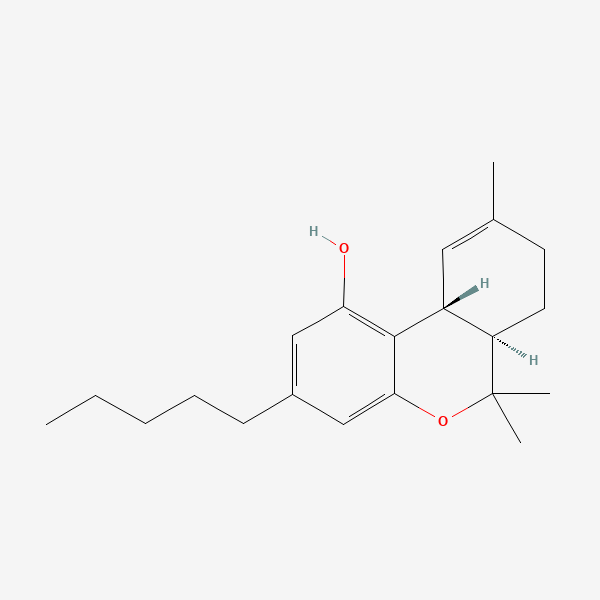
Cannabinoids / THC family
THC · Δ9-Tetrahydrocannabinol
The best-known intoxicating cannabinoid, with a ring-closed structure. Cannabinoid-receptor activity; selected prescription uses.
Defined medicine evidence · In the US, prescription dronabinol is approved for selected chemotherapy-related nausea and AIDS-related appetite/weight-loss indications.
Where the evidence stops Approval concerns specific medicines. Intoxication, impairment and adverse effects remain relevant; it does not establish benefits for seed foods.
Identity Natural trans-(6aR,10aR) Δ9 configuration. Other THC isomers are not interchangeable.
Formula: C21H30O2 · PubChem CID 16078 ↗
FDA and Cannabis: Research and Drug Approval Process ↗Regulator · 2026 · Current page checked 5 October 2026. Supports US prescription dronabinol indications; not approval of the plant or seed foods. The page has older CBD age wording, so the current product label is used for CBD.PubChem: Δ9-Tetrahydrocannabinol — CID 16078 ↗Chemical identity database · 2026 · CID, molecular formula and IUPAC identity checked through PubChem PUG REST on 5 October 2026. Identity evidence only; it supplies no clinical efficacy conclusion. Natural trans-(6aR,10aR) Δ9 configuration. Other THC isomers are not interchangeable.
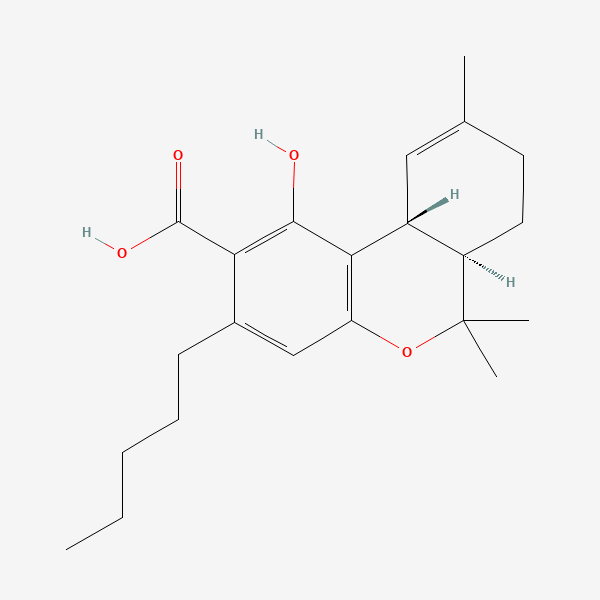
Cannabinoids / THC family
THCA-A · Δ9-Tetrahydrocannabinolic acid A
An acidic precursor that can lose carbon dioxide to form THC. Acidic member of the THC biosynthetic branch.
Animal evidence · A 2017 study found PPARγ-related activity in cells and protection in a toxin-induced mouse model.
Where the evidence stops This is preclinical research, not evidence that THCA treats a human neurodegenerative disease.
Identity Explicit natural trans-THCA-A identity; generic THCA name searches can return a different isomer.
Formula: C22H30O4 · PubChem CID 98523 ↗
Tetrahydrocannabinolic acid is a potent PPARγ agonist with neuroprotective activity ↗Cell and animal study · 2017 · Primary abstract inspected. THCA-A receptor/cell experiments and a toxin-induced mouse model; no clinical treatment result. DOI: 10.1111/bph.14019.PubChem: Δ9-Tetrahydrocannabinolic acid A — CID 98523 ↗Chemical identity database · 2026 · CID, molecular formula and IUPAC identity checked through PubChem PUG REST on 5 October 2026. Identity evidence only; it supplies no clinical efficacy conclusion. Explicit natural trans-THCA-A identity; generic THCA name searches can return a different isomer.
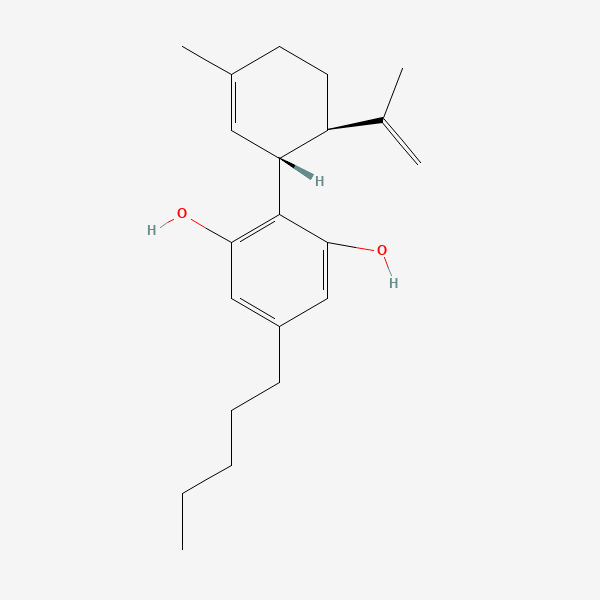
Cannabinoids / CBD family
CBD · Cannabidiol
A cannabinoid whose open-ring arrangement differs from THC. Exact purified formulations have prescription evidence.
Defined medicine evidence · The May 2026 US EPIDIOLEX label covers seizures associated with Dravet syndrome, Lennox–Gastaut syndrome and tuberous sclerosis complex from age one.
Where the evidence stops This exact prescription formulation requires clinical monitoring. Liver injury, sedation and interactions occur; retail CBD and hemp seed oil are not equivalent.
Identity Natural (1R,6R) cannabidiol. Formula alone cannot distinguish CBD from THC.
Formula: C21H30O2 · PubChem CID 644019 ↗
EPIDIOLEX prescribing information, revised May 2026 ↗Medicine label · 2026 · Full label available. Exact US prescription formulation, seizure indications, age range, liver monitoring, sedation and interactions; not an endorsement of other CBD products.Trial of Cannabidiol for Drug-Resistant Seizures in the Dravet Syndrome ↗Randomized trial · 2017 · Primary abstract inspected. In 120 children and young adults, adjunctive purified CBD reduced convulsive seizure frequency over 14 weeks compared with placebo, with more adverse events and withdrawals. DOI: 10.1056/NEJMoa1611618.PubChem: Cannabidiol — CID 644019 ↗Chemical identity database · 2026 · CID, molecular formula and IUPAC identity checked through PubChem PUG REST on 5 October 2026. Identity evidence only; it supplies no clinical efficacy conclusion. Natural (1R,6R) cannabidiol. Formula alone cannot distinguish CBD from THC.
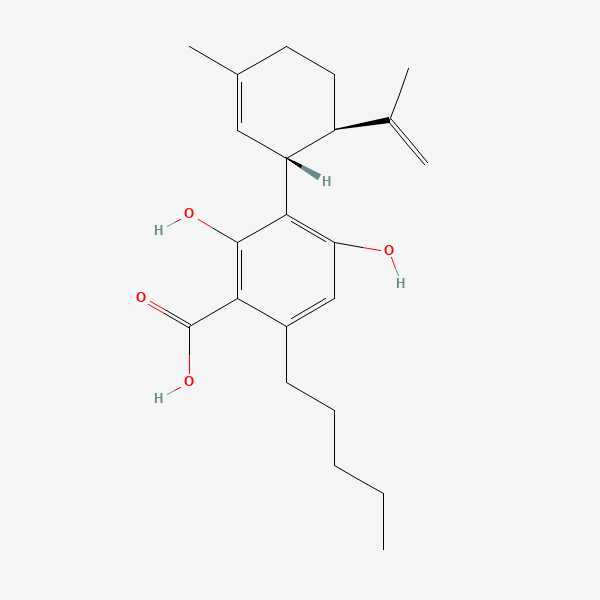
Cannabinoids / CBD family
CBDA · Cannabidiolic acid
The acidic counterpart of CBD found in the plant’s cannabinoid chemistry. Acid precursor to CBD through decarboxylation.
Animal evidence · A 2019 study reported anticonvulsant activity in a mouse model of Dravet syndrome and measured cannabinoid-acid exposure.
Where the evidence stops Mouse exposure and seizure results do not establish an effective or safe human treatment.
Identity Natural (1R,6R) CBDA; carboxylated CBD connectivity.
Formula: C22H30O4 · PubChem CID 160570 ↗
Pharmacokinetics of Phytocannabinoid Acids and Anticonvulsant Effect of Cannabidiolic Acid in a Mouse Model of Dravet Syndrome ↗Animal study · 2019 · Primary abstract inspected. Acid-cannabinoid pharmacokinetics and CBDA anticonvulsant activity in a genetic mouse model. DOI: 10.1021/acs.jnatprod.9b00600.PubChem: Cannabidiolic acid — CID 160570 ↗Chemical identity database · 2026 · CID, molecular formula and IUPAC identity checked through PubChem PUG REST on 5 October 2026. Identity evidence only; it supplies no clinical efficacy conclusion. Natural (1R,6R) CBDA; carboxylated CBD connectivity.
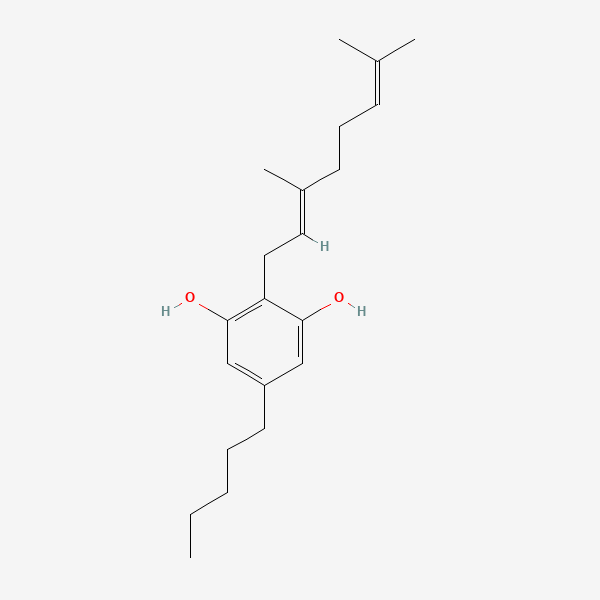
Cannabinoids / CBG family
CBG · Cannabigerol
A cannabinoid with a flexible geranyl side chain. Neutral counterpart of the biosynthetic precursor CBGA.
Human study · A 2026 single-dose study in 12 healthy adults measured oral CBG exposure and tolerability; robust pharmacodynamic effects were not observed.
Where the evidence stops A small acute study cannot establish disease benefit, long-term safety or safety in other populations.
Identity The registry specifies the E geranyl-chain configuration.
Formula: C21H32O2 · PubChem CID 5315659 ↗
Safety, pharmacodynamics, and pharmacokinetics of oral cannabigerol in healthy adults ↗Human study · 2026 · Primary indexed abstract inspected. Single ascending-dose study in 12 healthy adults; tolerability and exposure, not disease-treatment efficacy. DOI: 10.1016/j.jpet.2026.104984.PubChem: Cannabigerol — CID 5315659 ↗Chemical identity database · 2026 · CID, molecular formula and IUPAC identity checked through PubChem PUG REST on 5 October 2026. Identity evidence only; it supplies no clinical efficacy conclusion. The registry specifies the E geranyl-chain configuration.
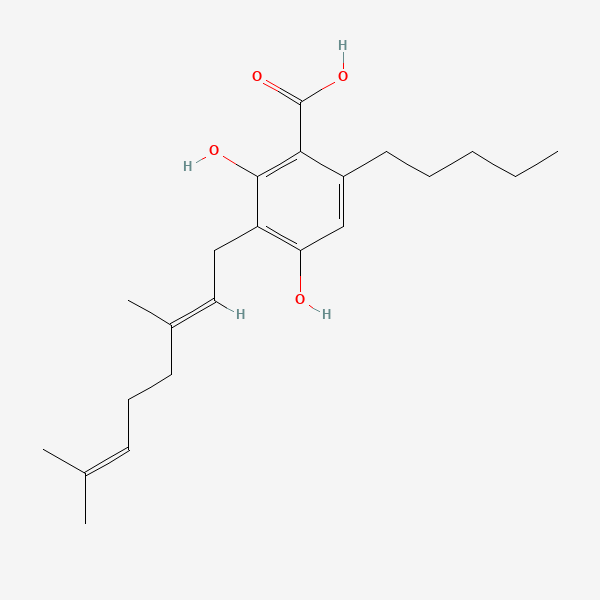
Cannabinoids / CBG family
CBGA · Cannabigerolic acid
A branch-point precursor in the production of several cannabinoid acids. Biosynthetic precursor; acid counterpart of CBG.
Animal evidence · In 2021 mouse experiments, CBGA protected in some seizure tests but worsened seizures in other models or conditions.
Where the evidence stops The conflicting effects rule out a simple anticonvulsant claim. Human benefit is not established here.
Identity E geranyl-chain acid; distinct from neutral CBG.
Formula: C22H32O4 · PubChem CID 6449999 ↗
Cannabigerolic acid, a major biosynthetic precursor molecule in cannabis, exhibits divergent effects on seizures in mouse models of epilepsy ↗Animal study · 2021 · Primary abstract inspected. CBGA, CBDVA and CBGVA raised thermal seizure thresholds; CBGA also worsened seizures in other models or conditions. DOI: 10.1111/bph.15661.PubChem: Cannabigerolic acid — CID 6449999 ↗Chemical identity database · 2026 · CID, molecular formula and IUPAC identity checked through PubChem PUG REST on 5 October 2026. Identity evidence only; it supplies no clinical efficacy conclusion. E geranyl-chain acid; distinct from neutral CBG.
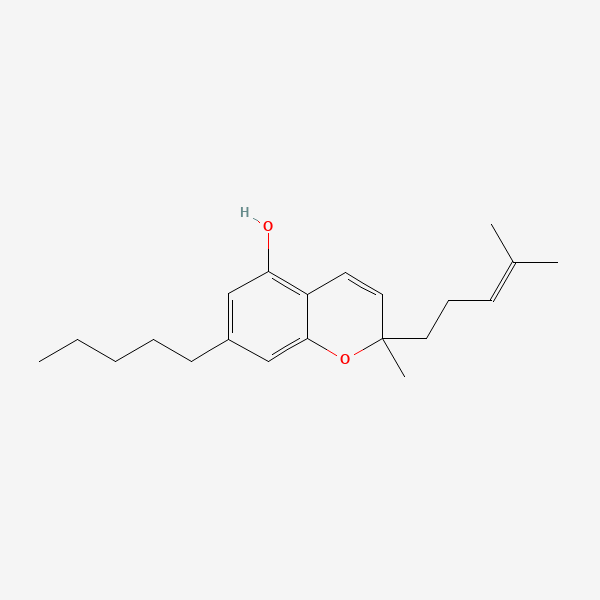
Cannabinoids / CBC family
CBC · Cannabichromene
A chromene-ring cannabinoid related to the acid CBCA. Neutral member of the CBC branch.
Animal evidence · CBC raised the thermal seizure threshold in a 2021 mouse model of Dravet syndrome.
Where the evidence stops This assay does not establish an epilepsy treatment for people or settle other proposed uses.
Identity This PubChem record leaves the stereocentre unspecified; it is not a claim about one natural enantiomer.
Formula: C21H30O2 · PubChem CID 30219 ↗
Cannabichromene, Related Phytocannabinoids, and 5-Fluoro-cannabichromene Have Anticonvulsant Properties in a Mouse Model of Dravet Syndrome ↗Animal study · 2021 · Primary abstract inspected. CBC, CBCA and CBCVA showed activity in a thermal seizure assay; CBCV did not. These are mouse findings. DOI: 10.1021/acschemneuro.0c00677.PubChem: Cannabichromene — CID 30219 ↗Chemical identity database · 2026 · CID, molecular formula and IUPAC identity checked through PubChem PUG REST on 5 October 2026. Identity evidence only; it supplies no clinical efficacy conclusion. This PubChem record leaves the stereocentre unspecified; it is not a claim about one natural enantiomer.
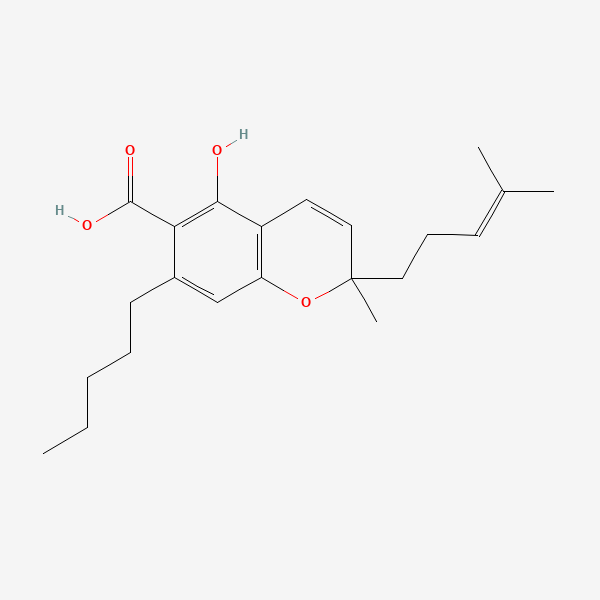
Cannabinoids / CBC family
CBCA · Cannabichromenic acid
The carboxylated member of the cannabichromene branch. Acid precursor to CBC.
Animal evidence · CBCA showed activity in the thermal seizure assay reported in the 2021 CBC-family mouse study.
Where the evidence stops The result is preclinical and does not establish human therapeutic efficacy.
Identity Registry connectivity has unspecified stereochemistry.
Formula: C22H30O4 · PubChem CID 3084339 ↗
Cannabichromene, Related Phytocannabinoids, and 5-Fluoro-cannabichromene Have Anticonvulsant Properties in a Mouse Model of Dravet Syndrome ↗Animal study · 2021 · Primary abstract inspected. CBC, CBCA and CBCVA showed activity in a thermal seizure assay; CBCV did not. These are mouse findings. DOI: 10.1021/acschemneuro.0c00677.PubChem: Cannabichromenic acid — CID 3084339 ↗Chemical identity database · 2026 · CID, molecular formula and IUPAC identity checked through PubChem PUG REST on 5 October 2026. Identity evidence only; it supplies no clinical efficacy conclusion. Registry connectivity has unspecified stereochemistry.
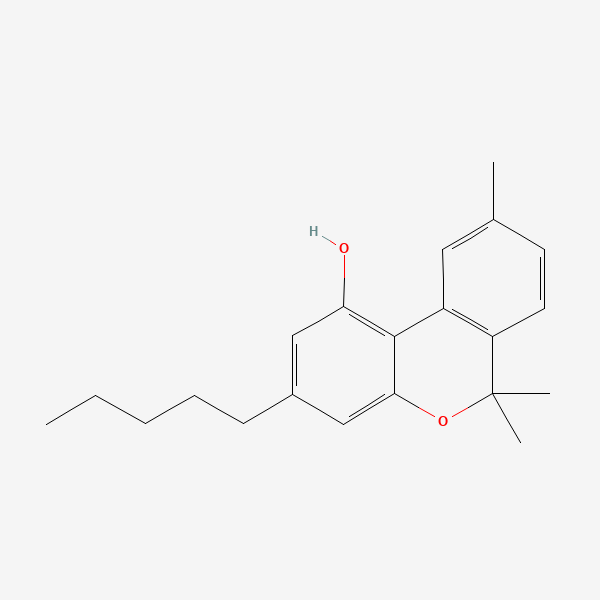
Cannabinoids / Oxidative & rearranged
CBN · Cannabinol
An aromatic cannabinoid often associated with changes during cannabis storage. Oxidative cannabinoid chemistry; sleep research.
Human study · In a 2026 crossover trial with 20 adults with insomnia, neither tested CBN dose significantly improved the primary wake-after-sleep-onset outcome.
Where the evidence stops Single-night findings do not show established insomnia efficacy; secondary findings cannot overturn the null primary result.
Identity A more aromatic ring system than THC; the formula differs accordingly.
Formula: C21H26O2 · PubChem CID 2543 ↗
Cannabinol for Acute Treatment of Insomnia Disorder in a Randomized Placebo-Controlled Crossover Trial ↗Randomized trial · 2026 · Primary abstract inspected. Twenty adults with insomnia; neither single-night CBN dose significantly improved the primary wake-after-sleep-onset outcome versus placebo.PubChem: Cannabinol — CID 2543 ↗Chemical identity database · 2026 · CID, molecular formula and IUPAC identity checked through PubChem PUG REST on 5 October 2026. Identity evidence only; it supplies no clinical efficacy conclusion. A more aromatic ring system than THC; the formula differs accordingly.
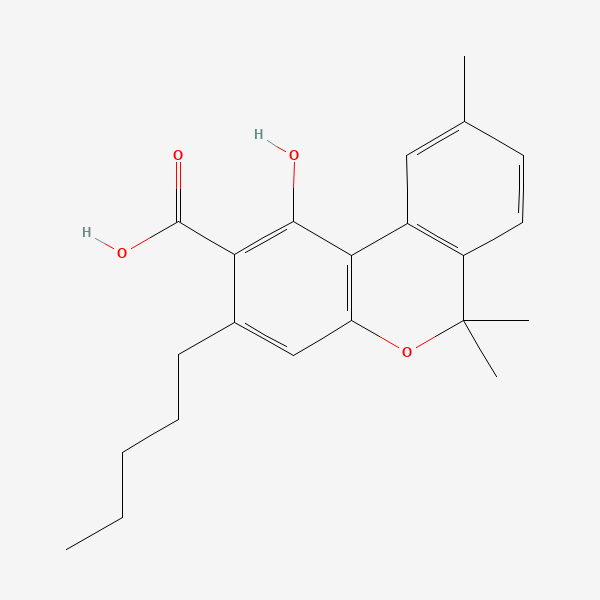
Cannabinoids / Oxidative & rearranged
CBNA · Cannabinolic acid
The carboxylated structural relative of cannabinol. Acidic member of the CBN family.
Chemical identification · The cited PubChem record verifies a distinct molecular identity and formula for CBNA.
Where the evidence stops An identity record supplies no human therapeutic result, dose or safety conclusion.
Identity Cannabinolic acid connectivity; not the same molecule as CBN.
Formula: C22H26O4 · PubChem CID 3081990 ↗
PubChem: Cannabinolic acid — CID 3081990 ↗Chemical identity database · 2026 · CID, molecular formula and IUPAC identity checked through PubChem PUG REST on 5 October 2026. Identity evidence only; it supplies no clinical efficacy conclusion. Cannabinolic acid connectivity; not the same molecule as CBN.
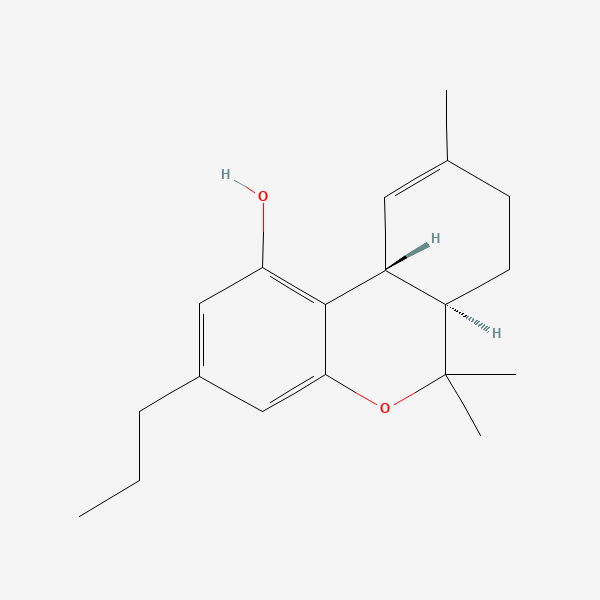
Cannabinoids / Varin family
THCV · Δ9-Tetrahydrocannabivarin
A THC relative with a three-carbon rather than five-carbon side chain. Propyl homologue of THC.
Human study · A 2016 diabetes pilot trial found no effect on its primary HDL endpoint; THCV showed exploratory secondary glycaemic signals.
Where the evidence stops The small five-arm trial does not establish a diabetes medicine or support weight-loss promises.
Identity Natural trans-(6aR,10aR) Δ9-THCV configuration.
Formula: C19H26O2 · PubChem CID 93147 ↗
Efficacy and Safety of Cannabidiol and Tetrahydrocannabivarin on Glycemic and Lipid Parameters in Patients With Type 2 Diabetes ↗Randomized pilot trial · 2016 · Primary abstract inspected. Sixty-two participants across five arms, 13 weeks. Primary HDL endpoint unaffected; secondary glycaemic findings remain exploratory. DOI: 10.2337/dc16-0650.PubChem: Δ9-Tetrahydrocannabivarin — CID 93147 ↗Chemical identity database · 2026 · CID, molecular formula and IUPAC identity checked through PubChem PUG REST on 5 October 2026. Identity evidence only; it supplies no clinical efficacy conclusion. Natural trans-(6aR,10aR) Δ9-THCV configuration.
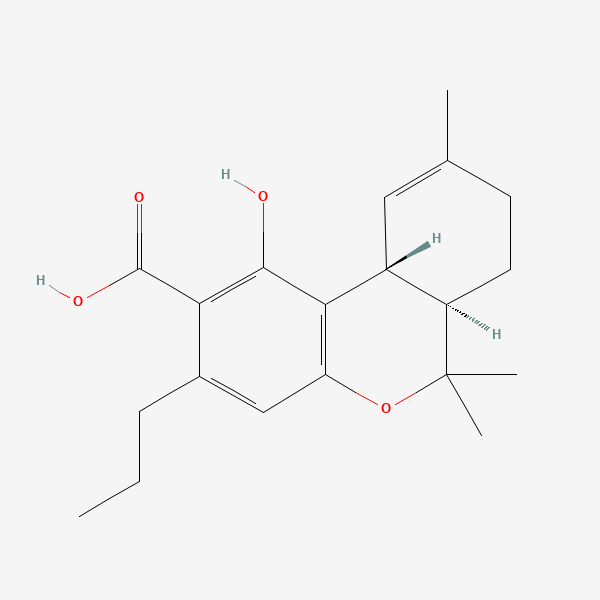
Cannabinoids / Varin family
THCVA · Δ9-Tetrahydrocannabivarinic acid
An acidic, shorter-side-chain relative of THCA. Acid precursor associated with the THCV branch.
Chemical identification · Its verified registry identity separates THCVA from neutral THCV and from the pentyl acid THCA.
Where the evidence stops Structural relatedness does not transfer THCV’s human findings to THCVA.
Identity The registry specifies the natural trans-(6aR,10aR) acid configuration.
Formula: C20H26O4 · PubChem CID 59444416 ↗
PubChem: Δ9-Tetrahydrocannabivarinic acid — CID 59444416 ↗Chemical identity database · 2026 · CID, molecular formula and IUPAC identity checked through PubChem PUG REST on 5 October 2026. Identity evidence only; it supplies no clinical efficacy conclusion. The registry specifies the natural trans-(6aR,10aR) acid configuration.
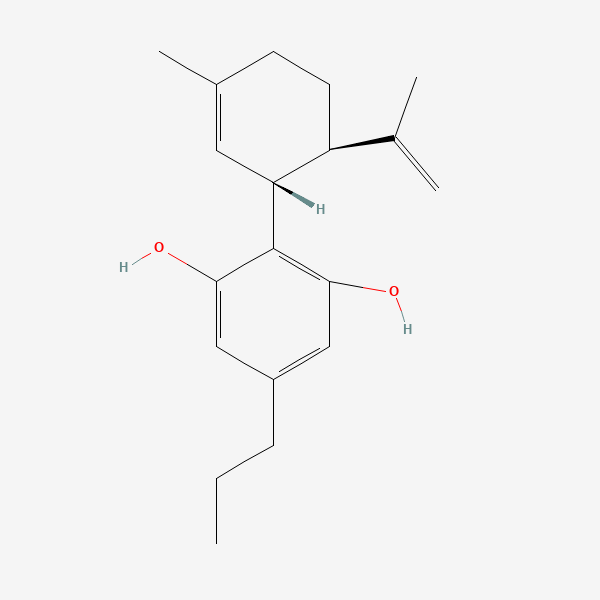
Cannabinoids / Varin family
CBDV · Cannabidivarin
A propyl-side-chain relative of cannabidiol. Neutral member of the CBD varin branch.
Human study · A 2021 randomized trial in 162 people with inadequately controlled focal seizures found no significant seizure-frequency advantage over placebo.
Where the evidence stops The primary trial was negative. CBDV should not inherit CBD medicine claims.
Identity Natural (1R,6R) CBDV; shorter side chain than CBD.
Formula: C19H26O2 · PubChem CID 11601669 ↗
A Phase 2 Randomized Controlled Trial of the Efficacy and Safety of Cannabidivarin as Add-on Therapy in Participants with Inadequately Controlled Focal Seizures ↗Randomized trial · 2021 · Primary abstract inspected. In 162 participants, seizure-frequency reduction did not differ significantly between CBDV and placebo (p = 0.648).PubChem: Cannabidivarin — CID 11601669 ↗Chemical identity database · 2026 · CID, molecular formula and IUPAC identity checked through PubChem PUG REST on 5 October 2026. Identity evidence only; it supplies no clinical efficacy conclusion. Natural (1R,6R) CBDV; shorter side chain than CBD.
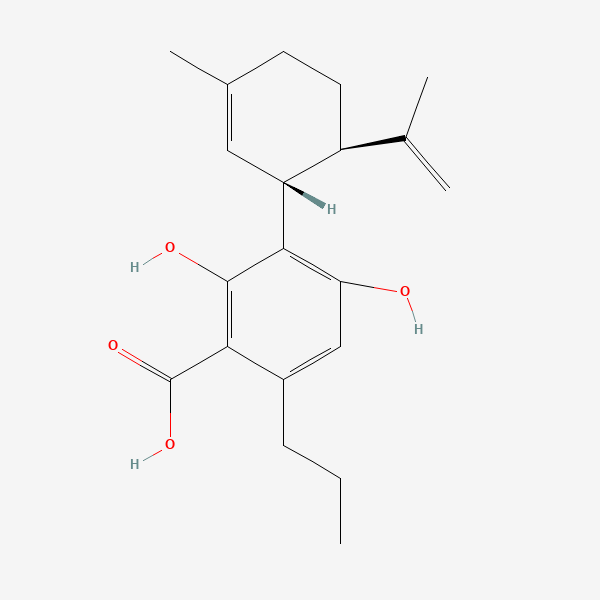
Cannabinoids / Varin family
CBDVA · Cannabidivarinic acid
The acidic counterpart of the shorter-side-chain molecule CBDV. Acid member of the CBD varin branch.
Animal evidence · CBDVA increased the thermal seizure threshold in the 2021 Dravet-model mouse experiments.
Where the evidence stops This does not establish human benefit or reverse the separate negative CBDV trial.
Identity Registry (1R,6R) acid configuration.
Formula: C20H26O4 · PubChem CID 59444387 ↗
Cannabigerolic acid, a major biosynthetic precursor molecule in cannabis, exhibits divergent effects on seizures in mouse models of epilepsy ↗Animal study · 2021 · Primary abstract inspected. CBGA, CBDVA and CBGVA raised thermal seizure thresholds; CBGA also worsened seizures in other models or conditions. DOI: 10.1111/bph.15661.PubChem: Cannabidivarinic acid — CID 59444387 ↗Chemical identity database · 2026 · CID, molecular formula and IUPAC identity checked through PubChem PUG REST on 5 October 2026. Identity evidence only; it supplies no clinical efficacy conclusion. Registry (1R,6R) acid configuration.
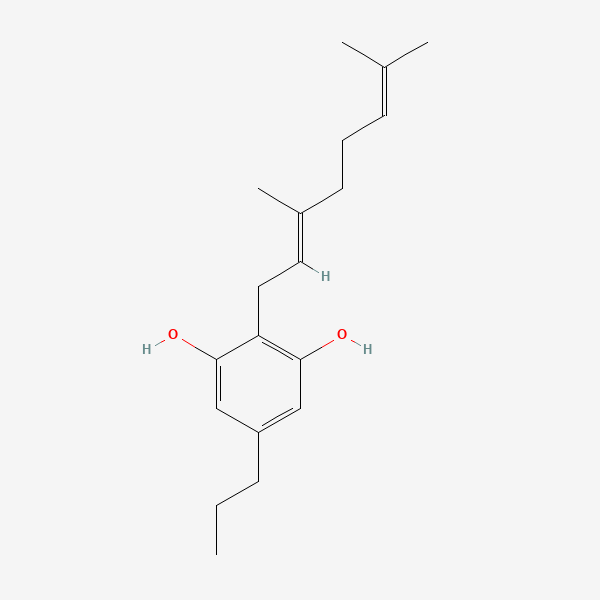
Cannabinoids / Varin family
CBGV · Cannabigerovarin
The propyl homologue of cannabigerol. Shorter-side-chain member of the CBG branch.
Laboratory evidence · Recombinant-cell experiments reported CBGV effects on TRPV3 and TRPV4 channel desensitization.
Where the evidence stops An ion-channel assay is not evidence of a gastrointestinal treatment in people.
Identity E geranyl-chain configuration; propyl aromatic side chain.
Formula: C19H28O2 · PubChem CID 59444407 ↗
Cannabinoid actions at TRPV channels: effects on TRPV3 and TRPV4 and their potential relevance to gastrointestinal inflammation ↗Cell study · 2011 · Primary abstract inspected; online publication 2011. CBGV effects in recombinant ion-channel assays, not a trial of gastrointestinal treatment. DOI: 10.1111/j.1748-1716.2011.02338.x.PubChem: Cannabigerovarin — CID 59444407 ↗Chemical identity database · 2026 · CID, molecular formula and IUPAC identity checked through PubChem PUG REST on 5 October 2026. Identity evidence only; it supplies no clinical efficacy conclusion. E geranyl-chain configuration; propyl aromatic side chain.
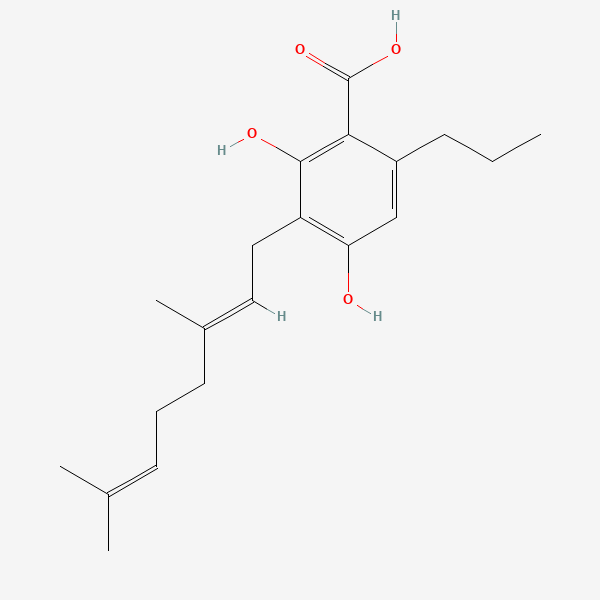
Cannabinoids / Varin family
CBGVA · Cannabigerovarinic acid
An acidic CBG relative with a shorter aromatic side chain. Precursor within varin cannabinoid chemistry.
Animal evidence · CBGVA raised the thermal seizure threshold in the 2021 mouse experiments.
Where the evidence stops The cited animal work does not establish human anticonvulsant efficacy or clinical safety.
Identity Registry E-chain acid; distinct from CBGV and CBGA.
Formula: C20H28O4 · PubChem CID 59444383 ↗
Cannabigerolic acid, a major biosynthetic precursor molecule in cannabis, exhibits divergent effects on seizures in mouse models of epilepsy ↗Animal study · 2021 · Primary abstract inspected. CBGA, CBDVA and CBGVA raised thermal seizure thresholds; CBGA also worsened seizures in other models or conditions. DOI: 10.1111/bph.15661.PubChem: Cannabigerovarinic acid — CID 59444383 ↗Chemical identity database · 2026 · CID, molecular formula and IUPAC identity checked through PubChem PUG REST on 5 October 2026. Identity evidence only; it supplies no clinical efficacy conclusion. Registry E-chain acid; distinct from CBGV and CBGA.
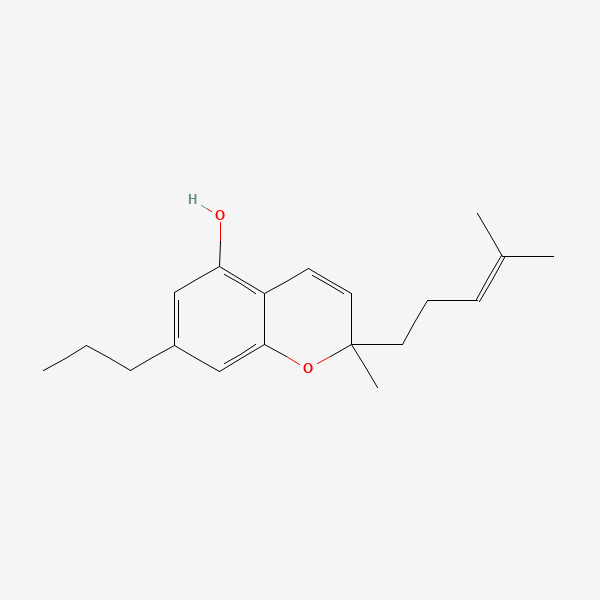
Cannabinoids / Varin family
CBCV · Cannabichromevarin
A shorter-side-chain structural relative of CBC. Propyl homologue in the CBC branch.
Animal evidence · CBCV did not show efficacy in the thermal seizure assay in the 2021 CBC-family mouse study.
Where the evidence stops Positive results for neighbouring molecules should not be assigned to CBCV.
Identity The registry leaves the stereocentre unspecified.
Formula: C19H26O2 · PubChem CID 6451726 ↗
Cannabichromene, Related Phytocannabinoids, and 5-Fluoro-cannabichromene Have Anticonvulsant Properties in a Mouse Model of Dravet Syndrome ↗Animal study · 2021 · Primary abstract inspected. CBC, CBCA and CBCVA showed activity in a thermal seizure assay; CBCV did not. These are mouse findings. DOI: 10.1021/acschemneuro.0c00677.PubChem: Cannabichromevarin — CID 6451726 ↗Chemical identity database · 2026 · CID, molecular formula and IUPAC identity checked through PubChem PUG REST on 5 October 2026. Identity evidence only; it supplies no clinical efficacy conclusion. The registry leaves the stereocentre unspecified.
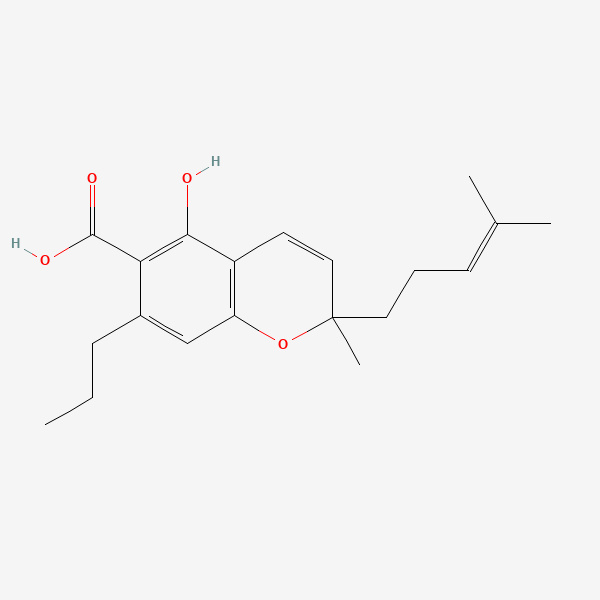
Cannabinoids / Varin family
CBCVA · Cannabichromevarinic acid
The acidic form of the CBC varin branch. Carboxylated relative of CBCV.
Animal evidence · CBCVA increased the thermal seizure threshold in the 2021 mouse study, whereas neutral CBCV did not.
Where the evidence stops A molecule-specific animal finding is not a demonstrated human treatment.
Identity Registry acid connectivity has unspecified stereochemistry.
Formula: C20H26O4 · PubChem CID 11110322 ↗
Cannabichromene, Related Phytocannabinoids, and 5-Fluoro-cannabichromene Have Anticonvulsant Properties in a Mouse Model of Dravet Syndrome ↗Animal study · 2021 · Primary abstract inspected. CBC, CBCA and CBCVA showed activity in a thermal seizure assay; CBCV did not. These are mouse findings. DOI: 10.1021/acschemneuro.0c00677.PubChem: Cannabichromevarinic acid — CID 11110322 ↗Chemical identity database · 2026 · CID, molecular formula and IUPAC identity checked through PubChem PUG REST on 5 October 2026. Identity evidence only; it supplies no clinical efficacy conclusion. Registry acid connectivity has unspecified stereochemistry.
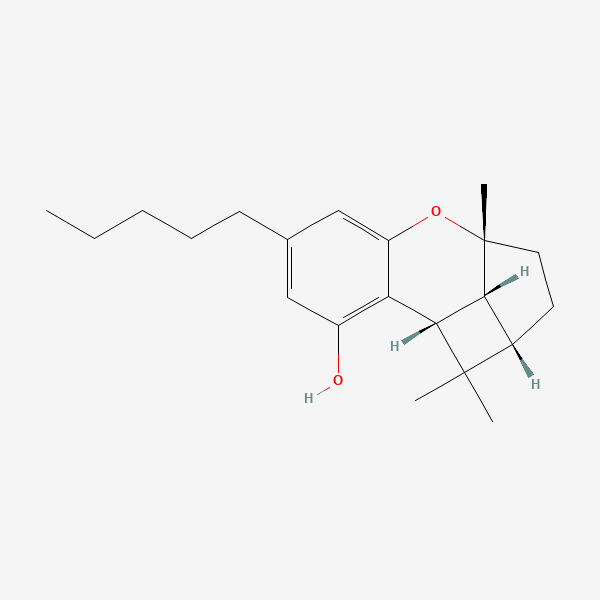
Cannabinoids / Oxidative & rearranged
CBL · Cannabicyclol
A cannabinoid distinguished by a compact, rearranged ring system. Structural example of cannabinoid rearrangement chemistry.
Chemical identification · PubChem records a defined cannabicyclol structure and molecular formula.
Where the evidence stops The cited identity source does not establish therapeutic effects or the proportions of stereoisomers in plant material.
Identity This record specifies (1R,9R,12S,14R); the display represents that configuration, not every CBL stereoisomer.
Formula: C21H30O2 · PubChem CID 59444380 ↗
PubChem: Cannabicyclol — CID 59444380 ↗Chemical identity database · 2026 · CID, molecular formula and IUPAC identity checked through PubChem PUG REST on 5 October 2026. Identity evidence only; it supplies no clinical efficacy conclusion. This record specifies (1R,9R,12S,14R); the display represents that configuration, not every CBL stereoisomer.
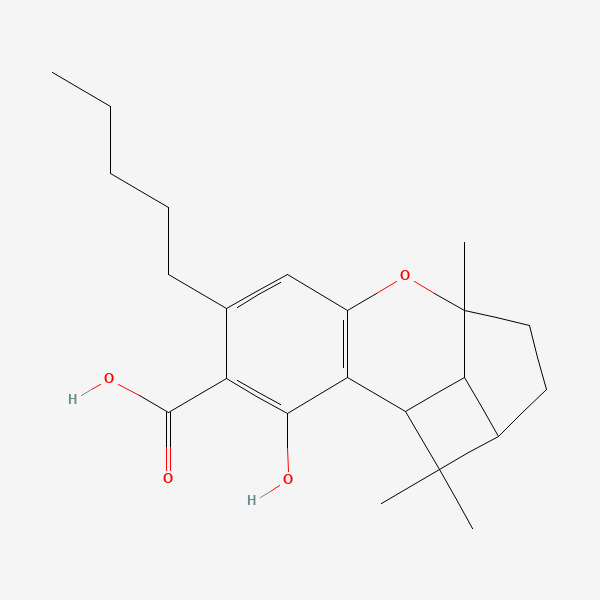
Cannabinoids / Oxidative & rearranged
CBLA · Cannabicyclolic acid
A rearranged cannabinoid acid reported from stored cannabis. Shows how light and storage can change cannabinoid chemistry.
Chemical identification · The 1972 isolation paper also prepared CBLA by ultraviolet irradiation of CBCA.
Where the evidence stops Occurrence after storage does not prove an enzymatic plant pathway or a medical benefit.
Identity The PubChem record leaves stereochemistry unspecified; an acid relative of CBL.
Formula: C22H30O4 · PubChem CID 71437560 ↗
Cannabis. VI. Cannabicyclolic Acid ↗Chemical isolation · 1972 · Primary journal record inspected. Isolated from stored cannabis and prepared from CBCA under ultraviolet irradiation; storage chemistry matters.PubChem: Cannabicyclolic acid — CID 71437560 ↗Chemical identity database · 2026 · CID, molecular formula and IUPAC identity checked through PubChem PUG REST on 5 October 2026. Identity evidence only; it supplies no clinical efficacy conclusion. The PubChem record leaves stereochemistry unspecified; an acid relative of CBL.
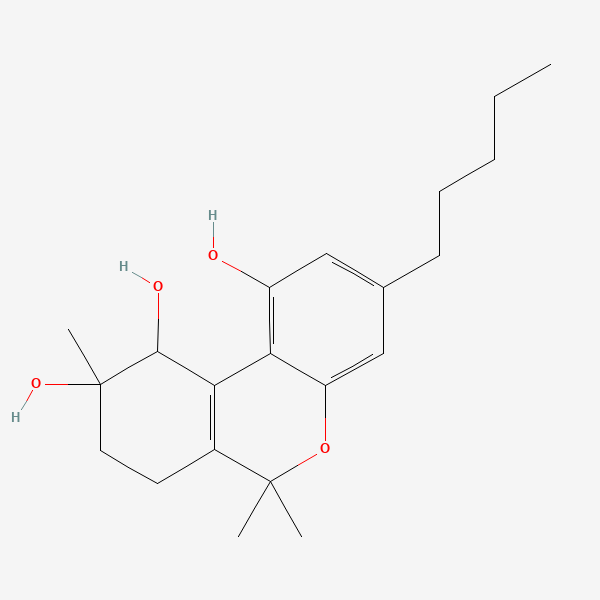
Cannabinoids / Oxidative & rearranged
CBT · Cannabitriol
An oxygenated cannabinoid name that requires careful stereochemical qualification. Historical extract chemistry with several possible stereochemical forms.
Chemical identification · A 1977 paper reported the isolation and characterization of (+)-cannabitriol from a cannabis extract.
Where the evidence stops Only the bibliographic record was accessible. It supplies no clinical finding; CBT can also be confused with cannabicitran abbreviations.
Identity Generic PubChem connectivity has unspecified stereochemistry; it does not establish the exact (+)-isomer from the historical paper.
Formula: C21H30O4 · PubChem CID 11551959 ↗
Isolation and characterization of (+)-cannabitriol and (-)-10-ethoxy-9-hydroxy-delta 6a[10a]-tetrahydrocannabinol: two new cannabinoids from Cannabis sativa L. extract ↗Chemical isolation · 1977 · PubMed bibliographic record only; no abstract available there. Supports the reported isolation of (+)-cannabitriol, not a pharmacological claim or all CBT isomers.PubChem: Cannabitriol — CID 11551959 ↗Chemical identity database · 2026 · CID, molecular formula and IUPAC identity checked through PubChem PUG REST on 5 October 2026. Identity evidence only; it supplies no clinical efficacy conclusion. Generic PubChem connectivity has unspecified stereochemistry; it does not establish the exact (+)-isomer from the historical paper.
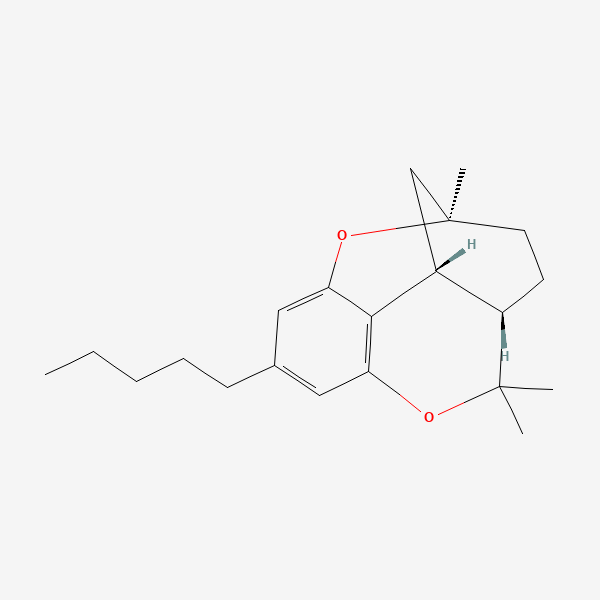
Cannabinoids / Oxidative & rearranged
CBTC · Cannabicitran
A multiring cannabinoid that must not be confused with cannabitriol. Extract chemistry and stereochemical provenance.
Chemical identification · A 2023 study found racemic cannabicitran in a commercial extract and separated its two enantiomers.
Where the evidence stops The origin remains a research question. Chemical identification does not establish clinical benefit.
Identity CID specifies one (1R,4S,13R) enantiomer; it does not depict the study’s racemic mixture.
Formula: C21H30O2 · PubChem CID 101820920 ↗
Cannabicitran: Its unexpected racemic nature and potential origins ↗Stereochemical study · 2023 · Primary abstract inspected. Cannabicitran from a commercial extract was racemic; both enantiomers were separated. Extract occurrence does not establish a single enzymatic origin. DOI: 10.1002/chir.23571.PubChem: Cannabicitran — CID 101820920 ↗Chemical identity database · 2026 · CID, molecular formula and IUPAC identity checked through PubChem PUG REST on 5 October 2026. Identity evidence only; it supplies no clinical efficacy conclusion. CID specifies one (1R,4S,13R) enantiomer; it does not depict the study’s racemic mixture.
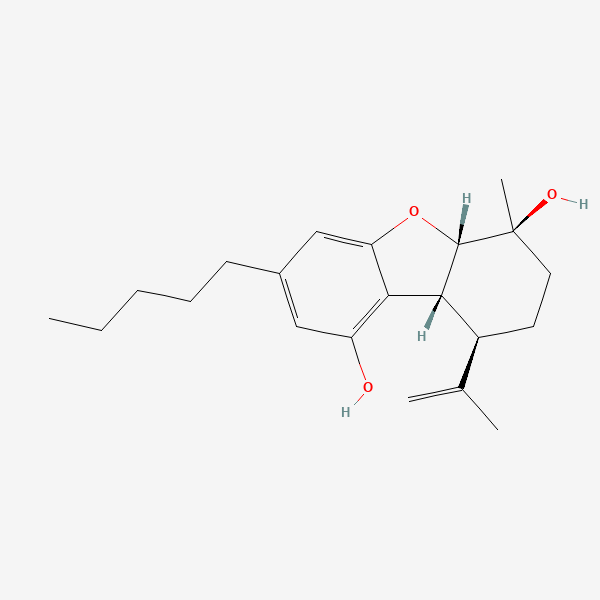
Cannabinoids / Oxidative & rearranged
CBE · Cannabielsoin
An oxygenated molecule studied as a CBD oxidation product. Connects cannabinoid transformation with receptor-signalling research.
Laboratory evidence · In 2024 cell assays, S-CBE activated CB1-linked cAMP signalling without corresponding β-arrestin recruitment under the tested conditions.
Where the evidence stops Biased signalling in a cell assay does not show a safer or effective medicine in humans.
Identity CID specifies (5aS,6S,9R,9aR); other CBE configurations are not represented.
Formula: C21H30O3 · PubChem CID 162113 ↗
Cannabielsoin (CBE), a CBD Oxidation Product, Is a Biased CB1 Agonist ↗Cell study · 2024 · Primary abstract inspected. S-CBE activated cAMP signalling but not β-arrestin recruitment under the tested cell-assay conditions; no clinical trial.PubChem: Cannabielsoin — CID 162113 ↗Chemical identity database · 2026 · CID, molecular formula and IUPAC identity checked through PubChem PUG REST on 5 October 2026. Identity evidence only; it supplies no clinical efficacy conclusion. CID specifies (5aS,6S,9R,9aR); other CBE configurations are not represented.
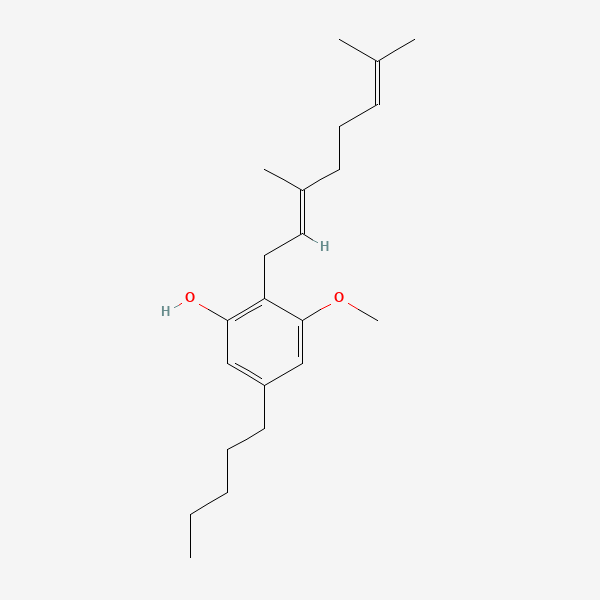
Cannabinoids / CBG family
CBGM · Cannabigerol monomethyl ether
A methyl-ether relative of cannabigerol. Example of naturally reported cannabinoid functional-group variation.
Chemical identification · A 1968 primary paper described CBGM as an isolated component of hemp.
Where the evidence stops Historical isolation supplies chemical evidence, not an established human treatment or safety profile.
Identity One phenolic oxygen is methylated; the registry specifies an E side-chain configuration.
Formula: C22H34O2 · PubChem CID 13864080 ↗
Cannabigerol Monomethyl Ether, a New Component of Hemp ↗Chemical isolation · 1968 · Primary journal record inspected. Historical identity/isolation, not clinical efficacy. Chemical and Pharmaceutical Bulletin 16(6), 1164–1165.PubChem: Cannabigerol monomethyl ether — CID 13864080 ↗Chemical identity database · 2026 · CID, molecular formula and IUPAC identity checked through PubChem PUG REST on 5 October 2026. Identity evidence only; it supplies no clinical efficacy conclusion. One phenolic oxygen is methylated; the registry specifies an E side-chain configuration.
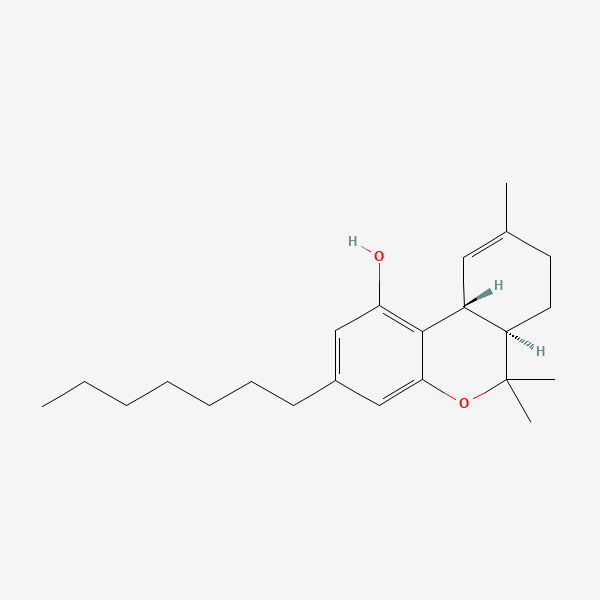
Cannabinoids / Side-chain homologues
THCP · Δ9-Tetrahydrocannabiphorol
A THC homologue with a seven-carbon side chain. Heptyl cannabinoid studied in binding assays and mice.
Animal evidence · The 2019 isolation study reported high CB1 binding affinity and cannabimimetic effects in mice.
Where the evidence stops Receptor affinity is not a human potency multiplier. Human therapeutic efficacy and safety were not established.
Identity Natural trans-(6aR,10aR) Δ9-THCP configuration.
Formula: C23H34O2 · PubChem CID 6453074 ↗
A novel phytocannabinoid isolated from Cannabis sativa L. with an in vivo cannabimimetic activity higher than Δ9-tetrahydrocannabinol: Δ9-Tetrahydrocannabiphorol ↗Isolation and animal study · 2019 · Primary abstract and article excerpts inspected. THCP/CBDP identity and acidic precursor fractions; THCP receptor binding and mouse behaviour. Binding affinity is not a human potency multiplier. DOI: 10.1038/s41598-019-56785-1.PubChem: Δ9-Tetrahydrocannabiphorol — CID 6453074 ↗Chemical identity database · 2026 · CID, molecular formula and IUPAC identity checked through PubChem PUG REST on 5 October 2026. Identity evidence only; it supplies no clinical efficacy conclusion. Natural trans-(6aR,10aR) Δ9-THCP configuration.
Cannabinoids / Side-chain homologues
THCPA · Δ9-Tetrahydrocannabiphorolic acid
The acidic member of the seven-carbon THC homologue branch. Acidic precursor fraction linked to THCP.
Chemical identification · The 2019 study described an acidic THCPA fraction used to obtain THCP by decarboxylation.
Where the evidence stops The precursor observation is chemical evidence, not evidence of clinical activity.
Identity Structure review 15 October 2026: no exact PubChem CID was returned for the acid name or THCPA / THCP-A aliases. The paper describes an acidic fraction; no coordinate model is substituted from neutral THCP or its acetate.
Formula: Not verified here · No exact structure mapped in this edition.
A novel phytocannabinoid isolated from Cannabis sativa L. with an in vivo cannabimimetic activity higher than Δ9-tetrahydrocannabinol: Δ9-Tetrahydrocannabiphorol ↗Isolation and animal study · 2019 · Primary abstract and article excerpts inspected. THCP/CBDP identity and acidic precursor fractions; THCP receptor binding and mouse behaviour. Binding affinity is not a human potency multiplier. DOI: 10.1038/s41598-019-56785-1.
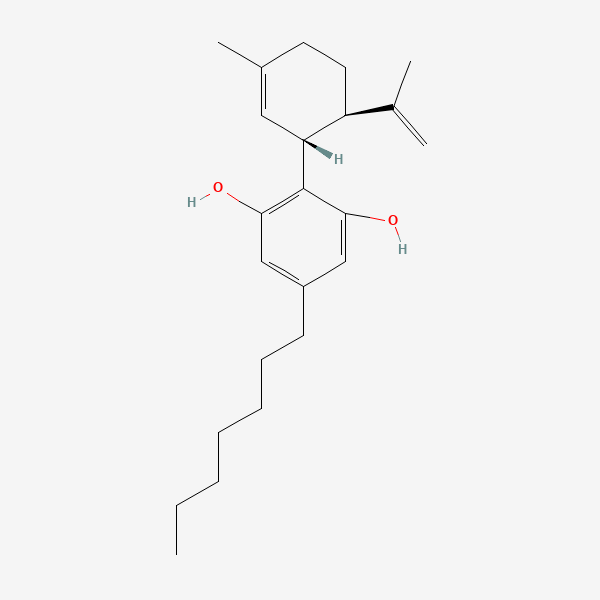
Cannabinoids / Side-chain homologues
CBDP · Cannabidiphorol
A seven-carbon-side-chain relative of CBD identified in cannabis. Heptyl CBD homologue; receptor-modulation research.
Animal evidence · A 2026 study proposed dual-site CB1 negative allosteric modulation using cell assays, modelling and male-mouse experiments.
Where the evidence stops The proposed mechanism and modest mouse signals are preclinical, not proof of clinical benefit or safer THC use.
Identity Natural (1R,6R) CBDP; not the mirror-image synthetic ent-CBDP.
Formula: C23H34O2 · PubChem CID 49873141 ↗
Cannabidiphorol (CBDP) acts as a negative allosteric modulator at two distinct sites of cannabinoid receptor 1 ↗Cell and animal study · 2026 · Primary abstract inspected. Mutagenesis, cellular allosterism assays, modelling and male-mouse experiments; possible dual-site modulation remains preclinical. DOI: 10.1038/s42004-026-01990-z.A novel phytocannabinoid isolated from Cannabis sativa L. with an in vivo cannabimimetic activity higher than Δ9-tetrahydrocannabinol: Δ9-Tetrahydrocannabiphorol ↗Isolation and animal study · 2019 · Primary abstract and article excerpts inspected. THCP/CBDP identity and acidic precursor fractions; THCP receptor binding and mouse behaviour. Binding affinity is not a human potency multiplier. DOI: 10.1038/s41598-019-56785-1.PubChem: Cannabidiphorol — CID 49873141 ↗Chemical identity database · 2026 · CID, molecular formula and IUPAC identity checked through PubChem PUG REST on 5 October 2026. Identity evidence only; it supplies no clinical efficacy conclusion. Natural (1R,6R) CBDP; not the mirror-image synthetic ent-CBDP.
Cannabinoids / Side-chain homologues
CBDPA · Cannabidiphorolic acid
An acidic relative of the seven-carbon cannabinoid CBDP. Acidic precursor fraction linked to CBDP.
Chemical identification · The 2019 study described the corresponding acidic CBDPA fraction before decarboxylation to CBDP.
Where the evidence stops This does not establish pharmacological equivalence with CBDP or CBD, or clinical benefit.
Identity Structure review 15 October 2026: no exact PubChem CID was returned for the acid name or CBDPA / CBDP-A aliases. The acidic fraction described in the paper is not replaced by a CBDP coordinate model.
Formula: Not verified here · No exact structure mapped in this edition.
A novel phytocannabinoid isolated from Cannabis sativa L. with an in vivo cannabimimetic activity higher than Δ9-tetrahydrocannabinol: Δ9-Tetrahydrocannabiphorol ↗Isolation and animal study · 2019 · Primary abstract and article excerpts inspected. THCP/CBDP identity and acidic precursor fractions; THCP receptor binding and mouse behaviour. Binding affinity is not a human potency multiplier. DOI: 10.1038/s41598-019-56785-1.
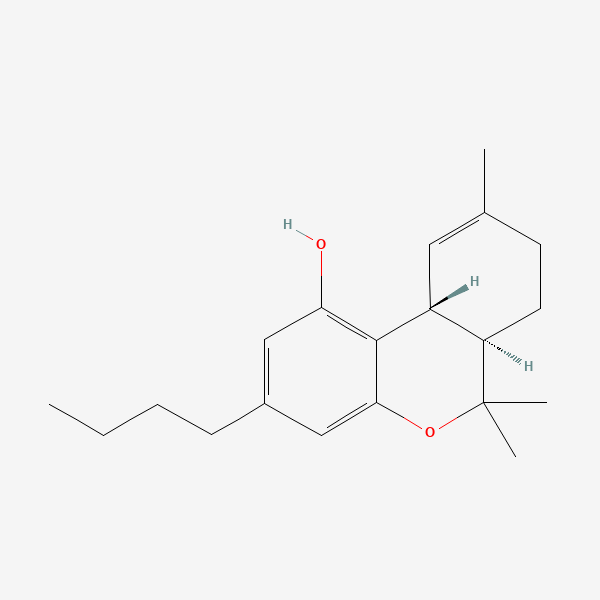
Cannabinoids / Side-chain homologues
THCB · Δ9-Tetrahydrocannabutol
A four-carbon-side-chain homologue of THC. Butyl cannabinoid isolated from medicinal cannabis.
Laboratory evidence · The 2020 isolation study characterized THCB and reported affinity for the human CB1 receptor in laboratory assays.
Where the evidence stops A human receptor in an assay is not a human clinical trial; efficacy and safe use are not established here.
Identity PubChem CID 6453891 specifies trans-(6aR,10aR) Δ9-THCB. Checked 15 October 2026; the stereochemically unspecified CID 21719145 is not substituted. The 3D view is a computed conformer, not a measured biological pose.
Formula: C20H28O2 · PubChem CID 6453891 ↗
Isolation of a High-Affinity Cannabinoid for the Human CB1 Receptor from a Medicinal Cannabis sativa Variety: Δ9-Tetrahydrocannabutol, the Butyl Homologue of Δ9-Tetrahydrocannabinol ↗Isolation and receptor study · 2020 · Primary publication metadata and abstract inspected. Butyl homologues THCB and CBDB from medicinal cannabis; receptor binding is not a human treatment result.PubChem: Δ9-Tetrahydrocannabutol — CID 6453891 ↗Chemical identity database · 2026 · CID, molecular formula and IUPAC identity checked through PubChem PUG REST on 5 October 2026. Identity evidence only; it supplies no clinical efficacy conclusion. PubChem CID 6453891 specifies trans-(6aR,10aR) Δ9-THCB. Checked 15 October 2026; the stereochemically unspecified CID 21719145 is not substituted. The 3D view is a computed conformer, not a measured biological pose.
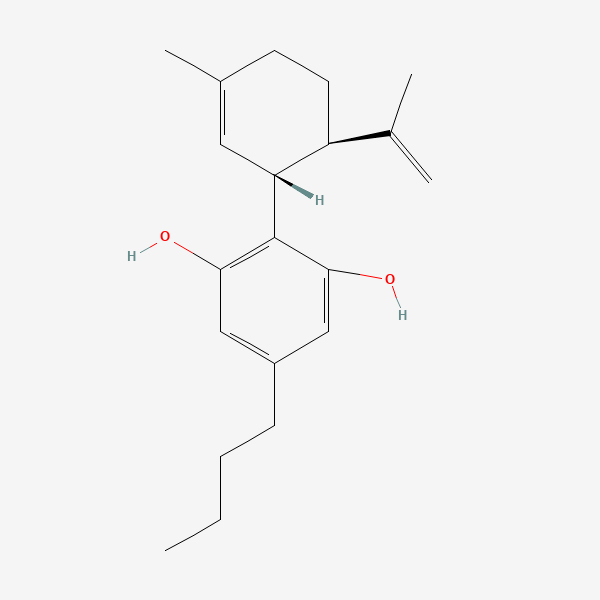
Cannabinoids / Side-chain homologues
CBDB · Cannabidibutol
A four-carbon-side-chain relative of CBD. Butyl homologue in the CBD series.
Chemical identification · The 2020 butyl-homologue work identified CBDB alongside THCB in medicinal cannabis.
Where the evidence stops Identification does not transfer CBD’s prescription evidence to this different molecule.
Identity Registry (1R,6R) configuration with a butyl aromatic side chain.
Formula: C20H28O2 · PubChem CID 59444413 ↗
Isolation of a High-Affinity Cannabinoid for the Human CB1 Receptor from a Medicinal Cannabis sativa Variety: Δ9-Tetrahydrocannabutol, the Butyl Homologue of Δ9-Tetrahydrocannabinol ↗Isolation and receptor study · 2020 · Primary publication metadata and abstract inspected. Butyl homologues THCB and CBDB from medicinal cannabis; receptor binding is not a human treatment result.PubChem: Cannabidibutol — CID 59444413 ↗Chemical identity database · 2026 · CID, molecular formula and IUPAC identity checked through PubChem PUG REST on 5 October 2026. Identity evidence only; it supplies no clinical efficacy conclusion. Registry (1R,6R) configuration with a butyl aromatic side chain.
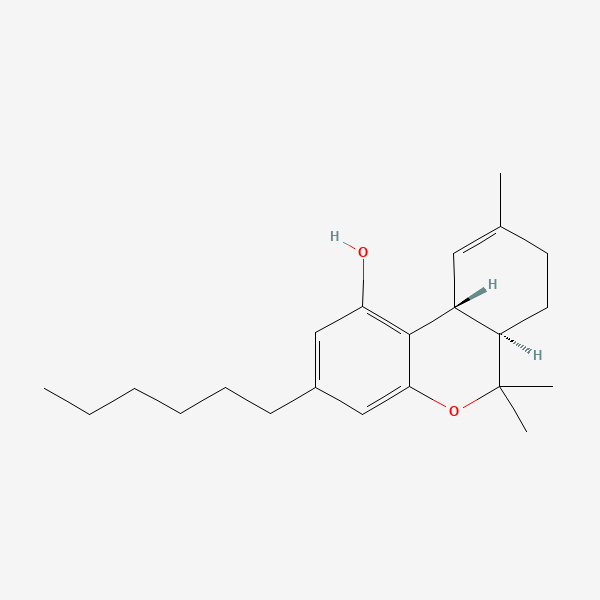
Cannabinoids / Side-chain homologues
THCH · Δ9-Tetrahydrocannabihexol
A six-carbon-side-chain THC homologue. Hexyl homologue investigated through analytical identification.
Chemical identification · The 2020 hexyl-homologue paper identified THCH using analytical comparison with a synthesized reference compound.
Where the evidence stops CBDH’s mouse antinociception result must not be assigned to THCH; clinical efficacy is not shown.
Identity PubChem CID 161906 specifies trans-(6aR,10aR) n-hexyl-Δ9-THC. Checked 15 October 2026; do not confuse this Δ9-THCH identity with parahexyl double-bond isomers. The 3D coordinates are a computed conformer.
Formula: C22H32O2 · PubChem CID 161906 ↗
Identification of a new cannabidiol n-hexyl homolog in a medicinal cannabis variety with an antinociceptive activity in mice: cannabidihexol ↗Analytical and animal study · 2020 · Primary abstract and article excerpts inspected. CBDH and THCH identification using synthetic reference compounds; mouse antinociception studied for CBDH. DOI: 10.1038/s41598-020-79042-2.PubChem: Δ9-Tetrahydrocannabihexol — CID 161906 ↗Chemical identity database · 2026 · CID, molecular formula and IUPAC identity checked through PubChem PUG REST on 5 October 2026. Identity evidence only; it supplies no clinical efficacy conclusion. PubChem CID 161906 specifies trans-(6aR,10aR) n-hexyl-Δ9-THC. Checked 15 October 2026; do not confuse this Δ9-THCH identity with parahexyl double-bond isomers. The 3D coordinates are a computed conformer.
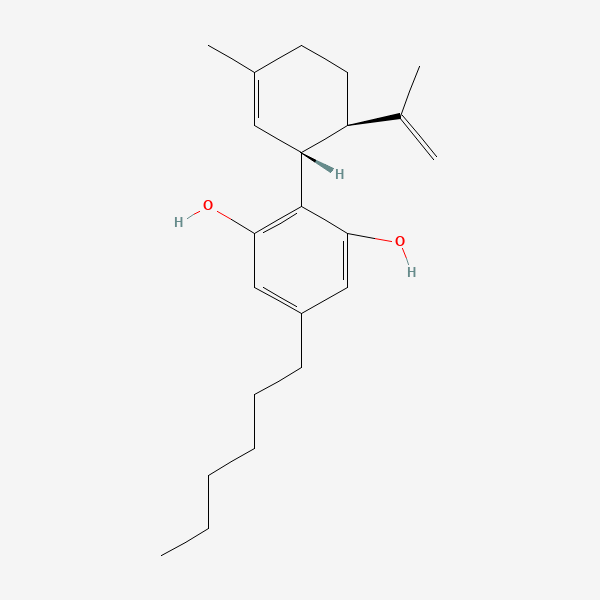
Cannabinoids / Side-chain homologues
CBDH · Cannabidihexol
A six-carbon-side-chain relative of CBD. Hexyl homologue joining the pentyl and heptyl series.
Animal evidence · The 2020 identification study reported antinociceptive activity of CBDH in mice.
Where the evidence stops An animal pain-response experiment does not establish pain relief or safety in humans.
Identity Registry natural (1R,6R) CBDH configuration.
Formula: C22H32O2 · PubChem CID 140883953 ↗
Identification of a new cannabidiol n-hexyl homolog in a medicinal cannabis variety with an antinociceptive activity in mice: cannabidihexol ↗Analytical and animal study · 2020 · Primary abstract and article excerpts inspected. CBDH and THCH identification using synthetic reference compounds; mouse antinociception studied for CBDH. DOI: 10.1038/s41598-020-79042-2.PubChem: Cannabidihexol — CID 140883953 ↗Chemical identity database · 2026 · CID, molecular formula and IUPAC identity checked through PubChem PUG REST on 5 October 2026. Identity evidence only; it supplies no clinical efficacy conclusion. Registry natural (1R,6R) CBDH configuration.
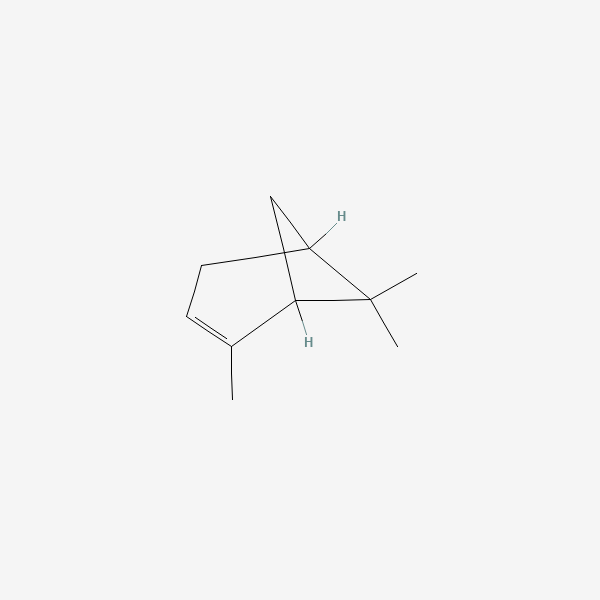
Terpenes & terpenoids / Monoterpene hydrocarbon
α-Pinene
Two joined rings give this ten-carbon molecule a compact shape. The α name places its double bond inside the larger ring. A volatile constituent in studied cannabis flower profiles.
Laboratory evidence · Measured in Finola flowers; Cannabis enzymes also produced it. A separate cell assay found no THC-response enhancement.
Where the evidence stops A detected molecule is not a demonstrated treatment. Amounts depend on the plant, tissue and handling; no Mount Herbs batch was tested in these studies.
Identity The PubChem entry leaves some stereochemistry unspecified. A rendered shape must not imply a measured enantiomer ratio.
Formula: C10H16 · PubChem CID 6654 ↗
Terpene synthases from Cannabis sativa ↗original biosynthesis and analytical study · 2017 · Full text: Finola flower profiles and recombinant Cannabis enzymes; Table 1 and Figures 4–5. Enzyme products are not proof of abundance in every plant.Absence of Entourage: Terpenoids Commonly Found in Cannabis sativa Do Not Modulate the Functional Activity of Δ9-THC at Human CB1 and CB2 Receptors ↗original cell study · 2019 · Abstract and methods/results inspected: six terpenoids did not modify THC responses in the tested potassium-channel assay. This does not test every molecular target or clinical combination.PubChem: α-Pinene (CID 6654) ↗chemical identity database · · CID, formula and IUPAC identity checked against PubChem PUG REST on 5 October 2026. Identity does not establish detection in cannabis, clinical benefit or a batch composition.
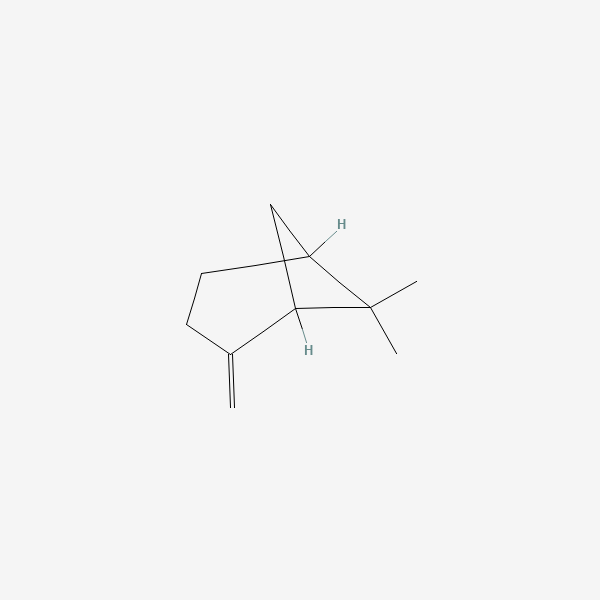
Terpenes & terpenoids / Monoterpene hydrocarbon
β-Pinene
β-Pinene has the same formula as α-pinene, with the double bond moved outside the ring. A volatile constituent and a useful comparison in isomer studies.
Animal evidence · Measured in Finola. Isolated β-pinene changed mouse behavior; another receptor assay found no THC-response enhancement.
Where the evidence stops Mouse injections and cell assays are different experiments. Neither establishes clinical benefit from smelling or consuming a β-pinene-rich product.
Identity The PubChem entry leaves some stereochemistry unspecified. A rendered shape must not imply a measured enantiomer ratio.
Formula: C10H16 · PubChem CID 14896 ↗
Terpene synthases from Cannabis sativa ↗original biosynthesis and analytical study · 2017 · Full text: Finola flower profiles and recombinant Cannabis enzymes; Table 1 and Figures 4–5. Enzyme products are not proof of abundance in every plant.Cannabis sativa terpenes are cannabimimetic and selectively enhance cannabinoid activity ↗original cell and animal study · 2021 · Original mouse and cell experiments using isolated compounds and the synthetic agonist WIN55,212-2; no patient efficacy trial.Absence of Entourage: Terpenoids Commonly Found in Cannabis sativa Do Not Modulate the Functional Activity of Δ9-THC at Human CB1 and CB2 Receptors ↗original cell study · 2019 · Abstract and methods/results inspected: six terpenoids did not modify THC responses in the tested potassium-channel assay. This does not test every molecular target or clinical combination.PubChem: β-Pinene (CID 14896) ↗chemical identity database · · CID, formula and IUPAC identity checked against PubChem PUG REST on 5 October 2026. Identity does not establish detection in cannabis, clinical benefit or a batch composition.

Terpenes & terpenoids / Monoterpene hydrocarbon
β-Myrcene
Myrcene has an open chain and three double bonds, rather than the ringed framework of pinene. A frequent analytical marker in cannabis volatile profiles.
Laboratory evidence · Measured in Finola; two characterized Cannabis enzymes produced myrcene. The cited receptor assay found no THC-response enhancement.
Where the evidence stops A high myrcene percentage does not establish sedation or predict an individual response. The cell result is limited to its tested signaling system.
Identity This acyclic structure has no assigned stereocentre.
Formula: C10H16 · PubChem CID 31253 ↗
Terpene synthases from Cannabis sativa ↗original biosynthesis and analytical study · 2017 · Full text: Finola flower profiles and recombinant Cannabis enzymes; Table 1 and Figures 4–5. Enzyme products are not proof of abundance in every plant.Absence of Entourage: Terpenoids Commonly Found in Cannabis sativa Do Not Modulate the Functional Activity of Δ9-THC at Human CB1 and CB2 Receptors ↗original cell study · 2019 · Abstract and methods/results inspected: six terpenoids did not modify THC responses in the tested potassium-channel assay. This does not test every molecular target or clinical combination.PubChem: β-Myrcene (CID 31253) ↗chemical identity database · · CID, formula and IUPAC identity checked against PubChem PUG REST on 5 October 2026. Identity does not establish detection in cannabis, clinical benefit or a batch composition.

Terpenes & terpenoids / Monoterpene hydrocarbon
(S)-(−)-Limonene
This is the S form of limonene. Its mirror image has the same atoms but a different three-dimensional arrangement. A specifically identified product of Cannabis terpene biosynthesis.
Chemical identification · Finola flowers and the characterized CsTPS1FN enzyme contained or produced this enantiomer.
Where the evidence stops A detected molecule is not a demonstrated treatment. Amounts depend on the plant, tissue and handling; no Mount Herbs batch was tested in these studies.
Identity Defined S configuration. Do not substitute the R form used in the human D-limonene experiment.
Formula: C10H16 · PubChem CID 439250 ↗
Terpene synthases from Cannabis sativa ↗original biosynthesis and analytical study · 2017 · Full text: Finola flower profiles and recombinant Cannabis enzymes; Table 1 and Figures 4–5. Enzyme products are not proof of abundance in every plant.PubChem: (S)-(−)-Limonene (CID 439250) ↗chemical identity database · · CID, formula and IUPAC identity checked against PubChem PUG REST on 5 October 2026. Identity does not establish detection in cannabis, clinical benefit or a batch composition.

Terpenes & terpenoids / Monoterpene hydrocarbon
(R)-(+)-Limonene
Also called D-limonene, this is the R mirror image. It should be distinguished from an unqualified limonene assay. A chiral volatile studied both analytically and alongside THC in humans.
Human study · In 20 healthy adults, a double-blind crossover study tested vaporized compounds. In a 12-person subset, 30 mg THC plus 15 mg D-limonene reduced anxious/nervous and paranoid ratings versus THC alone; other measured drug effects were unchanged.
Where the evidence stops This was a small acute exposure study, not anxiety treatment. D-limonene alone did not differ from placebo. Experimental amounts describe the study, not dosing advice or a result for ordinary flower or seed foods.
Identity Defined R configuration; the cited human experiment cannot be transferred to S-limonene.
Formula: C10H16 · PubChem CID 440917 ↗
Comprehensive analysis of chemical and enantiomeric stability of terpenes in Cannabis sativa L. flowers ↗original analytical study · 2024 · Full text: chiral analysis and experimental UV/heat stress. Published online August 2024; journal issue January 2025. Laboratory aging is not a retail shelf-life claim.Vaporized D-limonene selectively mitigates the acute anxiogenic effects of Δ9-tetrahydrocannabinol in healthy adults who intermittently use cannabis ↗original human crossover study · 2024 · Abstract verified through PubMed/Europe PMC: 20 healthy adults; the highest combination was tested in 12. Acute vaporized exposure, not treatment of an anxiety disorder.PubChem: (R)-(+)-Limonene (CID 440917) ↗chemical identity database · · CID, formula and IUPAC identity checked against PubChem PUG REST on 5 October 2026. Identity does not establish detection in cannabis, clinical benefit or a batch composition.
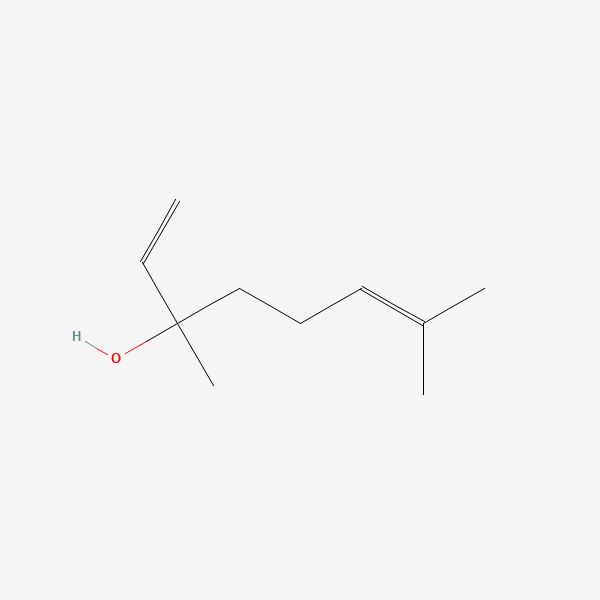
Terpenes & terpenoids / Monoterpenoid alcohol
Linalool
An alcohol group adds oxygen to an open ten-carbon framework. That makes linalool a terpenoid. An oxygenated constituent in measured cannabis profiles.
Animal evidence · Detected in biomass. Isolated linalool produced mouse behavioral effects; a separate cell assay did not enhance THC signaling.
Where the evidence stops Laboratory and injected-mouse exposures do not show that a linalool aroma treats sleep, anxiety or pain in people.
Identity The PubChem entry leaves some stereochemistry unspecified. A rendered shape must not imply a measured enantiomer ratio.
Formula: C10H18O · PubChem CID 6549 ↗
A High-Throughput Method for the Comprehensive Analysis of Terpenes and Terpenoids in Medicinal Cannabis Biomass ↗original analytical study · 2020 · Full text: Table 1 distinguishes standard-confirmed from tentative identities; Table 4 records nondetections. Routine separation does not assign every enantiomer.Cannabis sativa terpenes are cannabimimetic and selectively enhance cannabinoid activity ↗original cell and animal study · 2021 · Original mouse and cell experiments using isolated compounds and the synthetic agonist WIN55,212-2; no patient efficacy trial.Absence of Entourage: Terpenoids Commonly Found in Cannabis sativa Do Not Modulate the Functional Activity of Δ9-THC at Human CB1 and CB2 Receptors ↗original cell study · 2019 · Abstract and methods/results inspected: six terpenoids did not modify THC responses in the tested potassium-channel assay. This does not test every molecular target or clinical combination.PubChem: Linalool (CID 6549) ↗chemical identity database · · CID, formula and IUPAC identity checked against PubChem PUG REST on 5 October 2026. Identity does not establish detection in cannabis, clinical benefit or a batch composition.
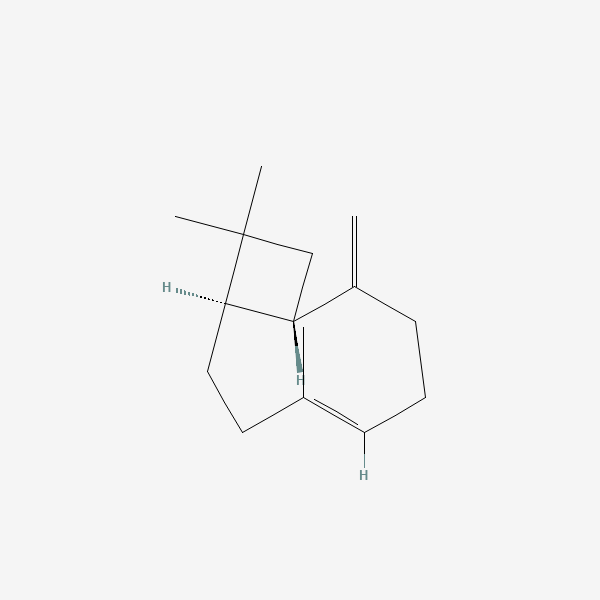
Terpenes & terpenoids / Sesquiterpene hydrocarbon
(E)-β-Caryophyllene
This fifteen-carbon molecule contains a small four-membered ring. Its chemistry belongs to terpenes even though researchers have studied cannabinoid-receptor activity. A cannabis volatile and a receptor-pharmacology research subject.
Animal evidence · Measured in Finola. Gertsch and colleagues reported CB2 activity and reduced inflammation in mice; a later potassium-channel assay gave a different receptor result.
Where the evidence stops Receptor and mouse findings do not establish a human anti-inflammatory treatment. Calling it a dietary cannabinoid describes pharmacology; it does not make it THC.
Identity The reference identity is (1R,4E,9S). Keep it separate from cis-caryophyllene and caryophyllene oxide.
Formula: C15H24 · PubChem CID 5281515 ↗
Terpene synthases from Cannabis sativa ↗original biosynthesis and analytical study · 2017 · Full text: Finola flower profiles and recombinant Cannabis enzymes; Table 1 and Figures 4–5. Enzyme products are not proof of abundance in every plant.Beta-caryophyllene is a dietary cannabinoid ↗original receptor and animal study · 2008 · Receptor experiments and mouse inflammation model, including CB2-deficient mice. The title describes receptor pharmacology, not a THC-like chemical structure.Absence of Entourage: Terpenoids Commonly Found in Cannabis sativa Do Not Modulate the Functional Activity of Δ9-THC at Human CB1 and CB2 Receptors ↗original cell study · 2019 · Abstract and methods/results inspected: six terpenoids did not modify THC responses in the tested potassium-channel assay. This does not test every molecular target or clinical combination.PubChem: (E)-β-Caryophyllene (CID 5281515) ↗chemical identity database · · CID, formula and IUPAC identity checked against PubChem PUG REST on 5 October 2026. Identity does not establish detection in cannabis, clinical benefit or a batch composition.
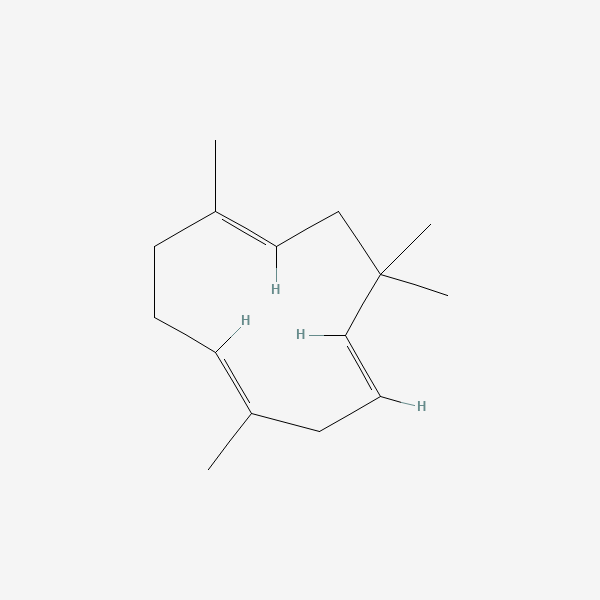
Terpenes & terpenoids / Sesquiterpene hydrocarbon
α-Humulene
A broad carbon ring with three double bonds distinguishes humulene from compact pinene. A sesquiterpene measured in cannabis resin and studied experimentally.
Animal evidence · Measured in Finola. Isolated α-humulene produced cannabinoid-like behavioral changes in mice in the cited experiment.
Where the evidence stops Mouse behavior and combinations with a synthetic agonist do not prove patient benefit or an entourage effect for retail cannabis.
Identity The reference defines the three ring double bonds as E.
Formula: C15H24 · PubChem CID 5281520 ↗
Terpene synthases from Cannabis sativa ↗original biosynthesis and analytical study · 2017 · Full text: Finola flower profiles and recombinant Cannabis enzymes; Table 1 and Figures 4–5. Enzyme products are not proof of abundance in every plant.Cannabis sativa terpenes are cannabimimetic and selectively enhance cannabinoid activity ↗original cell and animal study · 2021 · Original mouse and cell experiments using isolated compounds and the synthetic agonist WIN55,212-2; no patient efficacy trial.PubChem: α-Humulene (CID 5281520) ↗chemical identity database · · CID, formula and IUPAC identity checked against PubChem PUG REST on 5 October 2026. Identity does not establish detection in cannabis, clinical benefit or a batch composition.

Terpenes & terpenoids / Monoterpene hydrocarbon
Terpinolene
One double bond sits in the ring and another links the ring to a side group. A component used to describe the chemistry of studied cannabis flowers.
Chemical identification · Measured in the Finola flower profile.
Where the evidence stops A detected molecule is not a demonstrated treatment. Amounts depend on the plant, tissue and handling; no Mount Herbs batch was tested in these studies.
Identity This identity is distinct from both α-terpinene and γ-terpinene.
Formula: C10H16 · PubChem CID 11463 ↗
Terpene synthases from Cannabis sativa ↗original biosynthesis and analytical study · 2017 · Full text: Finola flower profiles and recombinant Cannabis enzymes; Table 1 and Figures 4–5. Enzyme products are not proof of abundance in every plant.PubChem: Terpinolene (CID 11463) ↗chemical identity database · · CID, formula and IUPAC identity checked against PubChem PUG REST on 5 October 2026. Identity does not establish detection in cannabis, clinical benefit or a batch composition.

Terpenes & terpenoids / Monoterpene hydrocarbon
α-Terpinene
Its two ring double bonds form a conjugated arrangement, separated by one single bond. A product used to investigate Cannabis terpene-enzyme function.
Chemical identification · A characterized Purple Kush enzyme produced α-terpinene.
Where the evidence stops A detected molecule is not a demonstrated treatment. Amounts depend on the plant, tissue and handling; no Mount Herbs batch was tested in these studies.
Identity The α and γ names identify different double-bond positions, not opposite mirror images.
Formula: C10H16 · PubChem CID 7462 ↗
Terpene synthases from Cannabis sativa ↗original biosynthesis and analytical study · 2017 · Full text: Finola flower profiles and recombinant Cannabis enzymes; Table 1 and Figures 4–5. Enzyme products are not proof of abundance in every plant.PubChem: α-Terpinene (CID 7462) ↗chemical identity database · · CID, formula and IUPAC identity checked against PubChem PUG REST on 5 October 2026. Identity does not establish detection in cannabis, clinical benefit or a batch composition.

Terpenes & terpenoids / Monoterpene hydrocarbon
γ-Terpinene
The ring double bonds occupy different positions from those in α-terpinene. A Cannabis enzyme product and a subject of aging chemistry.
Chemical identification · Produced by a Cannabis enzyme; experimental light stress also linked it to p-cymene formation.
Where the evidence stops A detected molecule is not a demonstrated treatment. Amounts depend on the plant, tissue and handling; no Mount Herbs batch was tested in these studies.
Identity An achiral positional isomer; it is not interchangeable with α-terpinene.
Formula: C10H16 · PubChem CID 7461 ↗
Terpene synthases from Cannabis sativa ↗original biosynthesis and analytical study · 2017 · Full text: Finola flower profiles and recombinant Cannabis enzymes; Table 1 and Figures 4–5. Enzyme products are not proof of abundance in every plant.Comprehensive analysis of chemical and enantiomeric stability of terpenes in Cannabis sativa L. flowers ↗original analytical study · 2024 · Full text: chiral analysis and experimental UV/heat stress. Published online August 2024; journal issue January 2025. Laboratory aging is not a retail shelf-life claim.PubChem: γ-Terpinene (CID 7461) ↗chemical identity database · · CID, formula and IUPAC identity checked against PubChem PUG REST on 5 October 2026. Identity does not establish detection in cannabis, clinical benefit or a batch composition.

Terpenes & terpenoids / Aromatic monoterpene
p-Cymene
Its benzene ring makes p-cymene chemically aromatic. In chemistry, that word describes bonding rather than a smell. A useful molecule for studying how terpene mixtures change over time.
Chemical identification · The UV/heat study identified p-cymene as an important aging product.
Where the evidence stops Experimental aging chemistry does not identify the age, safety or storage history of an untested product.
Identity The para arrangement differs from ortho- and meta-cymene.
Formula: C10H14 · PubChem CID 7463 ↗
Comprehensive analysis of chemical and enantiomeric stability of terpenes in Cannabis sativa L. flowers ↗original analytical study · 2024 · Full text: chiral analysis and experimental UV/heat stress. Published online August 2024; journal issue January 2025. Laboratory aging is not a retail shelf-life claim.PubChem: p-Cymene (CID 7463) ↗chemical identity database · · CID, formula and IUPAC identity checked against PubChem PUG REST on 5 October 2026. Identity does not establish detection in cannabis, clinical benefit or a batch composition.

Terpenes & terpenoids / Monoterpene hydrocarbon
Camphene
Bridged rings and an outward-facing double bond create a compact, rigid framework. A minor volatile in the studied cannabis material.
Chemical identification · Detected; identity checked against a standard.
Where the evidence stops A detected molecule is not a demonstrated treatment. Amounts depend on the plant, tissue and handling; no Mount Herbs batch was tested in these studies.
Identity The PubChem entry leaves some stereochemistry unspecified. A rendered shape must not imply a measured enantiomer ratio.
Formula: C10H16 · PubChem CID 6616 ↗
A High-Throughput Method for the Comprehensive Analysis of Terpenes and Terpenoids in Medicinal Cannabis Biomass ↗original analytical study · 2020 · Full text: Table 1 distinguishes standard-confirmed from tentative identities; Table 4 records nondetections. Routine separation does not assign every enantiomer.PubChem: Camphene (CID 6616) ↗chemical identity database · · CID, formula and IUPAC identity checked against PubChem PUG REST on 5 October 2026. Identity does not establish detection in cannabis, clinical benefit or a batch composition.
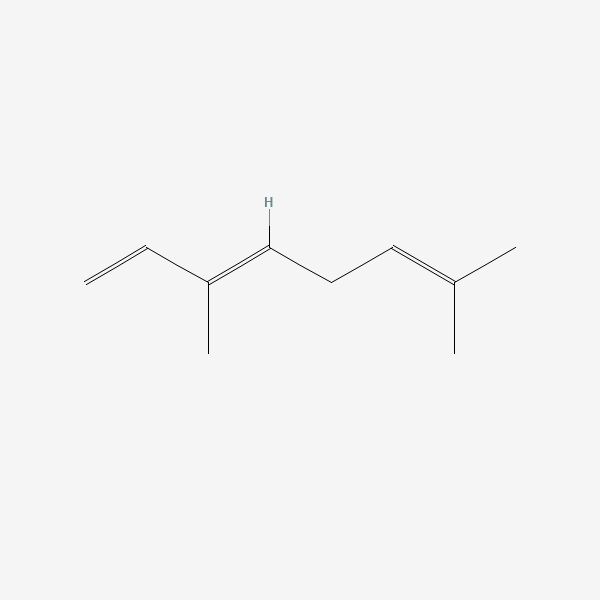
Terpenes & terpenoids / Monoterpene hydrocarbon
(E)-β-Ocimene
A long open chain carries three double bonds. The E label specifies the geometry of the central one. A volatile and a characterized Cannabis enzyme product.
Chemical identification · Measured in Finola; CsTPS6FN mainly produced the E isomer.
Where the evidence stops A detected molecule is not a demonstrated treatment. Amounts depend on the plant, tissue and handling; no Mount Herbs batch was tested in these studies.
Identity Defined 3E geometry; do not merge this structure with Z-β-ocimene.
Formula: C10H16 · PubChem CID 5281553 ↗
Terpene synthases from Cannabis sativa ↗original biosynthesis and analytical study · 2017 · Full text: Finola flower profiles and recombinant Cannabis enzymes; Table 1 and Figures 4–5. Enzyme products are not proof of abundance in every plant.PubChem: (E)-β-Ocimene (CID 5281553) ↗chemical identity database · · CID, formula and IUPAC identity checked against PubChem PUG REST on 5 October 2026. Identity does not establish detection in cannabis, clinical benefit or a batch composition.
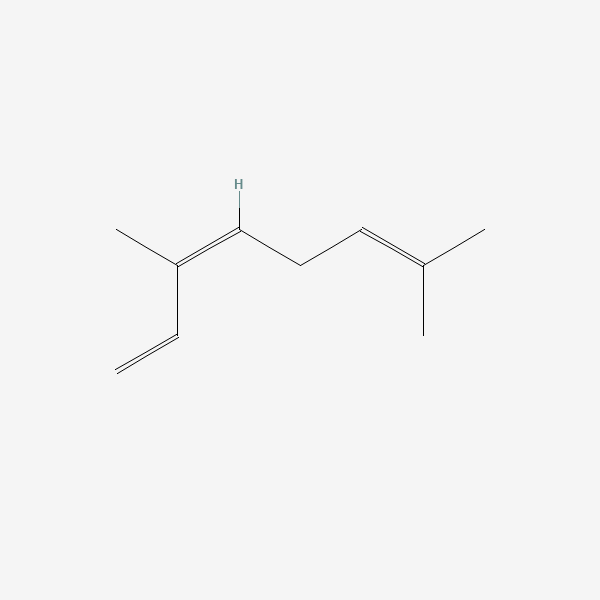
Terpenes & terpenoids / Monoterpene hydrocarbon
(Z)-β-Ocimene
The central double bond has the opposite geometry from E-β-ocimene, while the formula remains unchanged. A resolved product in Cannabis terpene-synthase experiments.
Chemical identification · The Purple Kush enzyme CsTPS13PK mainly produced Z-β-ocimene.
Where the evidence stops A detected molecule is not a demonstrated treatment. Amounts depend on the plant, tissue and handling; no Mount Herbs batch was tested in these studies.
Identity Defined 3Z geometry. Enzyme output alone does not establish its amount in harvested flower.
Formula: C10H16 · PubChem CID 5320250 ↗
Terpene synthases from Cannabis sativa ↗original biosynthesis and analytical study · 2017 · Full text: Finola flower profiles and recombinant Cannabis enzymes; Table 1 and Figures 4–5. Enzyme products are not proof of abundance in every plant.PubChem: (Z)-β-Ocimene (CID 5320250) ↗chemical identity database · · CID, formula and IUPAC identity checked against PubChem PUG REST on 5 October 2026. Identity does not establish detection in cannabis, clinical benefit or a batch composition.
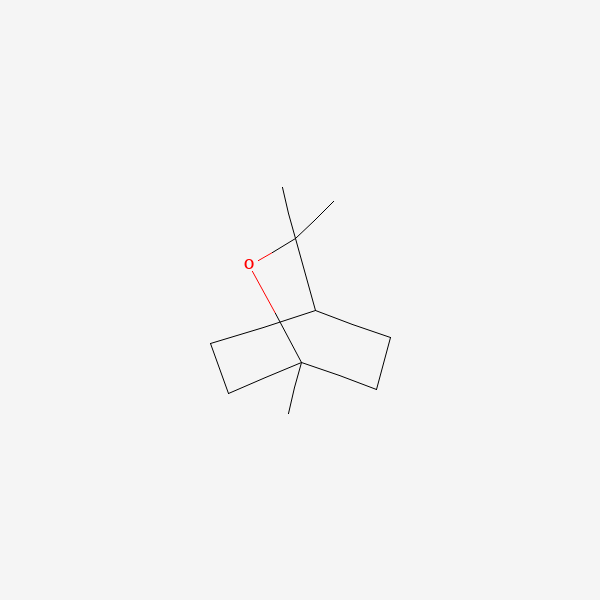
Terpenes & terpenoids / Monoterpenoid ether
Eucalyptol
An oxygen atom forms part of a bridged ring rather than an alcohol group. An oxygenated analyte in cannabis volatile profiling.
Chemical identification · Detected; identity checked against a standard.
Where the evidence stops A detected molecule is not a demonstrated treatment. Amounts depend on the plant, tissue and handling; no Mount Herbs batch was tested in these studies.
Identity This is 1,8-cineole, not the different 1,4-cineole structure.
Formula: C10H18O · PubChem CID 2758 ↗
A High-Throughput Method for the Comprehensive Analysis of Terpenes and Terpenoids in Medicinal Cannabis Biomass ↗original analytical study · 2020 · Full text: Table 1 distinguishes standard-confirmed from tentative identities; Table 4 records nondetections. Routine separation does not assign every enantiomer.PubChem: Eucalyptol (CID 2758) ↗chemical identity database · · CID, formula and IUPAC identity checked against PubChem PUG REST on 5 October 2026. Identity does not establish detection in cannabis, clinical benefit or a batch composition.
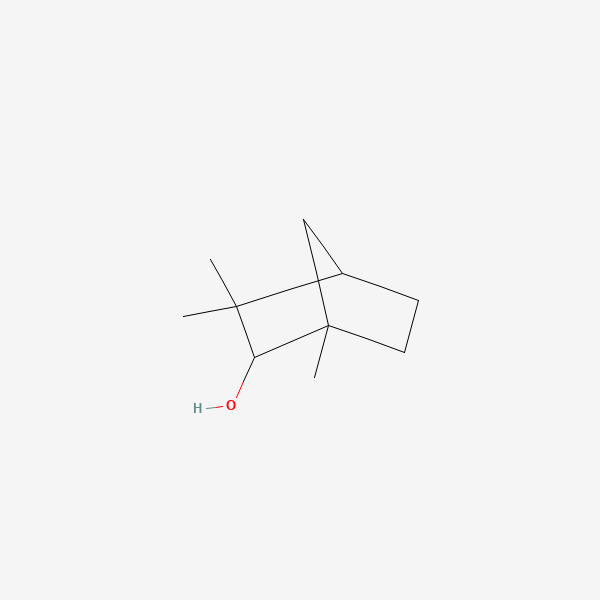
Terpenes & terpenoids / Monoterpenoid alcohol
Fenchol
A bridged carbon framework carries an alcohol group. Several stereochemical forms are possible. A tentatively assigned constituent in the cited biomass analysis.
Chemical identification · Assigned by spectral-library matching, without an authentic standard.
Where the evidence stops The cited detection is tentative. The reference structure illustrates the proposed identity; it does not confirm the peak or a specific stereoisomer.
Identity The PubChem entry leaves some stereochemistry unspecified. A rendered shape must not imply a measured enantiomer ratio.
Formula: C10H18O · PubChem CID 15406 ↗
A High-Throughput Method for the Comprehensive Analysis of Terpenes and Terpenoids in Medicinal Cannabis Biomass ↗original analytical study · 2020 · Full text: Table 1 distinguishes standard-confirmed from tentative identities; Table 4 records nondetections. Routine separation does not assign every enantiomer.PubChem: Fenchol (CID 15406) ↗chemical identity database · · CID, formula and IUPAC identity checked against PubChem PUG REST on 5 October 2026. Identity does not establish detection in cannabis, clinical benefit or a batch composition.
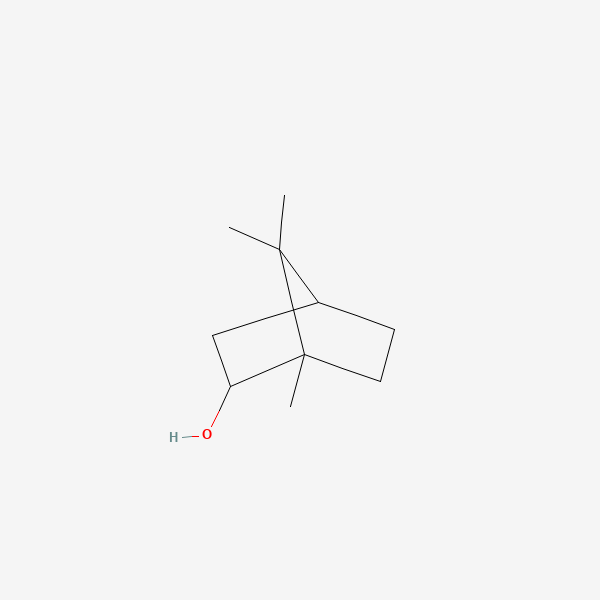
Terpenes & terpenoids / Monoterpenoid alcohol
Borneol
Borneol carries an alcohol group on a rigid bridged skeleton. It shares a formula with fenchol but has different connectivity. A confirmed oxygenated analyte in the cited cannabis work.
Chemical identification · Detected; identity checked against a standard.
Where the evidence stops A detected molecule is not a demonstrated treatment. Amounts depend on the plant, tissue and handling; no Mount Herbs batch was tested in these studies.
Identity The PubChem entry leaves some stereochemistry unspecified. A rendered shape must not imply a measured enantiomer ratio. Borneol and isoborneol are not interchangeable names.
Formula: C10H18O · PubChem CID 64685 ↗
A High-Throughput Method for the Comprehensive Analysis of Terpenes and Terpenoids in Medicinal Cannabis Biomass ↗original analytical study · 2020 · Full text: Table 1 distinguishes standard-confirmed from tentative identities; Table 4 records nondetections. Routine separation does not assign every enantiomer.PubChem: Borneol (CID 64685) ↗chemical identity database · · CID, formula and IUPAC identity checked against PubChem PUG REST on 5 October 2026. Identity does not establish detection in cannabis, clinical benefit or a batch composition.
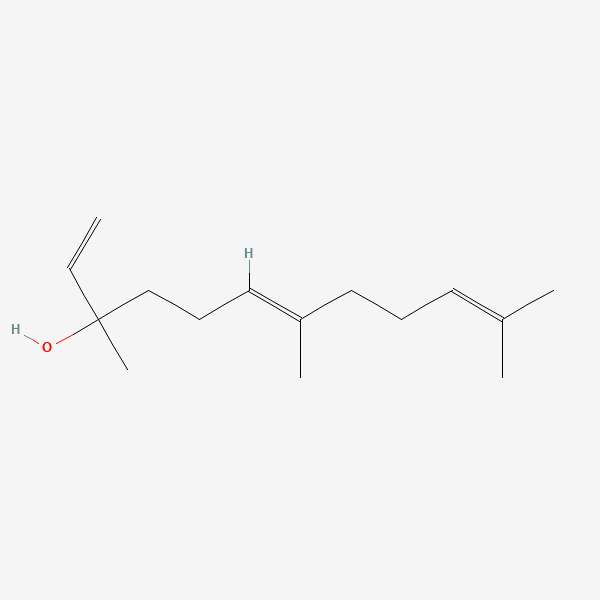
Terpenes & terpenoids / Sesquiterpenoid alcohol
(E)-Nerolidol
Nerolidol extends an open terpene chain to fifteen carbons and includes an alcohol group. A molecule examined in chiral cannabis analysis.
Chemical identification · Detected in authentic extracts; geometric isomers were examined.
Where the evidence stops Nerolidol has both geometric and optical isomers. An unqualified assay name does not establish the configuration or abundance of this reference form.
Identity The reference specifies E geometry but leaves the alcohol-bearing stereocentre unspecified. It does not represent every nerolidol isomer.
Formula: C15H26O · PubChem CID 5284507 ↗
Comprehensive analysis of chemical and enantiomeric stability of terpenes in Cannabis sativa L. flowers ↗original analytical study · 2024 · Full text: chiral analysis and experimental UV/heat stress. Published online August 2024; journal issue January 2025. Laboratory aging is not a retail shelf-life claim.PubChem: (E)-Nerolidol (CID 5284507) ↗chemical identity database · · CID, formula and IUPAC identity checked against PubChem PUG REST on 5 October 2026. Identity does not establish detection in cannabis, clinical benefit or a batch composition.
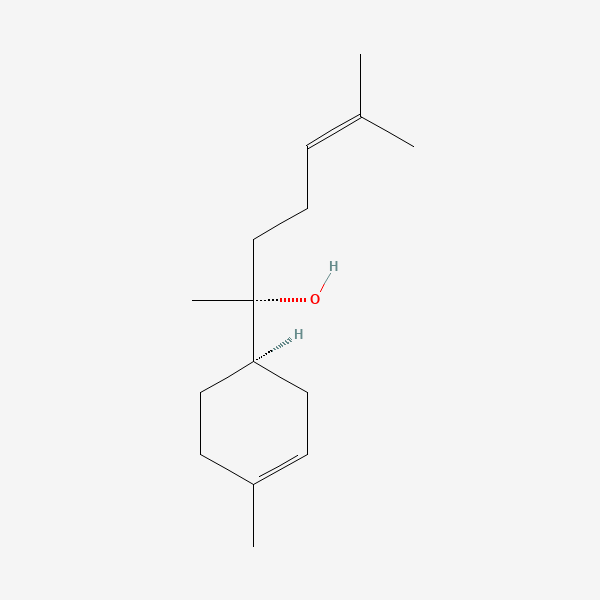
Terpenes & terpenoids / Sesquiterpenoid alcohol
α-Bisabolol
A six-membered ring connects to an oxygen-bearing side chain in this fifteen-carbon molecule. An oxygenated constituent in studied cannabis biomass.
Chemical identification · Detected; identity checked against a standard.
Where the evidence stops A detected molecule is not a demonstrated treatment. Amounts depend on the plant, tissue and handling; no Mount Herbs batch was tested in these studies.
Identity The selected reference defines the side-chain centre as 2R and the ring attachment centre as 1R. Routine detection does not establish that ratio in a sample.
Formula: C15H26O · PubChem CID 1549992 ↗
A High-Throughput Method for the Comprehensive Analysis of Terpenes and Terpenoids in Medicinal Cannabis Biomass ↗original analytical study · 2020 · Full text: Table 1 distinguishes standard-confirmed from tentative identities; Table 4 records nondetections. Routine separation does not assign every enantiomer.PubChem: α-Bisabolol (CID 1549992) ↗chemical identity database · · CID, formula and IUPAC identity checked against PubChem PUG REST on 5 October 2026. Identity does not establish detection in cannabis, clinical benefit or a batch composition.
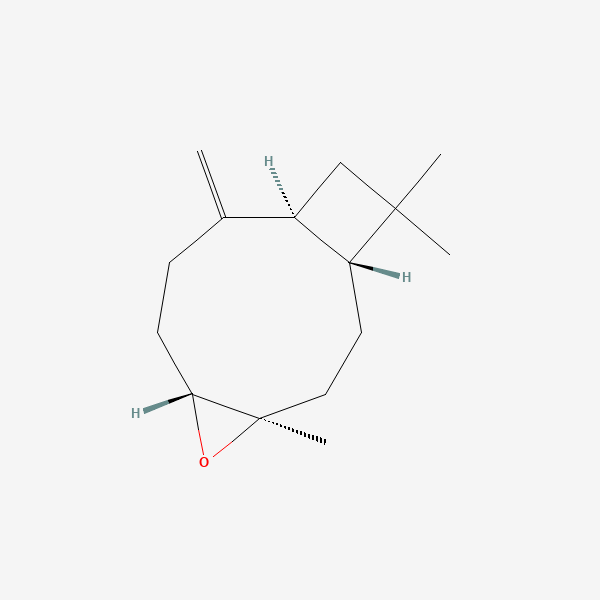
Terpenes & terpenoids / Sesquiterpenoid epoxide
Caryophyllene oxide
An epoxide adds oxygen across part of the caryophyllene framework. It is a separate molecule from β-caryophyllene. An oxygenated analyte in cannabis chemistry.
Chemical identification · Detected; identity checked against a standard.
Where the evidence stops A detected molecule is not a demonstrated treatment. Amounts depend on the plant, tissue and handling; no Mount Herbs batch was tested in these studies.
Identity The reference is a defined stereoisomer, (1R,4R,6R,10S). Do not reuse β-caryophyllene pharmacology for this epoxide.
Formula: C15H24O · PubChem CID 1742210 ↗
A High-Throughput Method for the Comprehensive Analysis of Terpenes and Terpenoids in Medicinal Cannabis Biomass ↗original analytical study · 2020 · Full text: Table 1 distinguishes standard-confirmed from tentative identities; Table 4 records nondetections. Routine separation does not assign every enantiomer.PubChem: Caryophyllene oxide (CID 1742210) ↗chemical identity database · · CID, formula and IUPAC identity checked against PubChem PUG REST on 5 October 2026. Identity does not establish detection in cannabis, clinical benefit or a batch composition.

Terpenes & terpenoids / Monoterpene hydrocarbon
Sabinene
A three-membered ring joins a larger ring in a bridged framework. A minor volatile and a product in Cannabis enzyme studies.
Chemical identification · Detected; identity checked against a standard.
Where the evidence stops A detected molecule is not a demonstrated treatment. Amounts depend on the plant, tissue and handling; no Mount Herbs batch was tested in these studies.
Identity The PubChem entry leaves some stereochemistry unspecified. A rendered shape must not imply a measured enantiomer ratio.
Formula: C10H16 · PubChem CID 18818 ↗
A High-Throughput Method for the Comprehensive Analysis of Terpenes and Terpenoids in Medicinal Cannabis Biomass ↗original analytical study · 2020 · Full text: Table 1 distinguishes standard-confirmed from tentative identities; Table 4 records nondetections. Routine separation does not assign every enantiomer.PubChem: Sabinene (CID 18818) ↗chemical identity database · · CID, formula and IUPAC identity checked against PubChem PUG REST on 5 October 2026. Identity does not establish detection in cannabis, clinical benefit or a batch composition.
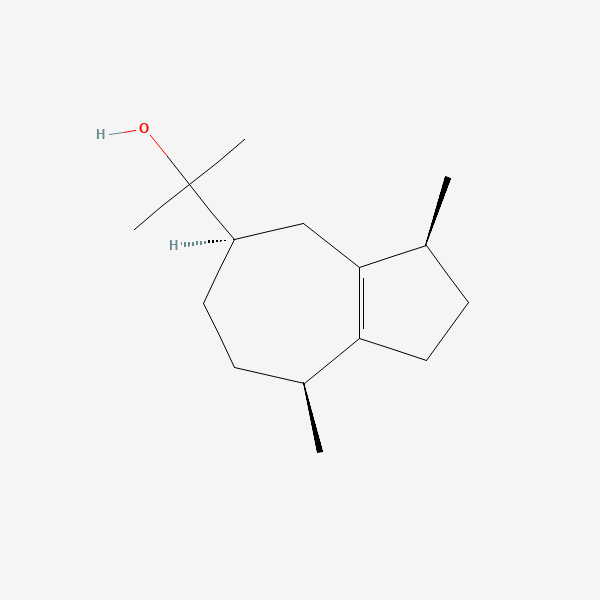
Terpenes & terpenoids / Sesquiterpenoid alcohol
Guaiol
Fused five- and seven-membered rings carry an alcohol-bearing side group. An oxygenated sesquiterpene in the tested cannabis biomass.
Chemical identification · Detected; identity checked against a standard.
Where the evidence stops A detected molecule is not a demonstrated treatment. Amounts depend on the plant, tissue and handling; no Mount Herbs batch was tested in these studies.
Identity The PubChem reference has defined 3S,5R,8S stereochemistry; an achiral assay does not prove an enantiomer ratio.
Formula: C15H26O · PubChem CID 227829 ↗
A High-Throughput Method for the Comprehensive Analysis of Terpenes and Terpenoids in Medicinal Cannabis Biomass ↗original analytical study · 2020 · Full text: Table 1 distinguishes standard-confirmed from tentative identities; Table 4 records nondetections. Routine separation does not assign every enantiomer.PubChem: Guaiol (CID 227829) ↗chemical identity database · · CID, formula and IUPAC identity checked against PubChem PUG REST on 5 October 2026. Identity does not establish detection in cannabis, clinical benefit or a batch composition.
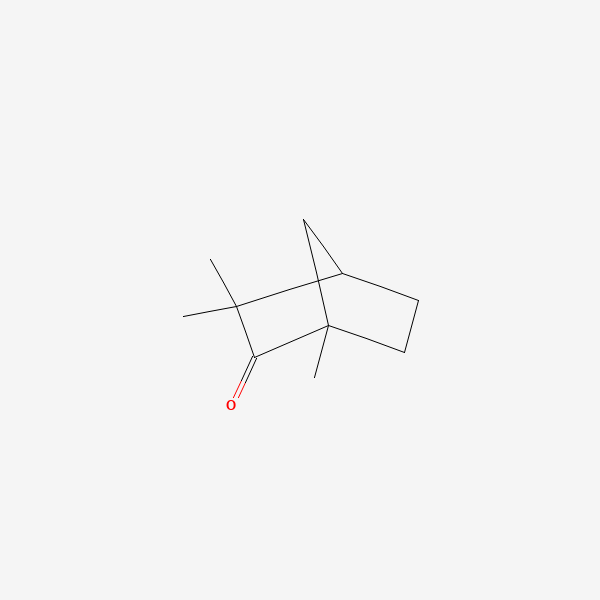
Terpenes & terpenoids / Monoterpenoid ketone
Fenchone
A carbon–oxygen double bond turns this bridged framework into a ketone, distinct from the alcohol fenchol. An oxygenated analyte in the cited cannabis profile.
Chemical identification · Detected; identity checked against a standard.
Where the evidence stops A detected molecule is not a demonstrated treatment. Amounts depend on the plant, tissue and handling; no Mount Herbs batch was tested in these studies.
Identity The PubChem entry leaves some stereochemistry unspecified. A rendered shape must not imply a measured enantiomer ratio.
Formula: C10H16O · PubChem CID 14525 ↗
A High-Throughput Method for the Comprehensive Analysis of Terpenes and Terpenoids in Medicinal Cannabis Biomass ↗original analytical study · 2020 · Full text: Table 1 distinguishes standard-confirmed from tentative identities; Table 4 records nondetections. Routine separation does not assign every enantiomer.PubChem: Fenchone (CID 14525) ↗chemical identity database · · CID, formula and IUPAC identity checked against PubChem PUG REST on 5 October 2026. Identity does not establish detection in cannabis, clinical benefit or a batch composition.
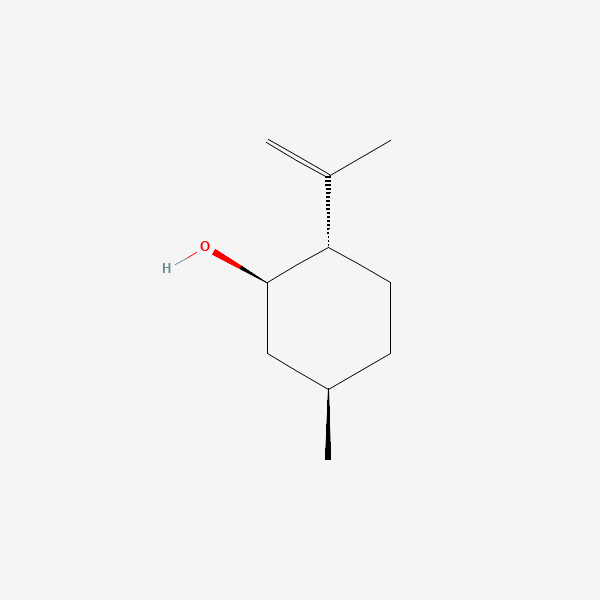
Terpenes & terpenoids / Monoterpenoid alcohol
Isopulegol
This oxygenated molecule has a six-membered ring, an alcohol and a double-bonded side group. A standard-confirmed analyte in cannabis biomass analysis.
Chemical identification · Detected; identity checked against a standard.
Where the evidence stops A detected molecule is not a demonstrated treatment. Amounts depend on the plant, tissue and handling; no Mount Herbs batch was tested in these studies.
Identity The selected PubChem reference is (1R,2S,5R); the assay does not assign all sample stereochemistry.
Formula: C10H18O · PubChem CID 170833 ↗
A High-Throughput Method for the Comprehensive Analysis of Terpenes and Terpenoids in Medicinal Cannabis Biomass ↗original analytical study · 2020 · Full text: Table 1 distinguishes standard-confirmed from tentative identities; Table 4 records nondetections. Routine separation does not assign every enantiomer.PubChem: Isopulegol (CID 170833) ↗chemical identity database · · CID, formula and IUPAC identity checked against PubChem PUG REST on 5 October 2026. Identity does not establish detection in cannabis, clinical benefit or a batch composition.
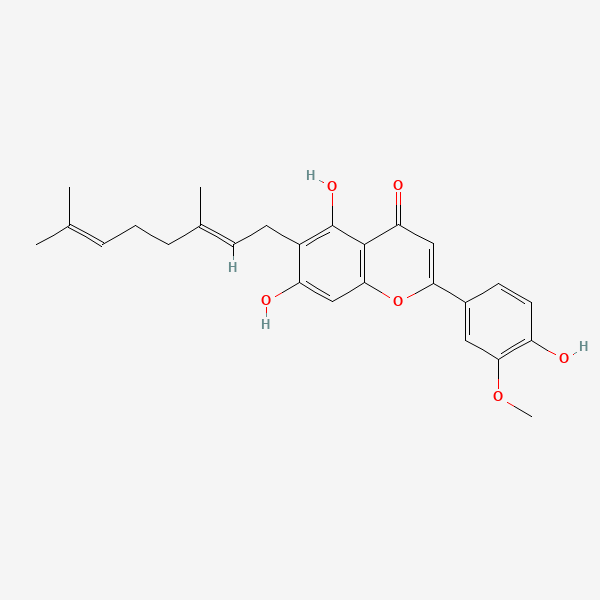
Flavonoids / Geranylated flavone
Cannflavin A
A geranyl side chain attaches to the flavone core. This branch distinguishes cannflavin A from cannflavin B. A specialized metabolite with a characterized biosynthetic route.
Laboratory evidence · CsPT3 enzyme experiments formed cannflavin A from chrysoeriol using a geranyl donor.
Where the evidence stops Enzyme reconstruction explains how the molecule can be made. It does not establish human pain relief, potency versus aspirin or a benefit from hemp seed products.
Identity A geranyl chain attaches at carbon 6; cannflavin C attaches the chain at a different position.
Formula: C26H28O6 · PubChem CID 10071695 ↗
Biosynthesis of cannflavins A and B from Cannabis sativa L. ↗original biosynthesis study · 2019 · Abstract inspected: CsOMT21 converts luteolin to chrysoeriol; CsPT3 adds geranyl or dimethylallyl groups to form cannflavins A or B.PubChem: Cannflavin A (CID 10071695) ↗chemical identity database · · CID, formula and IUPAC identity checked against PubChem PUG REST on 5 October 2026. Identity does not establish detection in cannabis, clinical benefit or a batch composition.
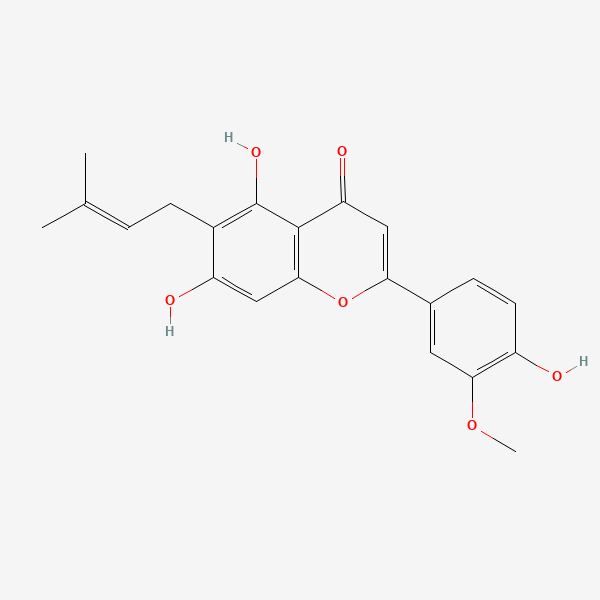
Flavonoids / Prenylated flavone
Cannflavin B
A five-carbon prenyl group sits on a methylated flavone scaffold. A specialized metabolite studied through enzyme reconstruction.
Laboratory evidence · CsPT3 formed cannflavin B from chrysoeriol using a dimethylallyl donor.
Where the evidence stops Biosynthesis is not clinical efficacy. Findings for synthetic isocannflavin B cannot be attributed to cannflavin B or ordinary cannabis products.
Identity The branch attaches at carbon 6. Isocannflavin B is a different positional isomer.
Formula: C21H20O6 · PubChem CID 403815 ↗
Biosynthesis of cannflavins A and B from Cannabis sativa L. ↗original biosynthesis study · 2019 · Abstract inspected: CsOMT21 converts luteolin to chrysoeriol; CsPT3 adds geranyl or dimethylallyl groups to form cannflavins A or B.PubChem: Cannflavin B (CID 403815) ↗chemical identity database · · CID, formula and IUPAC identity checked against PubChem PUG REST on 5 October 2026. Identity does not establish detection in cannabis, clinical benefit or a batch composition.
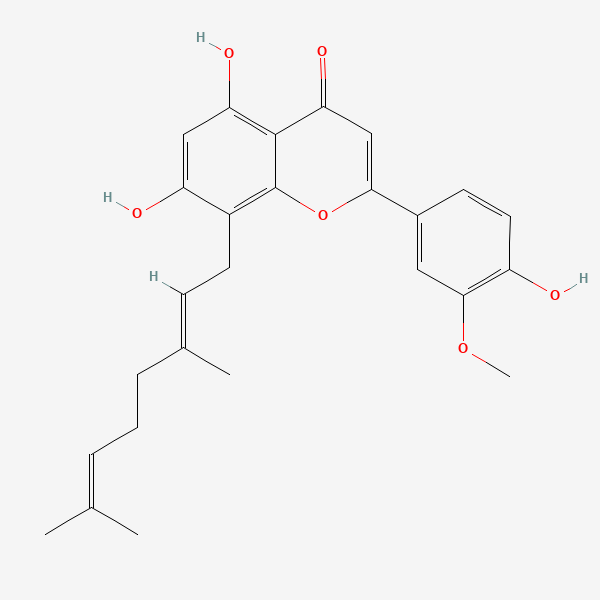
Flavonoids / Geranylated flavone
Cannflavin C
Cannflavin C shares a formula with cannflavin A, but its geranyl branch connects at a different site. A less familiar constituent characterized by isolation chemistry.
Chemical identification · Isolated and structurally characterized from the cannabis variety studied in 2008.
Where the evidence stops A detected molecule is not a demonstrated treatment. Amounts depend on the plant, tissue and handling; no Mount Herbs batch was tested in these studies.
Identity The geranyl group is at carbon 8, not carbon 6. Equal mass alone cannot distinguish it from cannflavin A.
Formula: C26H28O6 · PubChem CID 25141335 ↗
Non-cannabinoid constituents from a high potency Cannabis sativa variety ↗original isolation and structure study · 2008 · Publisher abstract and article preview: isolation and structural characterization of cannflavin C from the studied cannabis variety. No human treatment evidence.PubChem: Cannflavin C (CID 25141335) ↗chemical identity database · · CID, formula and IUPAC identity checked against PubChem PUG REST on 5 October 2026. Identity does not establish detection in cannabis, clinical benefit or a batch composition.
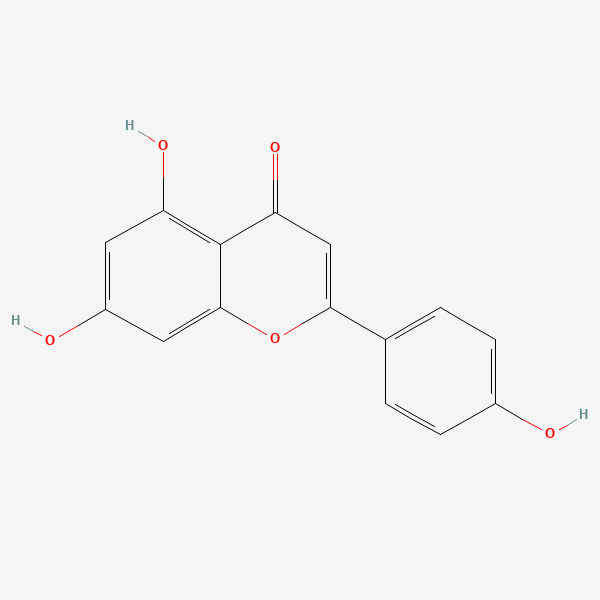
Flavonoids / Flavone aglycone
Apigenin
Apigenin illustrates the three-ring flavone core without an attached sugar. A phenolic constituent measured in cannabis analytical studies.
Chemical identification · Quantified in dried material from three cultivars.
Where the evidence stops A detected molecule is not a demonstrated treatment. Amounts depend on the plant, tissue and handling; no Mount Herbs batch was tested in these studies.
Identity The aglycone is distinct from its C-linked and O-linked sugar derivatives.
Formula: C15H10O5 · PubChem CID 5280443 ↗
Tea Prepared from Dried Cannabis: What Do We Drink? ↗original analytical study · 2024 · Table 2: measured flavonoids in three dried cultivars. Four tested flavonoids were below quantification; a target list alone is not positive detection.PubChem: Apigenin (CID 5280443) ↗chemical identity database · · CID, formula and IUPAC identity checked against PubChem PUG REST on 5 October 2026. Identity does not establish detection in cannabis, clinical benefit or a batch composition.
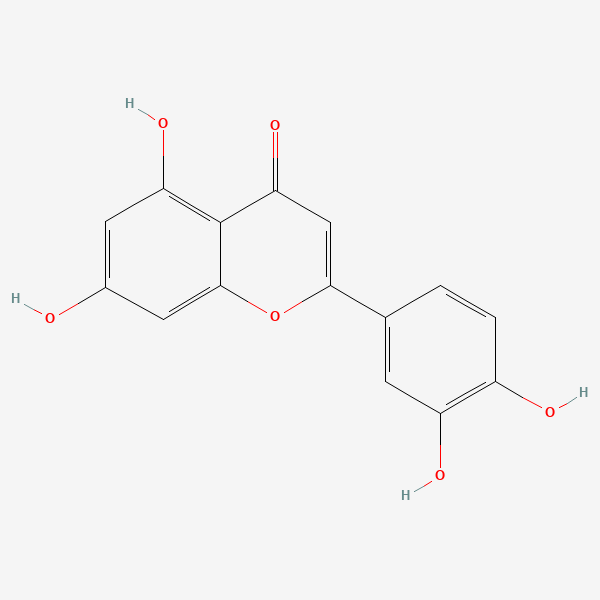
Flavonoids / Flavone aglycone
Luteolin
An additional hydroxyl group distinguishes luteolin from apigenin. A measured constituent and a starting point in cannflavin biosynthesis.
Laboratory evidence · Quantified in dried cannabis; the characterized CsOMT21 enzyme converted luteolin to chrysoeriol.
Where the evidence stops A detected molecule is not a demonstrated treatment. Amounts depend on the plant, tissue and handling; no Mount Herbs batch was tested in these studies.
Identity This aglycone is not luteolin glucoside. It also shares a formula, but not connectivity, with kaempferol.
Formula: C15H10O6 · PubChem CID 5280445 ↗
Tea Prepared from Dried Cannabis: What Do We Drink? ↗original analytical study · 2024 · Table 2: measured flavonoids in three dried cultivars. Four tested flavonoids were below quantification; a target list alone is not positive detection.Biosynthesis of cannflavins A and B from Cannabis sativa L. ↗original biosynthesis study · 2019 · Abstract inspected: CsOMT21 converts luteolin to chrysoeriol; CsPT3 adds geranyl or dimethylallyl groups to form cannflavins A or B.PubChem: Luteolin (CID 5280445) ↗chemical identity database · · CID, formula and IUPAC identity checked against PubChem PUG REST on 5 October 2026. Identity does not establish detection in cannabis, clinical benefit or a batch composition.
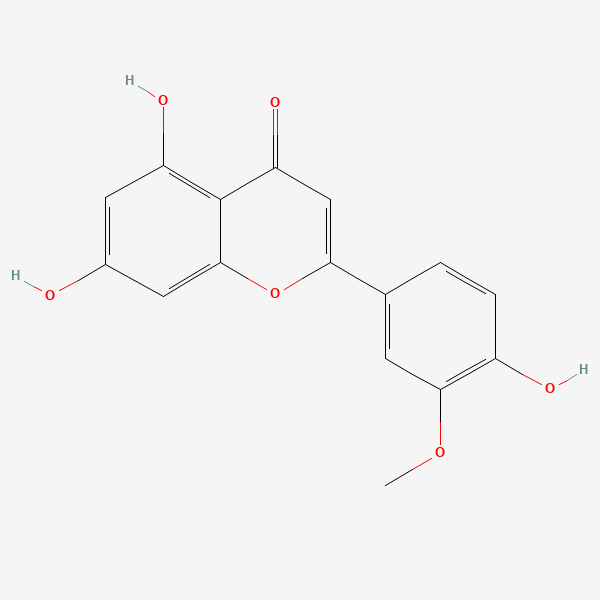
Flavonoids / Methoxylated flavone
Chrysoeriol
Methylation changes one of luteolin’s oxygen-bearing groups to a methoxy group. An experimentally supported intermediate on the route to cannflavins A and B.
Laboratory evidence · Enzyme experiments placed chrysoeriol between luteolin and cannflavins A/B; it was also quantified in dried cannabis.
Where the evidence stops A detected molecule is not a demonstrated treatment. Amounts depend on the plant, tissue and handling; no Mount Herbs batch was tested in these studies.
Identity The methoxy group is at 3′; similarly named methoxylated flavones can have different attachment positions.
Formula: C16H12O6 · PubChem CID 5280666 ↗
Biosynthesis of cannflavins A and B from Cannabis sativa L. ↗original biosynthesis study · 2019 · Abstract inspected: CsOMT21 converts luteolin to chrysoeriol; CsPT3 adds geranyl or dimethylallyl groups to form cannflavins A or B.Tea Prepared from Dried Cannabis: What Do We Drink? ↗original analytical study · 2024 · Table 2: measured flavonoids in three dried cultivars. Four tested flavonoids were below quantification; a target list alone is not positive detection.PubChem: Chrysoeriol (CID 5280666) ↗chemical identity database · · CID, formula and IUPAC identity checked against PubChem PUG REST on 5 October 2026. Identity does not establish detection in cannabis, clinical benefit or a batch composition.
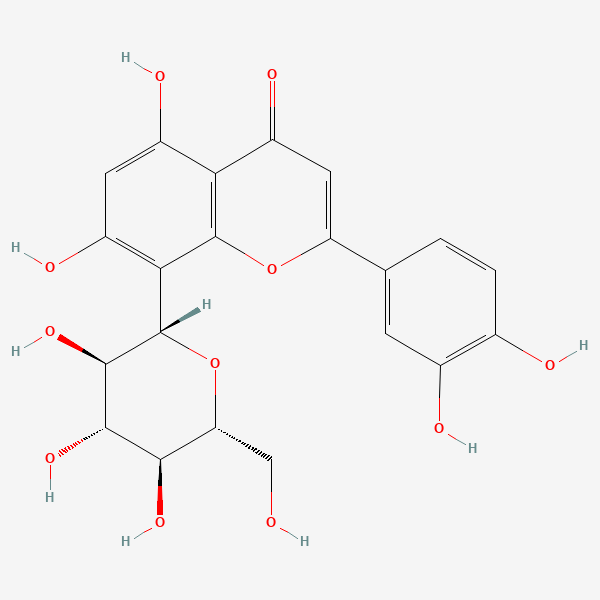
Flavonoids / Flavone C-glycoside
Orientin
Orientin carries a glucose unit directly on carbon 8 of a luteolin scaffold. A glycosylated phenolic constituent of the tested cannabis material.
Chemical identification · Quantified in dried material from three cultivars.
Where the evidence stops A detected molecule is not a demonstrated treatment. Amounts depend on the plant, tissue and handling; no Mount Herbs batch was tested in these studies.
Identity Luteolin-8-C-glucoside; do not replace it with the carbon-6 isomer isoorientin.
Formula: C21H20O11 · PubChem CID 5281675 ↗
Tea Prepared from Dried Cannabis: What Do We Drink? ↗original analytical study · 2024 · Table 2: measured flavonoids in three dried cultivars. Four tested flavonoids were below quantification; a target list alone is not positive detection.PubChem: Orientin (CID 5281675) ↗chemical identity database · · CID, formula and IUPAC identity checked against PubChem PUG REST on 5 October 2026. Identity does not establish detection in cannabis, clinical benefit or a batch composition.
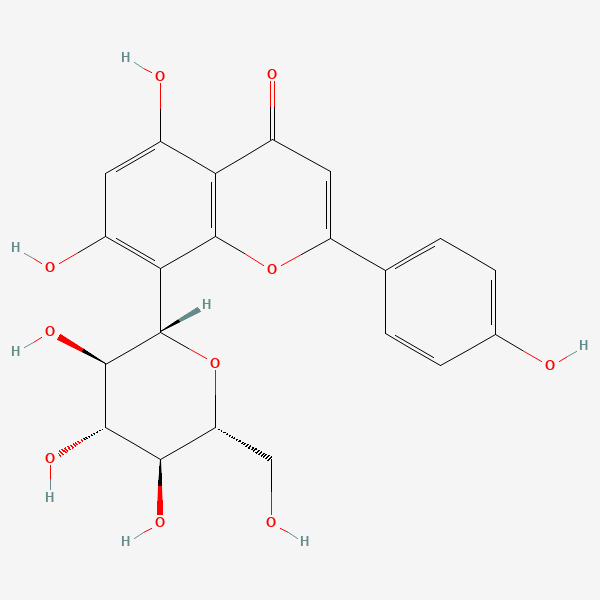
Flavonoids / Flavone C-glycoside
Vitexin
A glucose unit connects directly to carbon 8 of apigenin. A quantified flavonoid in the tested cannabis material.
Chemical identification · Quantified in dried material from three cultivars.
Where the evidence stops A detected molecule is not a demonstrated treatment. Amounts depend on the plant, tissue and handling; no Mount Herbs batch was tested in these studies.
Identity Apigenin-8-C-glucoside. Its attachment position differs from isovitexin.
Formula: C21H20O10 · PubChem CID 5280441 ↗
Tea Prepared from Dried Cannabis: What Do We Drink? ↗original analytical study · 2024 · Table 2: measured flavonoids in three dried cultivars. Four tested flavonoids were below quantification; a target list alone is not positive detection.PubChem: Vitexin (CID 5280441) ↗chemical identity database · · CID, formula and IUPAC identity checked against PubChem PUG REST on 5 October 2026. Identity does not establish detection in cannabis, clinical benefit or a batch composition.
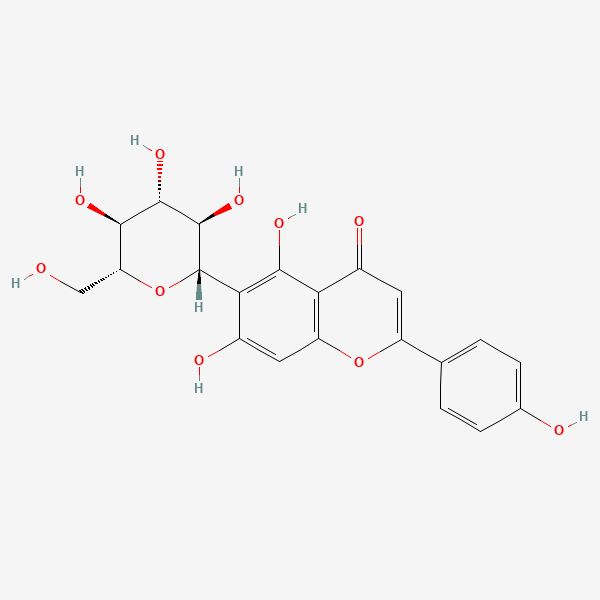
Flavonoids / Flavone C-glycoside
Isovitexin
The glucose unit occupies carbon 6 rather than carbon 8. The formula remains identical to vitexin. A candidate tracked in cannabis flavonoid analysis.
Chemical identification · Leaf imaging assigned an isovitexin-compatible signal; three other cultivars were below the quantification limit.
Where the evidence stops The imaging assignment has isomer ambiguity, and nondetection depends on the method’s limit. Neither establishes presence in every cultivar.
Identity Apigenin-6-C-glucoside. Exact-mass imaging alone cannot uniquely separate it from vitexin.
Formula: C21H20O10 · PubChem CID 162350 ↗
Leaves of Cannabis sativa and their trichomes studied by DESI and MALDI mass spectrometry imaging for their contents of cannabinoids and flavonoids ↗original analytical imaging study · 2023 · Full text: leaf imaging and Table 2. Exact-mass images may combine isomers; they do not uniquely distinguish every named flavonoid.Tea Prepared from Dried Cannabis: What Do We Drink? ↗original analytical study · 2024 · Table 2: measured flavonoids in three dried cultivars. Four tested flavonoids were below quantification; a target list alone is not positive detection.PubChem: Isovitexin (CID 162350) ↗chemical identity database · · CID, formula and IUPAC identity checked against PubChem PUG REST on 5 October 2026. Identity does not establish detection in cannabis, clinical benefit or a batch composition.
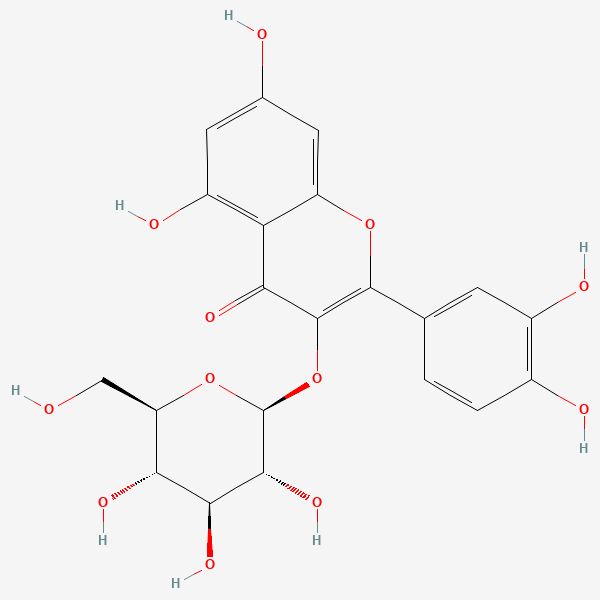
Flavonoids / Flavonol O-glycoside
Isoquercetin
An oxygen link joins glucose to carbon 3 of quercetin. A measured glycoside in cannabis phenolic profiles.
Chemical identification · Quantified in dried material from three cultivars.
Where the evidence stops A detected molecule is not a demonstrated treatment. Amounts depend on the plant, tissue and handling; no Mount Herbs batch was tested in these studies.
Identity This reference is quercetin-3-O-β-D-glucopyranoside. PubChem names can also resolve to other sugar forms, so the selected CID matters.
Formula: C21H20O12 · PubChem CID 5280804 ↗
Tea Prepared from Dried Cannabis: What Do We Drink? ↗original analytical study · 2024 · Table 2: measured flavonoids in three dried cultivars. Four tested flavonoids were below quantification; a target list alone is not positive detection.PubChem: Isoquercetin (CID 5280804) ↗chemical identity database · · CID, formula and IUPAC identity checked against PubChem PUG REST on 5 October 2026. Identity does not establish detection in cannabis, clinical benefit or a batch composition.
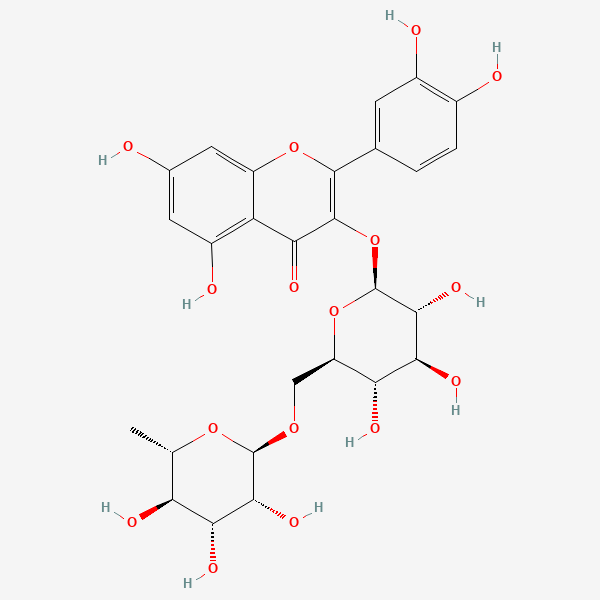
Flavonoids / Flavonol O-glycoside
Rutin
A two-sugar group is attached to the quercetin core, making rutin larger than isoquercetin. A glycoside measured in commercial hemp inflorescences.
Chemical identification · Measured using chromatography and an authentic reference standard.
Where the evidence stops A detected molecule is not a demonstrated treatment. Amounts depend on the plant, tissue and handling; no Mount Herbs batch was tested in these studies.
Identity Quercetin-3-O-rutinoside contains a disaccharide; it is not another name for quercetin itself.
Formula: C27H30O16 · PubChem CID 5280805 ↗
Analysis of Phenolic Compounds in Commercial Cannabis sativa L. Inflorescences Using UHPLC-Q-Orbitrap HRMS ↗original analytical study · 2020 · Full text: Tables 1–2 and analytical standards. Conventional flavonoids were measured; cannflavins used post-target screening without authentic standards.PubChem: Rutin (CID 5280805) ↗chemical identity database · · CID, formula and IUPAC identity checked against PubChem PUG REST on 5 October 2026. Identity does not establish detection in cannabis, clinical benefit or a batch composition.
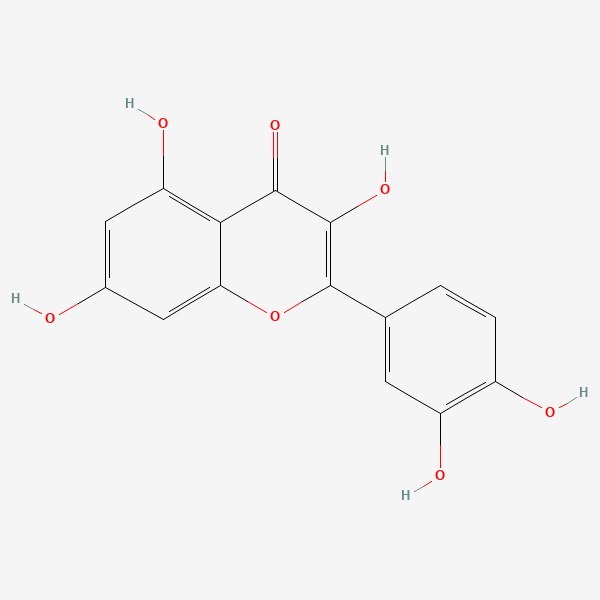
Flavonoids / Flavonol aglycone
Quercetin
Quercetin has a hydroxyl group at carbon 3 of the central ring and no sugar attached. A flavonol quantified in some cannabis inflorescence samples.
Chemical identification · Measured against a standard in one study; below quantification in three cultivars in another.
Where the evidence stops The differing analytical results show why detection cannot be generalized across plants. This catalogue makes no clinical claim for quercetin in cannabis.
Identity The sugar-free aglycone differs from isoquercetin and rutin.
Formula: C15H10O7 · PubChem CID 5280343 ↗
Analysis of Phenolic Compounds in Commercial Cannabis sativa L. Inflorescences Using UHPLC-Q-Orbitrap HRMS ↗original analytical study · 2020 · Full text: Tables 1–2 and analytical standards. Conventional flavonoids were measured; cannflavins used post-target screening without authentic standards.Tea Prepared from Dried Cannabis: What Do We Drink? ↗original analytical study · 2024 · Table 2: measured flavonoids in three dried cultivars. Four tested flavonoids were below quantification; a target list alone is not positive detection.PubChem: Quercetin (CID 5280343) ↗chemical identity database · · CID, formula and IUPAC identity checked against PubChem PUG REST on 5 October 2026. Identity does not establish detection in cannabis, clinical benefit or a batch composition.
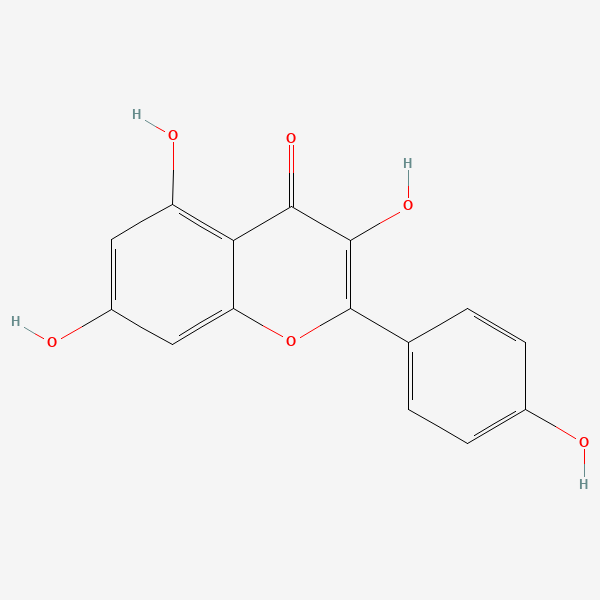
Flavonoids / Flavonol aglycone
Kaempferol
Kaempferol has the same formula as luteolin, but a hydroxyl group occupies a different position. A flavonol investigated in cannabis phenolic profiles.
Chemical identification · Measured against a standard in one study; below quantification in three cultivars in another.
Where the evidence stops Presence and concentration vary with sample and analytical method; a listed chemical is not a standardized ingredient or a proven treatment.
Identity A constitutional isomer of luteolin. Formula or exact mass alone is not enough to distinguish them.
Formula: C15H10O6 · PubChem CID 5280863 ↗
Analysis of Phenolic Compounds in Commercial Cannabis sativa L. Inflorescences Using UHPLC-Q-Orbitrap HRMS ↗original analytical study · 2020 · Full text: Tables 1–2 and analytical standards. Conventional flavonoids were measured; cannflavins used post-target screening without authentic standards.Tea Prepared from Dried Cannabis: What Do We Drink? ↗original analytical study · 2024 · Table 2: measured flavonoids in three dried cultivars. Four tested flavonoids were below quantification; a target list alone is not positive detection.PubChem: Kaempferol (CID 5280863) ↗chemical identity database · · CID, formula and IUPAC identity checked against PubChem PUG REST on 5 October 2026. Identity does not establish detection in cannabis, clinical benefit or a batch composition.
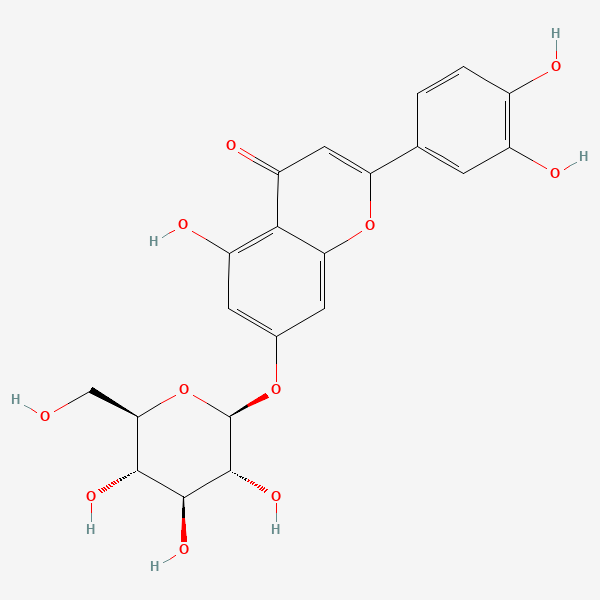
Flavonoids / Flavone O-glycoside
Cynaroside
Glucose connects through the oxygen at position 7 of luteolin. A flavone glycoside measured in the studied hemp inflorescences.
Chemical identification · Measured using chromatography and an authentic reference standard.
Where the evidence stops A detected molecule is not a demonstrated treatment. Amounts depend on the plant, tissue and handling; no Mount Herbs batch was tested in these studies.
Identity Luteolin-7-O-β-D-glucopyranoside. It shares a formula with orientin but differs in both linkage and attachment position.
Formula: C21H20O11 · PubChem CID 5280637 ↗
Analysis of Phenolic Compounds in Commercial Cannabis sativa L. Inflorescences Using UHPLC-Q-Orbitrap HRMS ↗original analytical study · 2020 · Full text: Tables 1–2 and analytical standards. Conventional flavonoids were measured; cannflavins used post-target screening without authentic standards.PubChem: Cynaroside (CID 5280637) ↗chemical identity database · · CID, formula and IUPAC identity checked against PubChem PUG REST on 5 October 2026. Identity does not establish detection in cannabis, clinical benefit or a batch composition.
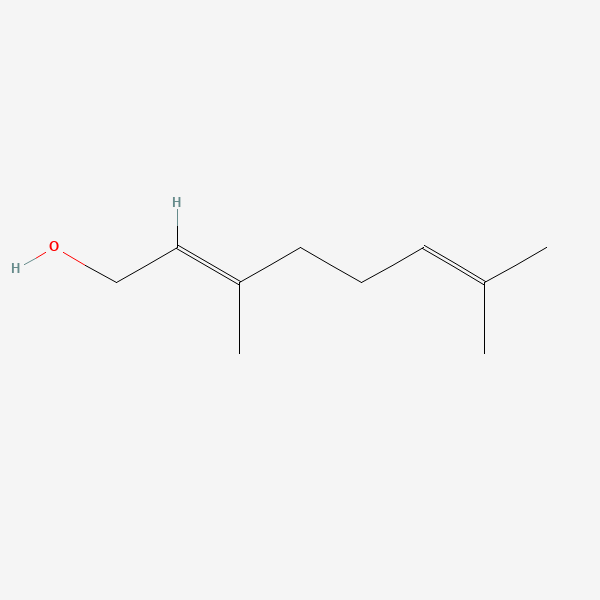
Terpenes & terpenoids / Monoterpenoid alcohol
Geraniol
An alcohol group sits at the end of an open ten-carbon chain. The E double-bond geometry distinguishes geraniol from nerol. A volatile detected in a studied hemp population and investigated in cell and mouse experiments.
Animal evidence · Geraniol was detected in some F2 hemp plants. Separately, LaVigne and colleagues reported cannabinoid-like mouse behaviors and interactions with the synthetic agonist WIN55,212-2.
Where the evidence stops Injected-mouse and cell experiments do not establish a clinical benefit from geraniol, its aroma or a cannabis product. Detection varied among the plants; no Mount Herbs batch was tested.
Identity PubChem specifies (2E)-3,7-dimethylocta-2,6-dien-1-ol. Nerol is the different 2Z geometric isomer.
Formula: C10H18O · PubChem CID 637566 ↗
Quantitative trait loci controlling agronomic and biochemical traits in Cannabis sativa ↗original analytical and genetic study · 2021 · Full-text results and Table 2 inspected. Geraniol was detectable in members of the Carmagnola × USO31 F2 hemp population, although not in the parents or F1. This is positive sample evidence, not merely inclusion in a standards panel.Cannabis sativa terpenes are cannabimimetic and selectively enhance cannabinoid activity ↗original cell and animal study · 2021 · Original mouse and cell experiments using isolated compounds and the synthetic agonist WIN55,212-2; no patient efficacy trial.PubChem: Geraniol (CID 637566) ↗chemical identity database · · CID, formula and IUPAC identity checked against PubChem PUG REST on 5 October 2026. Identity does not establish detection in cannabis, clinical benefit or a batch composition.
A SIMPLIFIED MAP / NOT A PRODUCTION GUIDE
A shared beginning.
Different chemical paths.
CBGA sits at a branch point in major cannabinoid pathways. Different synthases form different acids. Losing carbon dioxide through decarboxylation produces corresponding neutral forms; that is a separate change from the enzyme reactions. The map shows selected relationships, not every pathway, intermediate or storage reaction.
Branch pointCBGA ↗Precursor acid
Terpenes and flavonoids follow other biosynthetic routes. Their presence alongside cannabinoids does not prove that a mixture works better in people. The catalogue includes both negative receptor experiments and positive early studies of particular combinations.
Luo et al. · cannabinoid pathway experiments ↗
From a molecule to a medical claim.
- Identify
- Chromatography, mass spectrometry and NMR help establish what a sample contains. A name in a paper is not a measurement of your product.
- Model
- Docking predicts possible poses. Molecular dynamics explores motion within a chosen model; its assumptions matter.
- Measure
- Binding and signalling assays test molecular activity in a defined system. Affinity, potency and efficacy describe different measurements.
- Test in animals
- An animal result can guide the next experiment. Species, sex, route and exposure can change what it means.
- Test in people
- A clinical result needs a defined formulation, population, comparator, outcome and safety assessment.
Follow the molecular studies.
Cloning & functional expression
9 August 1990 · Laboratory evidence
A receptor, identified.
Matsuda and colleagues cloned a rat receptor and expressed it in cells. Its responses helped establish a specific G-protein-coupled mechanism for cannabinoids.
Where the evidence stops This is receptor biology, not a trial showing that a medicine helps patients.
Structure of a cannabinoid receptor and functional expression of the cloned cDNA ↗Original indexed abstract
Isolation · mass spectrometry · NMR
18 December 1992 · Laboratory evidence
The body has signals of its own.
Devane and colleagues identified anandamide in porcine brain, confirmed its structure by synthesis and tested cannabinoid-receptor binding.
Where the evidence stops Anandamide is an endocannabinoid made in the body. It is not a plant cannabinoid or an ingredient in hemp seed oil.
Isolation and structure of a brain constituent that binds to the cannabinoid receptor ↗Original indexed abstract
Molecular cloning & receptor characterization
2 September 1993 · Laboratory evidence
Another receptor broadens the picture.
Munro and colleagues characterized a second cannabinoid receptor, now called CB2. Cannabis research gained another defined molecular target.
Where the evidence stops Receptor expression or binding alone does not establish an anti-inflammatory treatment.
Molecular characterization of a peripheral receptor for cannabinoids ↗Original indexed publication
Receptor assays · cells · mice
23 June 2008 online · Animal evidence
A terpene can have receptor activity.
Gertsch and colleagues studied β-caryophyllene at CB2 and in an inflammatory mouse model. The response differed between wild-type and CB2-deficient mice.
Where the evidence stops Receptor activity does not turn a terpene into a THC-like molecule. This study did not establish an anti-inflammatory treatment in people.
Beta-caryophyllene is a dietary cannabinoid ↗Original full-text abstract / indexed date
Trichome transcriptomics & enzyme assays
16 July 2012 online · Laboratory evidence
How the plant begins building cannabinoids.
Gagne and colleagues showed that tetraketide synthase works with olivetolic acid cyclase to form olivetolic acid, an early part of cannabinoid biosynthesis.
Where the evidence stops An enzyme pathway explains chemical production. It does not show medicinal benefit or the composition of a particular product.
Identification of olivetolic acid cyclase from Cannabis sativa reveals a unique catalytic route to plant polyketides ↗Original full text / abstract
X-ray crystallography · docking
16 November 2016 online · Laboratory evidence
A closer view of the binding pocket.
Shao and colleagues resolved engineered human CB1 bound to taranabant at 2.6 Å. The structure provided a framework for studying ligand binding.
Where the evidence stops The measured structure contains an inhibitor. A docked THC pose is a model, not an experimentally measured THC complex.
High-resolution crystal structure of the human CB1 cannabinoid receptor ↗Publisher abstract; primary structure accession 5U09
Metabolic engineering
27 February 2019 online · Laboratory evidence
The pathway can work outside the plant.
Luo and colleagues engineered yeast to make several cannabinoid acids from galactose. Feeding different fatty acids also produced modified analogues.
Where the evidence stops Microbial production is a chemistry platform. Modified analogues are not automatically natural cannabis compounds or effective medicines.
Complete biosynthesis of cannabinoids and their unnatural analogues in yeast ↗Original indexed abstract; author correction published 17 March 2020
Recombinant enzymes · biosynthesis
28 May 2019 online · Laboratory evidence
Another branch of the plant’s chemistry.
Rea and colleagues reconstructed enzyme steps from luteolin through chrysoeriol to cannflavins A and B. The work helped explain how cannabis makes these prenylated flavones.
Where the evidence stops The enzyme pathway establishes chemical production, not an effective or safe treatment using cannflavins.
Biosynthesis of cannflavins A and B from Cannabis sativa L. ↗Original indexed abstract
Human-receptor cell assay · negative finding
23 September 2019 collection date · Laboratory evidence
A mixture does not always change the response.
Santiago and colleagues tested six terpenoids in cells expressing human CB1 or CB2. They did not find enhancement of THC responses in the potassium-channel assay they used.
Where the evidence stops This does not rule out every target or combination. It does challenge a universal claim that adding these terpenes enhances THC at these receptors.
Absence of Entourage: Terpenoids Commonly Found in Cannabis sativa Do Not Modulate the Functional Activity of Δ9-THC at Human CB1 and CB2 Receptors ↗Original indexed abstract; collection date used, not an inferred first-online date
Cell assays · mouse behavioural experiments
15 April 2021 · Animal evidence
Other experiments ask different questions.
LaVigne and colleagues reported cannabinoid-like behavioural effects of selected terpenes in mice and interaction with the synthetic cannabinoid agonist WIN55,212-2.
Where the evidence stops Different compounds, targets and experimental designs can give different answers. These results do not establish a whole-plant entourage benefit in people.
Cannabis sativa terpenes are cannabimimetic and selectively enhance cannabinoid activity ↗Original publisher paper / indexed abstract
Cryo-EM · docking · molecular dynamics · signalling assays
9 May 2023 · Laboratory evidence
Seeing an analogue of a body-made signal.
Krishna Kumar and colleagues studied CB1 with AMG315, an anandamide analogue, and investigated interactions with receptor toggle-switch residues.
Where the evidence stops AMG315 is a research analogue. Its structure is not direct imaging of anandamide or proof of a clinical treatment.
Structural basis for activation of CB1 by an endocannabinoid analog ↗Original indexed abstract
Small acute human crossover experiment
13 March 2024 online · Human study
A particular mixture, tested in people.
Spindle and colleagues studied vaporized D-limonene with THC in 20 healthy adults who used cannabis intermittently. The strongest combination, tested in 12 participants, reduced acute THC-associated anxiety and paranoia ratings; other effects were unchanged.
Where the evidence stops This is not a treatment trial for an anxiety disorder and does not establish benefits from oral terpene blends, aromas or consumer products.
Vaporized D-limonene selectively mitigates the acute anxiogenic effects of Δ9-tetrahydrocannabinol in healthy adults who intermittently use cannabis ↗Original indexed abstract
Cryo-EM · molecular dynamics · cellular pharmacology
8 January 2025 · Laboratory evidence
Binding is more than a frozen shape.
Thorsen and colleagues resolved HU210-bound CB1 and compared THC with ten analogues using signalling assays and molecular simulations. Different ligands produced different activity and kinetics.
Where the evidence stops HU210 is a synthetic tool compound. The simulated poses and receptor assays do not establish patient benefit or safe use of the compounds.
Structural basis of THC analog activity at the Cannabinoid 1 receptor ↗Original full-text sections / abstract
Virtual screening · synthesis · cryo-EM · male-mouse experiments
6 March 2025 · Animal evidence
A prediction becomes a testable candidate.
Tummino and colleagues docked 74 million molecules, synthesized selected candidates and optimized a CB1 agonist called 1350. It showed analgesic activity in male mice with a separation from some adverse behaviours.
Where the evidence stops The paper combines prediction with experiments. The compound is a synthetic lead, and mouse results do not establish effectiveness or safety in people.
Virtual library docking for cannabinoid-1 receptor agonists with reduced side effects ↗Original publisher abstract; structure deposited as PDB 9DGI
Pangenomics & synthase-gene analysis
28 May 2025 online · Laboratory evidence
Many genomes, many chemical possibilities.
Lynch and colleagues assembled a cannabis pangenome and examined structural variation, cannabinoid synthases and their evolutionary relationships.
Where the evidence stops Genes help explain potential chemistry. They do not substitute for testing the compounds in a harvest or establish its therapeutic effect.
Domesticated cannabinoid synthases amid a wild mosaic cannabis pangenome ↗Original publisher sections / indexed record
Agonist-bound X-ray crystal structures · corrected publication
27 August 2025 online · Laboratory evidence
The scientific record can change.
Hua and colleagues published CB1 structures with the research agonists AM11542 and AM841. The publication sits alongside a same-day retraction notice for the earlier 2017 article with the same title.
Where the evidence stops We cite the 2025 publication, not the retracted 2017 paper as current evidence. Research agonists are not the same as natural THC; this record does not establish clinical efficacy.
Crystal structures of agonist-bound human cannabinoid receptor CB1 · 2025 publication ↗Publisher abstract and publication metadata
Retraction notice for the earlier 2017 article ↗Ligand design · cellular pharmacology · molecular modelling
18 March 2026 online · Laboratory evidence
Small changes can shift receptor activity.
Ganzoni and colleagues varied a position on an HU-308-derived scaffold to change CB2 receptor activity. The work investigated how those modifications interact with the Trp258 toggle switch.
Where the evidence stops These are designed ligands and laboratory findings. They do not prove that natural terpenes, a plant extract or a seed food treats inflammatory disease.
Single-position ligand modifications tune CB2R activity by targeting the toggle switch ↗Original publisher abstract / supplementary metadata
Cellular assays · mutagenesis · modelling · male mice
28 March 2026 · Animal evidence
A rare cannabinoid brings new questions.
A CBDP study investigated negative allosteric modulation of CB1 at two proposed sites, combining receptor experiments, molecular modelling and mouse work.
Where the evidence stops Predicted binding energies are computational estimates. The study is preclinical and does not establish human benefit, dosing or safety.
Cannabidiphorol (CBDP) acts as a negative allosteric modulator at two distinct sites of cannabinoid receptor 1 ↗Original indexed abstract / publisher sections
Structure–activity analysis · signalling assays · mouse pain models
13 April 2026 online · 28 May issue · Animal evidence
Can signalling separate relief from side effects?
Liao and colleagues designed Gi-biased CB1 agonists LZD503 and LZD505. The study reported analgesic effects with reduced adverse effects in mouse experiments.
Where the evidence stops Reduced adverse effects in mice do not establish human safety. These synthetic research compounds are not ingredients in Mount Herbs products or approved treatments established by this study.
Rational design of Gi-biased CB1 agonist with reduced side effects ↗Original indexed abstract / publisher summary
What this atlas includes.
Coverage, identities & limits
Sources checked 5 October 2026. This edition contains 72 selected compound records: 32 cannabinoids, 26 terpenes and terpenoids, and 14 flavonoids. 70 exact PubChem identities have local coordinate files. 2 records have no included structure. Detection differs between tissues, varieties, storage conditions and analytical methods; this catalogue is not an assay of Mount Herbs products.
Coordinate identity review · 2026-10-15 THCB and Δ9-THCH now have stereochemically specified PubChem identities, computed 3D conformers and separate 2D coordinates. The two remaining gaps are THCPA and CBDPA: the acid names and catalogue aliases did not return an exact CID in this review. Neither neutral counterparts nor acetate derivatives are substituted. This does not prove the absence of equivalent records under every possible identifier. Clinical-study source dates above are unchanged.
“All” does not have one agreed count. Papers may count acids, neutral forms, glycosides, degradation products and stereoisomers differently. This catalogue names the included identities; it does not claim every cannabis compound or every molecular study. Terpenoids include oxygenated relatives of terpenes. Endocannabinoids and synthetic tool compounds appear in the study timeline for context and are not added to the plant-compound count.
PubChem 3D coordinates are computed conformers of reference identities. The movement here is camera rotation, not a molecular dynamics simulation, docking result or electron-density measurement. Original PubChem 2D drawings, retrieved on 26 October 2026, preserve the source stereochemical markings in the interactive reader and full catalogue. Connectivity fallbacks show bond orders but omit stereo annotations and hydrogens. Read each identity note before interpreting an enantiomer or isomer. PubChem 3D documentation ↗
Evidence labels identify the kind of evidence described in each record; they are not scores or a claim that the compound is safe or effective. Sources range from full-text experiments to abstract-only access and older bibliographic records; that access is identified. The 19-record timeline is a selected introduction to receptor biology, biosynthesis, genomics and drug discovery. It is ordered by publication dates, with equal spacing rather than a proportional time scale. Human treatment results are covered separately in the medical reading room.
Published descriptions were summarized; no new molecular experiments or simulations were performed for this website. A clinician has not independently reviewed this atlas. Download the catalogue, evidence notes & sources ↗ · Read the clinical evidence ↗